The AI agent market is a minefield of conflicting information. On one side, you have software vendors offering AI-powered solutions for a few thousand dollars, which are essentially glorified wrappers around pre-trained models. On the other side, enterprise consultancies pitch custom builds with price tags that rival your annual IT budget. The gap between these extremes makes business leaders reluctant to act. They are left unsure of what is realistic, what is necessary, and what is simply marketing fluff.
If you are a CEO, founder, or technical leader, you have likely felt this frustration. You know AI agents have the potential to transform your business by streamlining operations, automating workflows, and driving measurable return on investment. However, when it comes to budgeting, costs become difficult to predict. Hidden costs such as token usage, infrastructure scaling, and compliance requirements often surface mid-project and can turn what seemed like a straightforward investment into a financial headache.
That’s why we’ve put together this guide to help you gain more clarity. At Enlight Lab, we build the future of your business using AI.
After 18 years in the tech industry, taking companies from day one to an IPO, I have seen a lot of changes. Yet the shift to autonomous agents stands out as the most significant change so far.
We have seen it all: the good, the bad, and the wildly overpriced.
In the sections ahead, we will break down the true cost structure of AI agent development in 2026. Covering everything from the underlying technical architecture to the stages of deployment and ongoing maintenance, we will show you where your money goes, how to avoid budget overruns, and how to build a digital workforce that actually scales.
Technical Architecture Requirements and Cost Drivers
Building an AI agent is fundamentally different from building traditional software. You are not just writing code that executes linear commands; you are building a system that can reason, plan, and take action. The cost of your AI agent is directly tied to the complexity of its underlying architecture.
Here are the three primary technical components that drive development costs in 2026.
Inference and Model Selection
The core intelligence of your AI agent comes from the foundation model it uses. However, the frameworks you choose, such as LangChain, LlamaIndex, or CrewAI, add another critical dimension to your architecture and bottom line. These orchestration frameworks abstract away much of the agentic workflow plumbing, making it easier to experiment quickly and maintain modular code. However, they are not universally suitable for every application.
- LangChain offers versatile composability, making it easy to prototype and chain modules, but it can introduce additional abstraction layers that slow down debugging at enterprise scale.
- LlamaIndex is excellent for retrieval-augmented generation (RAG) and rapid data ingestion into vector databases, but it may require customization for complex enterprise legacy systems.
- CrewAI brings structured multi-agent collaboration with high-level orchestration primitives, but every added layer introduces potential latency and versioning challenges in production environments.
One of the most overlooked trade-offs is latency. Every API handoff, embedding generation, and cross-agent message adds milliseconds of delay. In customer-facing workflows, even a one-second lag can erode user trust and stall adoption. Furthermore, when using commercial APIs or cloud-based models, you must adhere to provider-imposed rate limits that restrict the number of requests allowed per minute or per day. At a small scale, this is manageable. However, at enterprise volumes, these rate limits can become operational bottlenecks. As a result, organizations may need to invest in costly parallelization strategies or opt for higher-priced premium API tiers.
Ultimately, selecting the right model and orchestration framework is about more than just technical “fit.” You need to balance flexibility, production latency, cost control, and the ability to future-proof your stack for scale. The approach you take to inference and framework selection will significantly impact both your upfront engineering investment and your long-term operational costs.
- Commercial APIs (OpenAI, Anthropic): Using proprietary APIs is the fastest way to get an agent off the ground. You pay zero upfront infrastructure costs to host the model, but you pay a premium for ongoing token usage. For moderate workloads, this is highly cost-efficient. For massive, high-volume enterprise workflows, API costs can scale aggressively.
- Open-Source and Self-Hosted Models (Llama 3, Mistral): Hosting your own open-source model gives you complete control over your data and eliminates variable token fees. However, setting up the cloud infrastructure (like AWS or GCP GPU instances) requires deep DevOps architecture expertise. You trade variable usage costs for a higher fixed monthly infrastructure bill and increased upfront engineering hours.
- Fine-Tuning: If your agent needs to understand highly specific industry jargon or replicate your top salesperson’s exact tone, you must fine-tune the model. Fine-tuning a pre-trained model on your proprietary data typically adds $10,000 to $30,000 to the initial development cost, depending on the volume and quality of your training data.
Orchestration Layers
The orchestration layer acts as the intelligence hub, where your agents do more than simply execute instructions. They interact as autonomous decision-makers. In advanced use cases, you may deploy multiple specialized agents that collaborate, compete, or pass tasks among themselves to orchestrate workflows far beyond simple routing.
For example, a customer service AI might call upon a billing agent for refunds, a knowledge agent for technical queries, and a compliance agent to validate user permissions. In each of these scenarios, the process unfolds dynamically without human handoff.
Engineering robust multi-agent collaboration requires a blend of cutting-edge software architecture and deep systems thinking:
- Communication Protocols and Task Delegation: Each agent must have clear rules for when to trigger another, how to interpret their responses, and how to avoid endless loops or conflicting instructions. Implementing well-defined message schemas and orchestration protocols is essential to prevent costly error cascades and production downtime.
- State Management and Consensus: Multi-agent workflows require shared or synchronized state. For example, multiple AI “personas” must keep track of the same customer context or update shared records in a coordinated and atomic manner. This often demands distributed memory and sophisticated locking mechanisms to prevent data races or overwrites.
Perhaps the most difficult technical challenge is unpredictability. Large language models and modern AI agents do not always give the same answer for the same input, especially when real-world data varies. As a result, unless they are properly managed, one agent may send unpredictable data downstream. This can lead to inconsistent or unsafe business outcomes.
To control this, you need to implement deterministic guardrails:
- Strict Output Validation: Before one agent’s output becomes another’s input, apply rigorous type- and schema-checking, along with plausibility filters. If an agent outputs a price override or refund amount, it must first pass guardrails that ensure it is within a rational and authorized range.
- Fallback Scenarios: Build human-in-the-loop escalation paths for any output that doesn’t match policy or passes certain thresholds of risk or uncertainty.
- Auditability and Traceability: Every inter-agent communication and decision point should be logged, creating a clear, tamper-proof trail for compliance and rapid post-mortem debugging.
Building these deterministic controls is not a task for junior engineers. It requires product architects with expertise in AI safety, distributed systems, and mission-critical enterprise workflows. When implemented correctly, such guardrails transform a collection of smart agents from a potential liability into a solution that is repeatable, auditable, and truly autonomous as a digital workforce.
- Simple Routing: If your agent only needs to route customer support tickets based on keyword intent, the orchestration layer is lightweight. Development is fast and inexpensive.
- Complex Autonomous Planning: If your agent needs to research a lead, draft an email, check your CRM for past interactions, and schedule a meeting in your calendar, the orchestration layer becomes incredibly complex. We must build robust safety guardrails, error-handling logic, and multi-step planning frameworks. Building this level of autonomy requires senior AI engineers and significantly increases the development budget.
Memory Management and Vector Databases
Unlike traditional software that stores data in rows and columns, AI agents rely on vector databases. These systems are designed to store high-dimensional concept representations, not just raw facts. This forms the agent’s long-term memory and allows it to reason over relationships and context far beyond simple lookups.
However, preparing your data so that an AI agent can use it meaningfully is where both complexity and cost can increase significantly.
- Semantic Chunking: Legacy company documents, emails, PDFs, tickets, and logs are often messy, unstructured, and overloaded with irrelevant material. Before anything can be embedded, we must break this chaos into coherent, semantically meaningful “chunks.” Poorly chunked data leads to vectors that can’t be reliably retrieved, destroying answer accuracy and creating user trust issues down the line.
- Embedding Generation Costs: Each document chunk is transformed into a dense, mathematical embedding—a costly operation at scale, especially for enterprises with years of historical content. Commercial embedding APIs (from OpenAI, Google, etc.) charge by token and quickly add up to thousands or tens of thousands of dollars for large knowledge bases. Even open-source, self-hosted embedding models require significant GPU resources, infrastructure, and DevOps engineering to run efficiently.
- Data Cleanliness and Garbage In, Garbage Out: Feeding raw, unfiltered legacy data directly into a vector database is a recipe for disaster. Outdated policies, duplicate content, and sensitive information can easily leak through and bias the agent’s outputs. The risk compounds as systems scale. Agents trained on uncurated or outdated business knowledge can confidently generate incorrect outputs, create regulatory risks, and propagate errors at lightning speed.
- Ongoing Upkeep: As business data changes, old vector representations lose value and new information must be continuously embedded and indexed. Keeping the vector database accurate and performant isn’t a one-time project—it’s an ongoing operational investment.
In our experience, companies routinely underestimate both the cost and the strategic risk tied to data preparation. A successful AI agent project often allocates 20 to 30 percent of its initial development budget specifically to professional data cleaning, semantic chunking pipelines, and a rigorous strategy for embedding refresh cycles. Neglecting this step is the leading cause of projects languishing in what is often called “pilot purgatory,” resulting in deployment failures. This holds true regardless of how advanced the underlying model or other architecture components may be.
- Context Window Limits: Foundation models can only process a certain amount of information at one time. To get around this, we use Retrieval-Augmented Generation (RAG). RAG allows the agent to search a massive vector database of your company’s documents, pull the exact relevant paragraphs, and use that context to answer a question.
- Cost Implications: Setting up a robust data pipeline to clean your messy internal data, chunk it into vectors, and store it securely is a major cost driver. Professional data cleanup and management are non-negotiable here. If you feed the agent garbage data, it will confidently make garbage decisions. Building a secure, enterprise-grade vector database setup typically accounts for 20% to 30% of the total project cost.
Development Phases: From PoC to Production
Successful AI deployment never happens in a single massive leap. We strongly advise our clients to take a phased approach. This mitigates financial risk, accelerates time-to-value, and ensures the final product actually solves your business problems.
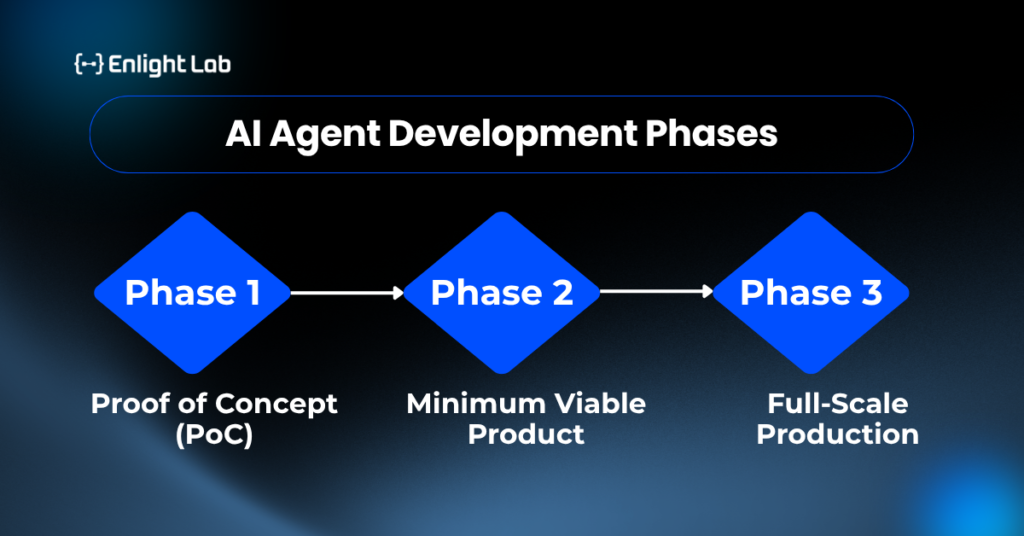
However, each stage carries its own critical friction points. These silent killers can derail AI investments if not expertly managed. Here is what you need to watch out for, and why seasoned guidance is absolutely essential:
Phase 1: Proof of Concept (PoC)
This phase is where you determine whether the AI model can actually perform the specific task you require.
- Common Friction Points: Common issues include Incomplete or low-quality sample data, unclear problem framing, and unrealistic expectations of what pre-trained models can do “out of the box.” Many teams stall here by overfitting to synthetic data or building a PoC that works in isolation, but fails with real inputs.
- Leadership Value: A veteran Fractional CTO ensures the problem is tightly framed, pushes back on vanity demos, and defines objective criteria for technical feasibility. This expert can recognize early if the architecture will not scale, preventing costly dead-ends.
Phase 2: Minimum Viable Product (MVP)
At this stage, you need to connect prototype logic to your real systems and users.
- Common Friction Points: Integrating with brittle or undocumented APIs, surfacing messy internal data structures, or discovering that existing business processes are far less standardized than assumed. Security oversights, such as weak access controls or ignoring compliance realities, can stall or even kill momentum.
- Leadership Value: With deep technical experience, a Fractional CTO can orchestrate pragmatic API and data integration strategies, enforce essential security from day one, and facilitate rapid feedback loops between domain experts and AI developers. They prevent “too much, too soon,” ensuring the MVP remains focused squarely on a high-impact, low-risk workflow.
Phase 3: Full-Scale Production
When you expand to a larger scale, every weakness in your architecture becomes exposed.
- Common Friction Points: Many teams encounter issues such as a lack of robust DevOps automation, cloud infrastructure that cannot auto-scale under load, and governance gaps related to auditability. Agents may behave unpredictably when exposed to real-world data variability. Distributed systems risks (including race conditions and data consistency issues), brittle error handling, and hidden bottlenecks in vector database or embedding generation pipelines threaten operational stability. Most critically, if monitoring is immature, model drift or hallucination issues can go unnoticed until after they have affected customers.
- Leadership Value: In these circumstances, the strategic value of a Fractional CTO becomes transformative. Having navigated the transition from pilot to production across various market cycles, they understand where projects often fail and can architect solutions for scaling, resilience, and compliance from the outset. Rather than simply addressing symptoms like a junior team would, a seasoned CTO implements proactive controls, real-time monitoring, and promotes a culture of post-mortem learning. Their architectural decisions ensure you launch on time and remain in production without facing dangerous surprises.
At every phase, experienced technical leadership is the difference between an AI initiative that gets stuck in endless pilot purgatory and one that advances to high-value, stable production. In these situations, inexperienced teams are often caught off guard. However, a Fractional CTO provides the necessary foresight to help you anticipate challenges, avoid costly surprises, and unlock the true value of agentic AI for your business.
Phase 1: Proof of Concept (PoC)
The goal of a PoC is to validate the technical feasibility of your idea. Can the AI model actually perform the specific task you need it to?
- What happens: We use off-the-shelf models and synthetic data to test the core logic. We do not build complex integrations or polished user interfaces.
- Timeline: 2 to 4 weeks.
- Cost Estimate: $5,000 – $15,000.
- Outcome: A functional backend script that proves the AI can execute the desired logic, giving you the confidence to invest further.
Phase 2: Minimum Viable Product (MVP)
Once the PoC proves the concept, we build the MVP. The goal here is to create a functional agent that can be deployed to a small group of internal users or friendly clients.
- What happens: We connect the agent to your actual data sources. We build the necessary API integrations (e.g., hooking the agent into Slack, Salesforce, or Zendesk). We establish basic security protocols and deploy the system to a staging environment.
- Timeline: 6 to 10 weeks.
- Cost Estimate: $25,000 – $50,000.
- Outcome: A working AI agent that handles real-world tasks, allowing you to gather user feedback and measure initial return on investment.
Phase 3: Full-Scale Production
Moving an MVP to full-scale enterprise production is where the heavy lifting occurs. A prototype that works for ten users will crash when exposed to ten thousand users if the architecture is not rock-solid.
- What happens: We implement enterprise-grade DevOps practices. We set up auto-scaling cloud infrastructure, implement rigorous security and compliance guardrails, build human-in-the-loop escalation paths, and establish real-time monitoring dashboards.
- Timeline: 12 to 20+ weeks.
- Cost Estimate: $80,000 – $250,000+.
- Outcome: A highly secure, autonomous digital worker that scales seamlessly with your business.
AI Agent Pricing Tiers for 2026
To help you visualize the financial landscape, we have categorized custom AI agent builds into three primary tiers.
| Tier | Capabilities & Integrations | Typical Use Cases | Estimated Cost Range |
| Basic Agent | Pre-trained models, simple prompt engineering, 1-2 basic integrations (e.g., Slack, email). No persistent memory. | Internal FAQ bots, basic triage, simple data extraction. | $15,000 – $35,000 |
| Intermediate Agent | RAG implementation, persistent memory (Vector DB), 3-5 complex integrations (CRM, ERP), custom orchestration logic. | Sales automation, advanced customer support, HR onboarding. | $40,000 – $90,000 |
| Enterprise Agent | Multi-agent collaboration, custom model fine-tuning, highly regulated data handling, enterprise security (SOC 2/HIPAA). | Autonomous supply chain management, financial strategy execution. | $100,000 – $250,000+ |
Note: These estimated cost ranges reflect the initial build (PoC to Production) and do not include the 15% to 20% annual compliance and maintenance budget required for enterprise operations.
Maintenance, Security, and Optimization Costs
The initial build is only the beginning. A critical mistake many founders make is treating an AI agent like a static piece of software. AI agents are dynamic systems that require ongoing care. You must budget for the operational reality of the 2026 technological landscape.
The Cost of AI Hallucinations and Debugging
One of the least discussed, yet most financially devastating aspects of running AI agents at scale is the cost of AI hallucinations and the debugging overhead that surrounds them. Unlike traditional systems, autonomous agents can generate convincing but incorrect answers—hallucinations—that often go undetected until they create customer dissatisfaction, compliance issues, or operational mistakes.
When an AI agent pulls together information from vast, unstructured data sources or synthesizes an answer under ambiguity, it can fabricate facts or invent process steps, especially under pressure from edge-case inputs. Catching these issues is not as simple as fixing a logic bug in conventional code. Root cause analysis in AI systems means sifting through model prompts, hundreds of vector embeddings, API handoffs, and non-deterministic outputs.
What makes debugging so difficult?
- Non-determinism: The same input can produce different outputs depending on subtle context clues or model versioning.
- Black box reasoning: Many LLM-based agents offer little transparency into the decision-making trail leading to an output.
- Multi-agent complexity: In collaborative agent setups, a hallucination by one agent can silently cascade through a workflow, contaminating downstream results.
How do you defend against this operational threat?
Robust detection and rapid response require an investment in modern DevOps monitoring and observability tools purpose-built for AI:
- Prompt and output logging: Capture and store all prompts, intermediate outputs, and final results in a searchable, centralized log.
- Automated drift detection: Use statistical analysis and anomaly detection to surface when model outputs begin to deviate from expected norms, flagging possible hallucinations or accuracy decay.
- Human-in-the-loop dashboards: Surface uncertain or low-confidence outputs to subject-matter experts in real time for rapid triage before they can impact customers.
- Continuous evaluation pipelines: Integrate regular validation with real-world data, synthetic edge cases, and third-party benchmark datasets to uncover silent failures before they scale.
Budgetary impact: Expect initial configuration and ongoing monitoring of these systems to consume 10–20% of your annual operational AI budget, depending on complexity and volume. Neglecting robust debugging and hallucination mitigation often leads to far more costly incidents—both in remediation spend and reputational harm.
In short, the invisible tax of hallucinations and hard-to-diagnose failures is the true operational cost of autonomy. Cutting corners here exposes your business to open-ended financial risk—one which only seasoned DevOps and AI leadership can reliably contain.
Infrastructure Scaling and Token Usage
As your business scales, your agent works harder—and so do your infrastructure and cloud budgets. One of the most significant, and often underestimated, operational exposures is cloud egress fees. Every time your AI agent retrieves or pushes large volumes of data outside the cloud provider’s ecosystem, you incur egress charges. With open-source, self-hosted models and custom vector database deployments, these costs multiply rapidly, especially if your workflows require real-time data flows to external APIs, mobile apps, or multi-cloud environments.
Infrastructure bloat is another silent killer: scaling open-source models often means spinning up dedicated GPU clusters, persistent storage for massive vector databases, and redundant pipelines for disaster recovery. Unlike tightly managed proprietary API offerings—where the provider abstracts infrastructure management and absorbs network costs in their token pricing—self-hosted stacks put the full weight of cloud compute, storage, and bandwidth on your IT budget. Even idle resources (provisioned but underutilized GPU or storage instances) can erode your ROI if not consistently optimized.
For many enterprises, this means a custom build that appears more economical on paper may outpace the monthly cost of a commercial LLM API once high egress and infrastructure fees hit at scale. To mitigate these risks, you need advanced DevOps automation for resource provisioning, real-time usage monitoring, and architectural discipline to avoid zombie compute and unnecessary network drag. Put simply: the flexibility of open-source comes with a premium in operational overhead, turning what looks like a cost-saver into a budgetary trap for the unwary.
- Token Costs: If you rely on commercial APIs, your monthly token costs will rise alongside your usage. A high-volume customer service agent processing thousands of complex queries a day can easily generate $2,000 to $5,000 in monthly API fees.
- Cloud Hosting: If you host your own open-source models and vector databases, you must pay for continuous cloud compute (GPU instances). Proper DevOps architecture is vital here. We implement auto-scaling to ensure you only pay for the compute you actually use, drastically reducing cloud infrastructure costs.
Compliance and Security Safeguards
If your agent touches personally identifiable information (PII), financial data, or healthcare records, security is paramount.
- Audit Logging: We must build systems that log every decision the AI makes. If an agent approves a refund or alters a contract, you must have a cryptographic paper trail.
- Access Controls: The agent must respect your internal data hierarchies. A junior employee should not be able to ask the AI agent for the CEO’s salary details. Building and maintaining these role-based access controls requires ongoing security audits.
- Expected Cost: Budget 15% to 20% of your initial development cost annually to maintain compliance standards like SOC 2, GDPR, or HIPAA.
Model Retraining and Drift Prevention
Over time, the data your business generates changes. Product lines evolve, company policies update, and customer behavior shifts. If your AI agent relies on old data, its accuracy will degrade—a phenomenon known as model drift.
- Continuous Optimization: You must budget for periodic data ingestion and model fine-tuning. We set up automated evaluation pipelines to monitor the agent’s output. When accuracy drops below a certain threshold, it triggers a retraining cycle.
- Expected Cost: Expect to spend $2,000 to $5,000 monthly on data management, performance monitoring, and continuous optimization.
Comparative Pricing Models: How to Build Your Agent
When deciding to build a custom AI agent, you have three primary paths to acquire the technical talent. Each model has distinct financial and strategic implications.
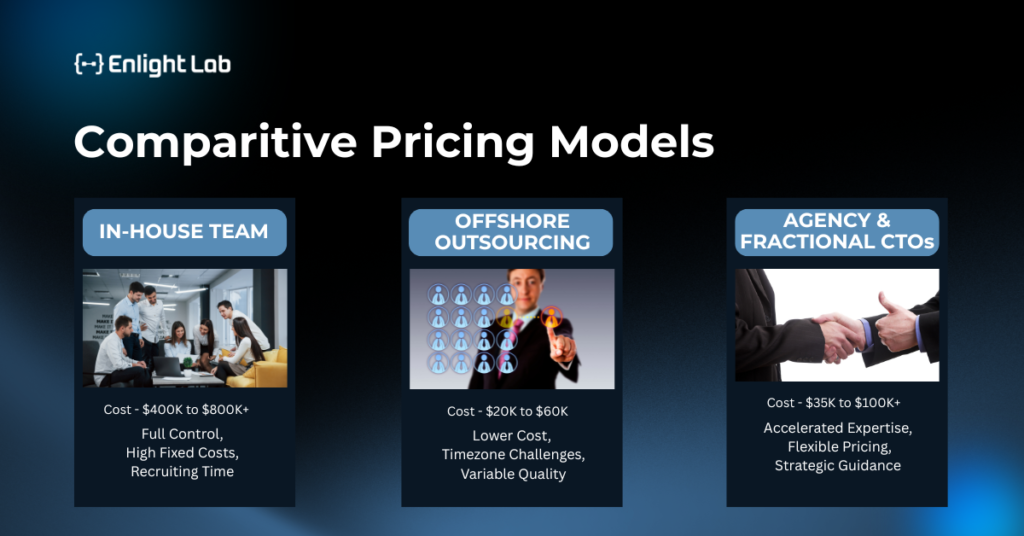
1. In-House Development Team
You hire full-time machine learning engineers, data scientists, and DevOps architects to build the system internally.
- Pros: Complete control over the team, deep alignment with company culture, and retention of all institutional knowledge.
- Cons: Extremely slow time-to-market. Hiring top-tier AI talent in 2026 is incredibly difficult and expensive. You will spend months just assembling the team before a single line of code is written.
- Cost Range: A minimal functional AI team will cost $400,000 to $800,000+ annually in salaries, benefits, and equity, regardless of whether the agent succeeds.
2. Offshore Outsourcing
You hire a development shop in a lower-cost region to build the software based on your specifications.
- Pros: Very low hourly rates. You can often get a team of five engineers for the price of one US-based developer.
- Cons: High risk of poor architectural decisions. Many offshore firms lack the deep, strategic AI expertise required to build secure, scalable autonomous systems. Communication barriers and time zone differences often lead to misaligned expectations and frustratingly slow release cycles.
- Cost Range: $20,000 – $60,000 per project. However, the long-term cost of rewriting messy code and fixing security vulnerabilities often negates the upfront savings
3. Agency Partnerships and Fractional CTOs (The Enlight Lab Approach)
You partner with a specialized technology consulting firm led by veteran technologists. We act as your fractional CTO and deploy our dedicated engineering teams to build your system.
- Pros: You get immediate access to elite AI architecture and DevOps expertise without the massive overhead of full-time hires. We cut through the AI hype, manage the messy data, and deliver practical results quickly. You get strategic tech leadership that ensures the system aligns perfectly with your business goals.
- Cons: Higher upfront project costs than cheap offshore labor.
- Cost Range: $40,000 – $150,000+ per project, with predictable, transparent pricing tied to specific deliverables and business outcomes.
Conclusion: Stop Guessing and Start Building
Transitioning to AI agents marks a fundamental operational pivot; it is not simply the adoption of another software tool. This shift involves embedding machine reasoning, autonomous workflows, and data-driven decision-making directly into your company’s DNA. In practice, it means that every department from support to supply chain begins operating at a scale, speed, and consistency that no human team can match.
But this transformation is not plug-and-play. The architectural demands—including AI safety, orchestration, memory management, compliance, and continuous optimization—are far more complex than those involved in legacy app development. For this reason, the difference between success and expensive false starts comes down to leadership. Specifically, your company must have the technical vision, proven experience, and pragmatic discipline required to architect for scale from day one.
At Enlight Lab, this is precisely where our fractional CTO and technology consulting services deliver exceptional value. With over 18 years of executive-level technical leadership, we ensure your AI initiative is not just another IT project. Instead, it becomes a strategic and future-proof operational foundation. We architect infrastructure that is secure, modular, and resilient to market shifts. This approach positions your digital workforce as a true asset, whether you are scaling into new markets or preparing for acquisition.
AI agent development is not simply about writing code; it is about fundamentally transforming how your business operates. With Enlight Lab guiding your AI journey, you gain more than just expert engineers. You also gain a trusted strategic partner, committed to driving real business transformation.
Understanding the true AI agent development cost is the first step toward modernization. When you prioritize scalable technical architecture, deploy in clear and manageable phases, and carefully budget for ongoing maintenance, you can build a digital workforce that generates significant ROI.
Do not let messy data, slow release cycles, or concerns about cloud costs hold your vision back. At Enlight Lab, we offer fractional CTO services and DevOps architecture expertise, so you can modernize your tech stack safely and profitably.
We explain complex technology in plain English. Our team streamlines your deployments and builds the autonomous systems you need to scale. Let us help you transform your vision into an efficient reality.