Stop relying on chat windows that wait for your commands. Most businesses currently treat artificial intelligence as a simple assistant. You feed a language model a prompt, and it gives you a quick answer. While helpful, this reactive approach leaves massive potential on the table.
The real breakthrough happens when systems stop asking for permission and start managing themselves.
Level 5 Autonomy in AI represents this critical shift. It moves technology from a helpful tool to a strategic, self-steering entity. A fully autonomous system anticipates problems, allocates resources, and executes complex strategies without human intervention. It shifts your role from a micro-manager of digital tools to a visionary leader of a self-operating machine.
This comprehensive guide breaks down exactly what Level 5 Autonomy in AI means for your business. We will explore the progression of machine intelligence, the technologies driving this shift in 2026, real-world case studies, and how you can prepare your infrastructure for the future.
What if your business could run itself?
Not just handle a few tasks, but strategize, adapt, and grow—all on its own. That’s the promise of Level 5 AI Autonomy.
To understand how revolutionary this is, let’s look at where most businesses are today. You’re likely at Level 1 or 2, using AI to draft emails or automate simple workflows. It’s helpful, but brittle. The moment an invoice format changes or a new variable appears, the system breaks. A human must jump in, fix the problem, and restart everything. It’s a constant cycle of monitoring and repair.
Level 5 AI leaves that fragility behind.
Imagine an AI that doesn’t just follow rules but helps write them. It’s a cohesive, self-improving network that understands your entire business—your market, your customers, your resources. It doesn’t just spot a new opportunity; it autonomously launches the marketing campaign, develops the software features, and reallocates the budget to make it happen. Instantly.
This level of autonomy requires deep contextual awareness. The system understands your business goals, your budget constraints, and your brand voice. It makes judgment calls based on a complex web of dynamic variables.
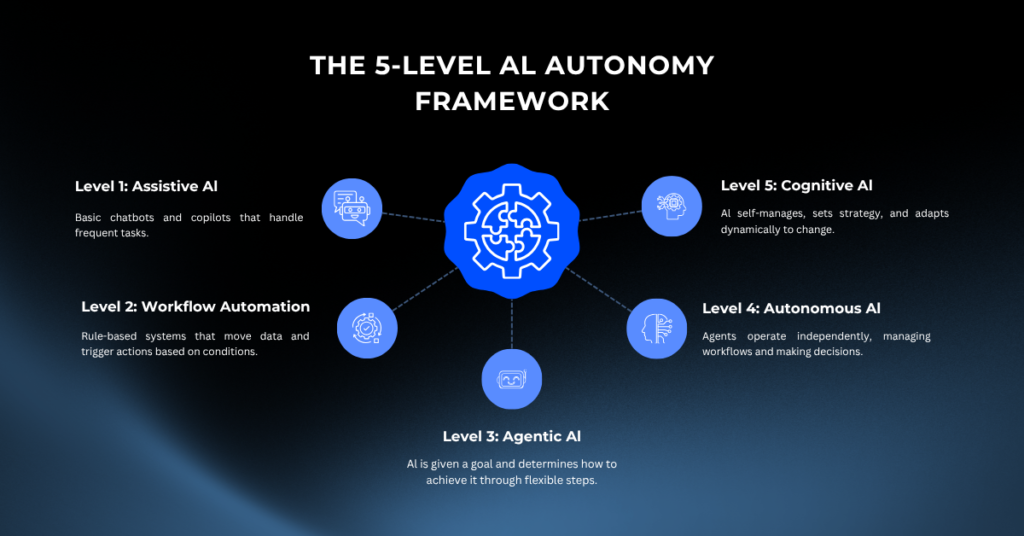
The 5-Level AI Autonomy Framework
Knowing these five levels helps you see where your company stands and where it can go.
The 5-Level AI Autonomy Framework
Understanding the stepping stones to Level 5 helps you benchmark your current operations. You cannot jump from Level 1 directly to Level 5. You must build the underlying infrastructure to support each subsequent phase. Here is how the progression unfolds.
Level 1: Assistive AI
At this stage, AI acts as a sophisticated calculator or reference tool. Think of standard coding copilots, spell-checkers, or basic chatbots. The human operator does 90% of the thinking, planning, and executing.
The AI simply speeds up micro-tasks. You ask it to generate a boilerplate function or summarize a meeting transcript. The system has zero autonomy and zero contextual awareness outside the immediate prompt. You must guide it step-by-step.
Level 2: Workflow Automation
This level introduces basic conditional logic. We see systems that can trigger actions based on specific, predefined rules. Robotic Process Automation (RPA) dominates this tier.
When a customer submits a support ticket, the system reads the category and routes it to the correct department. While helpful, these systems remain incredibly brittle. They lack the ability to adapt. If the support ticket form updates and changes the category names, the automation fails completely. Humans must constantly monitor and debug these pipelines.
Level 3: Agentic AI
Here is where the major shift begins. At Level 3, we introduce Agentic Workflows. Instead of following a rigid, linear script, the AI receives a high-level goal and figures out the steps required to achieve it.
If an agent hits an error, it loops back, re-evaluates, and tries a new approach. For example, you ask the system to “research competitor pricing and update our database.” The agent writes a web scraping script. It runs the script. It realizes the competitor has changed their website structure. Instead of crashing, the agent rewrites the script, pulls the data, and updates your records. The human sets the goal, but the agent navigates the roadblocks.
Level 4: Autonomous AI
At Level 4, Autonomous AI Agents operate continuously without needing a human to initiate every task. These agents monitor systems, identify optimization opportunities, and execute complex projects entirely on their own.
They manage their own compute resources, prioritize their backlogs, and collaborate with other specialized agents. A Level 4 system does not wait for a human to notice a server spike. It detects the anomaly, spins up additional resources, diagnoses the root cause of a memory leak, writes a patch, tests the patch, and deploys it. Humans transition from operators to high-level supervisors.
Level 5: Cognitive AI
Custom agenThis is the ultimate destination. The cognitive enterprise self-manages, dictates strategy, and adapts instantly. The lines between business operations and software architecture blur completely.
A Level 5 system might notice a sudden spike in social media sentiment around a specific product feature. Without human prompting, the AI instructs the engineering agents to prioritize building that feature. It instructs the marketing agents to draft and fund an ad campaign targeting the demographic driving the trend. It calculates the projected ROI and adjusts supply chain orders to meet the anticipated demand. Leadership focuses purely on vision, ethics, and overarching business constraints.
We, at Enlight Lab, specialize in developing Level 5 Cognitive AI systems that seamlessly integrate automation and strategic execution. With expertise in advanced AI frameworks, we empower businesses to harness the full potential of autonomous intelligence, driving innovation and efficiency at scale.
How Level 5 Changes Business Operations
Reaching Level 5 Autonomy in AI completely redefines how your business runs. You stop building rigid software pipelines and start orchestrating intelligent agents. This shift brings massive operational advantages across every department. Let’s look at the key ways Level 5 makes a difference.
Self-Healing Infrastructure
Traditional software development requires constant human monitoring. It requires people to write code, read dashboards, and fix crashes. But with Level 5 systems, you unlock self-healing software.
For example, if a server is acting up, the AI won’t just notify your team. Instead, it’ll diagnose the issue, create a safe environment to test solutions, write a fix, test it, and then update your system – all automatically. These repairs often happen before you even realize there’s a problem, bringing the concept of “NoOps” into a practical reality. Hence, your engineering team stops fighting fires and starts building new revenue streams.
Infinite Scalability
Growth often comes with increased staffing costs and resource demands. But Level 5 Autonomy in AI lets even small teams scale like giants.
Picture three founders who can produce the output of a 500-person organization. That’s because AI manages a whole fleet of specialized digital workers. It can ramp up or scale down operations instantly, so you only use resources when you truly need them—saving time and money.
Level 5 Autonomy in AI shatters this ceiling. A small team of three founders can operate with the output of a 500-person corporation. The AI manages an army of specialized digital workers.
It scales operations up or down instantly based on demand. If a marketing campaign goes viral, the AI instantly spins up 1,000 customer service agents to handle the influx of inquiries. When the surge subsides, it spins them down. This ensures you never overspend on idle resources or miss out on sudden spikes in customer interest.
Dynamic Resource Allocation
In a traditional enterprise, budgeting and resource allocation happen quarterly or annually. Department heads fight for capital, and by the time funds get approved, the market opportunity often passes.
A self-managing enterprise handles resource allocation dynamically. The AI monitors the performance of every initiative in real-time. If an ad campaign in a specific region underperforms, the system immediately pulls funding and reroutes it to a high-performing product development initiative. It treats the entire business as a fluid portfolio, constantly shifting assets to maximize return on investment.
Real-world scenarios demonstrating improved efficiency
Picture a product manager needing a detailed weekly sales analysis. Instead of logging into three platforms, exporting spreadsheets, cleaning data, and formatting the visuals, they simply request the analysis: “Show me sales trends by region over the last month, highlight anomalies, and suggest three accounts at risk.” The agent compiles a tailored dashboard and an executive summary, drawing from live data.
Or think of regulatory compliance: an agentic system reviews all transactions in real time, auto-flags potential violations for review, and surfaces a compliance report at the end of each quarter with minimal human input.
Outcome-driven AI doesn’t just save time; it ensures accuracy, focuses human effort where it will have the biggest impact, and gives your business a tangible edge in responding to market shifts or client demands.
Beyond the Hype: 2026 Trends You Need to Know
Most AI guides focus on how to write better prompts. To stay ahead, you must understand how AI systems are actually being built in 2026. True automation comes from three major shifts in technology.
Multi-Agent Meshes
You cannot achieve full autonomy by forcing one massive language model to do everything. Large monolithic models hallucinate, slow down, and consume massive amounts of compute. Instead, the industry is moving toward a multi-agent mesh.
In this system, hundreds of small, specialized AI agents work together. Think of it like a team of experts:
- One agent only reviews software code.
- One agent only checks legal contracts.
- One agent only manages marketing budgets.
These agents talk to each other directly. For example, if the coding agent writes a new feature, it asks the legal agent to check it for current GDPR regulations. This decentralized approach makes the overall system incredibly resilient, precise, and cost-effective.
Model Context Protocol (MCP)
Most big companies have data stuck in old systems that don’t talk to each other. In the past, moving this data so an AI could use it took years of work. The Model Context Protocol (MCP) changes this.
MCP acts as a universal translator. It allows AI agents to securely connect to any data source, whether it is an old office server or a modern cloud database. With MCP, an AI can:
- Pull old sales records from a 20-year-old database.
- Compare them to live website traffic.
- Create a report in seconds.
This allows companies to use advanced AI immediately without having to fix all their old technology first.
Edge Autonomy
Sending data to the cloud takes time. This delay, called latency, is dangerous for machines that need to react instantly, like robots in a factory.
Edge autonomy puts the AI’s “brain” directly on the device. Instead of waiting for a signal from a distant server, the device makes decisions locally.
- Speed: Decisions happen in milliseconds.
- Reliability: The machine keeps working even if the internet goes down.
- Efficiency: The device only sends important updates to the cloud, saving data and power.
By moving intelligence to the “edge” of the network, AI becomes faster and more reliable for real-world physical tasks.
Preparing Your Infrastructure for Level 5
The jump to a self-managing enterprise requires strategic preparation. You cannot simply buy a piece of software and achieve Level 5 Autonomy in AI overnight. You must lay the groundwork carefully.
Step 1: Audit and Connect Data Silos
Autonomous agents require unhindered access to high-quality data. If your marketing data lives in one system and your sales data lives in another, the AI cannot make holistic decisions. Begin by mapping your data architecture. Utilize protocols like MCP to build secure bridges between your siloed databases. The AI must have a unified view of the business to manage it effectively.
Step 2: Transition from Scripts to Orchestration
Stop building linear if-then automations. Begin replacing rigid scripts with goal-oriented agentic workflows. Start small. Choose a low-risk administrative process, such as vendor onboarding or internal IT support. Deploy a small multi-agent mesh to handle this process end-to-end. This allows your team to learn the nuances of AI orchestration without risking core business operations.
Step 3: Implement Robust Guardrails
Handing over the keys to an autonomous system requires strict governance. You must define the boundaries within which the AI operates. Set hard limits on budgets, clearly define ethical guidelines, and establish human-in-the-loop triggers for high-stakes decisions.
For example, the AI can autonomously launch ad campaigns under $5,000, but any campaign exceeding that amount requires human approval. As trust in the system grows, you can gradually expand these boundaries.
Ready to Build Your Self-Managing Enterprise?
The transition to Level 5 Autonomy in AI will separate the market leaders from the obsolete. Companies that cling to manual workflows, fragile scripts, and basic chatbots will simply move too slowly to compete. Your competitors are already looking beyond basic automation toward fully autonomous, self-healing systems.
You need expert guidance to bridge the gap between today’s processes and tomorrow’s opportunities. Enlight Lab specializes in multi-agent orchestration and operational strategy for cognitive enterprises.
Take action now. Partner with Enlight Lab for a Strategic Agentic Sprint. Our expert engineers will audit your existing workflows, identify high-impact areas for autonomous integration, and help you launch your very own self-managing AI mesh.
Don’t just manage your tools—lead a self-managing enterprise. Contact us today to claim your position at the forefront of enterprise autonomy.