You are burning through capital if you are still treating AI as a novelty. Two years ago, integrating basic generative AI was enough to impress investors. Now, it is baseline infrastructure. The question keeping founders and CTOs awake at night is rarely about whether to adopt AI, but rather how to implement it correctly without crippling technical debt.
By 2026, the startups that survive will be the ones that stop experimenting with isolated tools and start building cohesive AI systems. At the same time, overbuilding is just as risky. Creating a complex custom solution when a simple $50‑per‑month tool can do the job wastes time, money, and focus. Smart AI decisions help you move faster, lower costs, and compete with companies ten times your size.
At EnlightLab, we see this pattern every day. Early technical choices decide whether a startup scales smoothly or struggles to recover later. You need clarity on which AI technologies will drive revenue and which ones will quietly drain your runway.
This year marks a clear shift. Startups are moving away from simple AI experiments. They are building AI into the core of their products and operations. From autonomous AI agents to real‑time decision systems, the bar has been raised.
But not every AI trend deserves your attention. Some are hype. Others are already shaping winning startups.
In this guide, you will learn the top 7 AI trends startups shouldn’t ignore in 2026. Each trend is explained in simple terms. You will see why it matters, where it fits, and how it affects real startup growth. If you are building or scaling a startup, these are the signals you need to understand now.
The 7 AI Trends That Will Shape Your Startup
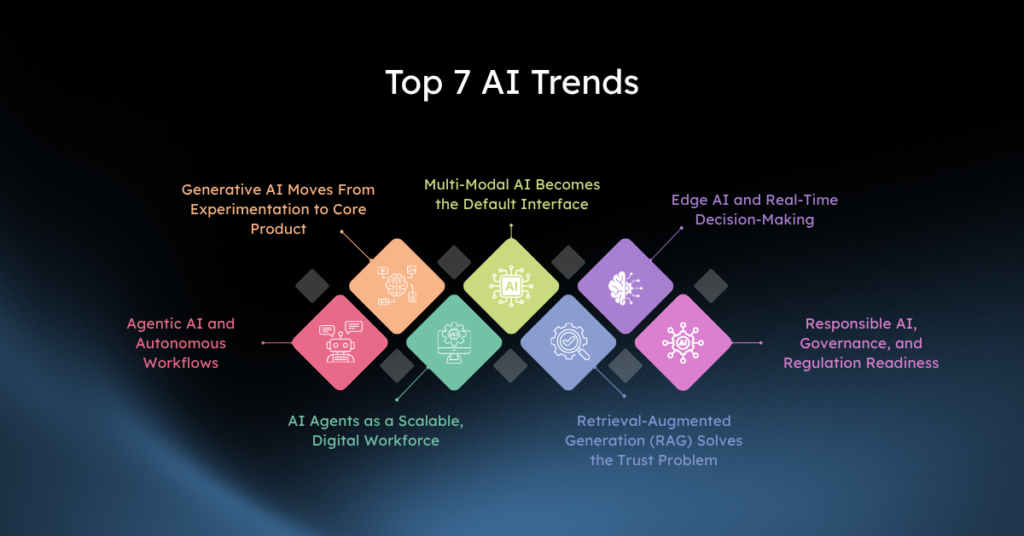
Failing to align with these trends will leave your startup vulnerable to obsolescence, while adopting them strategically will ensure you remain competitive and drive exponential growth.
Trend 1: Agentic AI and Autonomous Workflows
While your team is stuck in spreadsheets, your competitors are building autonomous systems that are actively stealing your customers. Paying employees to execute repetitive manual tasks is actively losing you money. Your human capital is your most expensive resource, and it should be directed toward high-value strategy, not data entry.
The Rise of the Digital Workforce
Agentic AI is more than simple automation. It involves creating systems of intelligent agents that can reason, plan, and execute complex, multi-step tasks without human intervention. These systems are already being used to:
- Plan and execute marketing campaigns: From initial research to final ad placement, autonomous agents can manage entire workflows.
- Automate sales outreach: Intelligent agents identify leads, personalize communication, and schedule meetings, freeing your sales team to focus on closing.
- Resolve complex support tickets: Advanced natural language understanding allows agents to handle sophisticated customer issues instantly, reducing support costs by up to 60%.
When you automate baseline operations, you free your best people to build better products. Instead of manually cleaning data, your analysts can uncover revenue-generating patterns. Startups that deploy intelligent automation can scale their operations without constantly expanding their payroll. Frameworks like CrewAI and AutoGPT allow a single employee to manage the output of an entire virtual team.
Trend 2: Generative AI Moves From Experimentation to Core Product
If you are using generative models only to write blog posts, you are wasting computational power and missing the real opportunity. The financial value lies in embedding these capabilities directly into your product to create proprietary assets and data that competitors cannot replicate.
Beyond Content Generation
The new frontier for generative AI is building functional, core components of your business. The most forward-thinking companies are using these models to:
- Generate functional software: Move beyond simple scripts to create complete application architectures and design systems. Platforms like Uizard can generate full UI kits in minutes.
- Power hyper-personalized experiences: Use generative engines to create dynamic user journeys and product interactions tailored to individual behaviors.
- Build defensible data moats: Generate proprietary datasets for training more specialized models, creating a competitive advantage that is difficult to copy.
The New Economics of Innovation
Speed to market dictates startup survival. Instead of spending $80,000 and four months on a traditional MVP, you can use generative coding environments to output a functional application architecture in days. This rapid iteration cycle lets you test market viability before committing heavy engineering resources. The primary risk is architectural fragility. You must pair generative output with rigorous human engineering oversight to ensure security, reliability, and scalability.
Trend 3: AI Agents as a Scalable, Digital Workforce
Relying on a purely human workforce for scalable tasks is a fast track to being outmaneuvered. The new competitive frontier is not just about using AI tools, but about deploying autonomous AI agents as a specialized, cost-effective digital workforce.
From Manual Tasks to Autonomous Missions
AI agents are goal-oriented systems designed to operate independently. You do not assign them a task; you give them a mission.
- For Sales: An agent can be tasked with identifying 100 new leads, researching their needs, drafting personalized outreach, and scheduling meetings—all autonomously. This frees your human sales team to focus exclusively on closing high-value deals.
- For Operations: A fleet of agents can manage inventory, process invoices, and perform market research, replacing functions traditionally filled by junior staff or outsourced contractors at a fraction of the cost.
- For Engineering: Agents can conduct routine software testing, identify bugs, and even suggest code fixes, accelerating development cycles.
This creates massive operational leverage. A single engineer can now manage a fleet of AI agents performing the work of an entire department, allowing early-stage startups to compete with the scale of much larger incumbents.
Trend 4: Multi-Modal AI Becomes the Default Interface
If your product experience is limited to text and clicks, you are already falling behind. Users now expect to interact with technology through a seamless blend of text, voice, images, and video. Multi-modal AI is no longer a novelty; it is the new standard for intuitive and effective user interfaces.
Your cognitive load, not the user’s
Multi-modal models process and generate information across different data types simultaneously. This creates a frictionless experience that drastically increases adoption and engagement.
- A user can upload a picture of a broken part and ask a verbal question about how to fix it.
- The system can then generate a step-by-step video tutorial in real time.
- The cognitive load moves from the user to the system, where it belongs.
How to drive conversion with multi-modal AI
Integrating these capabilities is non-negotiable for any product aiming for market leadership.
- Immersive e-commerce: Startups are using multi-modal AI to build experiences where users can visually “try on” products.
- B2B diagnostics: A field service technician can stream live video of a machine and receive AI-generated diagnostic instructions overlaid directly on their screen.
Trend 5: Retrieval-Augmented Generation (RAG) Solves the Trust Problem
Deploying a generic large language model that hallucinates or provides outdated information destroys user trust and exposes you to significant liability. Retrieval-Augmented Generation (RAG) solves this. It grounds your generative AI in secure, proprietary data, ensuring every output is accurate, verifiable, and relevant.
From generic answers to proprietary insights
RAG combines the reasoning power of a large language model with a real-time information retrieval system. When a user makes a query, the system works in two steps:
- It retrieves factual data from your specific knowledge base—be it technical documentation, customer support logs, or financial reports.
- It synthesizes a natural-language answer using the LLM, based only on that verified information.
The business case: Accuracy and security
This architecture gives you two critical advantages:
- It prevents hallucinations. Your AI provides answers strictly aligned with your trusted data and brand voice.
- It ensures data security. For regulated industries like finance and healthcare, RAG is not an option; it is a requirement.
You create a moat around your business by building an AI that knows your data better than any public model ever could.
Trend 6: Edge AI and Real-Time Decision-Making
If you rely entirely on cloud computing for real-time applications, latency is crippling your product performance. Sending every data packet back to a central server for analysis creates bottlenecks that frustrate users, drain your operational budget, and are completely unworkable for applications requiring instantaneous response.
Processing data where it is created
Edge AI shifts the computational workload from distant cloud servers directly to the local device—whether that is a smartphone, a factory sensor, or a smart camera. The AI model runs locally. This architectural shift drastically reduces the distance and time data must travel, enabling decisions in milliseconds.
Latency, privacy, and cost advantages
- Instantaneous response: Local processing is non-negotiable for autonomous systems, robotics, or any user-facing feature that cannot tolerate lag.
- Enhanced privacy: Keeping sensitive data on the device mitigates massive regulatory risk. You do not have to secure data in transit if it never leaves the user’s hardware.
- Cost efficiency: Cloud computing fees spiral out of control when you stream terabytes of raw sensor data. Edge processing filters the noise, sending only critical insights back to your central database.
Trend 7: Responsible AI, Governance, and Regulation Readiness
Ignoring compliance is a massive regulatory risk that will drain your capital overnight. Global regulators are actively targeting companies that deploy biased, insecure, or opaque algorithms. “Move fast and break things” is no longer a viable strategy when broken things lead to multi-million-dollar fines and permanent brand damage.
Ethical AI is a requirement, not a suggestion
By 2026, frameworks like the EU AI Act will impose strict operational requirements. You can no longer hide behind black-box algorithms. Regulators will demand clear model inventories, bias testing, and documented risk assessments for any system deemed high-risk. Failing to comply means being locked out of entire markets.
Building responsible systems from day one
You must embed governance directly into your engineering pipeline.
- Establish decision guardrails: Define exactly when an algorithm’s output requires human oversight.
- Maintain a model inventory: Track every piece of AI running in your company, including its data sources and risk profile.
- Test relentlessly for algorithmic bias: Regularly audit your models to ensure they do not discriminate against protected user groups.
Customers abandon brands they do not trust. Demonstrating transparent, ethical data practices is now a core competitive advantage that wins enterprise contracts and builds lasting loyalty.
Implementing AI in Your Startup: A Strategic Approach
You have mountains of data. But turning that raw, fragmented data into clean, accurate, and actionable insight requires deep architectural thinking and disciplined execution.
How to systematically integrate AI:
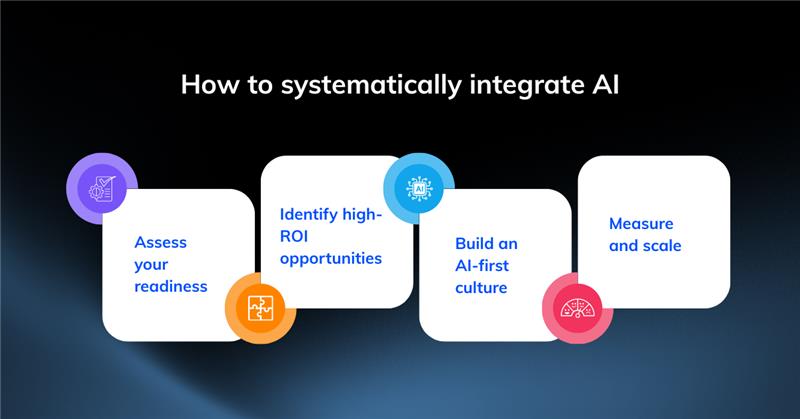
- Assess your readiness: Audit your existing data infrastructure. If your data is messy, your AI will be useless.
- Identify high-ROI opportunities: Target the operational bottlenecks that are bleeding the most capital. Do not deploy AI just to use AI.
- Build an AI-first culture: Train your existing workforce to build systems and manage agents, rather than manually executing tasks.
- Measure and scale: Track specific KPIs related to efficiency and revenue. If a model is not delivering a measurable return, kill it and pivot.
Partnering with experts like EnlightLab ensures you build scalable, secure architectures from day one, rather than rewriting your entire codebase in two years.
Why Enlight Lab Stands Out in Today’s AI Trends
- Future-ready learning to evolve AI skills and modern digital workflows
- Encourages creativity, exploration, and hands-on problem solving
- Focus on tools, techniques, and workflows used in real environments
- Helps businesses stay aligned with changing AI trends and opportunities
- Emphasis on practical application, not just theory or credentials
- Learning environment that supports collaboration and idea sharing
Align Your Business Strategy with Top AI Trends
Top AI trends will keep evolving, but your business success depends on how well you act on them. In 2026, the winners are not chasing every new idea. They are making focused, informed decisions that tie AI directly to growth, efficiency, and scale.
This is the moment to step back and assess your direction. Are your current AI choices helping you build faster and smarter, or are they adding unnecessary complexity? Are you investing in systems that will support you as you scale, or tools that will be costly to replace later?
The right AI strategy is not about more automation. It is about better outcomes. When AI is aligned with clear business goals, it becomes a force multiplier instead of a cost centre.
If you want to turn today’s AI trends into a long‑term advantage, now is the time to act.
Start building smarter AI with Enlight Lab today and make the AI decisions that will define markets tomorrow.