Three open engineering roles are costing you. With a median time-to-hire of 41 days for senior developers, your product timeline is slipping before you even make an offer. But as your dependence on software grows, one challenge keeps getting harder to ignore. The cost of software development is rising fast, and it is becoming difficult to control. It is lost sprint capacity compounding against your roadmap, crippling your ability to ship features and capture market share.
The tension is precise. Your CFO wants to protect the runway, and you need to ship the roadmap. Local hiring satisfies neither. The traditional approach to building a development team is bleeding revenue and slowing your momentum. In such a scenario, saving money only matters if your product and timelines stay strong.
This is why many enterprise leaders are turning to staff augmentation. When used strategically, it gives you access to experienced developers exactly when you need them. IT Augmented team members work within your existing teams, follow your processes, and align with your goals. You stay in control of architecture, delivery, and quality while avoiding long-term hiring commitments that may not make sense for every project.
In this blog, you will learn how staff augmentation can help you cut enterprise development costs in a practical and sustainable way. We will walk through the real cost drivers in enterprise development, explain where flexible talent makes the biggest impact, and show how you can scale your teams without slowing innovation or losing control.
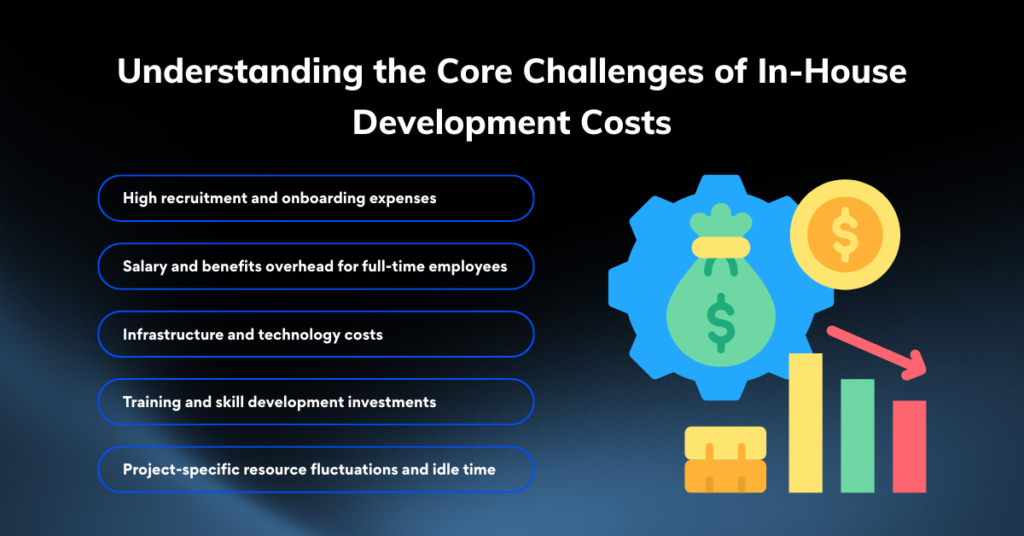
Understanding the Core Challenges of In-House Development Costs
You are probably calculating development costs by base salary alone. That is a massive budgeting mistake. The true cost of a local hire extends far beyond the number on the offer letter.
High recruitment and onboarding expenses
Agency fees for technical roles run 15% to 25% of the first-year salary. If you hire a senior software engineer with a $150,000 base, you are handing a recruiter $30,000 as a one-time placement cost. Add to that the 41-day drain on your internal team’s time spent interviewing, reviewing code tests, and negotiating offers.
Salary and benefits overhead for full-time employees
A fully loaded US employee costs your business 1.25x to 1.4x their base salary. For a senior developer earning a $155,000 base, your actual Year 1 cost easily reaches $265,000. You are paying for employer payroll taxes, health insurance, 401(k) matches, paid time off, and workers’ compensation. These benefits reliably represent over 30% of your actual engineering payroll.
Infrastructure and technology costs
Every new local hire requires a physical or remote infrastructure setup. You are spending anywhere from $5,000 to $10,000 per developer on a high-end laptop, monitors, cloud sandboxes, and expensive SaaS licenses like GitHub and JetBrains.
Training and skill development investments
The tech sector faces a 13.2% annual developer turnover rate. When an in-house developer leaves after 18 months, you lose the institutional knowledge you paid to build. You are forced to restart the costly hiring cycle and pay for new training programs to get the replacement up to speed.
Project-specific resource fluctuations and idle time
Your resource needs are rarely static. You might need three React developers for a six-month sprint, but only one for ongoing maintenance. Hiring full-time employees for project-based spikes means you are paying expensive salaries during inevitable idle periods.
Staff Augmentation as a Strategic Cost-Control Model
Staff augmentation replaces the bloated in-house cost stack with a single, predictable monthly fee. You get senior engineers integrated into your Slack, GitHub, and sprint planning at a fraction of the cost.
How staff augmentation differs from traditional outsourcing
Outsourcing forces you to hand over your project, your intellectual property, and your daily control to a third-party vendor. Staff augmentation keeps project ownership in-house. Your augmented developers attend your daily standups, work your hours, and submit pull requests directly to your repository. You maintain total control over the architecture and the output.
Access to specialized engineer without long-term commitment
When you need niche skills like machine learning integration or advanced DevOps, local hiring can take months. Augmentation gives you access to a global talent pool instantly. You scale up when the roadmap demands it and scale down when the project concludes, carrying zero severance or long-term liability risks.
No recruitment, benefits, or infrastructure costs
The flat monthly fee you pay an augmentation partner covers the developer’s salary, international compliance, HR, benefits, and equipment. You completely eliminate the 30% benefits load and the $30,000 recruiter fees.
Adjusting team size as needed
Scaling an in-house team requires board approval, budget expansion, and months of waiting. Augmentation allows you to double your engineering capacity in a matter of days. If a project pivots or funding shifts, you can adjust your team size with a simple two-to-four-week notice.
Faster project kick-off and reduced time-to-market
Traditional hiring stalls your product launch by 10 to 14 weeks. A quality staff augmentation partner delivers CTO-vetted candidates within 7 working days. Your new developer is pushing code by week two, directly accelerating your time-to-market.
Proven Ways Staff Augmentation Can Cut Enterprise Development Costs
Shifting from local hiring to augmented teams preserves 50% to 70% of your fully loaded engineering costs annually. Here is exactly how those savings materialize.
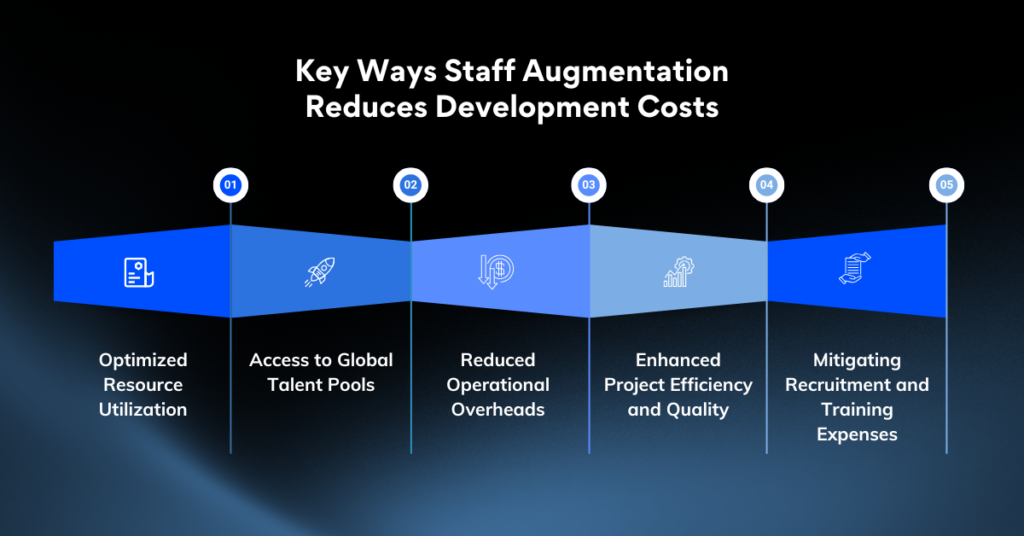
Optimized Resource Utilization
- Matching specific skill sets to project needs: You stop paying generalists to do specialist work. You hire exactly the expertise you need for the exact duration required.
- Eliminating downtime between projects: When the heavy lifting of a product launch is complete, you simply roll off the augmented staff. You never pay a developer to sit idle.
Access to Global Talent Pools
- Leveraging competitive international rates: A senior developer in the United States typically costs between $85 and $130 per hour when hired through contract or staffing models. Comparable senior talent in Latin America or Eastern Europe is often available at $40 to $70 per hour, fully loaded.
- Expanding talent search: You stop fighting the local talent shortage. A global talent pool gives you access to highly qualified engineers worldwide, without competing in tight local hiring markets.
Reduced Operational Overheads
- No additional office space or equipment: Your augmentation partner handles the physical infrastructure, home office stipends, and hardware requirements.
- Shifting employer-related liabilities: The vendor acts as the [Employer of Record (EOR)], absorbing legal risk, international compliance, and local labor law administration.
Enhanced Project Efficiency and Quality
- Accelerating development cycles: Pre-vetted senior developers drop into your workflows without needing basic hand-holding. They ship code faster.
- Reducing errors and rework: High-quality augmented talent comes with deep experience across multiple enterprise environments, leading to cleaner architecture and fewer costly bugs.
- Implementing best practices: External experts bring fresh perspectives and established best practices that elevate your internal team’s standards.
Mitigating Recruitment and Training Expenses
- Avoiding costly talent acquisition: You bypass the internal recruiting overhead and external agency fees entirely.
- Bypassing extensive internal training: You hire for the exact tech stack you run. Augmented developers arrive ready to execute, slashing your ramp-up time from months to days.
Staff Augmentation for Software Development Costs vs Traditional Outsourcing
Staff augmentation vs traditional outsourcing shows clear differences in software development costs, offering enterprises more control, flexibility, and predictable spending.
| Feature | Staff Augmentation | Traditional Outsourcing |
| Team Control | High | Low |
| Communication | Direct with developers | Through vendor |
| Flexibility | High | Medium |
| Long-Term Cost | Lower | Can become expensive |
| Integration | Seamless with internal team | External management |
Best Practices for Reducing Development Costs Through Staff Augmentation
Defining clear project scope
Do not engage an augmentation partner with vague requirements. Document your exact tech stack, required seniority level, timezone overlap needs, and the specific sprint goals the developer must hit in their first 30 days.
Selecting the right staff augmentation partner
Not all vendors are equal. Look for partners that use CTO-led technical vetting rather than basic keyword matching. Ensure they offer an Employer of Record structure, so your intellectual property remains fully protected under standard compliance frameworks.
Establishing effective communication and collaboration channels
Silence kills distributed teams. Bring your augmented developers into your core communication channels immediately. They need access to your Slack workspace, your Jira boards, and your engineering documentation.
Integrating augmented staff into existing workflows
Your augmented developer must follow your exact pull request processes, code review standards, and CI/CD pipelines. They work for you, not the vendor. Treat them exactly like a full-time local hire.
Performance monitoring and feedback mechanisms
Set clear KPIs and conduct regular 1:1 reviews. High-quality augmentation partners provide dedicated Client Success Managers to help monitor performance and handle any HR-related issues, leaving you free to focus strictly on technical output.
Potential Pitfalls and How to Avoid Them
The risks of distributed teams are real, but they are entirely manageable with the right structure.
Communication barriers and cultural differences
Timezone mismatches and language barriers will stall your sprints. Fix this by demanding overlapping working hours (e.g., a minimum of four hours of overlap with your local tech lead) and thoroughly vetting candidates for strong English proficiency and cultural alignment during the interview phase.
Ensuring data security and intellectual property protection
Never rely on a vendor’s internal frameworks if you want to own the code. Use an EOR model where the developer signs strict NDAs directly aligned with your corporate entities. Keep all code repositories, cloud instances, and client data secured behind your own internal access controls.
Maintaining team cohesion and morale
Contractor mentality sets in when developers feel isolated. Prevent this by inviting augmented staff to all-hands meetings, virtual team-building events, and architectural planning sessions. The best augmentation partners provide local physical offices and dedicated retention budgets to keep developers engaged and loyal to your project.
The Future of Enterprise Development: Blending In-House with IT Augmented Teams
The most successful engineering organizations no longer rely on a single hiring model. They use a hybrid approach to maximize output and protect their capital.
Staff augmentation as a permanent part of a flexible talent strategy
Augmentation is no longer just for emergencies. It is a permanent financial lever. CFOs and CTOs now build annual budgets assuming a baseline of core local staff supported by a flexible perimeter of augmented global talent.
Focusing in-house teams on core competencies
Hire locally for your technical co-founders, Principal Architects, and Engineering VPs. These roles require deep, long-term institutional knowledge and proximity. Use staff augmentation for feature delivery, QA automation, and specialized stack execution. Let your expensive local talent design the blueprint, and let your augmented team build the house.
Continuous adaptation to market demands
When AI and machine learning initiatives become mandatory overnight, you cannot afford a six-month hiring cycle. Staff augmentation allows your enterprise to pivot rapidly, absorbing new technologies and market demands without permanently inflating your payroll.
Why Enlight Lab Is a Trusted AI Staff Augmentation Partner
- Flexible Engagement Models: Scale AI teams based on project scope and business needs.
- Access to Specialized Talent: Work with AI engineers, ML specialists, data scientists, and MLOps experts.
- Seamless Team Integration: Professionals align with your workflows, tools, and delivery processes.
- Industry Experience: Supports AI projects across healthcare, fintech, SaaS, and other growing sectors.
- Faster Project Execution: Expand development capacity without long hiring cycles.
- Scalable Support: Add or reduce resources as project requirements evolve.
- Focus on Business Outcomes: Helps accelerate innovation while maintaining quality and efficiency.
Conclusion
Clinging to traditional in-house hiring for every engineering role is a fast track to wasted resources. The loaded costs, the recruiter fees, and the excruciating time-to-hire are actively draining your runway and stifling your product velocity.

Staff augmentation is a strategic imperative. It allows you to bypass the local talent shortage, integrate elite engineers in a matter of days, and permanently slash your development costs by up to 70%. Stop paying for idle time and bloated overhead. Assess your current roadmap, identify your immediate technical gaps, and deploy augmented talent to ship your product faster and scale your business smarter.
Ready to reduce software development costs using staff augmentation?
Partner with Enlight Lab today as we help businesses scale faster with flexible staff augmentation solutions tailored to enterprise needs. Whether you need AI engineers, developers, DevOps specialists, or project-based technical expertise, we connect you with top-tier talent that seamlessly integrates into your workflow and accelerates software delivery.