Digital transformation without AI is a fast track to wasted resources. Upgrading a technology stack by simply moving outdated and inefficient processes to the cloud does not solve fundamental business problems.
By 2026, organizations across industries are shifting from traditional, tool‑centric digitization initiatives toward AI‑first digital transformation, where intelligence, automation, and adaptability are embedded into core business processes from the start.
AI in Digital Transformation is no longer a supporting capability that enhances digital efforts. It has become the primary force that enables you to build resilient, intelligent, and future‑ready enterprises. AI acts as the catalyst for meaningful change by transforming raw, fragmented data into actionable intelligence that drives faster decisions and smarter outcomes.
At Enlight Lab, our vision for 2026 is clear. We see AI not as a novelty, but as the core engine of business sustainability and growth. Organizations that successfully integrate AI into their digital transformation strategy build resilient infrastructure and long‑term adaptability, while delayed adoption often results in rising complexity and technical debt.
Technologies such as generative AI, autonomous decision‑making systems, and advanced machine learning models are redefining productivity, customer engagement, and innovation, setting new standards for what digital transformation truly means in an AI‑driven world.
This guide highlights the actual meaning of AI in digital transformation, tangible benefits, proven implementation approaches, and overcoming challenges.
What is the role of AI in digital transformation?
AI plays a central role in digital transformation by enabling organizations to automate processes, make data‑driven decisions, personalize customer experiences, and build adaptive, intelligent systems. In 2026, AI has evolved from a support tool to a core business capability driving innovation, scalability, and competitive advantage.
The Strategic Impact of AI in Digital Transformation by 2026
When you build a custom AI solution, you create a capability your competitors cannot easily replicate. This strategic impact hits three main areas.
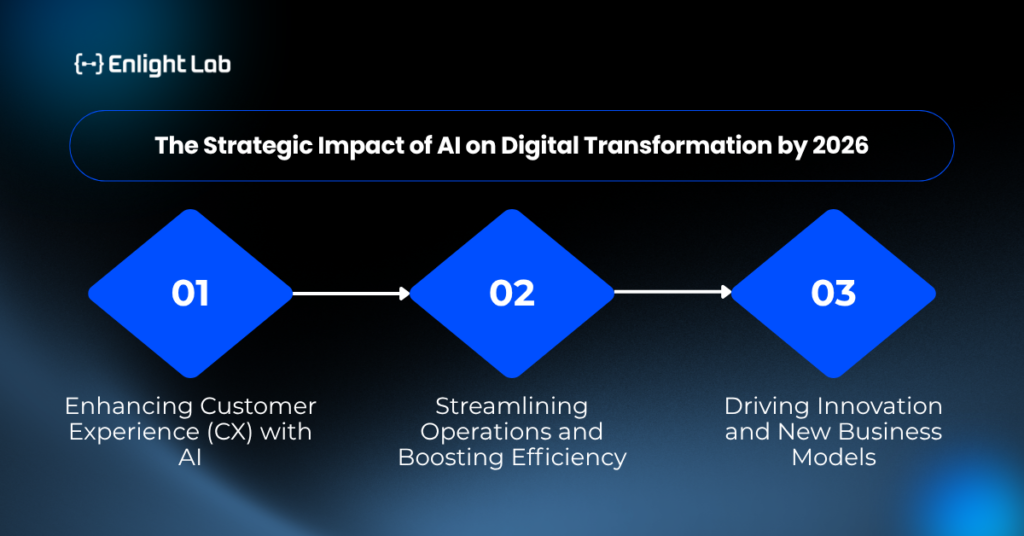
Enhancing Customer Experience (CX) with AI
Losing customers to poor service is a massive revenue risk. AI fixes the friction points in your customer journey.
- Personalized Interactions and Recommendations: Generic marketing turns buyers away. AI analyzes past behavior to offer exactly what the user wants, exactly when they want it.
- Intelligent Chatbots and Virtual Assistants: Wait times kill conversions. AI agents provide immediate, accurate support without human intervention.
- Predictive Customer Service: Instead of reacting to complaints, AI flags potential issues before the customer even notices them.
Streamlining Operations and Boosting Efficiency
Inefficient operations drain your cash reserves. AI targets the bloat.
- Supply Chain Optimization: Blind spots in your supply chain lead to stockouts. AI predicts disruptions and reroutes inventory automatically.
- Predictive Maintenance: Equipment failure halts production. AI models read sensor data to schedule repairs before machines break down.
- Automated Workflow Management: Reports that should take five minutes can end up taking three days to build. AI agents manage these workflows instantly.
Driving Innovation and New Business Models
- AI-Powered Product Development: Stop guessing what the market wants. Use AI to test variables and validate concepts faster.
- Data-Driven Decision Making: Relying on gut feeling is dangerous. AI provides concrete, data-backed realities.
- New Revenue Streams through AI Services: You can package and sell the AI capabilities you build internally as entirely new products.
Key Technologies Powering AI in Digital Transformation
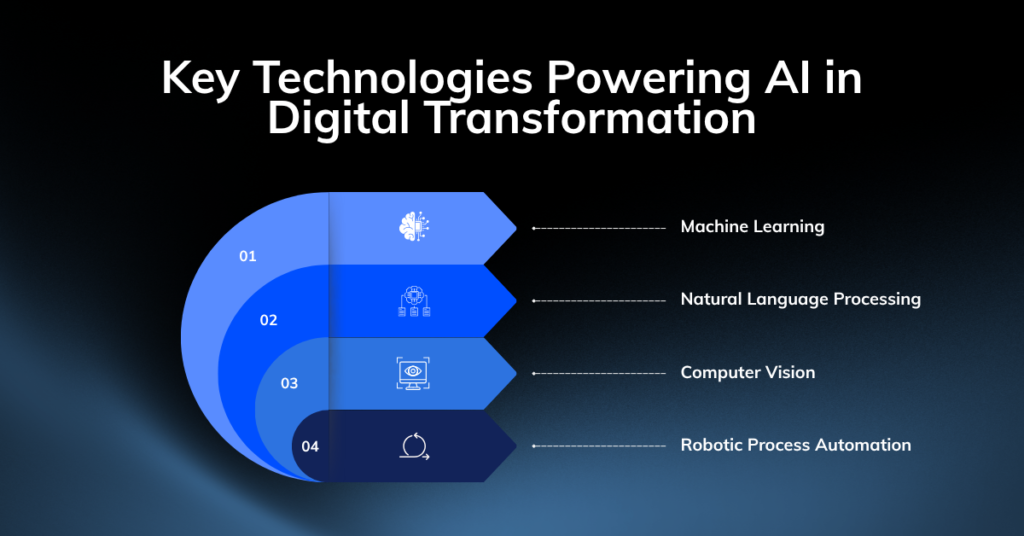
Choosing the wrong AI tool carries significant risk. Integrating the right technology stack is not about collecting tools; it is about building a specific capability to solve a specific business problem. You must understand which technologies apply to your most critical operational gaps.
Use Machine Learning to Stop Guessing
If you are not using machine learning to forecast demand, allocate resources, or predict customer churn, you are guessing. ML algorithms analyze your historical data to identify patterns and make predictions about future outcomes. This is not about building abstract models; it is about creating a direct line from past performance to future revenue. You use ML to replace high-stakes intuition with data-driven certainty.
Your core ML applications should include:
- Predictive Analytics: Forecast future sales, inventory needs, and market trends with a quantifiable degree of accuracy.
- Customer Segmentation: Group customers based on purchasing behavior to target marketing and product development efforts effectively.
- Fraud Detection: Identify anomalous transactions in real-time, protecting your revenue and customer trust.
Use Natural Language Processing to Act on Customer Feedback
Your customer feedback from support tickets, surveys, and social media is a mountain of unstructured data. Leaving it unanalyzed is a direct path to product irrelevance. NLP turns that raw, chaotic text into structured, actionable directives. It reads, interprets, and quantifies sentiment and intent at a scale no human team can match. This allows you to stop reacting to individual complaints and start addressing the root cause of customer dissatisfaction.
Your core NLP applications should include:
- Sentiment Analysis: Automatically gauge customer attitude from reviews and support chats to prioritize product fixes.
- Chatbots and Virtual Assistants: Resolve common customer queries instantly, freeing up your support team for high-value interactions.
- Information Extraction: Pull key details like names, dates, and product mentions from contracts or reports to accelerate document processing.
Use Computer Vision to Eliminate Human Error
In manufacturing, logistics, and quality assurance, human error is a direct drain on your profit margin. Computer vision automates visual inspection with superhuman accuracy and speed. These systems analyze images and video feeds to identify defects, track assets, and ensure compliance. This is essential for any operation where physical product quality or safety is non-negotiable.
Your core Computer Vision applications should include:
- Automated Quality Control: Instantly detect microscopic defects or assembly errors on a production line.
- Inventory Management: Monitor stock levels and track assets in a warehouse using camera feeds instead of manual counts.
- Security and Surveillance: Analyze video to identify security threats or monitor for workplace safety compliance automatically.
Use Robotic Process Automation for Low-Value Tasks
If your high-skilled employees are spending their days copying data between spreadsheets or manually processing invoices, you are burning capital. Robotic Process Automation (RPA) uses software “bots” to execute these repetitive, rule-based digital tasks. RPA is not AI, but it is a critical enabling technology. It frees your team from manual work so they can focus on complex problem-solving—the work that actually creates value.
Your core RPA applications should include:
- Data Entry and Migration: Move information between systems without manual keyboard entry.
- Report Generation: Automatically compile data from multiple sources into standardized reports.
- Invoice Processing: Extract data from invoices and enter it into your accounting system.
Top Industries Driving Digital Transformation with AI
Industry projections show the AI market in digital transformation will exceed $560 billion by 2026. Here is what this looks like on the ground.
AI in Finance
Outdated security is a massive regulatory risk. Financial institutions now use AI for:
- Real-time fraud detection: Identify and stop fraudulent transactions as they happen.
- Hyper-personalized products: Offer financial services and advice tailored to individual customer behavior.
- Smarter risk intelligence: Build predictive models that strengthen underwriting and credit decisions.
AI in Healthcare
Misdiagnoses cost lives and trigger lawsuits. AI enhances diagnostics and personalizes treatment, directly addressing these critical risks.
- Enhanced Diagnostics: AI algorithms process complex medical imagery such as MRIs, CT scans, and X-rays with a speed and accuracy that surpasses human capability.
- Personalized Treatment Plans: Instead of static care protocols, AI enables dynamic treatment strategies that adapt to individual patient data and responses in real time
AI in Retail
Overstocking burns cash. Stockouts destroy customer trust. Retail companies now use AI for:
- Smarter inventory management: AI-powered demand forecasting aligns your inventory with real-time market signals.
- Hyper-personalization: Deliver targeted offers to the right customers at the right time, increasing conversion and lifetime value.
Building Your AI-Powered Digital Transformation Roadmap
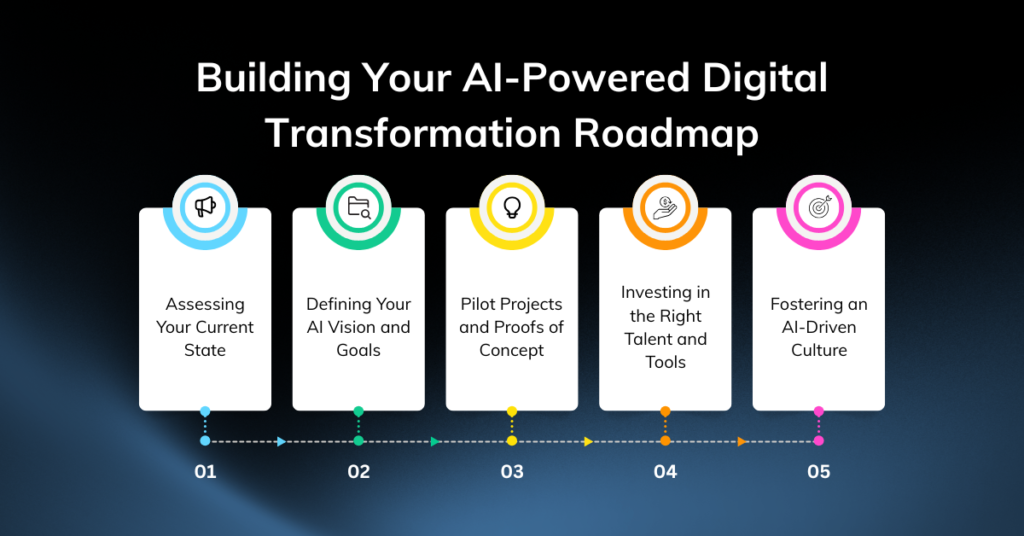
You need a structured plan to move from idea to product to scale.
Assessing Your Current State
Audit your existing infrastructure. Identify the manual processes that take the most time and cost the most money.
Defining Your AI Vision and Goals
Set concrete targets. Do not aim to “improve efficiency.” Aim to “reduce cloud infrastructure costs by 28% within six months.”
Pilot Projects and Proofs of Concept
Do not rebuild your entire company at once. Pick one painful workflow, build an MVP in eight weeks, and measure the results.
Investing in the Right Talent and Tools
Partner with proven tech consultants. At Enlight Lab, we provide CTO-as-a-Service and senior-only talent to guide your execution from end to end.
Fostering an AI-Driven Culture
If your team refuses to use the tools, the investment is useless. Train your staff and demonstrate exactly how AI makes their daily jobs easier.
Overcoming Challenges in Your AI Transformation Journey
Moving too quickly without proper architectural design always leads to crippling technical debt. You must navigate these roadblocks carefully.
Data Privacy and Security Concerns
Feeding sensitive customer data into public AI models always leads to data breaches. You must build secure, private environments for your data engineering.
Ethical Considerations in AI Development
Algorithmic bias will alienate your users and invite legal scrutiny. You need strict governance frameworks to ensure your AI acts fairly and transparently.
Skill Gaps and Talent Acquisition
Hiring full-time senior AI engineers is expensive and slow. Plugging in top-tier consultants on-demand gives your growing business the firepower it needs without the permanent overhead.
Integration with Existing Systems
Bolting AI onto outdated legacy systems causes system failures. You need resilient infrastructure and proper API management to ensure these tools communicate effectively.
The Importance of a Clear AI Strategy
Without a strategy, AI is just an expensive toy. Your AI initiatives must tie directly to specific, measurable business outcomes.
Preparing for AI in Digital Transformation: The Future is Now
The window to gain a competitive advantage is closing.
Continuous Learning and Adaptation
AI models degrade over time if left alone. You must continuously feed them new data and retrain them to reflect current market conditions.
The Human-AI Collaboration Imperative
AI does not replace your best people; it removes their busywork. When you pair senior talent with custom AI agents, productivity multiplies.
Measuring Success and Iterating
Real achievement is measurable results, not reports. Track your KPIs relentlessly. If a model is not saving you time or money, kill it and build a better one.
Embracing the AI-Powered Future of Your Business with Enlight Lab
The manual, fragmented way of doing business is dead. The cost of inaction is simply too high. You need to stop bleeding revenue through inefficient processes and start treating AI as the foundation of your digital infrastructure.
Ship faster. Scale smarter. Innovate confidently. By engaging with a strategic technology partner like Enlight Lab, you secure the architecture, the talent, and the execution frameworks required to deploy scalable AI solutions. The companies that survive 2026 will be the ones that take control of their data today.