
At some point, almost every startup reaches the same uncomfortable moment.
The product idea feels solid. Money is going into development. Maybe users are signing up. Investors start asking sharper questions. And suddenly, technology stops being just a backend task and becomes central to almost every decision you make.
That is when the question comes up:
“Do we need a CTO?” This is especially true when evaluating CTO-as-a-Service for startups as a flexible leadership solution.
For many founders, especially non‑technical ones, the default assumption is yes, and ideally a full‑time CTO. It feels like the mature move.
But here is the reality most founders only realize later.
Hiring a full‑time CTO too early can become one of the most expensive mistakes a startup makes. It can cost you six to twelve months of progress and drain half a million dollars from your runway. So, when you make the wrong leadership choice, what initially feels like progress can quietly turn into technical rigidity, slower execution, and dependency at a stage where flexibility matters most.
This is where a fractional CTO starts to make sense. It gives you access to senior technology leadership, including architecture decisions, technical direction, and team guidance, without the commitment of a full‑time executive.
With the right fractional CTO partner, you can move forward with confidence, make smarter technical decisions, and scale efficiently while staying flexible as your business evolves.
If you are building a startup and technology decisions are starting to feel heavier, development costs are rising without enough clarity, or you know you need experienced leadership but not a full‑time CTO just yet, you are in the right place.
In the sections ahead, we will explore when it truly makes sense to hire a fractional CTO, how this model compares to hiring a full‑time CTO, and how startups use fractional leadership to build technology that supports real business growth.
By the end of this post, you will have a clear framework for deciding your next technical hire.
Understanding the Core Concepts of Fractional CTO Model
A fractional CTO is an experienced technical executive who serves your company on a part-time, retainer, or contract basis. They provide high-level strategic direction without the financial burden of a full-time C-suite salary, benefits, and equity package.
These executives typically focus on the “big picture” rather than managing the day-to-day coding tasks. Their responsibilities include:
-
- Building and refining your long-term technology roadmap.
-
- Establishing coding standards and architectural patterns before your codebase becomes unmanageable.
-
- Translating complex technical requirements into actionable business strategies.
-
- Evaluating external vendors and managing high-level integrations.
-
- Sitting in on investor meetings to answer difficult technical due diligence questions.
How Does It Differ from a Traditional CTO?
A full-time CTO lives in your codebase and your company culture every single day. They manage engineering teams, run performance reviews, attend executive offsites, and handle the daily operational bottlenecks that arise when managing dozens of engineers.
A fractional CTO operates at a higher altitude. Because their time is limited, they focus purely on high-impact strategic decisions. They set the course, help you hire the right engineers, establish the testing patterns, and then step out of the way so your team can build. They give you executive-level judgment without executive-level overhead.
Fractional CTO Vs Full-Time CTO: A Practical Comparison
| Aspect | Fractional CTO | Full-Time CTO |
| Time Commitment | Part-time, flexible hours | Full-time, dedicated to the company |
| Cost | Lower overall cost, no long-term salary burden | Higher cost due to full-time salary and benefits |
| Focus Area | Strategic, high-impact decisions | Both strategic and operational responsibilities |
| Scope of Work | Short-term or project-based | Long-term, deeply integrated into company operations |
| Expertise Access | Access to experienced C-suite judgment | Can offer expertise but may take time to align with company trajectory |
| Flexibility | High flexibility; works on-demand | Limited flexibility due to full-time obligations |
| Hiring and Onboarding | Quicker to onboard, starts delivering results fast | Longer process to recruit, onboard, and integrate |
| Team Impact | Guides and empowers existing teams | Directly manages and engages with the teams daily |
Key Signs Your Business Is Ready for a Fractional CTO
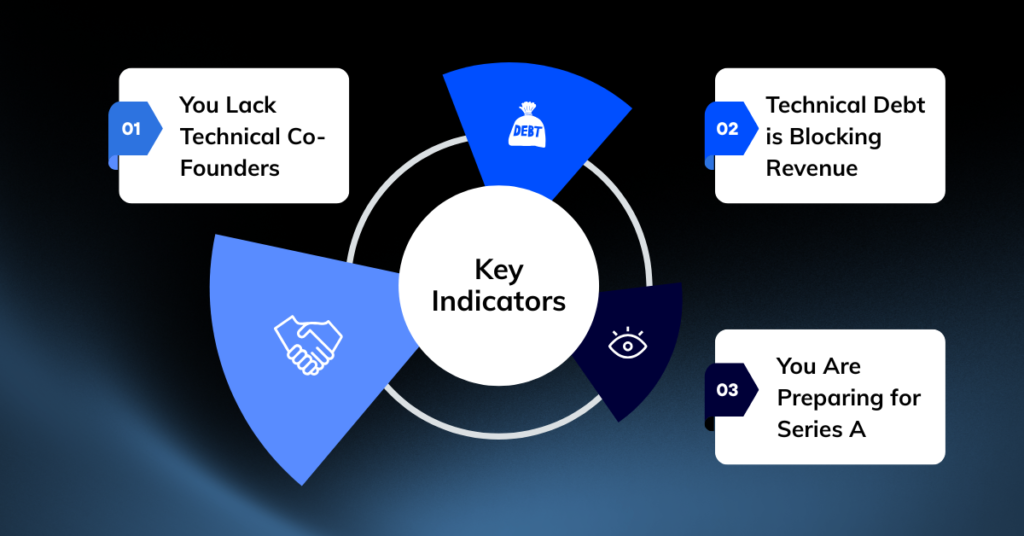
Founders often realize they need help when development slows down, but the root causes are usually present long before that happens. Here are the distinct signs that your business is ready for fractional technical leadership.
You Lack Technical Co-Founders
If you are a non-technical founder who has relied on outsourced agencies or junior developers to build your MVP, you are eventually going to hit a wall. Nobody on your team has made the architectural decisions required to scale from a thousand users to a million users. A fractional CTO can assess what you have built and map out a sustainable path forward.
Technical Debt is Blocking Revenue
Your engineers keep mentioning the need to “refactor” the codebase. As a founder, you might push back because refactoring does not immediately generate revenue. A fractional CTO steps in to quantify this technical debt. They can clearly explain that spending three weeks fixing a database issue now will prevent a total system crash during your busiest sales month.
You Are Preparing for Series A
Investors want to know that your technology can scale. They will look for hidden time bombs in your architecture. Having a fractional CTO provides credibility. They can present a coherent technical roadmap to venture capitalists, proving that your engineering team is building on a solid foundation.
The Product Works, but Feels Fragile
Your product is live. Users are using it. But behind the scenes, things feel unstable.
You might notice:
-
- Frequent bugs after releases
-
- Performance issues under small increases in load
-
- Fear of touching certain parts of the codebase
This is usually a result of early decisions made without long‑term context. A fractional CTO can assess what truly needs fixing now, what can wait, and how to stabilize the foundation without slowing the business.
Different Developers Keep Suggesting Different Directions
One developer suggests rewriting. Another wants new tools. Someone else says the current setup is “fine for now.”
When there is no single technical owner, direction becomes a debate rather than a decision. Founders end up mediating technical opinions they may not fully understand.
A fractional CTO acts as that decision‑maker, evaluating trade‑offs objectively and aligning technical choices with business goals.
Benefits of Hiring a Fractional CTO
Bringing in part-time technical leadership offers distinct advantages, especially for early-stage and mid-market companies navigating rapid growth.
Cost-Effectiveness
The financial difference is staggering. A full-time CTO in the U.S. typically costs between $250,000 and $500,000 per year, plus equity and benefits. A fractional CTO generally ranges from $80,000 to $150,000 annually. You gain access to the same tier of expertise for a fraction of the cost, preserving crucial capital for marketing, sales, or hiring additional developers.
Unmatched Expertise
Fractional CTOs have usually seen it all. They have worked across multiple industries, navigated various scaling crises, and managed diverse technology stacks. This breadth of experience allows them to recognize patterns and pitfalls that a first-time full-time CTO might miss.
Flexibility and Agility
Your needs will change rapidly as you grow. A fractional engagement can scale up during a major product launch or scale down during quieter development cycles. You are not locked into a static leadership structure.
Strategic Advantage
Companies utilizing fractional tech leadership often see improved financial performance. Strategic guidance ensures your technology investments directly align with your business goals, preventing expensive missteps like choosing the wrong cloud infrastructure or over-engineering a simple feature.
Scenarios Where a Fractional CTO Shines
Certain business environments are perfectly suited for the fractional model. Understanding these scenarios helps clarify if the model fits your current operational reality.
Startups Transitioning from MVP to V1
The code that proved your concept is rarely the code that will support your first ten thousand paying customers. When you are ready to transition from a messy MVP to a robust, scalable product, a fractional CTO sets the foundational standards testing patterns, API designs, and deployment pipelines.
Scale-ups Facing Vendor Lock-in
Growing companies often find themselves overly dependent on a specific third-party vendor or an outdated legacy system. A fractional tech leader can design a migration strategy that untangles your product from these dependencies without disrupting your current user experience.
Project-Specific Needs
Sometimes you only need high-level expertise for a specific initiative. Examples include:
-
- Navigating complex compliance requirements (e.g., SOC2, HIPAA, GDPR).
-
- Conducting technical due diligence prior to an acquisition.
-
- Restructuring a disorganized engineering department.
The Fractional CTO’s Role in Different Business Stages
The way a fractional CTO interacts with your company will evolve as you hit different growth milestones.
Seed Stage
At this stage, the focus is purely on survival and validation. The fractional CTO helps you select the right technology stack, vet your initial engineering hires (or agency partners), and ensures you are not making irreversible architectural mistakes.
Series A Readiness
Here, the focus shifts to credibility and scale. The fractional CTO audits the existing platform, formalizes the development lifecycle, and builds the technical pitch deck for your next round of funding. They act as the bridge between your engineering realities and investor expectations.
The Transition Phase (8-12 Engineers)
There is a natural breaking point for fractional leadership. Once your engineering team grows beyond eight to twelve people, the coordination overhead increases dramatically. At this scale, you typically have multiple teams that need daily management. A great fractional CTO will recognize this transition point and actually help you hire their full-time replacement.
How to Choose the Right Fractional CTO
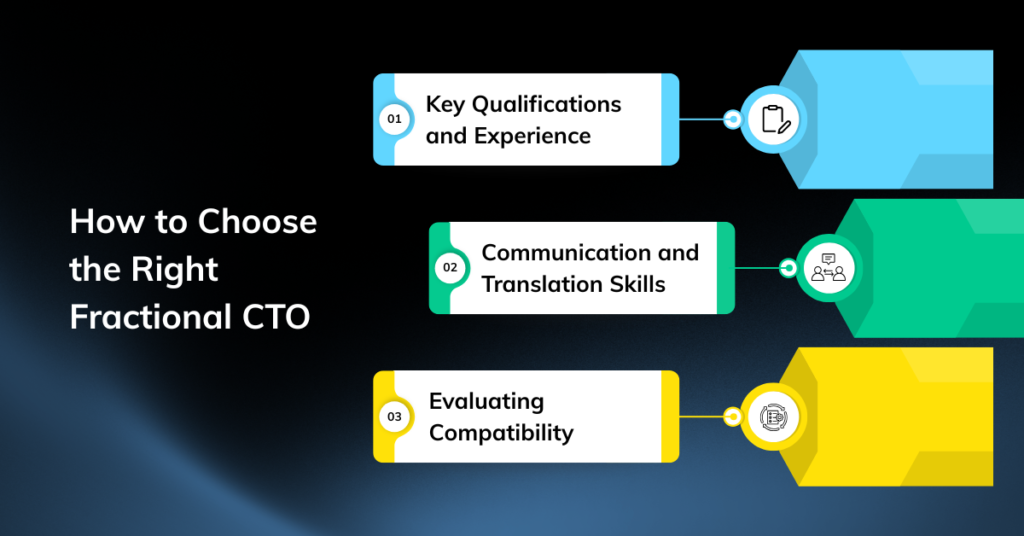
Finding the right person requires looking beyond a standard resume. You need a leader who aligns with your specific operational tempo.
Key Qualifications and Experience
Look for candidates who have successfully scaled companies at your specific stage. If you are a Seed-stage SaaS startup, a former Fortune 500 enterprise CIO might not understand your need for rapid, scrappy iteration. Conversely, if you are handling sensitive healthcare data, you need someone with deep compliance experience.
Communication and Translation Skills
The most critical skill a fractional CTO possesses is the ability to translate. They must be able to speak deeply technical jargon with your engineers, and then pivot to clear, ROI-focused business language with your executive team and investors.
Evaluating Compatibility
Ask potential candidates how they handle disagreements between the business side and the engineering side. Their answer will reveal their leadership style. You want someone who relies on data and strategic alignment, rather than ego, to resolve conflicts.
What a Fractional CTO Can Actually Do for Your Startup
One of the biggest misconceptions about a fractional CTO is that they are simply a senior developer who works fewer hours. In reality, the value of a fractional CTO has very little to do with writing code and everything to do with owning the technology direction of the startup.
Their role sits at the intersection of business, product, and engineering. The impact shows up in decisions that save time, reduce waste, and prevent problems long before they become expensive.
Here is what a fractional CTO actually does:
-
- Turning your business goals into a clear technology strategy
-
- Designing scalable, flexible, and cost-efficient architecture
-
- Hiring, guiding, and mentoring developers
-
- Managing code quality and technical debt before it becomes a problem
-
- Making the right call on tools, vendors, and agencies
-
- Acting as a bridge between founders, teams, and investors
Potential Challenges and How to Overcome Them
The fractional model is highly effective, but it is not without its hurdles. Being aware of these challenges allows you to mitigate them early.
Divided Attention
By definition, a fractional CTO is splitting their time between multiple clients. If you face a sudden, catastrophic server outage on a Tuesday, your fractional CTO might be in a board meeting with another company.
The Solution: Establish clear service-level agreements (SLAs) regarding emergency availability. Ensure your internal team has a designated incident commander who can handle immediate crises.
Scope Creep
Founders often try to use their fractional CTO for operational management—asking them to run daily stand-ups or conduct code reviews. This wastes their strategic value and quickly drains your retainer hours.
The Solution: Strictly separate strategic oversight from daily delivery. Use your fractional CTO for architecture and planning; use a lead engineer or engineering manager for daily execution.
The Continuity Gap
When a fractional engagement ends, valuable institutional knowledge can walk out the door.
The Solution: Mandate heavy documentation from day one. Your fractional CTO should be creating architectural decision records (ADRs) and comprehensive technical wikis so that their insights remain long after their contract concludes.
Why Partner with Enlight Lab for Your Fractional CTO Needs?
At Enlight Lab, we understand the unique technical and strategic hurdles that startups face. Our fractional CTOs have a proven track record of helping businesses like yours scale efficiently. We don’t just manage your tech; we bridge the gap between your engineering efforts and your business goals.
We build sustainable, scalable solutions and empower your team through robust documentation and clear communication. Our focus is on knowledge transfer, ensuring you retain all strategic insights long after our engagement ends. With Enlight Lab, you get the high-level expertise you need to grow, without the long-term commitment.
Is It Time to Hire a Fractional CTO?
Deciding when to hire a fractional CTO comes down to your startup’s growth stage and operational complexity. If you’re an early-stage or scaling startup, bringing in a fractional CTO is often the smartest financial and strategic move to build a robust, scalable foundation without draining your capital.
A great fractional CTO does more than write code or manage servers. They align your technology with your business vision, bring order to engineering chaos, and prepare your platform for exponential growth. When you’ve reached the point where technical leadership is essential, Enlight Lab’s CTO-as-a-Service provides the strategic oversight you need to ship with confidence.
By making an intentional leadership decision instead of defaulting to a massive full-time salary before you’re ready, you give your startup the strategic agility it needs to thrive.
Don’t wait. Take the first step toward scaling your startup with confidence. Your vision deserves the right leadership now. Contact us today to bring in Fractional CTO expertise and drive strategic growth across your organization.