Underestimating your web application development cost is a fast track to project failure.
You have a vision for a digital product. But moving forward without a precise financial roadmap always leads to crippling technical debt or half-finished projects that drain your resources. Budgeting for a web app in 2026 is no longer just about calculating developer hours. It requires navigating complex architectural decisions, integrating emerging AI tools, and protecting your system against evolving compliance risks.
This cost variability is further amplified by the fact that over 94% of enterprises now use cloud‑based environments, and nearly half of all business workloads run in the cloud.
Choosing the wrong technology stack or development partner carries significant risk. Opting for a cheap offshore agency without proper vetting can leave you bleeding revenue to fix broken code. Conversely, over-engineering a simple internal tool is a massive waste of money.
This guide breaks down exactly what you will pay to build a web application in 2026. You will learn where your budget goes, which hidden costs destroy timelines, and how to make strategic decisions that protect your investment.
How Much Does Web App Development Cost?
Web app development cost in 2026 typically ranges between $25,000 and $300,000+, depending on app complexity, features, development location, and technology stack. Simple web apps cost less, while enterprise‑grade or AI‑powered applications require higher investment.
The Core Components of Web App Development Costs
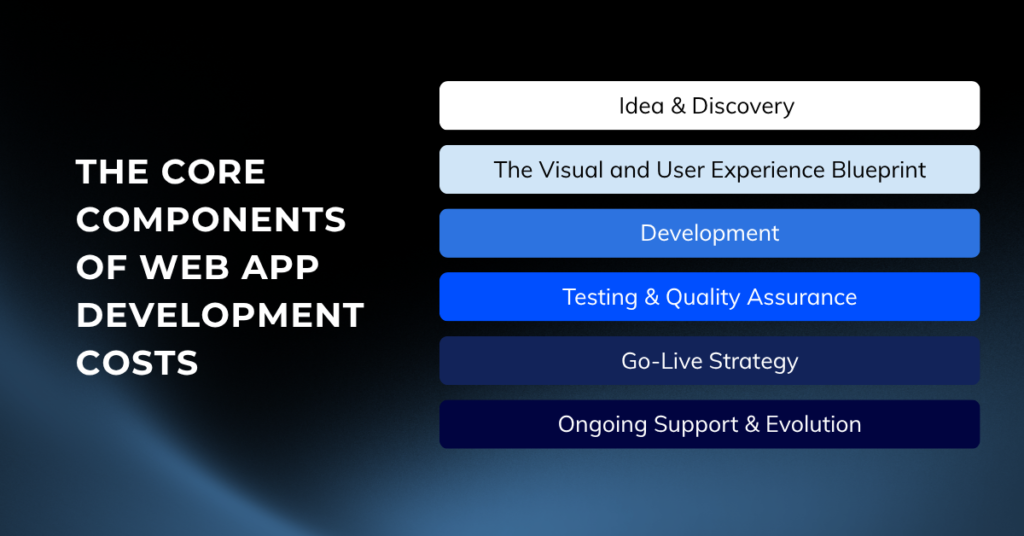
To understand the cost to build a web app, you must break the process down into its foundational phases. Skipping or rushing any of these steps inevitably inflates your budget later.
Idea & Discovery
If you start writing code before you define your business logic, you are actively losing money. The discovery phase aligns your business goals with technical realities.
- Business Analysis and Requirements Gathering: This stage defines what your app must achieve. Expect to spend 10% of your total budget here.
- User Story Mapping and Wireframing: You need clear blueprints. Mapping out the user journey prevents costly structural changes during the development phase.
The Visual and User Experience Blueprint
Ugly, confusing apps do not survive. But UI/UX design is about more than aesthetics; it dictates how easily your users can achieve their goals.
- UI/UX Design and Prototyping: Prototyping exposes usability flaws before they become expensive coding problems.
- Branding and Style Guides: Establishing visual rules ensures consistency across every screen and component.
Development
This is where the bulk of your web app development cost resides. Depending on complexity, development consumes 60% to 70% of your budget.
- Frontend Development: This is the user-facing magic. Developers build the interface your users interact with using frameworks like React or Vue.js.
- Backend Development: The engine room. Your backend handles server logic, authentication, and data processing. Complex business rules drastically increase backend costs.
- Database Design and Management: Structuring your data poorly guarantees slow performance and painful migrations later.
Testing & Quality Assurance
Launching a broken app destroys user trust instantly. Quality assurance is non-negotiable.
- Functional and Non-Functional Testing: QA engineers test every button, form, and data flow to ensure the app works under stress.
- User Acceptance Testing (UAT): Real users test the software against business requirements to confirm it solves the actual problem.
Go-Live Strategy
Moving your app from a testing environment to the public internet requires careful orchestration.
- Infrastructure Setup: Configuring cloud servers (like AWS or Azure) dictates your monthly hosting costs.
- Release Management: Proper CI/CD pipelines ensure that deploying updates does not break your live application.
Ongoing Support & Evolution
A web app is never truly finished. Ignoring post-launch maintenance is a massive security risk.
- Maintenance and Bug Fixing: Budget 15% to 20% of your initial development cost annually for basic upkeep.
- Feature Enhancements and Scalability: As your user base grows, you will need to fund new features and server upgrades.
Key Factors Influencing Web App Development Costs in 2026
No two web applications cost the same. Your final price tag depends heavily on a few critical variables.
Complexity of Features & Functionality
Every button and integration adds hours to your timeline.
- Basic vs. Advanced Features: A simple content portal might cost $15,000. Adding real-time video streaming, AI chatbots, or complex user hierarchies pushes the cost well over $100,000.
- Third-Party Integrations: Connecting your app to Stripe, Salesforce, or custom APIs requires deep architectural thinking. Broken integrations stifle your business operations.
Choosing the Right Tools & Tech Stack
The languages and databases you choose dictate both immediate costs and long-term scalability.
- Programming Languages and Frameworks: Specialized frameworks require specialized talent. You will pay a premium for developers fluent in cutting-edge tech.
- Databases and Cloud Platforms: Cloud costs spiral out of control if your architecture is inefficient.
Development Team Location & Structure
Where your team sits dictates their hourly rate.
- Onshore, Offshore, Nearshore: A senior developer in the US charges $80 to $135+ per hour. The same expertise in Eastern Europe or Latin America costs $40 to $60 per hour.
- Freelancers vs. Agencies: Freelancers are cheaper but require you to manage the project yourself. Partnering with a trusted software development firm like Enlight Lab gives you a complete team of designers, developers, and QA, reducing your management burden.
Project Management & Communication
Poor communication burns hours. Every minute spent clarifying requirements, chasing updates, or correcting misunderstandings is a minute not spent building your product. This is a direct drain on your budget.
- Agile vs. Waterfall Methodologies: Agile allows you to pivot when market demands change. Waterfall locks you into a rigid path.
- Transparency and Collaboration: Without daily updates and clear documentation, reports that should take five minutes can end up taking three days to decipher.
UI/UX Design Sophistication
Custom visuals take time. Building a unique and memorable user interface is an investment, not an expense.
- Custom Design vs. Templates: Templates save money upfront, but limit your brand identity. Custom animations and interactive elements require dedicated design hours.
Web App Types & Their Estimated Development Costs
Web application development costs in 2026 will vary significantly based on the type and complexity of the app. Understanding these categories will help businesses better estimate their budgetary requirements.
The following breakdown provides a realistic cost range for six common application types you will encounter in 2026.
| Web App Type | 2026 Estimated Cost Range | Key Drivers of Complexity |
| Basic Web Applications | $5,000 – $20,000 | Custom design, number of static pages |
| E-Commerce Applications | $20,000 – $70,000 | Payment gateways, inventory management |
| SaaS Applications | $50,000 – $200,000+ | Multi-tenancy, security, user management |
| Enterprise Web Applications | $100,000+ | CRM/ERP integrations, custom workflows |
| Progressive Web Apps (PWAs) | $10,000 – $50,000+ | Offline functionality, native-like features |
| Custom Web Applications | $200,000+ | AI/ML models, unique logic, from-scratch builds |
1. Basic Web Applications
These apps are typically used for simple functions such as informational websites or basic form submissions. Development costs can range from $5,000 to $20,000, depending on features and design customization.
2. E-Commerce Applications
Online stores or marketplaces are more complex, requiring integrations with payment gateways, inventory management systems, and user account functionalities. Development costs for e-commerce web apps are expected to range between $20,000 and $70,000 in 2026.
3. SaaS Applications
Software-as-a-Service platforms enable subscription-based services and require robust architecture with advanced security. SaaS development costs can range from $50,000 to $200,000 or more, depending on user scale and functionality.
4. Enterprise Web Applications
Tailored to meet specific business needs, these apps often include integrations with internal systems like CRMs or ERPs. Development costs for enterprise-level solutions may exceed $100,000, particularly if extensive customization is involved.
5. Progressive Web Applications (PWAs)
PWAs are designed to deliver an app-like experience through the web. Their development is often cost-effective, ranging from $10,000 to $50,000, but costs can climb based on offline functionality and advanced features.
6. Custom Web Applications
Highly specialized applications built from scratch to solve unique problems come with the highest cost due to development time and complexity. These apps can exceed $200,000, especially if AI or machine learning capabilities are included.
Budgeting for web app development necessitates thorough planning and alignment with long-term goals. Modern web applications demand a balance between cost-effectiveness and advanced functionality, making clear categorization a crucial step.
How to Estimate Your Web Application Development Budget
Guessing your budget leads to abandoned projects. You need a systematic approach to cost estimation.
Breaking Down the Estimation Process
- Top-Down vs. Bottom-Up Estimation: Top-down starts with a fixed budget and forces features to fit. Bottom-up calculates the exact hours needed for every single feature. Bottom-up is always more accurate.
- Analogy-Based Estimation: Comparing your project to similar existing apps gives you a rough baseline but ignores your unique business logic.
Tools and Resources for Cost Calculation
- Online Calculators and Consultations: Calculators offer a wide range, but they cannot replace a technical consultation.
- Getting Detailed Quotes: Demand line-item breakdowns from your development partners. Vague estimates hide vague execution.
Understanding Hidden Costs and Contingencies
- Unexpected Scope Changes: Feature creep kills budgets. Set aside a 20% contingency fund to handle inevitable changes in scope.
- Marketing and User Acquisition: Building the app is only half the battle. If you do not budget for marketing, you will launch into an empty room.
Hidden Costs in Web App Development Most Businesses Ignore
When estimating web app development cost, most businesses focus on the visible expenses – design, development, and deployment. However, what often throws budgets off track are the hidden costs that surface after the development phase begins.
Ignoring these costs doesn’t just impact your budget. It affects scalability, security, and long‑term ROI. Let’s unpack the most common yet overlooked web app development expenses in 2026.
Maintenance & Ongoing Support Costs
One of the biggest misconceptions is assuming that web app development ends at launch. In reality, launch is just the beginning.
After deployment, your web application requires:
- Bug fixes and performance tuning
- Framework, library, and dependency updates
- Browser and device compatibility updates
On average, annual maintenance costs range from 15% to 25% of the initial development cost.
Hosting, Cloud Infrastructure & Server Costs
Modern web applications rely heavily on cloud platforms like AWS, Azure, or Google Cloud. While these services offer scalability, their pricing models are usage‑based, which means costs grow as your app grows.
Hidden infrastructure costs may include:
- Increased server usage due to traffic spikes
- Database scaling and backups
- Content Delivery Networks (CDNs)
- Monitoring and logging tools
What starts as a modest $100–$200/month hosting bill can quickly turn into $1,000+ per month as user traffic and data volume increase.
Security, Compliance & Risk Management Costs
Many businesses underestimate the cost of keeping a web app secure and compliant.
Common hidden security costs include:
- SSL certificates and renewals
- Penetration testing and vulnerability audits
- Data encryption and secure authentication flows
- Compliance requirements (GDPR, HIPAA, SOC 2, etc.)
Failing to invest here can lead to legal penalties, reputational damage, and customer trust loss, which are far costlier than preventive security spending.
Scalability & Performance Optimization Costs
A web app that works perfectly for 1,000 users may struggle at 50,000. Scaling requires architectural planning and performance optimization.
Hidden scalability costs often show up as:
- Refactoring backend systems
- Database optimization
- Load balancing and caching improvements
- Microservices or modular restructuring
Third‑Party Tools, APIs & Licensing Fees
Modern web apps often rely on multiple third‑party services to function smoothly. While integrations speed up development, they add recurring and usage‑based costs.
Examples include:
- Payment gateways (transaction fees)
- Map services, email services, analytics tools
- AI/ML APIs with per‑request pricing
- CRM and marketing automation tools
These costs often aren’t visible in the initial development estimate, but they strongly impact monthly operating expenses.
Feature Creep & Change Requests
One of the most common budget killers is feature creep—adding “just one more feature” mid‑development.
Every additional feature impact:
- Development timelines
- QA and testing scope
- UI/UX complexity
- Long‑term maintenance needs
Without strict scope management, these seemingly small changes can quietly add 10–30% extra cost to your project.
Custom Web App vs Ready‑Made Solutions: Cost Comparison Table
When deciding between a custom web app and a ready-made solution, cost is often the deciding factor. The table below provides a direct comparison to help guide your decision-making process.
| Criteria | Custom Web Application Development | Ready‑Made / No‑Code / Low‑Code Solutions |
| Initial Development Cost | Higher upfront cost (typically $50,000 – $300,000+) | Lower upfront cost (around $5,000 – $30,000) |
| Ongoing Costs | Maintenance, hosting, and updates (flexible & predictable) | Monthly/yearly subscriptions, add‑ons, usage‑based fees |
| Customization Level | Fully customizable based on business needs | Limited to platform capabilities and templates |
| Scalability | Highly scalable, built for long‑term growth | Limited scalability; performance drops as usage grows |
| Ownership & Control | Full ownership of code, data, and IP | Platform‑dependent; vendor lock‑in |
| Time to Market | Longer development timeline | Faster launch with pre‑built components |
| Performance Optimization | High performance, tailored architecture | Shared infrastructure may limit speed and performance |
| Security & Compliance | Advanced security and compliance controls | Basic security; limited compliance flexibility |
| Best Use Case | SaaS platforms, enterprise apps, growth‑focused startups | MVPs, prototypes, internal tools, small projects |
| Long‑Term Cost Efficiency | More cost‑effective over time | Can become expensive as subscription and scaling costs grow |
Strategies to Reduce Your Web App Development Investment
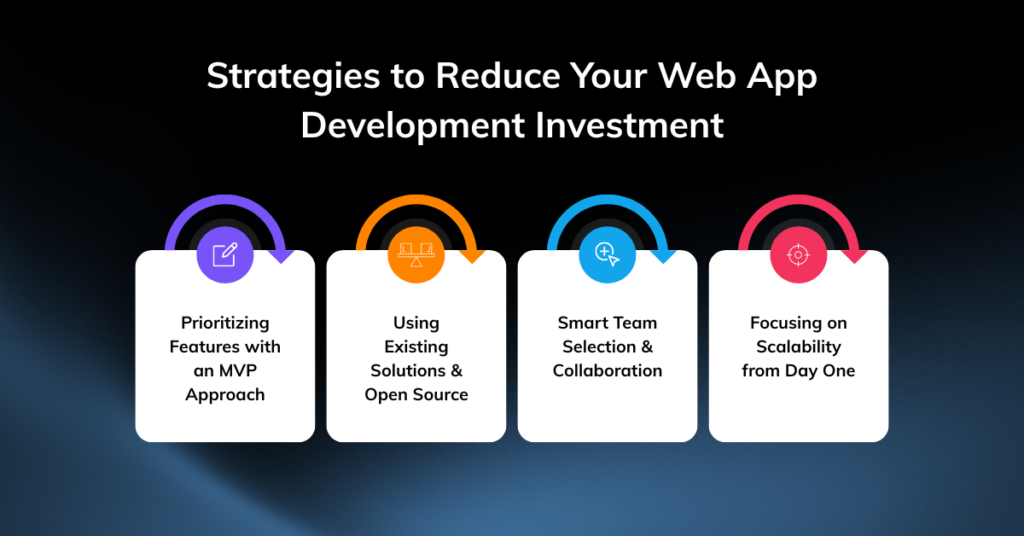
You want results fast. But cutting corners creates fragile software. Here is how to reduce costs without compromising quality.
Prioritizing Features with an MVP Approach
Stop trying to build everything at once.
- Launching Lean, Learning Fast: A Minimum Viable Product (MVP) includes only the core features necessary to solve your user’s primary problem.
- Iterative Development: Launch the MVP, gather real user feedback, and spend the rest of your budget building what users actually want.
Using Existing Solutions & Open Source
- APIs and Ready-Made Modules: Do not build a payment gateway from scratch. Integrate Stripe. Use Twilio for SMS.
- Open-Source Frameworks: Utilizing established open-source libraries speeds up development and reduces custom coding hours.
Smart Team Selection & Collaboration
- Hybrid Models for Cost-Effectiveness: Combine local product managers with offshore developers to balance communication quality with lower hourly rates.
- Clear Communication Channels: Use Jira, Slack, and daily standups to catch misunderstandings before they turn into written code.
Focusing on Scalability from Day One
- Future-Proofing Your Application: Building an app that cannot handle user growth forces you to rebuild the entire system a year later.
- Choosing Flexible Architectures: Microservices or well-structured monoliths allow you to scale specific parts of your application without overhauling the whole thing.
Calculate Your Web App’s Total Cost with Enlight Lab
The cost of a web application is a function of the choices you make. By understanding the trade-offs between low-code platforms, custom development, and emerging technologies like AR and Web3, you can align your budget directly with your strategic goals.
You know the risks of poor planning, the hidden fees of bad architecture, and the actual cost of building a digital product in 2026. The right choice depends entirely on the value you need to create.
Now is the time to execute. Don’t let analysis delay kill your momentum. Consult Enlight Lab to map out your architecture, define your MVP, and get a precise technical estimate. Stop guessing your budget. Start turning your complex technology decisions into clear, actionable plans and build future-ready web applications tailored to your business needs and budget.