
In today’s data-driven economy, data engineering plays a pivotal role in how modern businesses use data. Every dashboard, analytics model, AI initiative, or real-time insight ultimately depends on the strength of the data engineering foundation beneath it. And that foundation is only as good as the partner you choose to build it with.
You have mountains of data. But turning that raw, fragmented data into clean, accurate, and actionable insight requires far more than tools or infrastructure. It requires deep architectural thinking, disciplined execution, and a clear alignment with business outcomes. This is where the right data engineering partner gives your business a real competitive edge.
Choosing that partner can feel complex. You need a team you can trust with your most valuable asset. You need experts who understand your industry, can navigate security and compliance requirements, and build systems that scale reliably. That is why we put together this comprehensive guide.
In this post, we will walk you through exactly how to select the best data engineering partner for your business, covering everything from the technical capabilities you should demand to the glaring red flags you need to avoid. Let’s find you a team that actually helps you turn your data into a lasting competitive advantage.
Understand Your Business and Data Needs First
Before you start looking for a data engineering partner, it is important to understand your own business and data needs. Many companies make the mistake of choosing a partner based on tools, trends, or recommendations without first defining what success looks like for them. A strong internal understanding will help you choose a partner who solves the right problems, not just builds systems.
Define Your Business Goals
Start by clarifying what you want your data to achieve. Different goals require different data engineering approaches. For example, some businesses want faster and more accurate reporting. Others want to support machine learning, real‑time data processing, or better customer insights. Some need strong data governance to meet compliance requirements.
Ask yourself what outcomes matter most to your business. Are you trying to improve decision‑making, reduce operational risk, or create new data‑driven products? Clear goals make it easier to evaluate whether a data engineering partner has the right experience and approach.
Assess Your Current Data Maturity
Next, take an honest look at your current data environment. This helps you understand where you are starting from and what level of support you need. Consider the quality of your data, how well your pipelines work, and how easy it is for teams to access and trust information.
Some organizations are just beginning their data journey. Others may have existing systems that are slow, hard to maintain, or poorly documented. Knowing your current maturity level will help you choose a partner who can meet you where you are and guide you forward without over‑complicating the solution.
Identify Key Challenges and Constraints
Every business has limits, whether they involve budget, timelines, internal skills, or regulatory rules. Identifying these early helps avoid misalignment later. For example, you may need to work within a fixed budget or meet strict security standards. You may also need a partner who can train your internal team or work across time zones.
Sharing these constraints upfront allows potential partners to propose solutions that are realistic and sustainable.
Key Roles & Responsibilities of Data Engineering Consultants
Data engineering consultants play a critical role in helping businesses collect, organize, and use their data effectively. Their work lays the foundation for analytics, reporting, and advanced technologies like AI and machine learning.
Below are the key functions they typically perform.
Designing Data Architecture
Data engineering consultants design the overall structure of a company’s data systems. This includes deciding how data should be stored, accessed, and moved across platforms. A well‑designed architecture ensures that data is scalable, cost‑effective, and ready to support future business needs.
They choose the right mix of data warehouses, data lakes, or hybrid models based on company goals and data volume.
Building and Managing Data Pipelines
One of the most important functions of data engineering consultants is building reliable data pipelines. These pipelines collect data from multiple sources, clean it, transform it, and deliver it to analytics tools.
Consultants ensure that pipelines run smoothly, handle failures, and deliver data on time. This reliability helps teams trust the data they use every day.
Ensuring Data Quality and Consistency
Data is only useful when it is accurate and consistent. Data engineering consultants put checks and rules in place to improve data quality. This includes validating data, handling missing values, and standardizing formats across systems.
High data quality reduces errors in reports and improves confidence in decision‑making.
Implementing Data Governance and Security
Data engineering consultants help businesses protect sensitive data and meet compliance requirements. They design access controls, set data usage rules, and support privacy standards.
This function is especially important for industries that handle customer, financial, or health data.
Supporting Analytics and Data Teams
Consultants work closely with analysts, data scientists, and business teams. They make sure data is easy to access and ready for analysis. By removing technical barriers, data engineering consultants help teams focus on insights instead of data preparation.
Why You Need Data Engineering Consulting Services
You are likely sitting on a massive amount of data, yet struggling to turn those numbers into actual business value. As your information grows, your internal team might simply lack the bandwidth or specialized tools to keep up. This is exactly where data engineering consulting services step in. They take chaotic, unstructured information and transform it into a reliable engine for confident decision-making.
Here is exactly why bringing in an expert partner is often the smartest move you can make.
1. Your Data is Scattered Across Disconnected Systems
- You rely on multiple tools across teams—sales, marketing, and operations often work in separate systems.
- Your customer data is scattered across different platforms in inconsistent formats.
- You and your team spend excessive time just merging datasets for basic reporting needs.
- You end up making critical decisions without a complete view of the picture.
2. Inaccurate and Unreliable Records
- When your data quality drops, every insight you pull becomes a liability.
- You constantly deal with duplicate records, outdated details, and conflicting information that quietly disrupt your daily operations.
- You might find yourself calling inactive accounts, running marketing campaigns that miss the mark, or reviewing financial reports that simply don’t reflect what is really happening.
3. Drowning in Repetitive Manual Processes
- If you or your team spend your days manually cleaning up spreadsheets, you are actively losing money.
- Instead of uncovering valuable insights, you’re stuck doing repetitive data prep work.
- Reports that should take five minutes can end up taking three days to build.
- Your most important strategic questions go unanswered simply because you don’t have the bandwidth to focus on analysis.
4. Operating in the Past Without Real-Time Visibility
- In a fast-moving market, delayed information means you miss valuable opportunities.
- When you don’t have real-time visibility, you’re essentially driving blind.
- You can’t adapt your inventory planning quickly to sudden demand changes.
- Your customer support team lacks the up-to-date context needed to resolve urgent issues.
- You end up relying on financial forecasts built on data that no longer reflects reality.
5. Legacy Infrastructure Holding You Back
- Your older, legacy databases simply were not built to handle modern data demands.
- You struggle with scalability and run into constant issues integrating new, cloud-based tools.
- Your IT team spends all their energy just keeping outdated servers running.
- Because of this, your major initiatives get delayed and real innovation comes to a halt.
6. Looming Security and Compliance Risks
- When you don’t enforce strict data governance, you leave yourself open to costly financial and reputational damage.
- Sensitive customer information in your systems may lack proper encryption or even basic internal access controls.
- When you bring in a consulting partner, you can lock down these vulnerabilities, easily track data usage, and consistently meet complex regulatory requirements without unnecessary stress.
Core Capabilities to Look for in a Data Engineering Partner
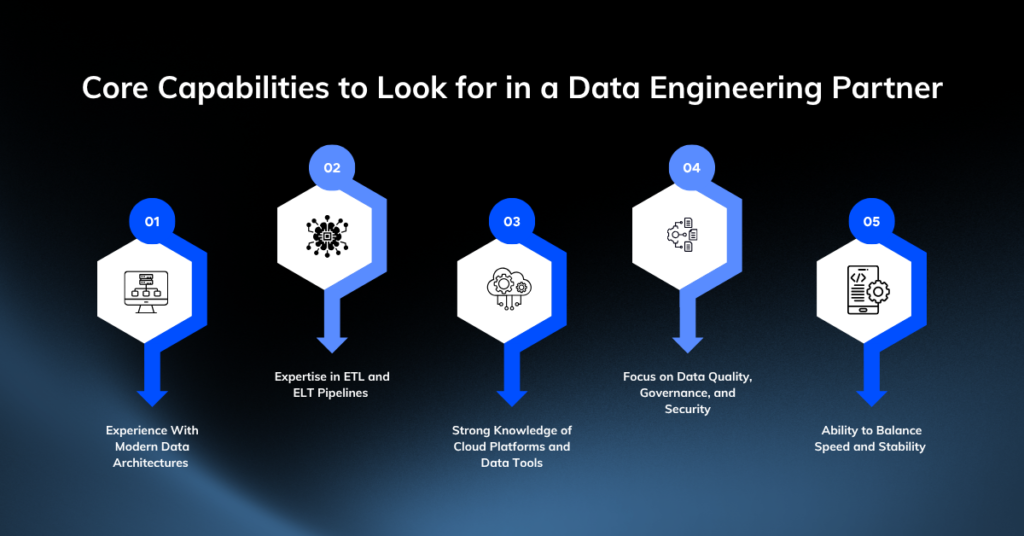
Once you understand your business goals and data needs, the next step is to evaluate a partner’s core data engineering capabilities. Not all providers offer the same depth of expertise, and choosing a partner with the right technical foundation is critical to building systems that are reliable, secure, and ready to scale.
Here is exactly what you should look for in their technical toolkit.
Experience With Modern Data Architectures
Your data does not live in a vacuum. A strong data engineering partner needs hands on experience designing and building modern data architectures. This means they should be highly fluent in data warehouses, data lakes, and hybrid lakehouse models.
The partner should be able to explain why a certain architecture fits your business, not just follow popular trends. Seek out teams focused on flexibility, cost savings, and scalable design, not one-size-fits-all solutions that may not serve you well down the road.
Expertise in ETL and ELT Pipelines
Data pipelines are the backbone of any modern data platform. Your partner should have strong experience building and managing ETL and ELT pipelines that ingest, clean, transform, and deliver data consistently.
Good data engineering partners focus on pipeline reliability, monitoring, and performance. They use proven orchestration tools and follow best practices to ensure data arrives on time and in the right format. This reduces errors, improves trust in data, and saves teams from manual fixes.
Strong Knowledge of Cloud Platforms and Data Tools
Today’s data platforms run mainly on the cloud. Your partner should have deep knowledge of major cloud providers such as AWS, Azure, or Google Cloud. They should also be experienced with modern tools like Snowflake, Databricks, BigQuery, and Redshift, depending on your needs.
More importantly, the partner should help you choose tools that fit your business goals, budget, and team skills. Tool expertise matters, but smart selection and integration matter even more.
Focus on Data Quality, Governance, and Security
Building pipelines is not enough if the data cannot be trusted. A capable data engineering partner puts strong emphasis on data quality, governance, and security from the start.
This includes data validation, clear data definitions, access controls, and compliance with industry regulations. A good partner designs systems that protect sensitive data and make sure the right people have the right level of access. This foundation is essential for confident decision‑making and long‑term success.
Ability to Balance Speed and Stability
When you invest in a new data initiative, you naturally want to see results fast. But moving too quickly without proper architectural design always leads to crippling technical debt down the road. The right partner knows exactly how to deliver tangible business value early while still building a highly stable and maintainable system.
They use proven frameworks, documentation, and testing practices to ensure that quick wins do not turn into future problems. It’s the mark of a mature, experienced team that puts your business’s needs first.
Choosing a data engineering partner with these core capabilities gives your business a strong technical base. It ensures your data platform can support analytics, innovation, and growth without constant rework or risk.
Steps to Evaluate Potential Data Engineering Partners
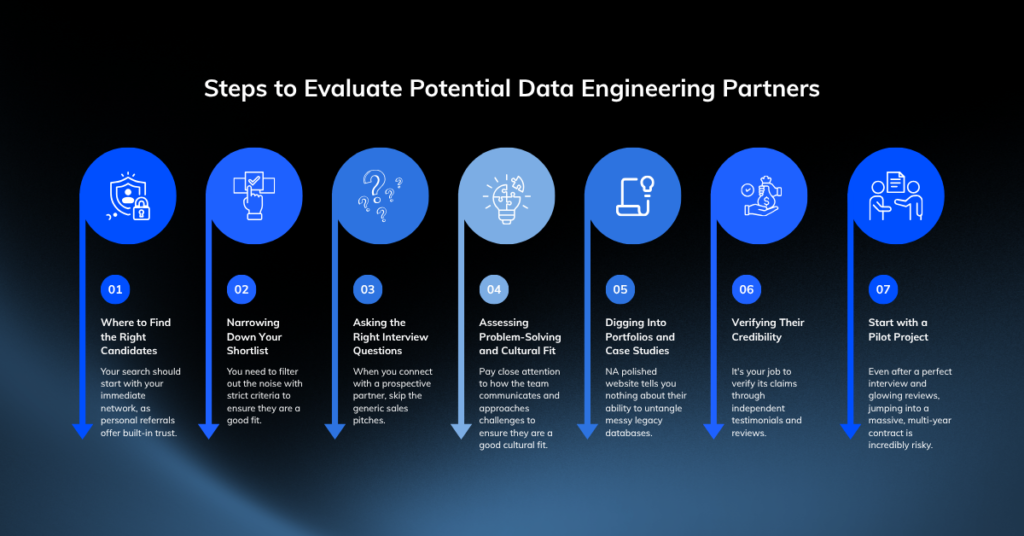
You know exactly what a data engineering partner does and why you need one. You even know the key traits to look for. Now comes the hard part: actually finding and thoroughly vetting the right team. Handing over your data infrastructure is a massive commitment, and you cannot afford to guess. Here is a clear, step-by-step roadmap to evaluate potential partners and ensure you make a choice that protects your business.
Where to Find the Right Candidates
Your search should start with your immediate network, as personal referrals offer built-in trust. If that comes up empty, look for specialized firms online.
- Ask your network: Reach out to other business leaders or technical founders for recommendations. Personal referrals provide real-world context on a partner’s performance.
- Use LinkedIn: Search for data engineering firms that publish insightful content about data architecture or cloud migrations, as this demonstrates expertise.
- Check online tech directories: Leverage B2B service directories that curate and rank providers based on specific technical capabilities.
Narrowing Down Your Shortlist
Once you have a list of potential candidates, you need to filter out the noise with strict criteria to ensure they are a good fit.
- Match your tech stack: If your company runs on AWS, don’t consider a firm that only specializes in Google Cloud.
- Filter by industry experience: A partner who already understands your industry’s unique regulatory requirements can save you significant time and prevent compliance issues.
- Consider company size and working style: Look for a team that is large enough to offer reliable support but nimble enough to give your project dedicated attention.
Asking the Right Interview Questions
When you connect with a prospective partner, skip the generic sales pitches. Ask pointed questions to test their real-world capabilities and problem-solving skills.
- Inquire about past failures: Ask them to describe a major data migration that went wrong and explain how they fixed it.
- Test their scalability knowledge: Find out how they handle sudden spikes in data volume and what their process is for managing unexpected loads.
- Evaluate their data governance strategies: Ask how they ensure data quality before it reaches a business intelligence dashboard to separate the true experts from amateurs.
Assessing Problem-Solving and Cultural Fit
Technical skills are only half the equation. Pay close attention to how the team communicates and approaches challenges to ensure they are a good cultural fit.
- Analyze their problem-solving approach: Do they push a specific tool, or do they ask deep, probing questions to understand your business goals? A great partner solves business problems, not just writes code.
- Assess their communication style: You’ll be communicating constantly, so look for transparency. A partner who is willing to push back on a bad idea and suggest a better route is a massive green light.
- Look for a strategic advisor: You want a partner who acts as a strategic advisor who will guide your decisions, not just an order-taker who follows instructions.
Digging Into Portfolios and Case Studies
Never hire a data engineering firm without extensively reviewing their past work. A polished website tells you nothing about their ability to untangle messy legacy databases.
- Request relevant case studies: Ask for detailed portfolios and case studies that mirror your project’s specific challenges and goals.
- Look for measurable results: Ignore marketing fluff and focus on concrete metrics. Did they reduce query load times by a specific percentage or save a client money on server costs?
- Identify innovative solutions: Note if they introduced a new automation method or a creative solution that the client hadn’t considered, as this indicates proactive problem-solving.
Verifying Their Credibility
A company will always present itself in the best possible light. It’s your job to verify its claims through independent testimonials and reviews.
- Check unbiased B2B review platforms: Use sites like Clutch or G2, which conduct verified, independent interviews with past clients for an unfiltered perspective.
- Analyze how they handle challenges: Pay attention to reviews that mention how the agency handled missed deadlines or scope changes.
- Request client references: Ask the agency for a past client reference you can contact directly to hear about their experience firsthand.
Start with a Pilot Project
Even after a perfect interview and glowing reviews, jumping into a massive, multi-year contract is incredibly risky. The best way to evaluate a data engineering partner is to watch them work.
- Propose a small, well-defined project: Ask them to build a single data pipeline or migrate a non-critical database as a low-risk test.
- Observe their process: A pilot project reveals everything you need to know about their communication, code quality, and ability to meet deadlines.
- Scale with confidence: If the pilot project goes smoothly, you can confidently scale up the partnership, knowing your data is in capable hands.
Why Enlight Lab Is the Right Data Engineering Consulting Partner
- Business‑first data engineering approach focused on measurable outcomes, not just tooling
- Proven expertise in designing scalable, cloud‑native data platforms tailored to real business needs
- Strong capabilities across modern data stacks including data lakes, warehouses, real‑time pipelines, and analytics enablement
- Emphasis on data quality, governance, and security from day one
- Collaborative engagement model that works as an extension of your internal team, not a vendor
- Track record of helping organizations turn raw data into reliable, decision‑ready intelligence
With a blend of deep technical expertise and strategic consulting, Enlight Lab partners with businesses to build data foundations that support growth, innovation, and long‑term resilience.
Finding Data Engineering Services That Actually Make an Impact
The right data engineering partner can transform how your business uses data. With a trusted team by your side, data becomes a powerful asset that fuels growth and informed decision-making.
Before you make a final decision, review your goals, challenges, and expectations one last time. Use a simple checklist. Does the partner understand your business? Can they explain their approach clearly? Are they transparent about cost, scope, and risks? Do they see this as a long‑term partnership instead of a short project?
At Enlight Lab, we help businesses turn data into a strategic advantage. If you’re ready to build a scalable, future-ready data foundation, get in touch with us today.
Frequently Asked Questions
What does a data engineering partner do?
A data engineering partner designs, builds, and manages data systems that collect, process, and store data efficiently. They create data pipelines, ensure data quality, and enable analytics, reporting, and AI use cases.
How do I choose the best data engineering company?
Choose a data engineering company by evaluating their technical expertise, industry experience, scalability approach, and communication practices. Look for proven case studies, transparent pricing, and the ability to align solutions with your business goals.
What are the benefits of outsourcing data engineering?
Outsourcing data engineering gives you access to specialized expertise, reduces hiring costs, speeds up implementation, and allows your internal team to focus on core business activities while experts handle complex data infrastructure.
When should a business hire a data engineering partner?
A business should hire a data engineering partner when data systems become complex, internal teams lack expertise, or when scaling data operations, improving data quality, or enabling real-time analytics becomes a priority.