The pressure to integrate artificial intelligence into your operations is intense. Leaders across every industry know that AI is no longer a futuristic experiment. It is a fundamental driver of growth, efficiency, and market survival. The question keeping founders and CTOs awake at night is rarely about whether to adopt AI, but rather how to implement it correctly without burning through capital.
When you decide to bring AI into your organization, you face a critical fork in the road. You can subscribe to Software-as-a-Service (SaaS) AI tools, or you can invest in custom AI development.
SaaS AI tools are pre-built, ready-to-use platforms that offer instant capabilities for a monthly fee. Custom AI, on the other hand, involves building proprietary systems tailored specifically to your internal workflows, data pipelines, and business objectives.
Choosing the wrong path carries significant risk. Opting for a simple subscription when you need complex automation can lead to fragmented workflows and compromised data. Conversely, over-engineering a custom solution for a problem that a $50-per-month tool could solve is a fast track to wasted resources.
This guide breaks down the true costs, limitations, and strategic advantages of both approaches, helping you make a confident, financially sound decision for your tech stack.
SaaS AI Tools: What You Need to Know
SaaS AI solutions are cloud-based platforms that provide immediate access to artificial intelligence capabilities. You do not need to manage the underlying infrastructure, train the foundation models, or hire a team of machine learning engineers to use them. You simply pay a subscription fee, configure a few settings, and deploy the tool across your team.
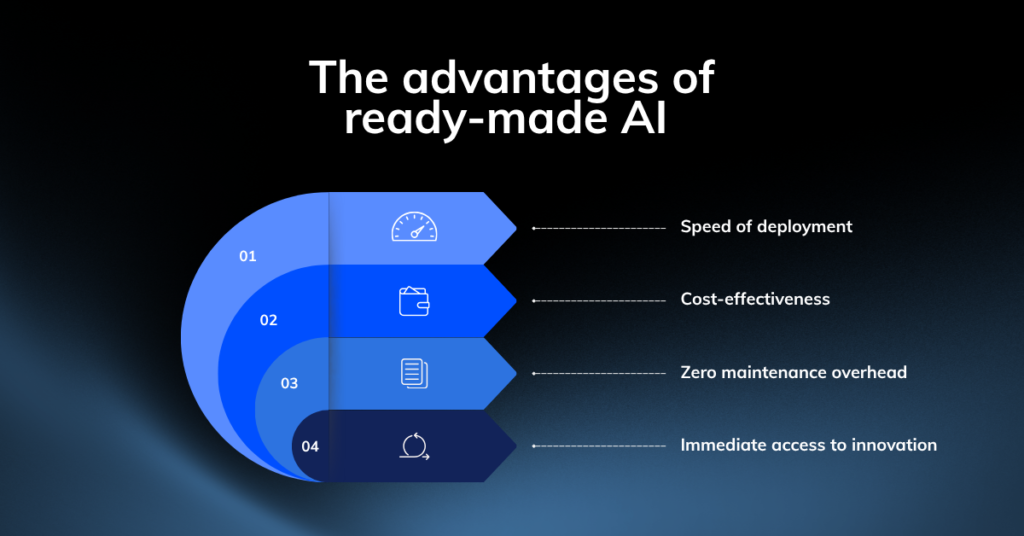
The advantages of ready-made AI
For many organizations, SaaS AI is the perfect entry point into automation. The benefits are clear and immediate:
- Speed of deployment: You can implement these tools in a matter of days or even hours. There are no lengthy development cycles or complex architectural decisions to navigate.
- Cost-effectiveness: The subscription model requires minimal upfront investment. You avoid the high capital expenditure associated with building software from scratch.
- Zero maintenance overhead: The vendor handles all bug fixes, server scaling, and model updates. Your internal IT team does not need to worry about server downtime or algorithm degradation.
- Immediate access to innovation: As the vendor improves their core model, you automatically receive the latest features without writing a single line of code.
Common examples of SaaS AI tools include ChatGPT for text generation, Midjourney for image creation, Grammarly for writing enhancement, and Salesforce Einstein for predictive CRM analytics. These platforms excel at solving generalized, well-documented business problems.
The hidden costs and limitations
While the low barrier to entry is attractive, SaaS AI tools come with strict boundaries that can stifle growing businesses.
- Lack of customization: SaaS platforms are built to serve the broadest possible audience. If your company relies on highly specific, non-standard workflows, a generic tool will eventually become a bottleneck. You will find yourself changing your internal processes to fit the software, rather than the software adapting to you.
- Vendor lock-in and data privacy: When you use a third-party AI platform, your data is processed outside of your controlled environment. This poses significant compliance risks for companies handling sensitive financial or healthcare data. Furthermore, migrating away from a deeply embedded SaaS tool can be incredibly disruptive.
- Feature bloat: Vendors frequently add new features to justify price increases, resulting in bloated software where you end up paying for tools your team never uses.
- Dependency on external roadmaps: You have zero control over the product’s future. If the vendor decides to sunset a feature you rely on, you have no recourse.
Custom AI Development: Key Insights and Considerations
Custom AI development is the process of architecting and deploying artificial intelligence systems specifically for your organization. This approach leverages your proprietary data to automate your unique workflows, often resulting in autonomous agents or tailored machine learning models that integrate flawlessly with your existing infrastructure. Before making a decision, it’s important to understand when to consider custom AI Development.
Why build your own AI?
Building your own AI is a strategic play for long-term market dominance. It transforms technology from a monthly expense into a proprietary asset.
- Tailored to specific business needs: A custom AI agent can navigate your legacy databases, understand your company’s specific jargon, and execute multi-step workflows exactly as you design them.
- Full ownership and IP control: You own the algorithms, the data pipelines, and the resulting intellectual property. Your internal data never leaves your secure environment to train a public model.
- A distinct competitive advantage: Anyone can buy a SaaS subscription. When you build a custom AI solution, you create a capability that your competitors cannot easily replicate.
- Seamless integration: Custom builds are engineered to communicate flawlessly with your existing CRM, ERP, and internal dashboards without relying on brittle, third-party middleware.
- Enhanced security: For industries governed by HIPAA, GDPR, or SOC 2 regulations, custom AI allows you to build mandatory compliance guardrails, cryptographic audit logs, and rigorous access controls directly into the foundation of the software.
The challenges of custom development
The rewards of custom AI are massive, but the barriers to entry are significantly higher than signing up for a SaaS product.
- High upfront costs: Developing a robust AI agent requires serious capital. Moving from a Proof of Concept (PoC) to an enterprise-grade production environment can cost anywhere from $80,000 to over $250,000, depending on the complexity of the orchestration layer and data pipelines.
- The need for specialized talent: Building autonomous systems requires senior machine learning engineers, DevOps architects, and data scientists. Hiring this talent in-house is exceptionally difficult and expensive. This is why many organizations turn to fractional CTO services and specialized tech consultancies, like Enlight Lab, to guide the architecture and execution.
- Ongoing operational overhead: AI models are not static. You must budget for continuous monitoring, cloud infrastructure costs, vector database maintenance, and model retraining to prevent accuracy degradation over time.
- Risk of scope creep: Without strict technical leadership, custom projects can easily spiral out of control, leading to endless development cycles and bloated budgets.
Key Factors to Consider When Choosing
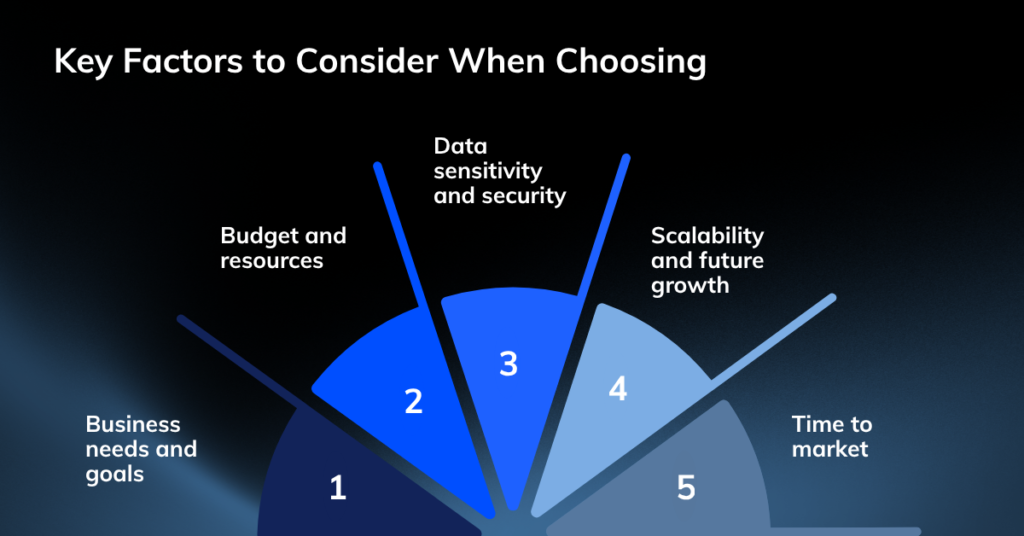
Selecting the right path requires a brutally honest assessment of your current operations and future goals. Base your decision on these five critical pillars.
Business needs and goals
Identify the exact problem you need to solve. If you want to draft marketing emails faster or summarize meeting notes, a SaaS tool is more than capable. However, if you need an AI agent to securely audit complex financial contracts against your proprietary company policies and automatically update your ERP, you require a custom-built solution. Evaluate the level of autonomy and customization the workflow demands.
Budget and resources
Analyze your capital allocation. SaaS tools offer predictable monthly operational expenses (OpEx). Custom development requires a substantial initial capital expenditure (CapEx) followed by ongoing maintenance budgets. You must also evaluate your internal technical talent. If you do not have senior AI architects on staff, you will need to partner with an external consulting firm to prevent costly architectural mistakes.
Data sensitivity and security
Data governance is often the ultimate deciding factor. If your AI initiative touches personally identifiable information (PII), patient health records, or highly confidential trade secrets, transmitting that data to a public SaaS vendor is a massive regulatory risk. Custom AI allows you to self-host models and retain absolute control over where and how your data is processed.
Scalability and future growth
Think about where your company will be in three years. SaaS tools scale easily in terms of user seats, but they often fail when you try to scale the complexity of the workflows. A custom AI system is designed to evolve alongside your business. You can add new agentic capabilities, integrate emerging foundation models, and expand the system’s memory without hitting a vendor’s arbitrary feature ceiling.
Time to market
Consider how quickly you need the solution operational. If an inefficient process is currently bleeding revenue and you need a stopgap immediately, deploy a SaaS tool. If you are building a core product feature that will define your company’s value proposition for the next decade, the months required to properly architect and build a custom AI solution are worth the wait.
When to Choose Which
Applying these frameworks to real-world scenarios clarifies the decision-making process.
When SaaS AI is the right choice
SaaS tools are the undisputed champions of generalized efficiency. They are the best choice for:
- Standardized tasks: Managing basic customer support inquiries, grammar checking, translating documents, or generating foundational code snippets.
- Resource-constrained teams: Small to medium-sized businesses that cannot justify a six-figure custom software investment.
- Rapid prototyping: When you need to validate an idea quickly, using a SaaS AI tool to build a minimum viable product (MVP) is highly effective.
- Non-core business functions: If a process does not define your competitive edge, offload it to a generic tool.
When custom AI is justified
Custom development becomes a necessity when off-the-shelf software turns into a liability. Invest in custom AI for:
- Core business functions: Automating the specific services or products that generate your primary revenue.
- Complex, multi-step workflows: Deploying AI agents that must reason, plan, and execute tasks across several disconnected legacy systems simultaneously.
- Deep data ecosystems: Large enterprises sitting on decades of unstructured data that needs to be cleaned, chunked into vector databases, and securely queried.
- Highly regulated environments: Healthcare providers, fintech platforms, and government contractors who mandate absolute data sovereignty and transparent audit trails.
Custom AI vs SaaS AI Tools: A Practical Comparison
| Feature | Custom AI Solutions | Off-the-Shelf AI Solutions |
| Deployment Time | Longer development phase | Rapid implementation |
| Cost | Higher upfront investment | Lower initial cost |
| Customization | Fully tailored to needs | Limited customization |
| Scalability | Built to scale as required | Generally scalable |
| Updates & Support | Dependent on in-house teams | Vendor-supported updates |
| Flexibility | Highly adaptable | Less adaptable |
| Suits Specialized Needs | Excellent for niche domains | May not cater to specific needs |
The Hybrid Approach: Combining SaaS AI and Custom AI
The hybrid approach offers the best of both worlds.
SaaS AI delivers speed. Custom AI delivers control. Together, they allow businesses to innovate without compromise.
In a hybrid setup, SaaS AI tools handle non-core tasks, while Custom AI solutions are used for business-critical workflows. Instead of forcing one solution to do everything, each is applied where it performs best. This keeps costs under control while still creating real competitive value.
When a Hybrid Approach Works Best
A hybrid AI strategy is ideal when:
- You want quick wins without locking into long‑term limits
- Your business is scaling and needs flexibility
- Some workflows are standard while others are unique
- You want to test AI value before expanding deeper
Many growing companies start here and evolve toward more custom AI over time.
To succeed with a hybrid model, you need:
- Clean data pipelines shared across tools
- Secure integration between SaaS platforms and custom systems
- Clear ownership of data and AI outputs
- A roadmap that supports future growth
Without proper planning, hybrid systems can become fragmented. With the right strategy, they become powerful and scalable.
Unlock Your AI Potential with Enlight Lab
Choosing the right AI strategy is crucial, but you don’t have to do it alone. At Enlight Lab, we specialize in helping businesses navigate the complexities of AI adoption. Whether you need a turnkey SaaS solution for immediate impact or a bespoke, custom-built AI to tackle your unique challenges, our team of experts is here to guide you.
How We Can Help As Your AI Partner
Enlight Lab, an experienced AI consulting firm, guides you in:
- Defining Your Strategy: Deciding whether a turnkey SaaS solution or a bespoke, custom-built AI is the right fit for your unique challenges and long-term vision.
- Building the Right Framework: Assisting in the development of a secure and effective AI structure, from leveraging enterprise-grade models to creating custom middleware that keeps your data safe.
- Transforming Vision into Reality: Turning your AI aspirations into a tangible competitive advantage by providing the expertise needed to implement and scale your chosen solution.
By collaborating with our expert team, you can ensure your AI vision becomes a reality, giving you a distinct edge in the market.
Custom AI Development vs SaaS AI Tools: Making an Informed Decision
Artificial intelligence is rapidly shifting from a competitive advantage to a baseline operational requirement. The choice between a custom build and a SaaS subscription will fundamentally shape your company’s technical debt, security posture, and agility for years to come.
SaaS AI tools offer an incredible shortcut to immediate productivity. It is cost-effective, fast, and constantly updating. Yet, it forces you to play by someone else’s rules.
Custom AI development is a heavier lift, requiring strategic foresight, serious investment, and expert execution. But when built correctly, it transforms your data into a proprietary digital workforce that scales infinitely and secures your position in the market.
There is no wrong option. There is only the option that fits your goals. By aligning your AI strategy with your true business objectives, you can cut through the hype and deploy technology that delivers measurable, lasting impact.
Choosing the wrong path can be costly. Connect with the right AI Consulting Services expert to find the best approach for your business.