Building an MVP (Minimum Viable Product) is one of the biggest challenges for modern startups. Investors expect speed, markets demand rapid validation, and users are more impatient than ever. In this race to launch, many teams make a critical trade-off by prioritizing speed over long-term scalability.
The result is early traction followed by problems. Products may gain initial users but later struggle due to technical debt, performance issues, or costly rewrites. You might end up spending too much time and money over-engineering a product that no one wants, or worse, one that breaks down as soon as the first wave of users arrives.
So, the real question is: can you build an MVP quickly without hurting scalability?
Yes, but only if the MVP is designed with a scalable foundation from day one. By focusing on a strong core architecture, modular components, and intentional scope, teams can accelerate MVP development while preserving the flexibility to scale without expensive rework later.
In this comprehensive guide, we’ll explore the practical strategies to speed up your MVP development without sacrificing scalability. You’ll learn proven methodologies, smart technology choices, and real-world use cases to help you make the best technical decisions for your startup.
What Is the Primary Purpose of an MVP?
The primary purpose of an MVP is learning. It is designed to be a scientific tool to test a business hypothesis. Specifically, an MVP helps you:
- Validate your core idea with real users, not just friends and family.
- Test market demand to see if people are willing to use, and eventually pay for, your solution.
- Gather actionable feedback on which features are most important.
- Minimize wasted resources by avoiding building features nobody wants.
- Attract early adopters who can become your first brand advocates.
Common MVP Development Myths You Should Stop Believing
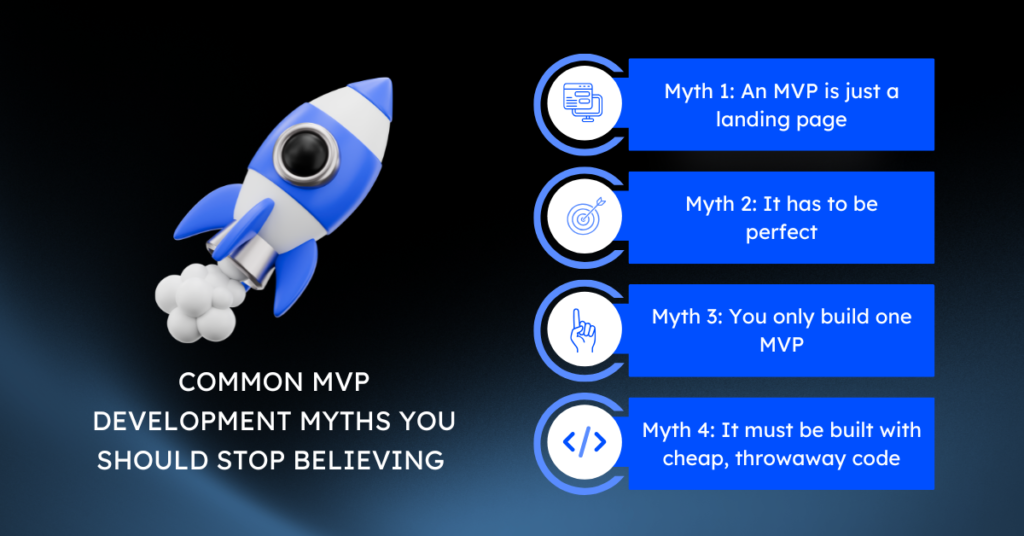
To build an effective MVP, you must first clear your mind of common myths that can derail your project.
Myth 1: An MVP is just a landing page
A landing page can be part of an MVP strategy to gauge interest (a “smoke test”), but a true MVP is a functional product that a user can interact with to solve a problem.
Myth 2: It has to be perfect
The goal is not perfection; it is learning. The product should be high quality and reliable, but it only needs to contain the essential features. Polish and extra features can come later.
Myth 3: You only build one MVP
The MVP is the starting point. Based on feedback, you will continuously iterate, improve, and release new versions. The build-measure-learn cycle is ongoing.
Myth 4: It must be built with cheap, throwaway code
While you want to build quickly, the code should be clean and organized. Building on a poor foundation makes it much harder to scale later.
The Real Reasons Fast MVP Development Often Fails to Scale
Speed and scalability are often seen as opposing forces in MVP development. Speed demands quick decisions and rapid execution, while scalability requires foresight, structure, and long-term thinking. When teams attempt to build an MVP under intense time pressure, scalability is often the first thing to suffer, not because it isn’t important, but because it is misunderstood.
Understanding why these two forces seem to conflict is essential to resolving this tension and building an MVP that is both fast and scalable.
1. Prioritizing Speed Over Structure
In the rush to launch, you might treat architecture as a “later problem.” You write code quickly, patch features together, and your system becomes a fragile house of cards. This approach might work for the first handful of users. As demand grows, cracks begin to appear: slower performance, frequent bugs, and difficulty adding new features without breaking existing functionality.
Speed without structure creates fragile systems.
2. Lack of Scalable Architecture from Day One
Many MVPs are built without considering how the system will evolve. Instead of designing a flexible foundation, you might create tightly coupled components that are hard to modify.
As a result, even small changes require major rework, making scaling slow and expensive.
A non-scalable foundation limits future growth, no matter how successful your MVP becomes.
3. Over-Engineering or Under-Engineering
Startups often fall into one of two extremes:
- Over-engineering: Building complex systems for features that may never be used
- Under-engineering: Writing quick, temporary solutions that can’t handle growth
Both approaches waste time and resources in different ways. The key is to build just enough by creating a system that supports current needs while allowing future expansion.
Balance is critical when you accelerate MVP development.
4. Ignoring Technical Debt Early On
You might dismiss technical debt as an acceptable trade-off during MVP development. While some shortcuts are necessary, ignoring debt completely is dangerous. As your product grows, unresolved issues pile up, making the system harder to maintain and slower to scale. Eventually, you’ll be forced into costly and time-consuming rewrites that halt all forward momentum.
Small shortcuts today can become major roadblocks tomorrow.
5. Choosing the Wrong Technology Stack
Selecting tools based on what you’re familiar with or what promises initial development speed can backfire. Some technologies are great for quick prototypes but crumble under real-world pressure.
Without careful consideration, you can face performance bottlenecks, integration nightmares, or complex migrations just as you’re starting to gain traction.
The wrong tech stack can slow you down when you need to grow the fastest.
Core Principles for Accelerated MVP Development
To get your MVP to market faster, your team needs to change its approach to software development. You must prioritize learning and the ability to adapt over creating a rigid, long-term plan.
Adopting Lean Methodologies and Iterative Development
The lean startup methodology is centered on the build-measure-learn feedback loop. Instead of disappearing for six months to build a huge, feature-rich product, you release small, functional pieces of your product one at a time. This approach dramatically reduces the amount of wasted engineering time. You can quickly see which features your users are actually using, allowing you to get rid of unpopular ideas before you spend too much money on them.
Key practices of iterative development include:
- Sprints: Breaking down development into short, time-boxed periods (usually 1-4 weeks), each with a specific goal.
- User Stories: Defining features from the perspective of the end user to ensure development is focused on creating value.
- Continuous Feedback: Regularly sharing progress with stakeholders and users to make adjustments along the way.
The Power of Prototyping and Rapid Experimentation
Before you write a single line of complex code, your team should create prototypes. Prototypes are early models of your product that allow you to test ideas quickly and cheaply.
- Low-Fidelity Prototypes: These are simple sketches or wireframes that map out the basic structure and user flow. They are great for brainstorming and early-stage validation.
- High-Fidelity Prototypes: These are more detailed, clickable mock-ups that look and feel like the real product. Tools like Figma or Adobe XD allow you to create realistic simulations of the user experience, providing immediate feedback on usability and design before development even starts.
By confirming demand and refining the user experience through these experiments, you can move into the development phase with much greater confidence that you are building the right product.
Key Strategies for Fast MVP Development Without Sacrificing Scalability
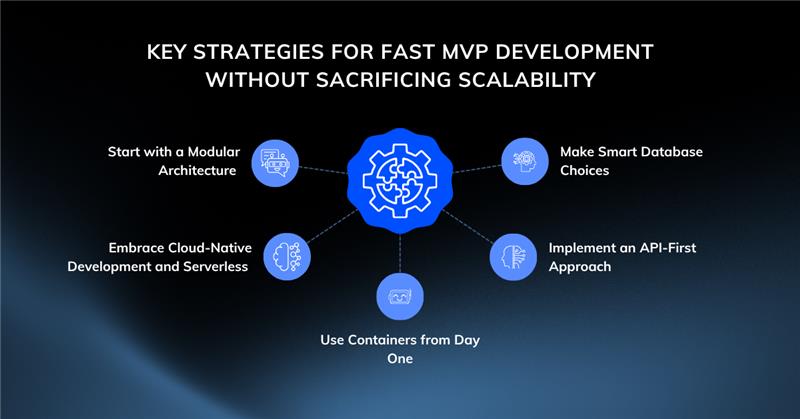
Choosing the right architectural design from the beginning can save you from major problems in the future. You can achieve both fast deployment and technical stability by making smart decisions about how your product is structured.
1. Start with a Modular Architecture
Many startups begin with a monolithic architecture, where the entire application is built as a single, unified unit. While a monolith can be fast to build at first, it becomes difficult to update and scale as it grows.
A better approach is a modular monolith. By organizing your code into separate, independent modules, you make the system much easier to understand and maintain. This modularity allows different developers to work on different features at the same time without causing conflicts, which speeds up the entire development process. This design also makes it easier to break out modules into microservices later if needed.
2. Embrace Cloud-Native Development and Serverless
Using cloud infrastructure is one of the easiest ways to ensure your MVP can scale automatically. Cloud providers like Amazon Web Services (AWS), Google Cloud Platform (GCP), and Microsoft Azure offer services that handle the complexities of infrastructure for you.
Serverless computing is particularly powerful for MVPs. Services like AWS Lambda or Google Cloud Functions allow you to run your code without thinking about servers at all. The cloud provider automatically handles everything. The best part is you only pay for the compute time your code actually uses. If your app suddenly gets a huge surge of traffic from a media mention, a serverless architecture will automatically scale to handle it without any manual intervention.
3. Use Containers from Day One
While a full microservices architecture is often too complex for a brand new MVP, containerization is an incredibly valuable practice from the start.
Tools like Docker allow you to package your application and all of its dependencies into a single, portable unit called a container. This ensures that your app runs exactly the same way everywhere, whether it is on a developer’s laptop, a testing server, or in production. Using containers for your modular architecture early on makes it much easier to move to a microservices model later when your user base grows and your needs become more complex.
4. Implement an API-First Approach
Adopting an API-first approach means you design your Application Programming Interfaces (APIs) before you write the actual application code. The API acts as a contract that defines how different parts of your system will communicate with each other.
This strategy offers several advantages for speed:
- Parallel Development: It allows your front-end (what the user sees) and back-end (the server-side logic) teams to work at the same time. The front-end team can build against a mock API while the back-end team implements the real logic.
- Flexibility: It creates a highly flexible system that can easily connect with third-party services or support new platforms like a mobile app in the future.
- Clearer Communication: It forces teams to agree on the data and logic upfront, reducing misunderstandings and bottlenecks during development.
5. Make Smart Database Choices
Your choice of database has a massive impact on how your application can scale in the future. The two main types of databases are relational (SQL) and non-relational (NoSQL).
- Relational Databases (e.g., PostgreSQL, MySQL): These are excellent for structured data and situations where you need to perform complex queries. They are very reliable for financial transactions or data that has clear relationships.
- NoSQL Databases (e.g., MongoDB, DynamoDB): These offer high flexibility for unstructured or semi-structured data. They are great for rapid development and iteration, as you can change your data model easily.
For scalable MVP development, a smart strategy is to start with a managed database service from your cloud provider (like Amazon RDS or Google Cloud SQL). These services handle backups, software patching, and scaling for you, which frees up your developers to focus on building your product instead of managing database servers.
Essential Tools and Technologies to Boost Your MVP
Equipping your team with the right tools can significantly reduce your development time. Automation and specialized platforms are crucial for a lean startup looking to move quickly.
Low-Code and No-Code Platforms
Low-code and no-code platforms are no longer just for simple websites. They have become powerful tools that can support complex business logic and database integrations.
- For non-technical founders: Th ese platforms allow you to build and launch a functional product in weeks instead of months, without hiring an expensive development team.
- For technical teams: They can be used to quickly build internal tools or prototypes, freeing up developers to focus on the core, complex parts of the product.
CI/CD Pipelines for Automated Deployment
A Continuous Integration and Continuous Deployment (CI/CD) pipeline automates the process of testing and releasing your code.
- Continuous Integration (CI): Every time a developer commits new code, the pipeline automatically runs a suite of tests to catch bugs early.
- Continuous Deployment (CD): If all the tests pass, the new code is automatically deployed to users.
This automation eliminates manual release errors, reduces risk, and allows your team to safely push updates and new features multiple times a day.
Monitoring and Observability Tools
You cannot fix problems that you cannot see. Implementing observability tools like Datadog, New Relic, or Sentry from day one is essential. These tools help you:
- Track application performance and identify slow parts of your code.
- Monitor server health and database load.
- Alert you to errors and crashes in real time.
Catching a performance issue or a memory leak early can prevent it from turning into a major outage during a critical growth phase.
How to Strategically Manage Technical Debt for Sustainable Growth
Treat technical debt like financial debt. A small loan to get your business off the ground can be a good investment, but you need a plan to pay it back.
- Track Your Debt: Maintain a backlog of technical debt items, just like you do for new features. Document why a shortcut was taken and what the ideal solution would be.
- Allocate Time for Repayment: Dedicate a small portion of every development sprint (e.g., 10-20% of your team’s time) to “paying down” this debt by cleaning up and improving the code.
- Know When to Refactor: Refactoring involves restructuring existing code to improve its design without changing its external behavior. You should refactor small parts of your code regularly to keep it healthy.
- Know When to Rebuild: A full rebuild is a major decision and should only be considered when the current architecture is fundamentally preventing you from adding critical features or scaling to meet user demand.
Why Partner with Enlight Lab for Scalable MVP Development
Internal teams alone aren’t enough to move fast, especially when speed to market is critical. This is where the right development partner becomes a strategic advantage, helping teams accelerate development without compromising scalability.
However, not all development partners deliver the same value. The wrong agency can add coordination overhead, slow down decision-making, and focus only on code delivery without real product thinking.
The right partner, on the other hand, takes a more thoughtful approach:
- Works as an extension of your team, not just a vendor
- Brings proven MVP patterns and strong architectural judgment
- Challenges assumptions to ensure the right product decisions are made early
At Enlight Lab, this approach is central to how we work. Our focus goes beyond just building features. We prioritize scalable MVP development, ensuring your product is designed to grow without costly rework later.
Ready to Build a Fast, Scalable MVP? Start with the Right Strategy Today
Launching a minimum viable product quickly does not mean you have to sacrifice the future stability of your application. By adopting a modular architecture, leveraging modern cloud-native tools, and being strategic about managing your technical debt, you can achieve impressive speed without compromising your ability to grow.
The key is to maintain a relentless focus on solving a specific, high-value problem for your first users. Start simple, gather feedback early, and scale your technology only when real demand requires it. This balanced approach gives your startup the best chance not just to survive, but to thrive.
While you’re planning, others are already learning from real users and gaining momentum. Every delay in launching your MVP means missed opportunities to validate, iterate, and grow.
At Enlight Lab, we help startups turn ideas into scalable MVPs that are built for real-world success. We don’t just develop software. We create products that solve real problems, adapt to user needs, and stand strong as they scale.
If you’re ready to accelerate MVP development without compromising scalability, let’s get started.