Scaling your startup should be an exciting milestone, yet growth often exposes unexpected bottlenecks that slow you down.
- Your marketing team runs a campaign targeting existing customers, but nobody told them sales already closed those accounts.
- Your finance team is working from last quarter’s numbers while operations are looking at a completely different spreadsheet.
- Your CTO wants to implement an AI tool, but the data feeding it is scattered across five incompatible platforms.
Sound familiar? This is what data silos do. Deadlines slip, teams misalign, and critical opportunities are missed all because data is trapped in silos.
Data silos don’t announce themselves with alarm bells. They quietly erode your decision-making, bleed your budget, and hold your business back from its full growth potential. Often, the damage is done before anyone even notices.
According to Salesforce Connectivity Report, 81% of IT leaders say data silos are hindering their digital transformation efforts. Meanwhile, research cited by Integrate.io estimates data silos cost organizations $7.8 million annually in lost productivity.
The solution? A streamlined, integrated approach to your data and systems. Breaking down silos and implementing cohesive collaboration tools unlocks faster growth, improves team alignment, and ensures your technology serves as a seamless enabler instead of a roadblock.
In this article, you’ll learn what data silos are, how much they cost your business, why they form, and how to break them down. By dismantling these silos, your business can move faster, improve customer service, and gain a competitive edge.
What Are Data Silos and Why Should You Care?
Data Silos are isolated data systems that are accessible to only one department and not shared across the organization. Data silos develop gradually as businesses grow and add tools, teams, and processes without a unified data strategy to connect them.
Why Data Silos Are Dangerous
- No single source of truth
- Conflicting reports across teams
- Delayed decision-making
- Limited visibility into customer journey
Businesses with disconnected data struggle to act fast because insights are incomplete or inconsistent.
Common Data Silo Examples Across Departments
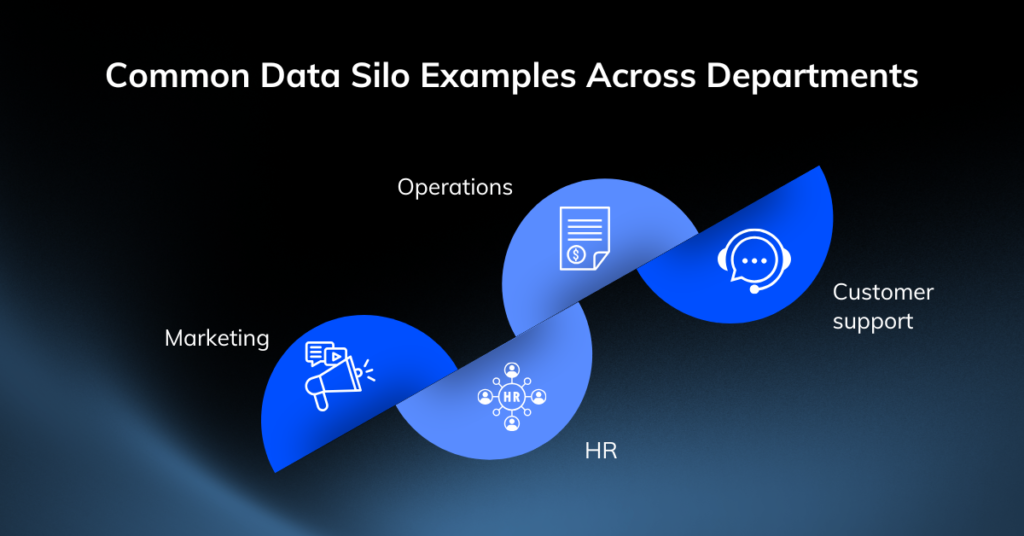
Here’s what data silos look like in the real businesses:
- Marketing stores lead data in HubSpot, but sales use Salesforce, and neither platform is connected. The same prospect gets cold-called twice and emailed three times a week.
- Operations track inventory in a spreadsheet. Finance uses a separate ERP system. Neither team has real-time visibility into cash flow or stock levels.
- Customer support doesn’t have access to purchase history stored in the e-commerce platform, so every customer interaction starts from zero.
- HR uses a standalone ATS that doesn’t integrate with payroll or performance management tools, creating duplicate records and manual reconciliation work.
Each department thinks they’re managing their data well. The problem is that data locked inside one team is worth a fraction of what it could be if it were connected to the whole.
The Real Cost of Data Silos on Business Growth
Data silos are not just a technical issue; they are a direct barrier to business growth.
Here is how they can slow down your company’s progress.
Impaired Decision-Making
Good decisions need complete information. When your data lives in silos, every strategic decision is made with incomplete visibility.
- Incomplete Insights and Blind Spots: Your leadership team may be reviewing performance dashboards that only reflect part of the picture. If revenue data doesn’t connect to customer acquisition cost or operational expenses, you can’t accurately assess profitability by product line or customer segment. You’re navigating with a partial map.
- Delayed Responses to Market Changes: Speed is a competitive advantage, especially for startups. When data is fragmented, generating a cross-functional report takes days instead of hours. By the time the right people see the data, the market window may have closed.
- Suboptimal Strategic Planning: Strategic planning depends on forecasting. Forecasting depends on connected historical data. Silos break that chain. You end up making capacity, hiring, and investment decisions based on assumptions rather than facts.
Reduced Operational Efficiency
Silos create waste in time, money, and human effort.
- Redundant Data Entry and Manual Processes: When systems don’t talk to each other, people fill the gap. Teams are forced to manually re-enter the same data across multiple platforms, copy and paste between spreadsheets, and maintain duplicate records. These tedious tasks create a breeding ground for errors.
- Wasted Resources and Increased Operational Costs: Every hour spent on manual data reconciliation is an hour not spent on building, selling, or serving customers. For a 10-person startup where every role matters, this overhead is disproportionately damaging.
- Slower Time-to-Market: Product launches, campaign rollouts, and new service offerings all depend on coordinated data flows across departments. When those flows are broken, timelines stretch, dependencies get missed, and delivery slows.
Damaged Customer Experience
Customers don’t care about your internal organizational structure. They expect seamless, consistent, and personalized service, which data silos make nearly impossible to deliver.
- Inconsistent Interactions Across Touchpoints: A customer who calls your support line after placing an order online shouldn’t have to re-explain their situation. But if customer service can’t see e-commerce data, that’s exactly what happens. Frustration builds. Trust erodes.
- Lack of Personalized Service: Personalization at scale requires unified customer data, including purchase history, browsing behavior, support interactions, and preferences all in one place. Silos fragment this picture, forcing you to deliver generic experiences when customers expect tailored ones.
- Missed Cross-Selling and Upselling Opportunities: If your sales team can’t see what a customer already owns or what support issues they’ve raised, they can’t make relevant recommendations. Revenue-generating opportunities slip through the cracks daily.
Hindered Innovation and AI Adoption
- AI performance is data-dependent: Modern AI tools, like predictive analytics and generative AI, are only as powerful as the data they’re trained on. Siloed, fragmented, and low-quality data will inevitably produce unreliable AI outputs.
- Widespread unpreparedness for AI: Salesforce’s 2024 Connectivity Report reveals that 62% of IT leaders admit their current data systems are not configured to fully support AI initiatives. This means businesses trying to gain a competitive edge with AI are building on a weak foundation.
- Slow progress in breaking down silos: While 83% of leaders surveyed by PwC believe AI will help break down traditional data silos, only 27% have actually implemented the capabilities to do so. This highlights a significant gap between recognizing the problem and solving it.
Compliance and Risk Management Challenges
For any business handling customer data, regulatory compliance requires a clear, auditable trail of how data is stored, accessed, and processed.
- Difficulty Establishing a Single Source of Truth: Data silos can cause the same data point to exist with different values across multiple systems. When auditors or regulators ask for definitive records, reconciling these discrepancies is time-consuming and high-risk.
- Increased Risk of Non-Compliance: Under regulations like GDPR, CCPA, or HIPAA, businesses must be able to respond accurately and quickly to data requests. Silos make this significantly harder, increasing the risk of accidental non-compliance and the penalties that follow.
Why Data Silos Form in the First Place
You can’t fix a problem you don’t understand. These are the five root causes behind data silos.
Organizational Structure
Departments are structured to focus on their specific objectives. This specialization often leads to data isolation:
- Marketing optimizes for leads.
- Sales optimizes for revenue.
- Finance optimizes for cost control.
Without a central directive for cross-functional data sharing, each team naturally chooses tools and processes that serve their individual goals, rather than the organization’s as a whole.
Technology Stack Fragmentation
- Reactive Tool Adoption: Businesses often adopt tools as needs arise, not as part of a planned data strategy.
- Example of Tool Sprawl: A startup may begin with Google Sheets, later adding a CRM, a project management tool, a billing platform, and an analytics suite.
- Lack of Integration: These tools often don’t integrate na tively, creating a disjointed infrastructure that naturally leads to data silos.
Absence of Data Governance
- Lack of Clear Policies: Without clear policies on data ownership, structure, and sharing protocols, data management becomes chaotic.
- Diverging Standards: Individual teams create their own data conventions, leading to a divergence in standards across the organization.
- Degraded Data Quality: This lack of uniformity ultimately degrades the quality and reliability of the data.
Resistance to Change
- Entrenched Habits: Teams accustomed to operating independently may resist data sharing due to long-standing habits and workflows.
- Internal Competition: Departments might withhold data out of concern for their competitive positioning or accountability within the organization.
- Lack of Executive Support: Without strong leadership championing a data-sharing culture, even the most advanced integration tools will fail to gain traction.
Rapid Growth Without a Unified Data Strategy
Rapid growth can lead to reactive decision-making, where new systems are added to solve immediate problems without a long-term plan. This often results in:
- Reactive System Adoption: Adding new tools and platforms on the fly to address urgent needs.
- Lack of Unified Architecture: Failing to build a cohesive data strategy from the outset.
- Deeply Embedded Fragmentation: By the time data silos become a noticeable issue, they are already integrated into core business operations, making them difficult to resolve.
The Blueprint for Breaking Down Data Silos
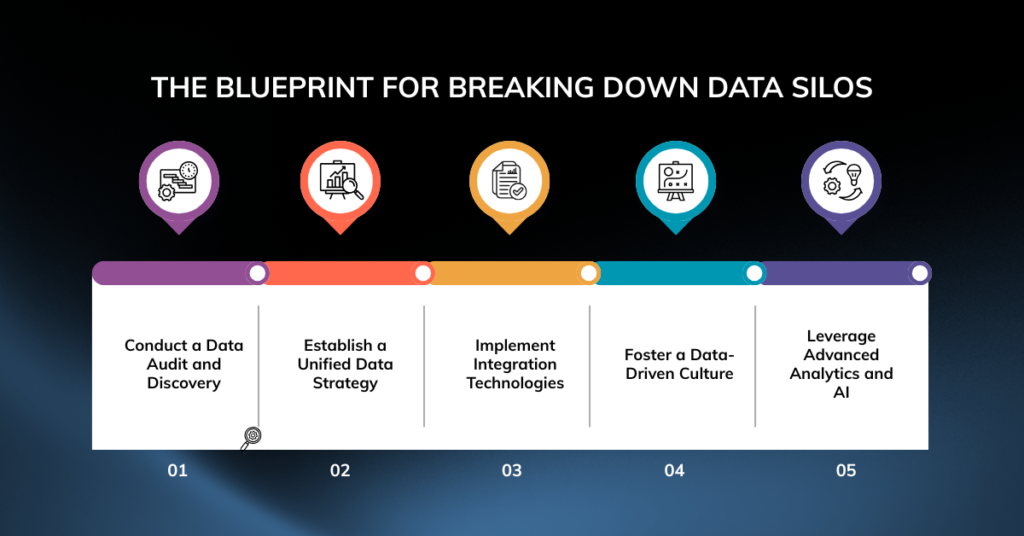
This five-step framework gives you a structured path from fragmentation to integration — regardless of your company’s size or technical sophistication.
Step 1: Conduct a Data Audit and Discovery
Before you can fix anything, you need to know what you have.
What to Include in Your Data Audit
- List every system, tool, spreadsheet, and database where data lives across the organization.
- Map data flows and dependencies between systems and departments.
- Look for duplicates, inconsistencies, outdated records, and gaps.
- Figure out who is responsible for each data set and identify if ownership is unclear.
This audit is unglamorous work, but it’s the foundation everything else builds on. Without it, you’re guessing.
Step 2: Establish a Unified Data Strategy
A data strategy isn’t a technical document — it’s a business decision about how your organization will treat data as a strategic asset.
Key Elements of a Unified Data Strategy
- Establish clear rules for how data is created, stored, accessed, and shared.
- Assign ownership of key data domains to specific individuals or teams.
- Focus on integrations with the highest business impact, such as those involving customer, operational, and financial data.
- Establish a single source of truth for each critical data type
Step 3: Implement Integration Technologies
The right tools depend on your current stack, technical resources, and budget. Here are the primary options:
Data Integration Technologies
- ETL Tools (Extract, Transform, Load) like Fivetran, Airbyte, or Talend pull data from multiple sources. Transform it into a consistent format and load it into a central repository.
- Centralized repositories like Snowflake, Google BigQuery, or Amazon Redshift store structured data from across the organization.
- For organizations managing large volumes of unstructured data, data lakes store raw data at scale and allow flexible querying.
- Real-time data integration between systems through APIs enables live data sharing rather than batch updates.
- Modern cloud platforms like Databricks or Azure Synapse combine storage, processing, and analytics in a unified environment.
For early-stage startups with limited technical resources, cloud-native solutions are typically the most cost-effective entry point. Many offer generous free tiers and pay-as-you-scale pricing that aligns with startup budget realities.
Step 4: Foster a Data-Driven Culture
Technology alone doesn’t break down silos. People do.
Building Cross-Functional Data Collaboration
- Promote data sharing as a norm, not an exception. Make it visible when cross-functional data access drives better outcomes.
- Invest in data literacy as it is not required that every employee is a data analyst.
- Secure executive buy-in rather than delegating it to IT and walking away.
- Establish a cross-functional data council to address data sharing issues, resolve conflicts, and align on governance standards.
Step 5: Leverage Advanced Analytics and AI
Once your data is integrated, the real value begins.
Unlocking Business Intelligence Through Unified Data
- Build comprehensive dashboards that unify data across marketing, sales, operations, and finance. This gives leadership a complete view of performance.
- Use predictive analytics to leverage historical data and build forecasting models that help you identify customer churn, demand changes, and operational bottlenecks before they happen.
- Leverage AI and machine learning with unified, high-quality data to unlock accurate predictions, personalized experiences, and smarter automation across your business.
- Unified data infrastructure requires ongoing governance. Establish data quality dashboards, scheduled audits, and feedback loops to prevent new silos from forming as the business scales.
Benefits of Eliminating Data Silos
When your data finally flows freely across departments, the impact isn’t just operational. It’s strategic. Here’s what changes when the walls come down.
Faster, More Confident Decision-making
When you can pull real-time insights from a single, unified source instead of waiting on five different teams to compile their numbers, you start making decisions in hours instead of weeks. You’re no longer reacting to last month’s data. You’re acting on what’s happening right now.
A Complete View of The Customer Journey
When your marketing, sales, and support data live in one place, you get the full story behind each customer, from their first click to their latest support ticket. This means fewer repeated questions, more personalized outreach, and a customer experience that actually feels connected.
Increased Operational Efficiency
Without silos, your team stops wasting hours on manual data entry, duplicate reporting, and cross checking numbers between systems. That reclaimed time goes straight back into work that actually moves your business forward.
Better Resource Allocation
With a clear, holistic view of performance, you can identify exactly where your resources are being underused or overextended, whether that’s budget, headcount, or tools, and reallocate accordingly instead of guessing based on partial information.
Improved Collaboration Across Teams
When everyone is working from the same data, you’ll notice cross departmental friction naturally decrease. Your marketing and sales teams stop disagreeing on lead quality, finance and operations stop reconciling conflicting numbers, and everyone starts working toward shared goals instead of siloed ones.
Real-World Examples: What Breaking Down Silos Can Look Like
Achieving a 360-Degree Customer View
Sephora provides one of the most cited examples of what’s possible when customer data silos are eliminated.
By integrating data from in-store purchases, its mobile app, e-commerce platform, and its Beauty Insider loyalty program into a unified customer profile, Sephora was able to deliver genuinely personalized recommendations and seamless omnichannel experiences.
A customer browsing online and purchasing in-store receives a consistent, contextually aware interaction because the data powering that interaction is connected.
Streamlining Supply Chain Operations Through Integration
In manufacturing and distribution environments, data silos between production, procurement, inventory management, and logistics create cascading inefficiencies.
When a warehouse management system (WMS) doesn’t communicate with an ERP, inventory counts diverge, purchase orders lag demand, and delivery timelines stretch.
By integrating their ERP and WMS systems, companies create a unified operational data environment and gain real-time visibility across their supply chain. They can identify bottlenecks before they become disruptions, optimize stock levels to reduce carrying costs, and respond to demand changes faster.
Stop Letting Data Silos Slow Your Business Down
Data silos that slow business growth aren’t a technology failure. They’re a strategic failure. Every day your data stays fragmented is a day your decisions are less informed, your teams are less efficient, your customers are less satisfied, and your competitive position is weaker than it should be.
The good news is that this is a solvable problem. You don’t need a massive budget or a team of data engineers to start. You need clarity about:
- Where your data lives
- A governance framework that establishes ownership and standards
- The right integration tools for your current stage
- Leadership committed to treating data as a shared organizational asset
Your data holds answers. If your data works together, your entire business works better and that’s when real growth becomes possible.
The organizations that get ahead in their markets are the ones with connected data and the clarity to act on it.
Ready to unlock the power of connected data? Get in touch with our team for a free data audit and discover exactly where your business is losing time, money, and opportunities. Enlight Lab will help you build future-ready digital solutions that improve collaboration, automate workflows, unify data, and strengthen business insights.