TL;DR: EHR integration connects external software systems to electronic health record platforms using data standards like HL7v2 and FHIR, interface engines, or direct APIs. The process involves mapping data, establishing secure connections, meeting compliance requirements, and ongoing maintenance. Most projects take three to twelve months and cost anywhere from tens of thousands to several hundred thousand dollars, depending on complexity and approach.
Healthcare data is fragmented by design – or rather, by accident. Decades of siloed software purchases, vendor lock-in, and inconsistent standards have left most health systems operating a patchwork of platforms that don’t talk to each other. EHR integration is the discipline of making them talk.
This guide covers what EHR integration actually is, how it works under the hood, which data standards you’ll encounter, the real costs and timelines involved, and how to plan a project that doesn’t stall six months in. Whether you’re a health-tech founder building a product that needs to connect to Epic, a product manager scoping an integration roadmap, or an IT decision-maker evaluating build vs. buy options, this is your starting point.
One caveat before we begin: EHR integration is one of the most technically complex and politically fraught problems in healthcare IT. This guide gives you a strong working foundation. It won’t replace a qualified integration engineer or compliance counsel.
What Is EHR Integration?
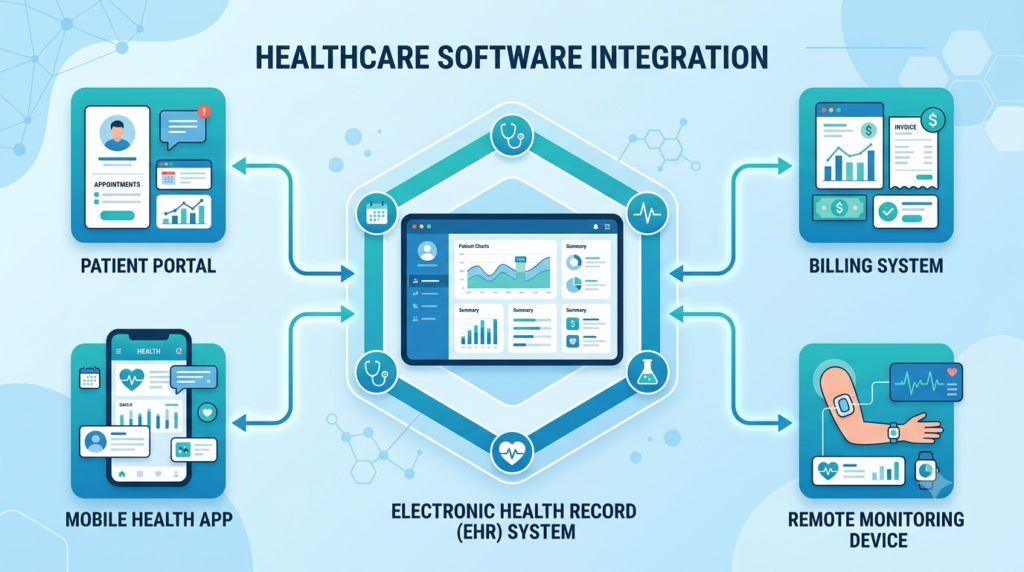
EHR integration is the process of establishing a structured, reliable data connection between an external system — a patient engagement app, a clinical decision support tool, a billing platform, a remote monitoring device — and an electronic health record. The goal is to move the right clinical or administrative data, in the right format, at the right time, without introducing errors or security risks.
This is harder than it sounds. EHR platforms are proprietary systems built over decades, each with their own data models, APIs, and certification requirements. Connecting to one isn’t like calling a REST API for weather data. It requires understanding a specific vendor’s implementation of shared standards, navigating credentialing and contracting processes, and handling edge cases that only appear when real patient data starts flowing.
The term “EHR interoperability” is sometimes used interchangeably with EHR integration, but they’re not identical. Interoperability is the broader goal: different systems exchanging and using data meaningfully. EHR integration is the technical and operational work that makes interoperability possible in practice.
How Does EHR Integration Work?
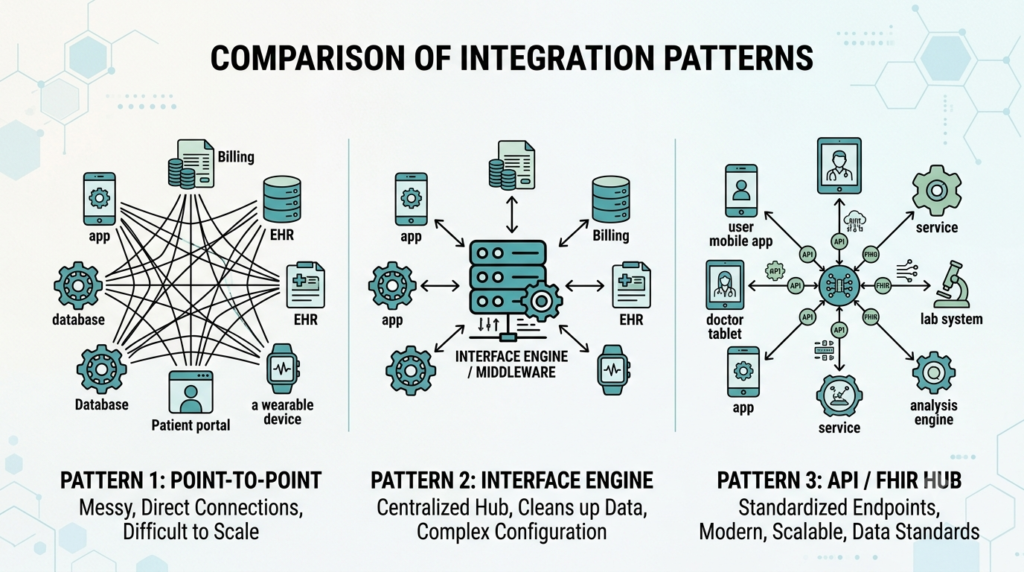
Direct answer: Data moves from a source system to an EHR — or vice versa — through one of three mechanisms: a point-to-point connection, an interface engine that translates and routes messages, or a modern API layer. The architecture you choose determines how maintainable and scalable the integration is over time.
The Basic Architecture
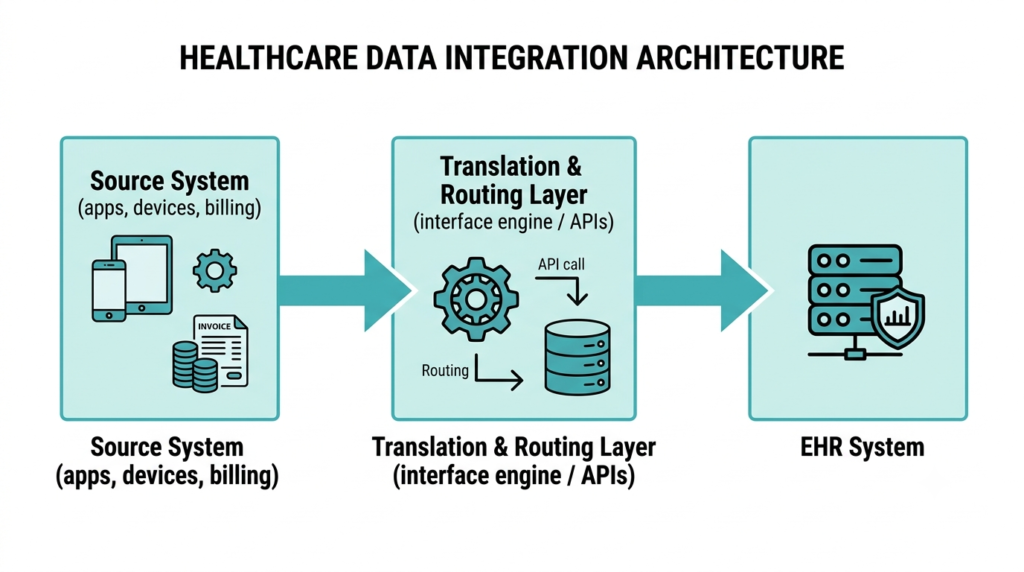
At its simplest, EHR integration involves three layers:
The source system — the application generating or consuming data (your app, a device, a billing platform)
The translation and routing layer — which converts data into a format the EHR expects
The EHR itself — which receives, processes, and stores the data
Between layers one and two, you’ll typically find one of three approaches.
APIs vs. Interface Engines vs. Point-to-Point Feeds
Point-to-point connections are the oldest approach. One system talks directly to another through a custom-built feed. They’re fast to build initially, but every new integration requires a new custom build. At scale, you end up with a spaghetti architecture that’s nearly impossible to maintain. Avoid this approach for anything beyond a single, stable integration.
Interface engines — platforms like Mirth Connect, Rhapsody, or Infor Cloverleaf — sit in the middle and translate messages between systems. They’re particularly effective in environments where you’re connecting multiple systems using HL7v2, the older messaging standard still dominant in many hospitals. An interface engine handles the translation, routing, and error-handling in one place. The downside: they add cost, operational complexity, and require specialized expertise.
API-based integration using modern standards like FHIR R4 is the current direction of the industry, strongly encouraged by ONC certification requirements. Instead of pushing messages through a proprietary pipe, your application calls a standardized API endpoint and retrieves structured data. FHIR APIs are more developer-friendly, more interoperable across vendors, and better suited to real-time use cases. The catch: not every EHR vendor has fully implemented FHIR, and even those that have often expose only a subset of clinical data through their public APIs.
Data Standards You Need to Know
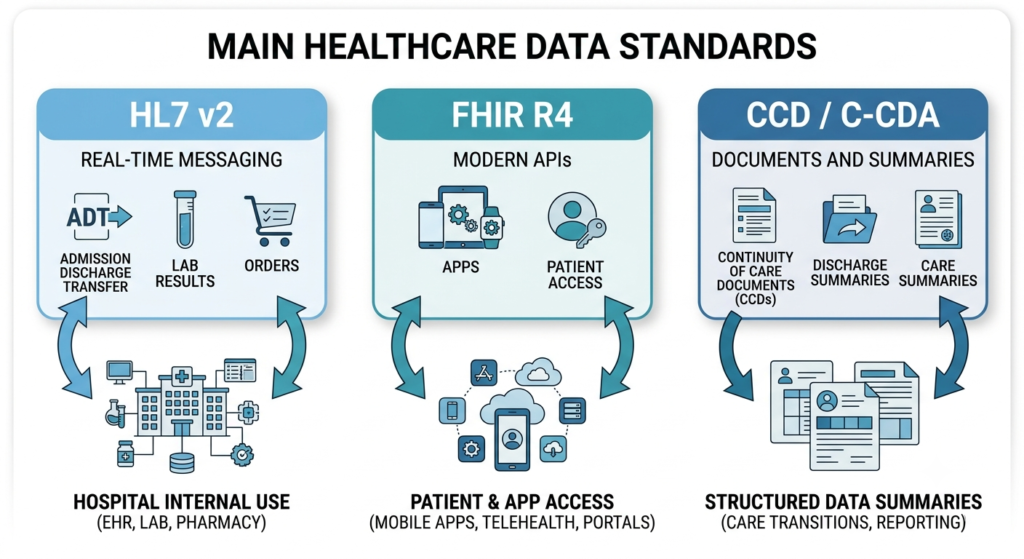
Direct answer: Three standards dominate EHR data exchange: HL7v2 for legacy messaging, FHIR for modern API-based integration, and CCD/CCDA for document-based sharing. Understanding which standard your target EHR uses — and for which data types — is the first thing you should do when scoping an integration.
Mature, widely implemented, well-understood by integration engineers
Highly variable implementations across vendors; requires custom mapping for almost every site
FHIR R4
API-based data exchange for apps, patient access, and interoperability
Growing rapidly — now an ONC requirement
Standardized API structure; developer-friendly; supports real-time and bulk data
Vendor implementations vary; not all clinical data is exposed; still maturing in some EHRs
CCD/CCDA
Structured clinical document sharing (transitions of care, referrals)
Yes — still used in document exchange workflows
Good for summarizing a patient’s record across encounters
XML-based and verbose; not well-suited to real-time or granular data needs
The practical implication: if you’re connecting to a large hospital system built on Epic or Oracle Health, you’ll likely encounter all three. If you’re building a patient-facing app for a smaller practice, FHIR R4 is probably your primary target. The HL7 vs FHIR decision isn’t binary — it depends on what data you need, from which system, and at what point in the workflow.
Types of EHR Integration
Direct answer: EHR integration falls into two broad categories — data exchange and workflow integration — and can operate in real time or through scheduled batch processes. The type you need depends on your use case, not your preference.
Data Exchange vs. Workflow Integration
Data exchange integration moves information between systems: pulling a patient’s medication list into your app, pushing a lab result back to the EHR, syncing a care plan. This is the most common starting point for health-tech companies. It’s generally more tractable than workflow integration and often achievable through FHIR APIs.
Workflow integration embeds your application directly into clinical workflows — launching your tool from within the EHR encounter, writing back structured data into clinical documentation, or triggering EHR workflows from your system. This requires deeper integration, usually involving vendor-specific SDKs, app marketplace processes, and tighter contractual relationships with the EHR vendor.
Real-Time vs. Batch Integration
Real-time integration delivers data immediately — within seconds of a triggering event. A patient is admitted, and your care coordination platform receives an alert. A clinician orders a medication, and your drug interaction tool is notified. Real-time integration improves clinical responsiveness but adds infrastructure complexity and cost.
Batch integration transfers data on a schedule: nightly, hourly, or weekly. It’s simpler to implement and maintain, but it means your data is always somewhat stale. For analytics use cases or population health reporting, batch is usually sufficient. For anything that needs to affect care at the point of encounter, it isn’t.
SMART on FHIR
SMART on FHIR deserves its own mention. It’s an authorization framework built on top of FHIR that allows third-party applications to launch within an EHR context and access patient data securely. Think of it as OAuth for healthcare apps. If you’re building a clinical decision support tool, a patient-facing portal, or any application that clinicians will use within an EHR workflow, SMART on FHIR is the mechanism that makes that possible in a standards-based way. Most major EHRs now support it, though implementation quality varies.
Common EHR Systems and Integration Quirks
Direct answer: The EHR landscape is dominated by a small number of vendors, each with distinct integration architectures, API maturity levels, and access requirements. Knowing the quirks of your target system before scoping the project saves significant time.
Epic
Epic holds the largest share of the U.S. hospital market. Its integration ecosystem is mature and well-documented, built around its proprietary App Orchard marketplace and its own implementation of FHIR R4. To access Epic’s FHIR APIs beyond basic patient-facing data, your application typically needs to go through a review and approval process. Epic’s FHIR implementation is among the most complete in the market, but some clinical data remains accessible only through older interfaces or custom agreements. Budget for the credentialing process — it takes time.
Oracle Health (formerly Cerner)
Oracle Health uses a mix of FHIR R4 APIs and its own integration framework. Its developer program provides access to sandbox environments and documentation. Like Epic, deeper clinical data access often requires a formal partnership or integration agreement. Oracle Health has been investing in FHIR capability since the ONC requirements came into force, but implementation depth varies across customer deployments.
Athenahealth
athenahealth is common in ambulatory and independent practice settings. Its API program is relatively accessible and developer-friendly compared to larger hospital-focused EHRs. If your target market is small-to-mid-sized practices rather than large health systems, athenahealth integrations are often faster to scope and execute.
Others
Allscripts, eClinicalWorks, NextGen, and Meditech each have their own integration approaches. Many smaller or specialty EHRs have limited FHIR support and still rely primarily on HL7v2 or proprietary APIs. Always validate API capabilities with the specific version a customer is running — EHR vendors often have meaningful differences between product versions in production.
Why Is EHR Integration So Difficult?
Direct answer: EHR integration is hard because the technical complexity is compounded by fragmented standards implementation, security overhead, and organizational friction. Most projects take longer than planned not because the technology fails, but because these structural issues weren't accounted for.
Fragmented Standards Implementation
HL7v2 is technically a standard, but implementations vary so widely across vendors and even across sites running the same vendor that it functions more like a dialect. Two hospitals both using “HL7v2” may structure the same message in incompatible ways. Every new site integration requires its own mapping work. This is the single biggest source of hidden time and cost in multi-site integration projects.
Data Mapping Complexity
Clinical data doesn’t map cleanly between systems. A medication recorded one way in your system may be structured completely differently in the EHR. Terminologies — SNOMED CT, LOINC, ICD-10, RxNorm — need to be correctly translated. Missing or optional fields in one system may be required in another. Getting data mapping right requires clinical informatics expertise, not just engineering effort.
Legacy Systems and Certification Hurdles
Many healthcare organizations are running EHR versions from several years ago. They may not have FHIR R4 available. Their integration infrastructure may be built around interface engines receiving HL7v2 feeds. Your modern API-first approach may need to accommodate systems that predate that architecture by a decade. This is the reality of enterprise healthcare IT.
Security Overhead
Healthcare data is among the most sensitive and most regulated. Every connection point requires authentication, authorization, encryption, audit logging, and formal Business Associate Agreements. These aren’t optional. Adding them correctly takes time. Skipping them creates legal exposure.
Build vs. Buy: Choosing Your EHR Integration Approach
Direct answer: The build vs. buy decision for EHR integration comes down to how many integrations you need, how much internal engineering capacity you have, and how quickly you need to move. Most health-tech companies underestimate the maintenance burden of building their own integration infrastructure.
Approach
Cost
Speed to First Integration
Control
Maintenance Burden
Best For
Build in-house
High upfront; ongoing engineering cost
Slow (months)
High
High — your team owns all issues
Orgs with large eng teams and unique integration requirements
Integration platform as a service (iPaaS)
Mid-range subscription
Medium (weeks to months)
Moderate
Low to medium — vendor handles infrastructure
Companies needing multiple EHR connections quickly
EHR vendor marketplace
Variable; revenue share often required
Variable
Low
Low — vendor manages API changes
Apps targeting a single dominant EHR in a specific market
Healthcare integration specialist
Variable; often project-based
Fast for first integration
Moderate
Shared with vendor
Teams without dedicated integration engineering capacity
Point-to-point (custom per site)
Low upfront per integration
Fast initially
High
Very high — scales poorly
Single-site pilots only; not recommended for production scale
One common mistake: teams choose to build in-house because they want control, then discover 18 months later that maintaining the integration layer consumes more engineering capacity than the product itself. If your core business is not EHR connectivity, seriously evaluate iPaaS and specialist options before defaulting to build.
EHR Integration Costs and Timelines
Direct answer: EHR integration costs range from tens of thousands to several hundred thousand dollars depending on approach, number of systems, and data complexity. Timeline ranges from six weeks for a simple FHIR read integration to twelve or more months for a multi-EHR, bidirectional workflow integration.
General Cost Ranges by Approach
These are general ranges, not guarantees. Your actual costs will vary based on your technical requirements, the EHR systems involved, and your team’s existing expertise.
Simple FHIR read integration (single EHR, limited data types): $20,000–$80,000 in engineering and setup costs
Bidirectional HL7v2 integration via interface engine: $50,000–$200,000+, depending on data complexity and site count
Full workflow integration (SMART on FHIR, write-back, EHR launch): $150,000–$500,000+
iPaaS subscription costs: typically $2,000–$15,000/month depending on volume and vendor
Timeline Ranges
Proof of concept / sandbox connection: 2–6 weeks
Production-ready simple integration: 2–4 months
Multi-system or bidirectional integration: 4–9 months
API version upgrades when EHR vendors release new versions
Ongoing data mapping maintenance as clinical workflows change
Security audits and BAA renewals
Monitoring and incident response for production data flows
Re-certification if ONC requirements evolve
Plan for ongoing annual maintenance costs of 20–30% of your initial build cost. Ignore this and you’ll find yourself with a production integration that nobody has the budget to fix when it breaks.
Compliance and Security Basics
Direct answer: EHR integration operates within a strict regulatory framework. HIPAA governs data privacy and security, ONC Certification sets technical standards for EHR software, and the Information Blocking Rule defines what EHR vendors must — and must not — do to restrict data access.
Note: The information in this section is general orientation for health-tech decision-makers and is not legal advice. Consult qualified legal and compliance counsel before making decisions about your specific integration.
HIPAA
Any system exchanging protected health information (PHI) must comply with HIPAA’s Privacy and Security Rules. For EHR integration, this means encrypting data in transit and at rest, establishing formal Business Associate Agreements (BAAs) with any vendors in the data flow, maintaining audit logs, and implementing access controls. These requirements apply to your application, your infrastructure, and any third-party tools you use in the integration pipeline.
ONC Certification and FHIR Requirements
The ONC (Office of the National Coordinator for Health Information Technology) certifies EHR technology against specific interoperability requirements. Since the 21st Century Cures Act Final Rule came into effect, certified EHRs are required to support FHIR R4 APIs for patient access and third-party app connectivity. This regulatory push is the main reason FHIR adoption has accelerated significantly since 2021. If you’re building on FHIR, the regulatory wind is at your back. If you’re still building entirely on HL7v2, plan your migration path.
Information Blocking Rule
The Information Blocking Rule prohibits healthcare actors — including EHR vendors — from practices that unreasonably restrict the access, exchange, or use of electronic health information. In practical terms, this means EHR vendors cannot arbitrarily block third-party applications from accessing patient data through certified APIs. If you encounter barriers from an EHR vendor that appear to go beyond legitimate technical or security requirements, the Information Blocking Rule may be relevant to your situation.
How to Plan an EHR Integration Project: A Step-by-Step Process
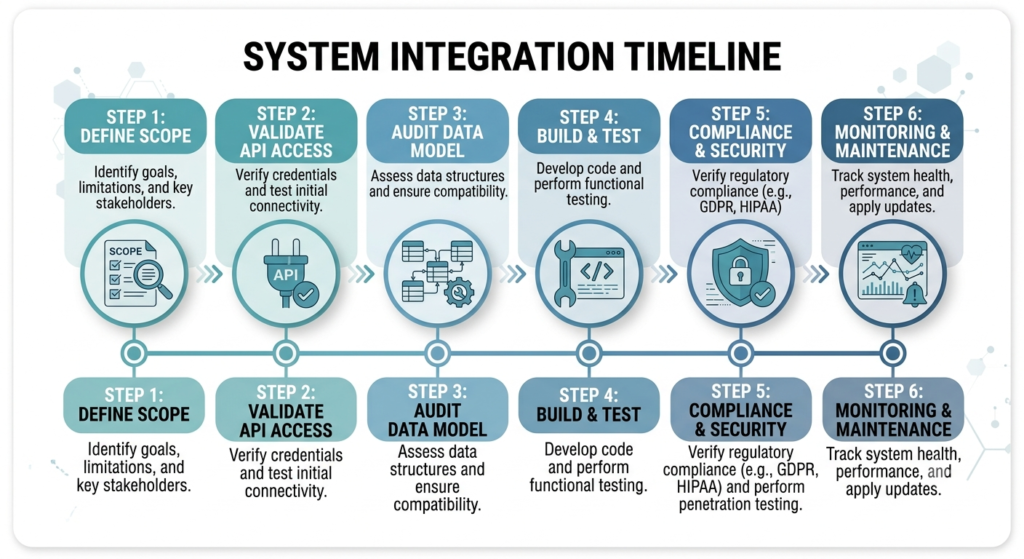
Direct answer: A successful EHR integration project follows a disciplined sequence: define scope, validate access, map data, build and test, complete compliance, and plan for ongoing maintenance. Skipping or compressing any of these steps is the most reliable way to extend your timeline.
Define integration scope precisely. List the specific data types you need to read or write, the EHR systems you’re targeting, and the clinical workflows you’re connecting to. Vague scope is the leading cause of budget overruns. “We need to integrate with Epic” is not a scope. “We need to read active medication lists and write structured care plan documents for patients seen in the outpatient oncology department” is a scope.
Validate API access and vendor requirements early. Contact the EHR vendor’s developer program. Confirm which APIs are available for your use case, what the access requirements are (sandbox access, production credentialing, marketplace listing), and what contractual agreements are needed. Do this before writing a line of code. EHR vendor processes have long lead times.
Audit your own data model. Map out exactly how data is structured in your system. Identify every field that needs to translate to or from the EHR’s data model. Engage a clinical informatics resource — not just an engineer — for this step. Terminology mapping (LOINC, SNOMED, RxNorm) requires clinical knowledge that most engineering teams don’t have.
Build and test against real sandbox data. Use the EHR vendor’s sandbox environment with realistic test data, not toy examples. The edge cases that break integrations in production almost never appear in simplified test scenarios. Write tests that cover missing fields, unexpected values, and partially complete records.
Complete compliance and security requirements. Execute BAAs with all relevant vendors. Implement encryption, access controls, and audit logging. Document your security controls in a format suitable for review by a hospital security team. Many enterprise healthcare customers will require a security questionnaire before granting production access — prepare for it.
Deploy with monitoring in place from day one. Set up alerting for failed messages, data mapping errors, authentication failures, and volume anomalies before you flip the production switch. You cannot troubleshoot what you cannot observe. Integration failures in healthcare have clinical consequences — treat monitoring as a patient safety requirement, not a nice-to-have.
Plan your maintenance cadence. Assign ownership for integration monitoring, schedule quarterly reviews of API version changes from your EHR partners, and budget for annual maintenance before the project closes. Integrations that aren’t actively maintained degrade. The question isn’t if something will change — it’s when.
Common EHR Integration Mistakes to Avoid
Scoping to the Vendor, Not the Use Case
Teams often start by saying “we need to integrate with Epic” rather than “we need to read current medications for patients in our care coordination workflow.” Vendor-first scoping leads to over-engineered integrations that collect data you don’t need and miss the specific API endpoints that matter for your actual use case. Define the clinical workflow first. Then identify the integration requirements that workflow creates.
Underestimating HL7v2 Variability
HL7v2 looks like a standard until you try to connect to your second or third site. Then you discover that the same message type is structured differently at every organization. Budget separately for per-site mapping and testing rather than assuming your first integration will work everywhere. Failing to do this is the single most common cause of EHR integration project overruns.
Treating Compliance as a Final Step
HIPAA compliance and security requirements don’t belong at the end of the project checklist. They belong at the beginning. Retrofitting audit logging, access controls, and encryption into an integration that wasn’t designed for them is expensive, time-consuming, and often incomplete. Build compliance in from the architecture phase.
Ignoring the Ongoing Maintenance Burden
EHR integrations are not deploy-and-forget systems. EHR vendors update their APIs. Data models change. Certification requirements evolve. Organizations change their workflows. An integration that works perfectly on launch day will require active maintenance to remain functional twelve months later. Teams that don’t plan for this end up with broken integrations and no budget to fix them.
Make Your Integration Decision Count
EHR integration is one of the highest-leverage technical decisions in a health-tech company’s early life. Get it right and you can move data where it needs to go, build trust with enterprise customers, and create integrations that scale. Get it wrong and you’ll spend years maintaining brittle custom connections that consume engineering capacity you can’t afford.
The three decisions that matter most: which standards and architecture to build on (FHIR where possible, HL7v2 where necessary, interface engines for multi-site complexity), whether to build or buy your integration infrastructure (default toward iPaaS unless integration is your core product), and how seriously you treat compliance from day one (treat it as foundational, not finishing work).
Start with a single well-defined use case. Validate API access before scoping the build. Design for compliance and maintenance from the beginning. The teams that execute EHR integration well aren’t the ones with the most resources — they’re the ones who respect the complexity before they start.
Frequently Asked Question (FAQ)
What is the difference between EHR integration and EHR interoperability?
EHR interoperability is the goal: different health systems and applications exchanging and using clinical data meaningfully. EHR integration is the technical process of building the connections that make interoperability possible. Interoperability describes what you’re trying to achieve; integration describes how you achieve it.
What does HL7 vs FHIR mean in practical terms for a health-tech company?
HL7v2 is a messaging standard used in most existing hospital infrastructure for events like admissions, lab results, and orders. FHIR is a modern API standard that structures clinical data as web resources accessible via REST APIs. For new integrations, FHIR is the recommended approach – especially given ONC mandates. HL7v2 expertise is still necessary when connecting to older hospital systems or handling real-time clinical event streams that haven’t yet migrated to FHIR.
How much does EHR integration cost for a health-tech startup?
A simple read-only FHIR integration with a single EHR typically costs between $20,000 and $80,000. A bidirectional integration involving HL7v2 and workflow write-back can cost $150,000 to $500,000 or more. These figures don’t include ongoing maintenance, which typically adds 20–30% of initial build cost annually. If you’re early-stage, an iPaaS platform can reduce upfront costs while you validate product-market fit.
What is SMART on FHIR and do I need it?
SMART on FHIR is an authorization framework that allows third-party apps to launch within an EHR interface and access patient-specific data securely. You need it if clinicians will use your application inside the EHR workflow, or if your application needs to authenticate against the EHR on behalf of a specific user or patient. If you only need to pull data into your own backend on a scheduled basis, standard FHIR API access without SMART may be sufficient.
How long does EHR integration take from start to production?
A production-ready simple FHIR integration typically takes two to four months. A bidirectional integration involving workflow embedding and write-back takes four to nine months. Multi-site enterprise deployments can take nine to eighteen months. EHR vendor credentialing and compliance requirements often have a greater impact on timeline than technical development itself.
Do I need a Business Associate Agreement (BAA) for EHR integration?
Yes, if your integration involves protected health information. Any vendor or service provider in the data flow – cloud infrastructure, iPaaS platform, monitoring tools — must sign a BAA before PHI flows through their systems. This is a HIPAA requirement. Establish BAAs before connecting production data, not after.
What's the best approach for connecting to multiple EHR systems?
An integration platform as a service (iPaaS) built for healthcare — such as Redox, Rhapsody, or similar — is typically the most pragmatic approach for companies needing connections to multiple EHR systems. These platforms abstract vendor-specific differences and provide pre-built connectors. Building multi-EHR connectivity in-house is feasible but requires significant dedicated engineering and should only be undertaken by teams for whom integration is a core product capability.
What is the Information Blocking Rule, and how does it affect my integration?
The Information Blocking Rule, established under the 21st Century Cures Act, prohibits healthcare actors — including EHR vendors, health systems, and health information exchanges — from practices that unreasonably restrict access to electronic health information. In practical terms, it means EHR vendors cannot arbitrarily block your application from accessing patient data through certified APIs. If you encounter unusual barriers to API access that go beyond legitimate security requirements, this rule may be relevant to your situation. Consult legal counsel for guidance specific to your circumstances.
Turn Your AI Vision into Reality with Trusted AI Experts
Develop Secure, Scalable, and Custom AI Software That Drives Business Growth
TL;DR: Most AI MVPs do not fail because the model is not advanced enough. They fail because the team builds before validating the problem, relies on unprepared data,
Quick answer: In 2026, hiring an AWS developer typically costs between $25 and $180 per hour, depending on experience level, location, and project complexity. Junior