Your competitors are hiring the exact software engineers you want, and they are doing it in half the time. If your talent acquisition team still relies on manual resume screening, endless email threads, and basic keyword matching, you are bleeding time and capital.
The global IT staffing industry has hit a strategic reset. The organizations securing top-tier technical talent in 2026 have abandoned legacy hiring processes and fully integrated artificial intelligence into their workflows.
The average hiring timeline for technical roles often stretches beyond 40 days and can exceed 70 days for specialized positions. Every day a critical engineering seat remains empty, your product roadmap stalls and your technical debt grows. You cannot solve a 2026 hiring problem with a 2015 tech stack. AI is no longer an experimental feature confined to basic chatbots. It is the core infrastructure of modern recruitment, handling complex sourcing, intelligent vetting, and autonomous scheduling.
Currently, nearly 87% of companies use AI in some part of their recruitment process, according to recent industry research from DemandSage. More importantly, 52% of talent acquisition leaders now use agentic AI to handle most transactional recruiting workflows autonomously. Understanding how to deploy these capabilities is the difference between a high-performing technical team and a stagnant IT department.
This guide details exactly how AI is transforming the global IT staffing industry and what you must do to remain competitive.
What AI Means for IT Staffing in 2026
In 2026, AI in IT staffing is not about hype or automation for the sake of speed. It is about helping you hire the right talent faster, with better accuracy, and at global scale. AI now sits at the core of modern IT staffing platforms, shaping how candidates are sourced, evaluated, and matched to real business needs rather than keywords on a resume.
If you are still thinking of AI as a simple resume‑scanning tool, you are already behind. Today, AI changes how staffing decisions are made, how risks are reduced, and how hiring teams focus on high‑value work instead of manual tasks.
It expands talent access by scanning global talent pools instead of limiting hiring to known regions. It also reduces dependency on job titles or degrees by focusing on real skills and how those skills connect to the role you need to fill.
More importantly, AI helps staffing teams move from guesswork to evidence‑based hiring. This is why AI‑enabled staffing firms are reducing placement time and improving match quality at the same time, not choosing one over the other.
The Current State of IT Staffing: Challenges and Opportunities
According to recent forecasts from Staffing Industry Analysts (SIA), the U.S. staffing market is entering a slower but more stable growth phase, driven by efficiency, automation, and selective hiring trends.
The chaotic hiring spikes and freezes of recent years have settled, leaving a highly selective, efficiency-driven landscape. Employers no longer want speed at the expense of quality. They want verified competencies and clear operational orchestration.
Traditional Hurdles in IT Recruitment
Relying on human recruiters to perform repetitive data processing is a fast track to wasted resources. Paying a senior recruiter a six-figure salary to manually parse 500 applications for a DevOps role makes zero financial sense. Traditional IT recruitment suffers from four fatal flaws:
- Manual screening inefficiencies: Humans get fatigued. Reviewing technical resumes manually leads to missed details and inconsistent evaluations.
- Bias in hiring processes: Unconscious human bias frequently filters out highly capable, non-traditional candidates based on university pedigree or previous employer brand recognition.
- Skill gap identification challenges: Legacy applicant tracking systems (ATS) rely on exact keyword matches. If your system requires “Python” and a candidate lists “R and MATLAB,” traditional software rejects them.
- High time-to-hire metrics: Coordinating interviews across multiple time zones with busy hiring managers adds weeks to the hiring timeline, directly resulting in candidate drop-off.
Emerging Opportunities with Technological Advancements
The shift from volume-based hiring to competency-based hiring presents a massive opportunity. AI allows you to transition your operations to a skills-first paradigm.
- Data-driven insights: By analyzing historical hiring data, you map exactly which candidate profiles yield the highest long-term retention rates.
- Global talent pool accessibility: Remote and fractional work models require you to source talent internationally. AI tools instantly evaluate candidates from global markets against your specific technical requirements.
- Focus on candidate experience: When autonomous agents handle the administrative burden, your human recruiters spend 80% of their time building relationships and selling the role to top candidates.
Core AI Technologies Powering IT Staffing Platforms
Several AI technologies work together behind the scenes of modern IT staffing platforms.
- Machine learning analyses thousands of past placements to understand what makes a hire successful.
- Natural language processing (NLP) reads resumes and profiles like a human would, understanding skills in context instead of exact wording.
- Predictive analytics estimates how well a candidate will perform and stay in a role based on historical data.
- AI agents handle sourcing, screening, and coordination tasks while recruiters focus on relationship building and decision making.
These technologies do not replace recruiters. They remove noise and surface valuable insights so you can make confident hiring choices.
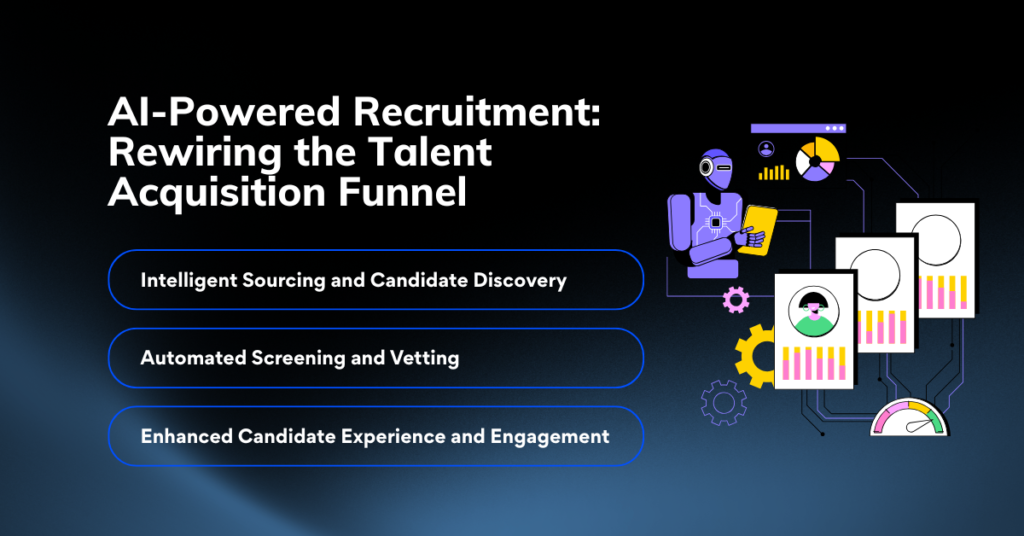
AI-Powered Recruitment: Rewiring the Talent Acquisition Funnel
Treating AI as a simple assistant is a mistake. In 2026, AI operates as a teammate. It possesses research, planning, decision-making, and execution capabilities that completely rewire the talent acquisition funnel.
Intelligent Sourcing and Candidate Discovery
You need candidates with upward trajectory and transferable skills, not just a list of buzzwords. Agentic AI proactively scans multiple data sources including GitHub, Stack Overflow, and niche developer communities to identify talent.
Automated Screening and Vetting
The “college degree required” filter is a competitive liability. In 2026, 92% of employers prioritize validated competencies over formal credentials. AI-driven screening enables this transition entirely.
- AI-driven resume parsing and analysis: Semantic intelligence evaluates the context of a candidate’s experience. It understands that a developer with extensive cloud infrastructure experience possesses the underlying logic to learn a new proprietary framework quickly.
- Chatbots for initial candidate engagement: Conversational AI handles preliminary technical screening, asking specific coding logic questions to qualify candidates immediately.
- Pre-employment assessments: AI administers and grades technical work simulations, generating quantified competency scorecards that accurately predict on-the-job performance.
Enhanced Candidate Experience and Engagement
Top-tier developers will not wait three weeks for interview feedback. They will accept a competing offer. AI guarantees a frictionless experience that keeps your company top-of-mind.
- Personalized communication at scale: Generative AI crafts highly tailored outreach emails based on a candidate’s public portfolio, drastically increasing response rates.
- Virtual assistants for 24/7 support: Candidates get immediate answers regarding benefits, tech stack, and company culture at any hour.
- Streamlined application processes: Multi-party calendar synchronization using the Model Context Protocol (MCP) allows AI to book technical interviews in seconds, resolving schedule conflicts autonomously.
Beyond Recruitment: AI’s Impact on Post-Hire Processes
Securing the talent is only half the battle. If your onboarding process is chaotic, your expensive new software engineer will leave within six months. AI extends directly into workforce management.
AI in Onboarding and Training
A generic 30-day onboarding plan stifles productivity. You need your new hires contributing to the codebase immediately.
- Customized learning paths: AI analyzes the specific skill gaps identified during the interview process and auto-generates a targeted technical training curriculum.
- AI-powered performance feedback: Continuous analysis of a developer’s code commits and sprint velocity provides real-time, objective feedback.
- Reducing attrition through proactive insights: Predictive analytics flag early warning signs of developer burnout or disengagement, allowing management to intervene before a resignation letter is filed.
Workforce Management and Optimization
For IT consulting firms and large enterprises, resource allocation dictates profitability.
- Predictive staffing needs: AI analyzes project pipelines and historical data to forecast exact headcount requirements for upcoming software releases.
- Skill gap analysis: Internal talent mobility algorithms map the skills of your current workforce, recommending targeted upskilling rather than expensive external hiring.
- Optimizing team composition: AI matches engineers based on complementary technical skills and working styles, creating highly efficient agile pods.
The Strategic Advantages of AI in IT Staffing by 2026
Anyone can buy a basic SaaS subscription. When you integrate custom AI solutions into your staffing architecture, you create a capability your competitors cannot easily replicate.
Cost Reduction and Efficiency Gains
The average cost-per-hire is $4,700, and significantly higher for specialized IT roles. AI directly attacks this margin leakage.
- Minimizing operational overhead: Automating the middle-office tasks—like compliance tracking and reference checking—reduces administrative overhead by 40% to 60%.
- Accelerating time-to-fill: AI-powered screening tools reduce the overall time-to-hire by up to 75%.
- Improved ROI on recruitment spend: With predictive models ensuring higher quality-of-hire, turnover drops, saving you the massive cost of replacement recruiting.
Mitigating Bias and Promoting Diversity
Homogeneous technical teams build narrow products. AI, when properly calibrated, removes the systemic biases that plague human screening.
- Algorithmic fairness: Standardized AI assessments evaluate candidates strictly on their ability to solve technical problems, ignoring demographic markers.
- Expanding talent pools: Shifting to skills-based hiring via AI expands your available candidate pool by up to 19x.
- Objective evaluation criteria: Every candidate receives the exact same baseline technical evaluation, creating a highly defensible hiring process.
Extracting Deeper Talent Insights
Data silos cost you money. Disconnected CRM, ATS, and payroll systems force your team into manual reconciliation loops.
- Data-driven decision-making: Unified AI platforms provide real-time dashboards detailing cost-per-hire, channel effectiveness, and offer acceptance rates.
- Understanding market trends: AI continuously scrapes global job boards to provide real-time salary benchmarks, ensuring your offers remain competitive but cost-effective.
- Identifying emerging skill sets: Predictive tools highlight rising technical requirements—like Prompt Engineering or MLOps—allowing you to build talent pipelines before the market becomes saturated.
Measurable Business Impact of AI Staffing
Organizations implementing AI-driven staffing systems are already seeing measurable operational gains:
- Time Savings: Firms deploying agentic scheduling report up to a 75% reduction in interview coordination time.
- Retention Boost: Agencies using skills-first validation technology see a 34% increase in candidate tenure.
- Margin Protection: Unified AI-enabled ERP systems reduce administrative overhead by as much as 60%.
These improvements are directly impacting hiring speed, workforce stability, and recruitment profitability at scale.
Navigating the Future: Challenges and Ethical Considerations
Implementing enterprise AI comes with strict operational and regulatory responsibilities. Moving too quickly without proper architectural design always leads to crippling technical debt and legal exposure.
Data Privacy and Security in AI Staffing
Feeding sensitive candidate data into unsecured, public AI models is a massive regulatory risk.
- Protecting candidate information: You must utilize private, enterprise-grade LLMs that encrypt personally identifiable information (PII) during the resume parsing phase.
- Compliance with evolving regulations: Your AI staffing architecture must comply natively with GDPR, CCPA, and emerging localized AI hiring laws. Audit trails are non-negotiable.
Maintaining Personal Connection
Do not fully remove humans from the hiring equation. At the executive and senior engineering levels, candidates demand human interaction for sensitive career decisions.
- Balancing automation: AI handles 80% of the transactional data. Humans handle the 20% of high-stakes relationship building and cultural assessment.
- Human-in-the-Loop (HITL) governance: AI surfaces the top candidates and flags anomalies. A human recruiter must always execute the final hiring decision and contract approval.
Ensuring Algorithmic Fairness and Transparency
If your AI model is trained on historically biased hiring data, it will automate and scale that bias.
- Avoiding algorithmic bias: You must continuously audit your AI screening models to ensure they do not disproportionately reject specific demographics.
- Explainable AI: When a hiring manager asks why a candidate was rejected, your system must provide a clear, logical technical reason—not a black-box algorithmic score.
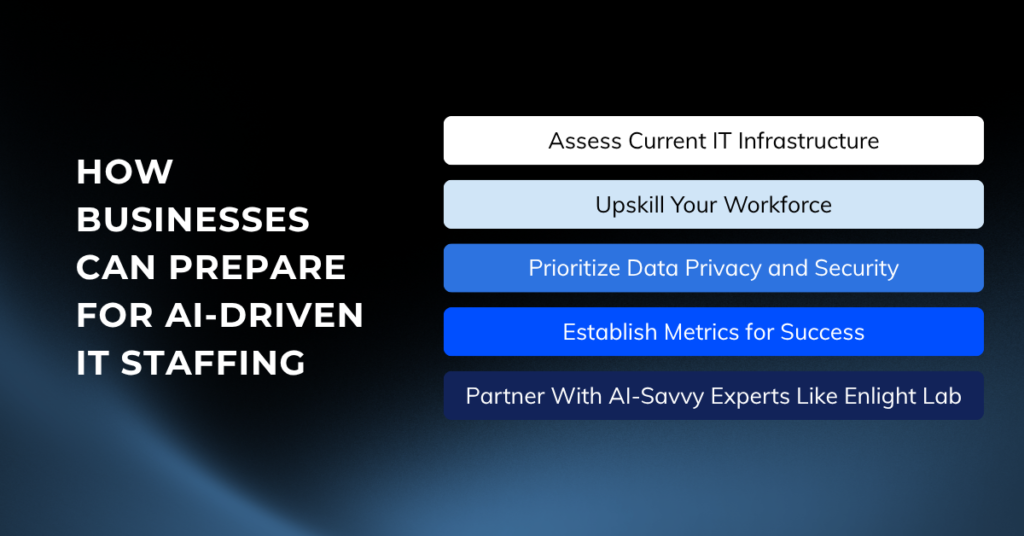
How Businesses Can Prepare for AI‑Driven IT Staffing
Preparing for AI‑driven IT staffing is not about rushing into tools. It is about making smarter choices around partners, platforms, and hiring processes so you get real value instead of surface‑level automation.
Assess Current IT Infrastructure
- Conduct an audit of existing systems to identify gaps or inefficiencies.
- Ensure compatibility with AI-driven staffing platforms.
- Invest in cloud solutions for seamless integration and scalability.
Upskill Your Workforce
- Provide training on AI tools and their applications in staffing.
- Encourage IT teams to acquire certifications in emerging technologies.
- Foster collaboration between IT staff and AI developers.
Prioritize Data Privacy and Security
- Review and update data protection policies.
- Implement robust encryption and access control measures.
- Ensure compliance with local and international cybersecurity standards.
Establish Metrics for Success
- Define clear KPIs for AI performance in staffing automation.
- Regularly evaluate AI-driven staffing outcomes against these benchmarks.
- Use analytics to refine processes and improve efficiency over time.
Partner With AI-Savvy Experts Like Enlight Lab
- Collaborate with providers proficient in AI and staffing integration.
- Request demonstrations or pilot programs to gauge platform effectiveness.
- Choose partners with proven track records in delivering value through AI.
Preparing for AI‑driven IT staffing is less about technology adoption and more about choosing systems and partners that improve hiring quality, speed, and confidence together. When done right, AI becomes a practical advantage rather than a risky experiment.
Stop Wasting Capital on Outdated Hiring Methods
The 2026 staffing landscape heavily favors the orchestrators over the operators. If you or your team spend your days manually cross-referencing spreadsheets and formatting resumes, you are actively losing ground to competitors running highly optimized, AI-native recruiting operations.
You have mountains of applicant data. But turning that raw, fragmented data into actionable hires requires deep architectural thinking and disciplined execution. It requires custom AI tools built for your specific enterprise environment.
At Enlight Lab, we build the AI capabilities your competitors cannot easily replicate. Stop burning capital on inefficient hiring cycles. Partner with us to deploy intelligent, compliant, and highly effective AI staffing solutions.