Building a mobile application without a precise financial roadmap is a fast track to wasted capital. You are bleeding revenue if you delay your digital initiatives, but diving into development blind will drain your resources even faster.
The mobile app development cost in 2026 is not a guessing game. It is a strict calculation based on the complexity of your features, the platforms you target, and the talent you hire. If you underestimate the effort required to build a secure, high-performing app, you risk running out of money before you even reach the app store.
This guide strips away the guesswork. We will break down exactly what drives development prices in 2026, where your money goes, and how you can control your budget without sacrificing quality.
How Much Does It Cost to Develop a Mobile App In 2026?
Basic applications (MVPs) cost between $40,000 and $80,000. Medium-complexity apps with custom interfaces and API integrations range from $80,000 to $150,000. Highly complex, feature-rich apps requiring AI or real-time data process cost anywhere from $150,000 to over $300,000.
Deconstructing Mobile App Development Costs: Key Factors
Your final bill is a direct result of the technical decisions you make on day one. Understanding these core cost drivers gives you control over your budget.
App Complexity
Complexity is the single largest factor determining your cost. The more your app does, the more you pay.
- Basic Functionality Apps ($40,000 – $80,000): These apps feature standard user interfaces, minimal backend requirements, and basic features like user login and form submissions. They are perfect for testing a business idea.
- Medium Complexity Apps ($80,000 – $150,000): This category includes most e-commerce and SaaS applications. They require custom UI/UX, user accounts, API integrations, and payment gateways.
- Highly Complex Apps ($150,000 – $300,000+): These applications process real-time data, integrate artificial intelligence, or utilize augmented reality. They require advanced architecture and intense security measures.
Platform Choice: iOS, Android, or Both?
| Platform | Development Effort | Cost Impact | Best-Fit Scenarios |
| iOS | Moderate to High | High | Premium apps targeting Apple users |
| Android | Moderate to High | Variable (based on scale of testing) | Broad audience or emerging markets |
| Cross-Platform | Lower (compared to native) | Moderate to Low | Apps with simple features targeting both platforms |
Choosing the wrong platform strategy inflates your budget unnecessarily.
- Native App Development: Building separate applications for iOS (using Swift) and Android (using Kotlin) provides the best performance and hardware integration. However, this requires two separate codebases, pushing costs up by 50% to 100%. Expect native builds to start around $100,000.
- Cross-Platform Development: Frameworks like Flutter and React Native allow you to use a single codebase for both platforms. This accelerates development and lowers initial costs to around $60,000 for a solid MVP, though you may face minor performance trade-offs on heavy animations.
- Progressive Web Apps (PWAs): PWAs run in a web browser but feel like native apps. Businesses comparing app and web solutions should also review Web Application Development Cost for 2026 – A Complete Guide before deciding on their digital investment strategy.
(UI/UX) Design Depth
A frustrating user interface actively drives customers to your competitors. Great design is not about making things pretty; it is about reducing friction. Design typically consumes 15% to 25% of your total budget.
- Wireframing and Prototyping: This maps the user journey. Skipping this step leads to expensive code rewrites later.
- User Interface (UI) Design: The visual language of your app. Custom animations and branded visuals increase design hours.
- User Experience (UX) Design: The logic behind the interface. Good UX ensures users can accomplish their goals quickly and intuitively.
Features and Functionality
Every button, screen, and capability translates directly to developer hours.
- User Accounts and Profiles: Simple email logins cost less; multi-factor authentication and biometric logins cost more.
- Push Notifications: Essential for engagement, but requiring distinct backend configurations for iOS and Android.
- In-App Purchases: Integrating payment gateways like Stripe or Apple Pay adds both security requirements and development time.
- Third-Party Integrations: Connecting to external services (like CRMs or marketing tools) adds technical complexity.
- Geolocation and Maps: Building live tracking (like a ride-sharing map) triples the effort compared to standard static maps.
- Security Features: Financial and healthcare apps demand high-end encryption. Compromising here is a massive regulatory risk.
- AI/ML Capabilities: Adding custom machine learning algorithms can significantly increase development costs. Learn more about how AI in Mobile App Development is transforming modern applications and influencing feature complexity.”
Development Team Location and Expertise
Labor accounts for 60% to 70% of your total app cost. Who you hire and where they live, dictates your required capital.
- Onshore vs. Offshore vs. Nearshore: Hiring senior developers in the US or Canada costs $100 to $150 per hour. Offshore teams in Eastern Europe (like Estonia or Romania) deliver excellent work for $20 to $60 per hour.
- Freelancers vs. Agencies: Freelancers are cheaper but require you to act as the project manager. Agencies cost more but provide structured, complete teams and assumed accountability.
- Team Structure: A successful project requires more than coders. You need a Project Manager, UI/UX Designers, Backend Developers, Mobile Developers, and Quality Assurance (QA) testers.
Post-Launch Costs
Your spending does not stop when you launch. Failing to budget for post-launch reality leads to dead applications.
- Maintenance and Updates: Expect to spend 15% to 20% of your initial development cost annually on OS compatibility patches and bug fixes.
- Marketing and Promotion: App Store Optimization (ASO) and user acquisition campaigns are mandatory. If no one knows your app exists, it will fail.
- Cloud Hosting and Infrastructure: Database management and server hosting will cost between $5,000 and $20,000 annually, scaling as your user base grows.
- Customer Support: Active users require technical assistance and issue resolution.
A Deep Dive into Feature-Specific Costs for Mobile App
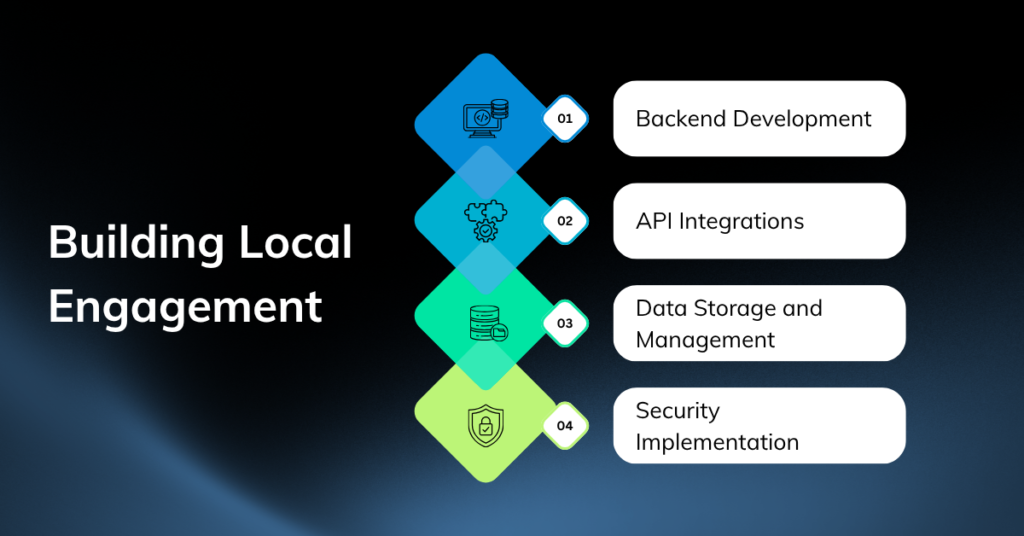
The features you cannot see often cost the most.
Backend Development
Your app is just an empty shell without a backend. A ride-sharing app requiring real-time location updates can easily cost $50,000 to $100,000 in backend development alone. You must plan for user scaling early.
API Integrations
Instead of building a payment processor from scratch, you integrate Stripe. While using APIs saves time compared to custom builds, each integration requires careful testing and ongoing maintenance to ensure it remains stable when the third-party service updates.
Data Storage and Management
You have mountains of data. Managing user records, transaction histories, and media files requires structured databases. Moving too quickly without proper architectural design always leads to crippling technical debt down the road.
Security Implementation
Data breaches destroy companies. Encrypted data storage, secure API endpoints, and continuous monitoring tools are not optional line items. They are mandatory investments.
The Development Process: Stages and Their Impact on Cost
Understanding the phases of development shows you exactly where your hours go.
Discovery and Planning
You define the business logic, target audience, and minimum viable product (MVP). Rushing this phase leads to scope creep and ballooning budgets.
Design Phase
Designers create wireframes and visual assets. This stage ensures the app is intuitive before a single line of code is written.
Development Phase
This is the core coding stage and the most expensive part of the process. Backend and frontend developers build the infrastructure and the user-facing screens.
Testing and Quality Assurance
Releasing a buggy app guarantees bad reviews and high uninstall rates. QA testing requires 20% to 30% of your total budget. Early QA prevents expensive post-launch emergency fixes.
Deployment and Launch
Submitting to the Apple App Store and Google Play requires strict adherence to their guidelines, proper metadata, and structured launch strategies.
Post-Launch Support and Iteration
You monitor real-time user data, fix unexpected crashes, and plan your next feature rollout based on actual customer feedback.
How to Accurately Estimate Your Mobile App Development Cost in 2026
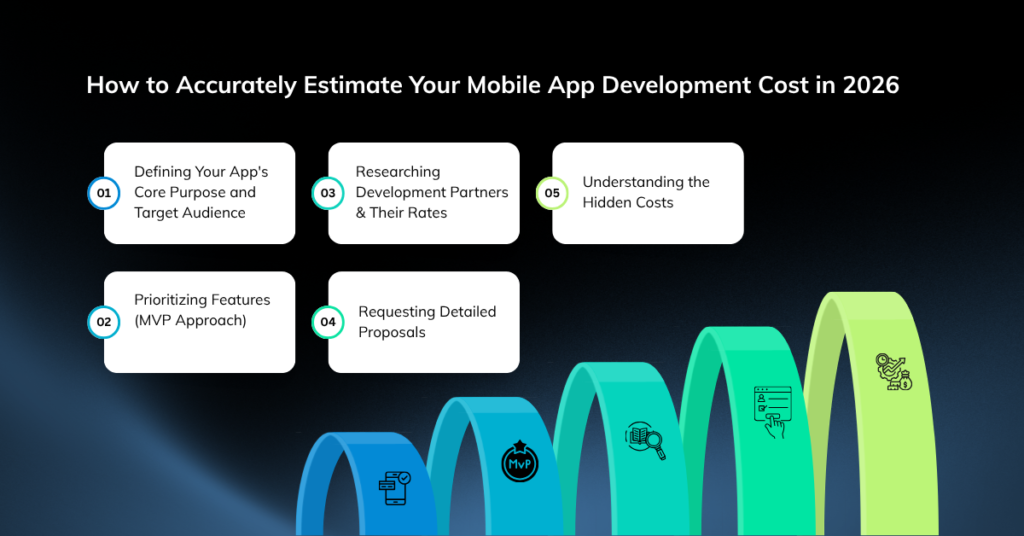
You need a concrete number to secure funding and align stakeholders. Here is how you calculate it.
Defining Your App’s Core Purpose and Target Audience
Write down exactly what problem you are solving. If you cannot explain the app’s value in one sentence, your feature list will be bloated and expensive.
Prioritizing Features (MVP Approach)
Separate your “must-have” features from your “nice-to-have” features. Launching with an MVP allows you to validate your idea with real users before you spend hundreds of thousands of dollars on complex additions.
Researching Development Partners and Their Rates
Compare hourly rates across different regions and agency sizes. Look for partners with proven portfolios in your specific industry.
Requesting Detailed Proposals
Never accept a flat-rate quote without a breakdown. Demand an itemized proposal that outlines hours estimated for design, backend development, frontend development, and QA testing.
Understanding the Hidden Costs
Add a 20% contingency buffer to your budget. Unexpected technical hurdles happen on every software project.
Cost-Saving Strategies Without Sacrificing Quality
You can reduce your total expenditure by making intelligent strategic choices.
Starting with an MVP (Minimum Viable Product)
Do not build a fully featured platform on day one. Build the core functionality, test it in the market, generate revenue, and use that data to fund phase two.
Choosing Cross-Platform Development Wisely
Unless your app requires intense 3D graphics or deep hardware integration, choose cross-platform frameworks like Flutter. You will save roughly 30% on frontend development costs.
Using Existing Solutions and APIs
Do not reinvent the wheel. Use existing cloud services for hosting (AWS, Google Cloud) and pre-built APIs for messaging, payments, and mapping.
Smart Feature Prioritization
Defer complex features like machine learning algorithms or augmented reality filters until you have a proven, paying user base.
Long-Term Maintenance Planning
Write clean, documented code. Spending a little more on a senior developer upfront prevents you from paying an entire team to untangle messy technical debt a year later.
Mobile App Development Cost Breakdown by Different App Types
Abstract numbers are unhelpful. Here is what actual apps cost to build in 2026.
Simple App Example (e.g., Basic Calculator, To-Do List)
- Target: Local business loyalty app.
- Features: User accounts, basic database, push notifications.
- Estimated Cost: $40,000 – $60,000.
Medium Complexity App Example (e.g., E-commerce Store, Social Media Lite)
- Target: Retail store app or fitness tracker.
- Features: Product catalogs, payment gateways, custom workout plans, subscription billing.
- Estimated Cost: $80,000 – $150,000.
Complex App Example (e.g., Ride-Sharing, Advanced FinTech)
- Target: Uber-clone or banking platform.
- Features: Real-time GPS tracking, complex security compliance, complex routing algorithms, high-load scaling.
- Estimated Cost: $150,000 – $350,000+
Hidden Costs of Mobile App Development Most Businesses Ignore
Many businesses plan their budget around development only. That is a mistake. In 2026, the real cost of a mobile app often shows up after launch. If you ignore these expenses, your budget can break quickly.
Here are the most common hidden costs you should plan for from day one.
Ongoing Maintenance
Your app will need regular updates to stay stable and secure. Operating systems change, devices evolve, and bugs appear only after real users start using your app.
Maintenance is not optional. If you skip it, your app performance drops and user trust suffers.
What maintenance usually includes:
- Bug fixes
- OS and device compatibility updates
- Minor feature improvements
Cloud Hosting and APIs
Most mobile apps depend on cloud servers and third‑party services. These services charge monthly or usage‑based fees, not one‑time costs.
As your user base grows, hosting and API usage costs increase. This often surprises teams who only budgeted for development.
Common cost sources:
- Cloud servers and storage
- Push notifications
- Maps, payments, or messaging APIs
App Store Fees
Publishing your app is not free. App stores charge recurring fees just to keep your app live.
While these fees are small compared to development, they are permanent costs that continue every year.
Typical fees include:
- Developer account subscriptions
- In‑app purchase commissions
Security Audits
Security is no longer optional in 2026. If your app handles user data, payments, or sensitive information, you must test it for vulnerabilities.
Security reviews add cost, but skipping them can lead to data breaches, legal issues, and loss of trust.
Security costs may include:
- Vulnerability testing
- Compliance checks
- Data protection reviews
Scaling and Performance Tuning
Your app may work fine with 100 users, but not with 10,000. Scaling requires backend changes, database tuning, and performance optimization.
These costs usually appear when your app starts succeeding.
Scaling efforts often involve:
- Server upgrades
- Load balancing
- Performance monitoring tools
Post‑Launch Feature Updates
Once users start using your app, they will request improvements. Markets change. Competitors evolve. Your app must keep up.
Adding features after launch costs more than building them early, especially if they change core logic.
Common post‑launch updates include:
- New user features
- UX improvements
- Integrations with new tools
Why These Costs Matter
Hidden costs do not mean wasted money. They mean your app is alive and growing. The key is to expect them, not be surprised by them.
If you plan for these costs early, you protect your budget and your roadmap.
Why Choose Enlight Lab for Mobile App Development
Enlight Lab stands out in the competitive landscape of mobile app development by combining technical expertise with a user-focused approach. Our team leverages cutting-edge technologies and proven methodologies to deliver apps that meet both business goals and evolving user expectations.
We focus on four key pillars:
- Scalable Architecture: We build apps designed to grow with your business. We don’t take shortcuts that lead to crippling technical debt. Our focus is on creating a solid foundation that supports future features and increasing user loads without a complete rebuild.
- Performance-Driven Development: We obsess over speed and reliability. Every line of code is written to ensure your app is fast, responsive, and free from the bugs that drive users away. You get a seamless user experience that works flawlessly across devices.
- Clear, Collaborative Process: You are never in the dark. We maintain direct, transparent communication from day one, ensuring the final product aligns perfectly with your vision and business objectives. No surprises, just disciplined execution.
- User-Centric Design: An app that isn’t intuitive is an app that won’t get used. We translate complex user needs into simple, elegant interfaces that feel natural. This isn’t just about aesthetics; it’s about creating an experience that drives adoption and engagement.
Choosing Enlight Lab means you are investing in a partner who is committed to your digital success.
Planning a Mobile App and Want Budget Clarity?
Success in the mobile landscape isn’t achieved through shortcuts or guesswork. It is a deliberate process. By prioritizing performance, security, and usability from the outset, you lay the foundation for a product that drives engagement and builds long-term loyalty.
With the right partner, you gain visibility into mobile app development costs, ongoing maintenance, and future scalability. Connect with Enlight Lab to plan smarter, avoid costly rework, and build a mobile app that continues to deliver value well beyond launch.