Digital transformation is the strategic adoption of digital technologies to redesign business processes, improve customer experiences, and enable data‑driven decision‑making across an organisation.
Relying on outdated systems and manual processes is costing you market share. While you debate the timeline for upgrading your legacy infrastructure, your competitors are actively using data to capture your customers. Enterprise digital transformation is no longer an optional IT project. It is a fundamental survival requirement.
The numbers paint a stark reality. Global spending on digital transformation will reach nearly $4 trillion by 2027, according to IDC research. Yet, research from Boston Consulting Group and McKinsey consistently shows that 70% of these initiatives fail to meet their objectives. That failure rate represents billions of dollars in burned capital and crippled technical debt.
You fear the disruption of a massive overhaul, and rightly so. Ripping out your core systems carries immense operational risk. But the cost of doing nothing is terminal.
If you want to protect your margins and build a resilient business, you must execute a strategic digital transformation guide that actually delivers a return on your investment.
This guide breaks down what digital transformation really means in 2026, why it often fails, and how you can build a practical, results‑driven transformation roadmap that actually works.
What Is Digital Transformation in 2026
Digital transformation in 2026 is the process of using digital technologies to redesign how your enterprise operates, makes decisions, and delivers value. It is no longer about adopting tools. It is about changing how work gets done across your business.
Today, transformation focuses on connected systems, clean data, intelligent automation, and AI‑driven decision‑making. Most enterprises are already on this journey.
Digital Transformation, Defined for Modern Enterprises
At an enterprise level, digital transformation means:
- Modernizing legacy systems so data can move freely
- Automating manual and repetitive processes
- Using analytics and AI to guide decisions, not gut feelings
- Improving customer and employee experiences across every touchpoint
What Are the Key Components of Digital Transformation?
- Strategy and Leadership: Clear alignment between business goals and technological execution.
- Culture and Change Management: Preparing your workforce to adapt to new workflows.
- Process Digitization: Removing manual bottlenecks and automating repetitive tasks.
- Data and Analytics: Building the infrastructure to capture, clean, and use data for decision-making.
- Customer Experience: Redesigning touchpoints to serve user needs faster and more accurately.
Focusing solely on the technology always leads to fragmented workflows and compromised data. Your digital transformation strategy must encompass your people, your processes, and your platforms equally.
Why Immediate Action is Required
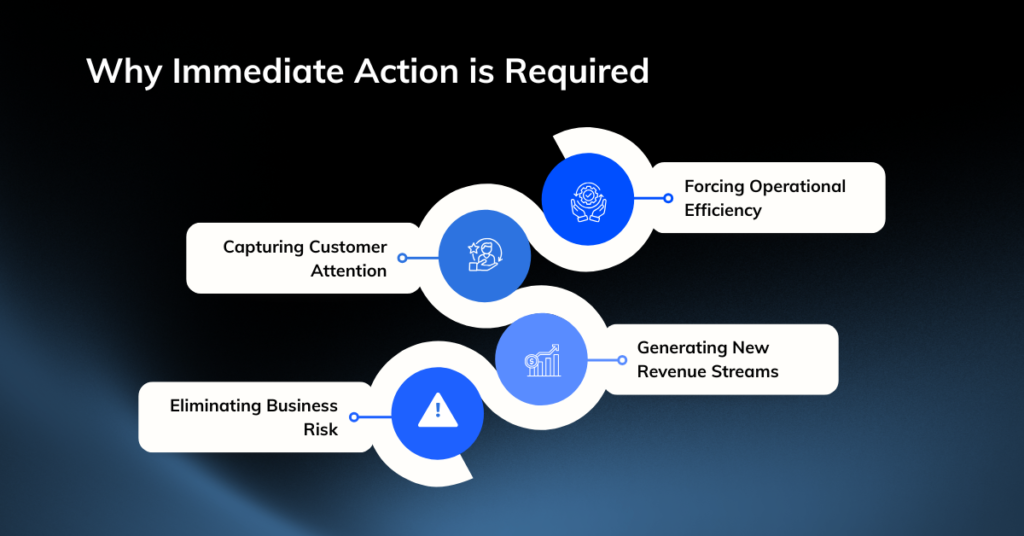
Enterprises adopt digital transformation to improve speed, reduce operational friction, and scale innovation sustainably.
Delaying your digital initiatives creates compounding risk. The longer you wait, the more expensive and painful the transition becomes.
Here’s why digital transformation matters for modern enterprises:
Capturing Customer Attention
Customers abandon companies that force them through slow, disconnected experiences. Upgrading your digital touchpoints directly impacts retention. When you anticipate customer needs using behavioral data, you keep them buying from you instead of your competitors.
Forcing Operational Efficiency
If your team spends its days manually cleaning up spreadsheets, you are actively losing money. Instead of discovering valuable insights, they are stuck doing repetitive data prep work. Automating these workflows reduces human error and strips out massive operational costs.
Generating New Revenue Streams
Legacy business models eventually stagnate. Transitioning to digital platforms allows you to create subscription models, monetize your data, and enter completely new markets with minimal physical overhead.
Eliminating Business Risk
Running on unsupported, legacy hardware is a massive regulatory risk. One security breach can cost you millions in fines and permanently destroy customer trust. Transitioning to modern, secure cloud environments protects your data and ensures business continuity during a crisis.
Key Digital Transformation Technologies Powering Enterprises in 2026
Enterprises that succeed focus on building a connected digital foundation rather than chasing every new trend.
Below are the key technologies powering real, enterprise‑scale transformation today.
Artificial Intelligence and Machine Learning
Artificial Intelligence (AI) and Machine Learning (ML) are at the core of enterprise innovation in 2026. These technologies enable businesses to derive actionable insights from vast amounts of data and optimize operations through predictive analytics and personalized solutions.
Enterprises leveraging AI-driven tools can improve decision-making while maintaining a competitive edge in dynamic markets. Research shows that AI delivers the most value when enterprises redesign workflows around it, not when it is added as a layer on top of existing processes.
Thus, AI now influences growth, workforce design, risk management, and long‑term competitiveness.
Cloud Computing and Cloud‑Native Architecture
Cloud solutions and cloud-native architectures are redefining scalability, efficiency, and flexibility for enterprises. By enabling rapid deployment of applications and seamless integration of services across hybrid and multi-cloud environments, businesses can reduce operational costs and respond quickly to market demands. This modern approach to IT infrastructure ensures resilience and future-ready operations.
Data Engineering and Modern Analytics Platforms
Data engineering and analytics platforms empower organizations to harness data as a strategic asset. Modern tools improve data integration, governance, and real-time processing, allowing enterprises to make well-informed decisions. These platforms drive innovation by uncovering impactful trends and opportunities, fostering proactive responses to shifting customer and market needs.
Automation, RPA, and Intelligent Workflows
Robotic Process Automation (RPA) and intelligent workflow solutions are transforming how enterprises operate by automating repetitive tasks and streamlining processes. These technologies reduce human error, enhance productivity, and free up resources for higher-value activities. Organizations that adopt automation gain a significant advantage through improved operational efficiency and reduced lead times.
Cybersecurity and Zero‑Trust Architecture
Cybersecurity remains paramount, with the rise of sophisticated cyber threats in 2026. A Zero-Trust Architecture ensures robust protection, requiring strict verification for every user and device accessing a network. Enterprises that implement advanced security measures, including endpoint detection, encryption, and identity management, safeguard sensitive data, comply with regulations, and build resilience against emerging threats.
Proactive Steps to Build Your Digital Transformation Roadmap
Moving too quickly without proper architectural design always leads to crippling technical debt down the road. You need a structured, deliberate approach.
Below is a high‑level roadmap that reflects how modern enterprises structure their digital transformation efforts today.
Assess Current Maturity
Audit your:
- Existing technology landscape
- Data silos
- workforce capabilities
Assessing digital maturity and business readiness helps avoid costly misalignment later.
Define Clear Business Outcomes
Digital transformation succeeds when it is anchored to business outcomes, not technology adoption.
At this stage, you need to typically define:
- The business problems transformation should solve
- Where value creation matters most
- Which areas demand modernisation first
Establish exact metrics for success, such as a 20% reduction in processing time.
Identify Technology Requirements
When you build a custom architecture that fits your specific operational needs, you create a capability your competitors cannot easily replicate.
Select the specific tools, such as:
- cloud infrastructure
- AI models
- APIs
to reach your goals.
Execute in Phases
Roll out changes in small, manageable pilot programs rather than a massive, company-wide launch.
Measure Impact and Continuously Optimize
Digital transformation does not have a fixed end date.
You need to continuously:
- Track performance against your KPIs
- Re‑prioritise initiatives
- Adjust based on performance data
Why This Roadmap Works in 2026
This enterprise digital transformation phased approach reflects a shift in how enterprises view transformation:
- From tools to outcomes
- From pilots to scale
- From IT projects to business evolution
By progressing step by step, you can reduce execution risk while building momentum and organisational confidence.
Tracking the Financial Impact
A digital initiative without measurable ROI is just an expensive hobby. You must prove financial impact.
Defining Clear KPIs
Track specific metrics that matter to the board. Monitor customer acquisition cost (CAC), employee productivity hours, and system uptime.
Calculating Return on Investment
Deloitte reports that organizations expect the ROI from tech investments to have jumped significantly since 2024. Track your initial capital expenditure against the operational savings and net new revenue generated by the digital upgrades.
How to Measure Digital Transformation Success
Operational Efficiency Metrics
Operational efficiency is a foundational measure of digital transformation success. Key metrics include cost savings, process automation rates, and employee productivity improvements.
For example, track the reduction in manual tasks or time spent on repetitive workflows, and assess how automation tools streamline operations. Additionally, monitor key performance indicators (KPIs) like system uptime, error rates, and transaction processing times.
These metrics directly correlate with reduced overhead costs and increased organizational agility.
Customer Experience Metrics
Transformation success hinges on improving customer-centric outcomes. Metrics such as Net Promoter Score (NPS), customer satisfaction (CSAT) rates, and churn metrics provide clear insights into customer experience improvements.
Additionally, monitor the adoption rates of new customer-facing digital channels and tools, as well as customer complaint resolution times. Enhancing the overall customer experience is critical to strengthening loyalty and driving long-term value.
Revenue and Growth Indicators
Revenue growth and expansion signify tangible success from digital initiatives. Evaluate revenue streams attributable to digital offerings, increases in market share, and the time-to-market acceleration for new products or services.
Pay close attention to customer acquisition costs (CAC) and lifetime value (LTV) to gauge the profitability of your digital investments. A direct impact on the bottom line validates the effectiveness of your transformation strategy.
Technology and Data Maturity Metrics
Effective digital transformation also relies on assessing technology and data maturity levels. This involves tracking metrics like system integration rates, data accessibility improvements, and the percentage of business decisions made based on data-driven insights.
Evaluate the deployment of emerging technologies such as artificial intelligence or cloud infrastructure and their alignment with organizational goals. Mature technology ecosystems enable sustained innovation and competitiveness.
Common Digital Transformation Challenges Enterprises Face & Their Solutions
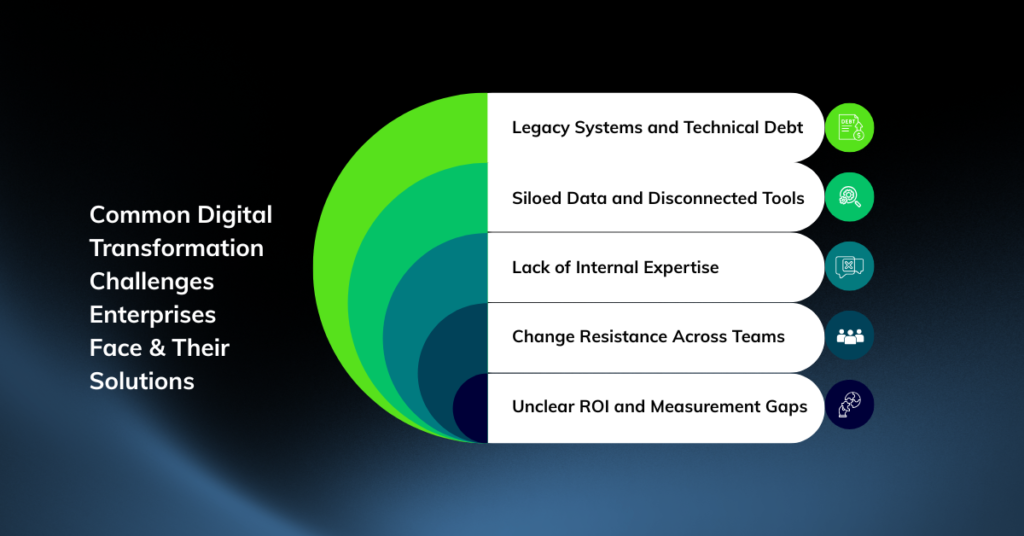
Digital transformation is rarely straightforward. Enterprises attempting to modernize their operations often encounter deep-rooted challenges that can derail progress and limit the impact of even the most well-conceived initiatives.
Below, we examine key pain points that hinder success and discuss why they must be addressed pragmatically.
Legacy Systems and Technical Debt
One of the most significant barriers to digital transformation is the reliance on outdated legacy systems that are deeply ingrained in an organization’s operations. These systems often lack the scalability, flexibility, and integration capabilities needed to support modern initiatives.
Solution:
- Adopt a phased modernization approach that prioritizes critical systems with the highest business impact.
- Leverage cloud migration, microservices, and automation to incrementally replace or enhance legacy infrastructure.
- Ensure appropriate stakeholder buy-in and allocate a dedicated budget to address technical debt over time without disrupting ongoing operations.
Siloed Data and Disconnected Tools
Siloed data and a lack of interoperability between systems prevent organizations from gaining holistic insights and leveraging their full data potential. Disconnected tools also slow down workflows, create inefficiencies, and increase redundancies across teams.
Solution:
- Implement a unified data strategy focused on centralizing and integrating data sources.
- Invest in modern platforms such as data lakes or enterprise data warehouses.
- Ensure all tools integrate seamlessly to enable cross-departmental collaboration.
Lack of Internal Expertise
Another challenge is the skills gap within organizations, where teams lack the technical expertise and experience necessary to implement and manage digital initiatives effectively. This leads to stalled projects and missed opportunities.
Solution:
- Focus on upskilling and reskilling your workforce through targeted training programs.
- Simultaneously, attract external talent capable of accelerating digital efforts.
- Partnering with consulting firms like Enlight Lab can also provide the necessary expertise to bridge gaps during critical phases of transformation.
Change Resistance Across Teams
Resistance to change is a pervasive issue in digital transformation efforts. Employees, wary of new tools and processes, often cling to the familiar, which slows down adoption and limits progress.
Solution:
- Develop a robust change management program, emphasizing transparent communication and the benefits of digital initiatives early in the process.
- Engage teams across departments as stakeholders and champions.
- Provide hands-on training to alleviate concerns and reinforce buy-in.
Unclear ROI and Measurement Gaps
Many organizations struggle with clearly defining the anticipated return on investment (ROI) from digital initiatives. Without robust measurement frameworks, projects can lose focus and fail to deliver measurable business value.
Solution:
- Establish clear metrics and KPIs from the outset to evaluate the impact of digital initiatives.
- Set goals aligned with broader business objectives.
- Regularly review and adapt these metrics to account for evolving priorities.
- Leverage analytics tools to track progress and ROI in real-time.
Digital Transformation Best Practices for Long-Term Success
- Start with outcomes, not tools: Define clear business outcomes before selecting technology solutions to avoid misaligned initiatives.
- Prioritize data before AI: Ensure your data is clean, accessible, and well-structured before integrating AI or advanced analytics.
- Modernize in phases, not all at once: Adopt a phased approach to transformation to reduce risks and ensure manageable implementation.
- Embed security from day one: Incorporate robust security measures into every step of the transformation process to protect sensitive data and systems.
- Partner with experienced delivery teams: Collaborate with a reliable partner like Enlight Lab, who brings expertise and proven methodologies to ensure smooth execution.
Make Digital Transformation Work for Your Enterprise with Enlight Lab
Digital transformation is all about building an organisation that can adapt, scale, and make smarter decisions in a constantly changing market.
You have the capital and the market position. But turning that raw potential into a modernized, highly profitable machine requires far more than buying software. It requires deep architectural thinking, disciplined execution, and a clear alignment with business outcomes.
The cost of waiting is too high! So, do not wait for a crisis to force your hand. Start auditing your legacy systems today, identify your most expensive operational bottleneck, and launch a targeted pilot program to fix it.
Digital transformation succeeds when strategy, technology, and execution move together. If your enterprise is ready to modernise systems, unlock data value, and scale with confidence, consult Enlight Lab. As your right transformation partner, we combine technology, domain expertise, and scalable engineering practices to help your business adapt faster, operate smarter, and unlock sustainable growth in a digital-first world.
Let’s build a strategic digital transformation roadmap together that delivers real business outcomes in no time.