Releasing a basic, static mobile application is a fast track to irrelevance. Users now expect intelligent, predictive experiences that adapt to their specific needs. If your app just sits there waiting for manual clicks, you are bleeding users to competitors who actively anticipate what those users want.
Today, users want apps that understand their behavior, predict what they need next, and automate tasks without friction. Behind these experiences are technologies like machine learning, natural language processing, and computer vision working silently to make mobile apps smarter and more valuable. AI is already shaping how successful apps are built, scaled, and improved.
According to Market.us, the global AI in mobile apps market is projected to reach USD 354.09 billion by 2034. Mobile apps recorded over 142 billion downloads globally in 2025, highlighting the scale and competitiveness of the app ecosystem.
Yet, the vast majority of startups fail to capture this value because they treat AI like a science fair project rather than a core business driver. Poor data foundations, unscalable models, and rushed deployments often surface months later as crippling technical debt.
You need a systematic approach. Understanding how AI functions within a mobile environment separates successful product launches from expensive failures.
This guide provides a direct framework for AI in mobile app development, the concrete business benefits it delivers, and the emerging trends you must prepare for. More importantly, you will learn how to build and ship production-ready AI systems that drive revenue, reduce operational costs, and create an unassailable competitive advantage.
Understanding AI in Mobile App Development
Artificial intelligence is not a single feature you simply turn on. It is a fundamental shift in how your application processes information, interacts with users, and executes tasks. Failing to understand the underlying mechanics guarantees you will choose the wrong architecture, resulting in bloated cloud bills and sluggish app performance.
What exactly is AI in this context?
To build an intelligent mobile application, you must distinguish between the core disciplines of artificial intelligence and where they apply to your business logic.
- Machine Learning (ML): Hardcoding rules for every possible user action is impossible. Machine learning allows your app to recognize patterns from historical data and make predictions without explicit programming. If your app needs to recommend products or flag fraudulent transactions, you need ML.
- Natural Language Processing (NLP): Forcing users to navigate complex menus creates friction. NLP enables your app to understand, interpret, and respond to human text and speech. This powers advanced conversational interfaces, sentiment analysis, and intelligent search functions.
- Computer Vision: Relying entirely on manual data entry slows your users down. Computer vision allows your app to extract actionable information from images and video in real-time. This is the engine behind facial recognition, mobile document scanning, and augmented reality overlays.
How AI Integrates into Mobile Apps
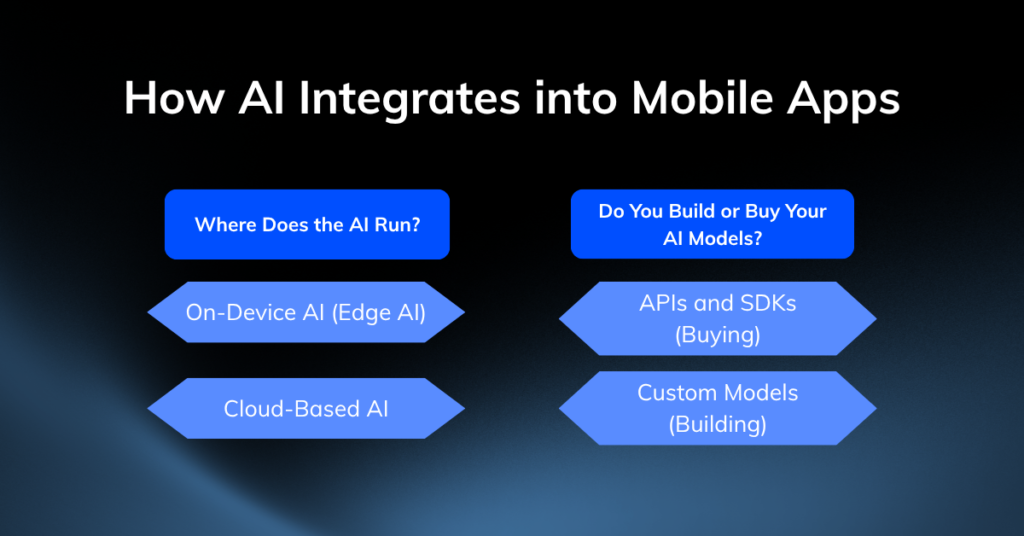
How you integrate AI into your mobile app is not a minor technical choice – it is a foundational business decision. It determines your app’s speed, your infrastructure costs, and your ability to comply with privacy regulations. Make the wrong choice, and you will build a slow, expensive, and insecure product.
There are two critical decisions you must get right.
Decision 1: Where Does the AI Run?
You must decide whether your AI models will run directly on your users’ devices or on your cloud servers. This choice has massive implications for cost, speed, and privacy.
- On-Device AI (Edge AI): This approach runs models directly on the user’s smartphone. It is the only way to guarantee zero-latency responses for features that require real-time processing. Because user data is never sent to an external server, on-device AI solves a huge category of privacy and compliance risks from day one. This is the correct path for features that demand speed and handle sensitive information.
- Cloud-Based AI: This approach sends user data to your servers for processing. It is necessary for extremely large, computationally intensive models that a smartphone cannot handle – think training a new large language model. But this power comes at a high cost: every user interaction adds to your server bill, and you introduce significant latency. You are also now responsible for securing vast amounts of user data in transit and at rest, a massive regulatory risk.
Decision 2: Do You Build or Buy Your AI Models?
Building every AI model from scratch is a fast track to wasted resources. Your engineering budget is finite; you must decide whether to build a proprietary model or integrate a pre-built one.
- APIs and SDKs (Buying): You can integrate powerful, established AI capabilities in a matter of days using Application Programming Interfaces (APIs) and Software Development Kits (SDKs) from providers like Google, AWS, or OpenAI. For standard functions like speech-to-text, translation, or basic image recognition, this is the smart choice. It accelerates your time to market and allows you to test AI features without a six-figure upfront investment.
- Custom Models (Building): Building a proprietary model only makes sense when the AI itself is your core competitive advantage. This path requires a dedicated team of machine learning engineers, access to massive datasets, and a budget that can run into the hundreds of thousands or even millions of dollars. Do not commit to building a custom model unless it is absolutely central to your unique value proposition.
Current Applications of AI in Mobile Apps
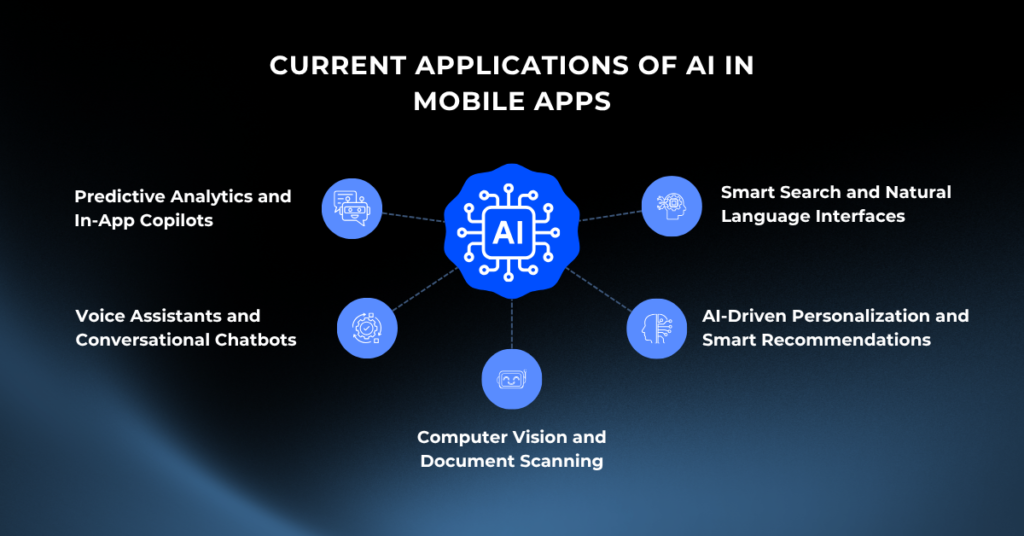
Theory only matters when it translates into functional software. Here is how AI currently operates in top-tier mobile applications.
Predictive Analytics and In-App Copilots
AI does not just react. It predicts.
By analyzing past behavior, AI can guess what a user might do next. It can predict when someone might abandon a cart, cancel a subscription, or need support.
Modern AI copilots do not just answer questions; they actively help users complete multi-step workflows.
In logistics apps, predictive systems analyze traffic, weather, and delivery windows to recalculate routes dynamically.
In financial apps, copilots guide users through complex account setups by predicting their financial goals based on initial inputs.
Voice Assistants and Conversational Chatbots
Today’s users expect instant answers. AI‑powered chatbots and voice assistants help you deliver exactly that. These tools use natural language processing to understand what users say or type and respond in a human‑like way.
If you add AI chatbots to your app, you can handle customer questions 24/7, reduce support costs, and give users quick help without making them wait. Voice‑enabled features also make your app more accessible and easier to use, especially when users are on the move.
Computer Vision and Document Scanning
Typing long strings of text on a mobile screen creates friction. Computer vision eliminates this. Image and facial recognition allow apps to identify objects, analyse faces, scan documents, or enable secure logins.
Real estate apps allow users to photograph a property, and the AI instantly extracts architectural details.
Healthcare apps use visual recognition to securely scan and digitize insurance cards. This reduces a two-minute manual process to a three-second automated action.
AI-Driven Personalization and Smart Recommendations
Generic content feeds drive users to your competitors. AI algorithms analyze a user’s past behavior, search history, and interaction metrics to curate a hyper-personalized experience in real-time.
- E-commerce personalization: Modern retail apps don’t just show top-selling items. They use machine learning to build personalized shopping feeds, predicting what a user wants to buy next.
- Measurable impact: By analyzing dwell time on product images and past purchase history, these apps increase average order value by up to 30%.
Smart Search and Natural Language Interfaces
Traditional search forces users to adjust to the app. AI‑powered search flips that around.
With AI, users can search the way they talk, not the way software expects them to.
If someone types or says a full question, AI understands the intent and shows accurate results. This makes your app easier to use, especially for new users. Better search means users find what they need faster and get more value from your app.
Key Benefits of AI in Mobile App Development
Manual operations and generic user interfaces drain your budget. When you build AI into your mobile product, you replace expensive manual labor with automated systems and replace high user churn with deep engagement.
Drastically Reduced Operational Costs
If your team spends its days answering routine customer support questions or manually verifying documents, you are actively losing money.
AI-powered copilots and chatbots handle routine inquiries instantly. Computer vision tools extract data from uploaded documents in seconds, eliminating manual data entry. Automating these workflows reduces operational costs significantly.
Instead of hiring more support staff as your user base grows, your AI infrastructure scales the workload automatically.
Competitive Advantage and Innovation
Anyone can build a basic mobile application. Relying on standard features means you are competing solely on marketing spend, which is a race to the bottom.
When you build custom AI models into your application, you create a capability your competitors cannot easily replicate. Proprietary algorithms trained on your unique user data create a massive protective moat around your business. With the integration of AI in Mobile App Development, you will be staying ahead in a crowded market:
Higher User Retention
Acquiring a new user costs five to twenty times more than retaining an existing one. A static app that requires users to do all the work leads to steep abandonment rates within the first 30 days.
AI personalization engines analyze interaction patterns to adapt the interface dynamically. They predict what the user wants to do next and surface the relevant content or feature automatically.
A user who experiences a highly personalized journey is far less likely to delete your app. You create a switching cost; users will not abandon an app that already knows exactly what they need.
Data-Driven Decision Making
Relying on gut feelings for your product roadmap leads to wasted engineering hours. AI analytics processes millions of data points to identify exact drop-off moments and feature usage trends.
You can see precisely where users struggle and which features drive revenue. This allows you to allocate your development budget toward updates that actually generate a return on investment.
New Revenue Streams and Business Models
Monetizing a standard app relies heavily on ads or basic subscriptions. AI opens entirely new avenues for generating cash flow.
Users are willing to pay for intelligent utility. You can gate advanced predictive insights, automated reporting, or hyper-personalized coaching behind premium subscription tiers, directly increasing your customer lifetime value (LTV). When you integrate AI in a mobile application, you can gain premium AI features and services.
Cost of AI in Mobile App Development
If you are thinking about adding AI to your mobile app, one of your first questions is probably about cost. The truth is, there is no single price tag. The cost of AI in mobile app development depends on what you want AI to do, how complex the solution is, and how much scalability you need.
- Basic AI features (chatbots, smart search, basic recommendations): lower investment
- Mid‑level AI apps (personalisation engines, predictive analytics, NLP features): moderate investment
- Advanced AI apps (computer vision, fraud detection, generative AI): higher investment
The good news is, today, businesses of all sizes can use AI if it is planned the right way.
Your Journey with AI: Getting Started and Avoiding Pitfalls
Knowing the benefits of AI in Mobile app development is useless if you botch the execution. Moving quickly without proper architectural design always leads to fragile systems. You need a disciplined, rigorous approach to bringing AI into your mobile product.
Identifying the Right AI Use Case for Your App
Do not build AI features looking for a problem. This results in expensive, ignored gimmicks.
Building AI features without a clear problem to solve results in expensive, ignored gimmicks. Your focus must be on solving real user problems.
- Start with the user journey. Audit your app to find where users abandon their tasks or which actions take them the longest. This data reveals your highest-impact opportunities.
- Connect AI to a failing metric. If users struggle to find products, your problem is discoverability; you need an AI recommendation engine. If customer support wait times are too high, your problem is response time; you need an NLP-powered agent.
- Define success before you build. A clear link between the AI initiative and a business KPI is non-negotiable. This ensures you build a capability, not a science project.
Data Strategy: The Fuel for Your AI
Your AI model is only as intelligent as the data it consumes. Training an algorithm on messy, fragmented data guarantees inaccurate, harmful outputs. Without a data strategy, your AI project is dead on arrival.
Before you hire a single machine learning engineer, you must establish a rigorous data pipeline that addresses:
- Collection: You need secure, transparent methods for gathering user data and business metrics.
- Cleaning & Structuring: Your data must be automatically processed, standardized, and made ready for model training. Raw data is unusable.
- Ethical Use & Compliance: You need strict frameworks to ensure you are not violating privacy laws like GDPR or CCPA. This is a massive regulatory risk.
Choosing the Right Partner for AI in Mobile App Development
Hiring an agency that learns AI on your dime will kill your runway. Traditional software shops lack the specialized expertise to build scalable ML architectures. They deliver products that work in a demo but crash in production.
You need a partner with expertise, experience, and a deep understanding of your vision. At Enlight Lab, we focus on shipping production-ready systems, not showcasing isolated pilots. We provide a unified execution strategy that gets you to market faster and more reliably.
Here is how we deliver:
- CTO-as-a-Service: We provide senior-level technical leadership to guide your AI strategy and ensure it aligns directly with your revenue goals.
- AI Consulting & Agent Development: We design and build battle-tested AI systems, from initial architecture to full-scale deployment, using senior-only talent.
- Unified Execution: We integrate AI development directly into your core product, creating intelligent systems designed to scale with your user base from day one.
The Future of AI in Mobile App Development
The capabilities of mobile AI are expanding rapidly. Understanding the trends for 2025 and 2026 ensures you build an architecture capable of supporting tomorrow’s features.
Agentic AI Systems
Apps are moving from passive tools to active agents. Agentic AI systems break complex user requests into smaller steps, using multiple tools to accomplish a goal without constant human supervision. Instead of a user manually comparing flights, booking a hotel, and setting a calendar reminder, an agentic mobile app will handle the entire sequence through one simple command.
Voice and Multimodal Interfaces
Typing is becoming a secondary input method. Multimodal AI understands voice commands, visual context, and text simultaneously. Users will point their phone camera at a broken appliance and ask, “How do I fix this part?” The app will understand the visual input and the spoken question, providing a precise, contextual answer.
Hyper-Personalization at the Edge
As mobile processors become more powerful, true hyper-personalization will happen entirely on the device. Apps will learn user habits, schedules, and preferences locally. This “Edge AI” will allow applications to adjust their entire layout and functionality based on the time of day and the user’s location, all without pinging a cloud server.
Stop Experimenting! Start Building Scalable AI Mobile Apps with Enlight Lab
AI in mobile app development is no longer about experimentation. It is about building apps that learn, adapt, and deliver value with every user interaction. If your app still relies on static features, you risk falling behind user expectations and faster‑moving competitors.
The smart next step is to start small but think long term. Identify one AI use case that directly improves user experience, automate what slows your team down, and let data guide every decision.
When you approach AI with a clear purpose and the right strategy, it stops being complex and starts driving real growth.
Anyone can buy a SaaS subscription. When you build a custom AI solution, you create a capability your competitors cannot easily replicate. But you need the right technical partner to execute that vision.
If your goal is to build a mobile app that is smarter today and ready for what comes next, now is the time to act. Partner with Enlight Lab and turn AI into a real competitive advantage for your mobile app.