Every missed call, unresolved ticket, and generic marketing email is actively losing you money. When your customers encounter friction, they don’t complain. They simply leave.
Research from Zendesk shows that 83% of customer experience leaders believe customers will leave a brand after just one unresolved issue, highlighting why fast and accurate resolution is critical in the AI‑driven CX era.
Today’s consumers expect 24/7 availability, instant responses, and seamless interactions across channels. Trying to meet these demands with outdated systems and traditional staffing models only leads to rising costs and growing technical debt.
Artificial intelligence changes this equation entirely. The AI customer service market is projected to reach $47.8 billion by 2030, and by the end of 2026, AI assistants are expected to drive 37% of all customer interactions. When AI in customer experience is implemented correctly, it reduces operational costs, shortens wait times, and delivers the personalized experiences your customers expect.
This guide breaks down how to stop customer churn using five specific AI strategies for CX. More importantly, you’ll learn the key benefits and frameworks needed to implement each one effectively.
AI in Customer Experience: What Does It Mean?
AI in customer experience is powered by a combination of advanced technologies that work together to deliver intelligent interactions:
- Machine learning helps systems learn from past customer behaviour and improve decision‑making over time
- Natural language processing (NLP) enables AI to understand and respond to customer conversations in a human‑like way
- Predictive analytics allows businesses to anticipate customer needs, churn risk, or purchase intent before they occur
- Generative AI supports personalised responses, recommendations, and automated content across channels.
Together, these technologies transform customer experience from reactive support into proactive, data‑driven engagement.
The Five Winning Strategies Using AI in Customer Experience
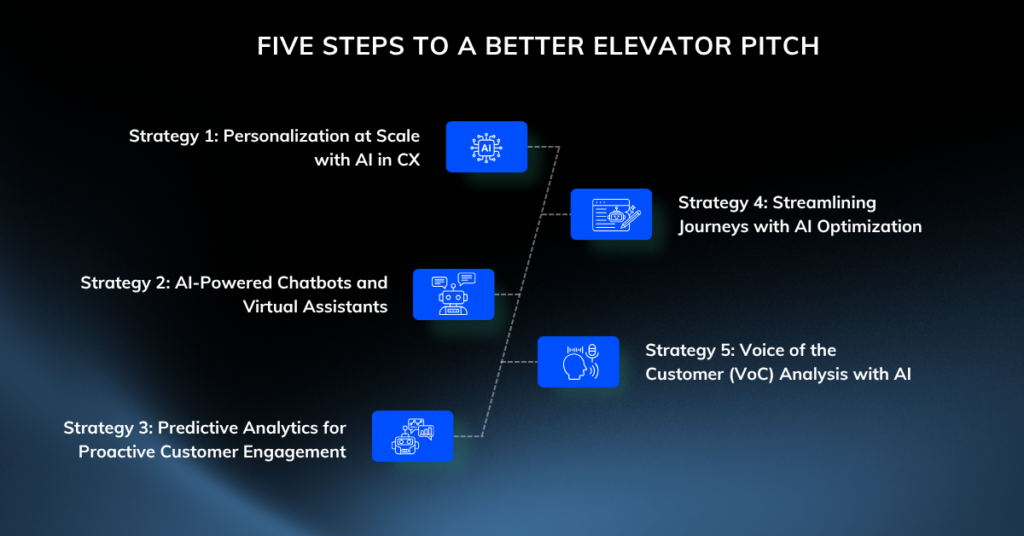
Here are the five strategies you need to implement to transform your customer experience.
Strategy 1: Personalization at Scale with AI in CX
Treating every customer the same guarantees you will lose them. Generic product recommendations and mass-blast emails tell your buyers that you do not understand their needs.
You have mountains of customer data sitting in your CRM, website analytics, and purchase histories. But turning that raw, fragmented data into actionable insight requires memory-rich AI. In fact, 83% of CX leaders state that memory-rich AI agents are the key to truly personalized journeys. AI in CX analyzes behavioral patterns in real-time to create hyper-personalized experiences that feel bespoke to the individual user.
Why Personalization Matters
AI-driven personalization shifts customer experience from a deterministic model (rule-based, one-size-fits-all) to an intelligent, context-aware model.
This transition:
- Enhances relevance in every interaction
- Builds stronger emotional connections
- Increases customer loyalty and retention
When customers feel understood, they are more likely to engage, convert, and remain loyal.
Key Use Cases for AI Personalization
- Dynamic Product Recommendations: AI models analyze past purchases and browsing behavior to shortlist options and suggest products with high conversion probability.
- Tailored Communication: Generative AI crafts messaging that aligns with the specific tone, timing, and channel preferences of individual users.
- Contextual Continuity: Customers can drop text, images, and video into the same support thread without restarting the conversation, a feature 76% of customers actively demand.
- Personalized Website Journeys: AI can dynamically alter a website’s layout, promotions, and content for each visitor. A first-time visitor might see an introductory offer, while a loyal customer sees exclusive access to new products. This creates a unique pathway for every user, guiding them toward their goals with minimal friction.
When you deploy AI to handle personalization, you shift from a deterministic model to one where context feeds intelligence. This directly impacts customer loyalty, as buyers feel understood and guided with clarity.
How AI Powers Personalization
AI-driven personalization works by continuously analyzing multiple data signals together:
- Browsing behavior: Clicks, time spent, drop-offs, and repeat visits help identify customer intent.
- Purchase history: Reveals preferences, buying patterns, and potential customer value.
- Interaction context: Includes device type, channel, location, and recent conversations to guide responses.
Strategy 2: AI-Powered Chatbots and Virtual Assistants
Making your customers wait on hold for hours is a massive regulatory and reputational risk. The average business misses over 60% of incoming calls during business hours, and 85% of those unanswered callers never try again. That is lost revenue walking out the door.
Customer Experience AI solves this by deploying intelligent virtual assistants and autonomous agents that handle routine inquiries instantly. These are not the rigid, frustrating decision trees of the past. Modern AI chatbots resolve up to 80% of routine tasks and customer inquiries without human intervention.
Tangible Efficiency Gains
- Slashed Resolution Times: Companies implementing AI have reduced resolution times from 32 hours to just 32 minutes.
- Round-the-Clock Availability: AI operates 24/7 without fatigue, answering queries instantly regardless of the time zone.
- Human Agent Productivity: When AI handles the repetitive queries, human reps spend 20% less time on routine cases. This frees up your expensive human capital to handle the complex, high-stakes conversations that require genuine empathy and creative problem-solving.
Strategy 3: Predictive Analytics for Proactive Customer Engagement
Waiting for a customer to report a problem means you are already losing the relationship. Reactive customer service forces your team into a constant state of firefighting, which drains resources and frustrates buyers.
Predictive analytics flips this model. By feeding historical data and behavioral signals into machine learning algorithms, AI anticipates customer needs and identifies potential issues before the customer even realizes they exist.
Proactive Applications
- Churn Prediction: AI identifies the subtle behavioral shifts—like decreased login frequency or ignored emails—that precede a cancellation, allowing your team to intervene with targeted retention offers.
- Inventory and Supply Chain Communication: If an algorithm detects a likely shipping delay, it automatically triggers a proactive apology and update to the customer, neutralizing anger before they pick up the phone.
- Predictive Maintenance: For hardware and SaaS providers, AI monitors system health to detect anomalies, triggering service tickets before a system failure impacts the end user.
Moving from reactive support to proactive engagement requires deep architectural thinking, but the result is a massive reduction in support volume and a significant spike in customer trust.
Strategy 4: Streamlining Journeys with AI Optimization
Friction in your digital experience directly suppresses your conversion rate. If a user struggles to navigate your website, complete a checkout process, or finish an onboarding flow, they will abandon the process entirely.
AI maps the entire customer journey, analyzing thousands of user sessions to identify exactly where customers are dropping off. It pinpoints the broken links, confusing interfaces, and overly complex forms that cost you money.
Optimizing Touchpoints
- Frictionless Checkout: AI analyzes cart abandonment data to dynamically adjust the checkout flow, offering alternative payment methods or instant support right when the user hesitates.
- Intuitive Onboarding: AI-driven platforms adapt the onboarding experience based on user behavior, providing contextual tooltips only when the user shows signs of confusion.
- Self-Service Optimization: Promptable analytics unlock insights in seconds that once took analysts weeks, allowing you to rapidly redesign self-service portals based on exactly what customers are searching for.
Strategy 5: Voice of the Customer (VoC) Analysis with AI
If you rely solely on quarterly surveys to understand customer sentiment, you are operating blindly. Customers are constantly talking about your brand across support tickets, social media, online reviews, and call transcripts. Manually reading and categorizing this feedback is impossible at scale.
AI processes this vast ocean of unstructured text and voice data instantly. Using Natural Language Processing (NLP) and sentiment analysis, AI extracts the core themes and emotions driving customer behavior.
Transforming Feedback into Strategy
- Sentiment Tracking: Algorithms assign positive, neutral, or negative scores to interactions, giving you a real-time pulse on brand health.
- Topic Extraction: AI automatically categorizes support tickets, highlighting sudden spikes in specific product issues or bugs so your product team can issue rapid fixes.
- Competitor Analysis: AI scrapes public reviews of your competitors, identifying exactly what their customers hate, giving you a clear roadmap for market differentiation.
Challenges and Considerations in Implementing AI for CX
Adopting these systems is not without significant hurdles. Moving blindly into AI deployment without addressing the underlying risks will stall your initiatives and waste your budget. Slapping a generic AI chatbot onto a broken customer journey will only accelerate customer frustration.
Data Privacy and Security
You cannot deploy AI without strict data governance. 32% of consumers state they will not share personal data with AI agents, and a failure to meet moral expectations regarding data privacy will trigger mass uninstalls and brand abandonment. You must prioritize transparency and give consumers clear control over their first-party data.
Integration Complexities
Buying a SaaS subscription is easy. Integrating it deeply into your proprietary CRM, billing, and inventory systems is difficult. Moving too quickly without proper architectural design always leads to data silos and fragmented workflows.
Human Oversight
AI is not a set-it-and-forget-it solution. AI models require continuous training, auditing for bias, and a seamless escalation path to human agents for complex, high-urgency issues. Balancing digital efficiency with human connection is the core challenge of modern CX.
Key Benefits of Using AI in Customer Experience
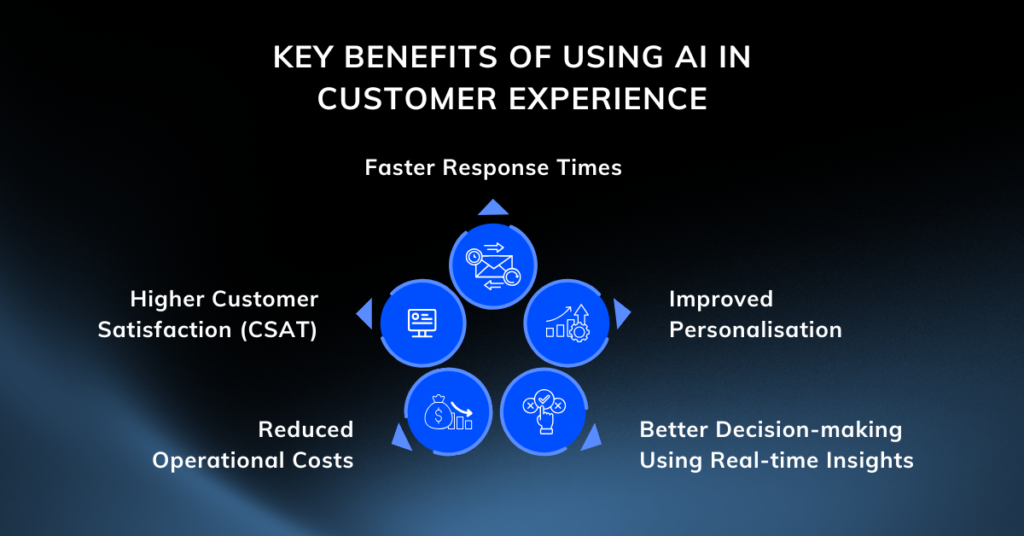
When you apply AI thoughtfully across your customer experience, the impact goes far beyond automation. You create faster, more relevant interactions while improving efficiency and decision‑making across the organisation.
The most visible benefits show up in the areas that matter most to your customers and your business.
Faster Response Times
With AI handling routine queries, intent detection, and intelligent routing, you can respond to customers instantly across channels. Instead of long wait times or manual triage, AI ensures customers receive quick, accurate answers whenever they engage. This speed reduces friction and keeps journeys moving forward, especially at high‑volume moments such as onboarding, checkout, or support spikes.
Higher Customer Satisfaction (CSAT)
Faster responses alone are not enough. AI improves satisfaction by making interactions feel relevant and contextual. When customers do not have to repeat themselves and receive support that reflects their history and intent, experiences feel smoother and more respectful. This consistency directly contributes to higher CSAT and stronger trust over time.
Reduced Operational Costs
By automating repetitive tasks and resolving a large share of interactions without human intervention, you lower the cost to serve without sacrificing quality. AI allows your teams to focus on complex or high‑value conversations rather than routine issues, improving productivity while controlling support and service costs.
Improved Personalisation
AI enables you to personalise experiences at scale by analysing behaviour, preferences, and context in real time. Instead of one‑size‑fits‑all journeys, you can deliver tailored content, recommendations, and support that feel genuinely helpful. This relevance drives deeper engagement and encourages long‑term loyalty.
Better Decision‑making Using Real‑time Insights
AI turns live customer data into actionable insight. You can identify trends, detect issues early, and make informed decisions faster. Rather than relying on delayed reports or assumptions, you respond based on what customers are actually experiencing in the moment.
Transform Your Customer Experience Using AI with Enlight Lab
Ignoring the AI revolution guarantees your competitors will outpace you. The businesses that thrive will be those that integrate intelligent automation to slash operational costs while delivering deeply personalized, zero-friction experiences. You need a solution that answers every call, resolves routine tickets instantly, and transforms your fragmented data into a unified, actionable customer view.
Anyone can buy a basic software subscription. When you build a custom AI solution, you create a capability your competitors cannot easily replicate.
Stop bleeding revenue to outdated customer service models. Start converting your customer friction into growth. Partner with Enlight Lab to architect and deploy AI-powered web, mobile, and enterprise solutions tailored to your exact business needs.