You already know everyone is talking about AI, but only a few are actually ready.
AI is shaping how companies operate, make decisions, and compete.
Here is the reality of 2026. AI tools are everywhere. Your competitors are announcing AI pilots. Your board is asking about your AI strategy. And you, the founder, the CTO, or the entrepreneur running this company, are sitting with a nagging question you have not said out loud yet:
“Are we actually ready for this, or are we about to waste a significant amount of money?”
That anxiety is the correct instinct. Adopting AI is not the hard part. Making it work is.
Across industries, businesses are experimenting with AI tools. Yet only a fraction are able to scale those initiatives into real business outcomes. Many projects stall. Others fail quietly.
The reason is not lack of ambition. It is lack of readiness.
Before you build, deploy, or invest further, you need clarity on whether your organization is truly prepared to succeed with AI or not.
That is where AI Readiness Assessment becomes critical. You can very frequently take the online assessment test using the free AI-ready tool to get AI maturity score instantly for your company. No sales call required.
This guide will help you understand what AI readiness really means, why most initiatives fail without it, and how you can get a concrete score in 5 minutes and evaluate your current state for better improvement.
What Is an AI Readiness Assessment
An AI Readiness Assessment is a structured evaluation that measures an organization’s ability to successfully adopt, implement, and scale artificial intelligence initiatives. It analyzes your business strategy, data quality, technology infrastructure, and workforce capabilities to identify gaps and priorities before AI deployment.
What an AI Readiness Assessment Actually Measures
Most companies assume AI readiness is about having the right software or the biggest cloud budget. It is not. Genuine AI readiness is about whether your company’s foundations can support AI doing real work, at scale, without breaking everything around it.
Here’s a list of key areas evaluated:
- Business strategy and leadership alignment
- Data quality, accessibility, and governance
- Technology infrastructure and integration readiness
- Skills, talent, and organizational culture
- Security, compliance, and AI governance
- Use-case feasibility and execution capability
Why AI Readiness Assessment Matters
- Prevents costly failed AI investments
- Creates clarity on where to start
- Aligns AI initiatives with business goals
- Builds a roadmap for scalable execution
Why Most AI Initiatives Fail Without an AI Readiness Assessment
Let us address what most founders and CTOs experience but rarely articulate.
You invest in AI tools. You launch a pilot. The early results look promising. Then things slow down.
Signs your company is not AI-ready:
- The data is inconsistent
- Teams are unclear on how to use AI
- You rely heavily on external vendors without internal capability
- Integration becomes complicated
- ROI is difficult to measure
- There is no clear ownership of AI strategy
Eventually, the initiative either stalls or delivers far less than expected. This is not a technology failure. It is a readiness failure.
Many organizations jump straight into implementation without understanding their true capabilities. Research consistently shows that AI projects struggle to move from pilot to production, largely because foundational elements like data, governance, and alignment are missing.
You are not alone if you recognize this pattern. What separates successful AI-driven organizations from the rest is their ability to prepare before they build.
The 4 Invisible Pillars of AI Maturity
The Enlight Lab AI Readiness Assessment framework evaluates four pillars. Each one is a multiplier, not a checkbox. Weakness in any single pillar will cap the performance of every other.
Pillar 1: Data Infrastructure for AI
This is the most underestimated pillar and the most common reason AI projects fail at the first hurdle.
Data infrastructure for AI is not just about having data. Every company has data. The question is whether that data is:
- Centralized and accessible, or scattered across ten different tools and spreadsheets
- Clean and consistent, or riddled with duplicate records, format mismatches, and missing fields
- Governed and secure, or a compliance liability waiting to surface
- Structured for machine learning, or only readable by the humans who built the system
If your data lives in silos, AI cannot learn from it effectively. If your pipelines are manual, AI cannot operate in real time. Weak data infrastructure is the single most common reason AI pilots never move to production.
The AI Readiness Assessment tool scores your data infrastructure across these exact dimensions, so you know precisely what to fix before you spend on models or platforms.
Pillar 2: Technology Stack Compatibility
Your current tech stack is either an accelerant or a ceiling for AI adoption.
This pillar is not about whether you use the latest tools. It is about whether your existing stack can:
- Integrate with modern AI APIs and platforms without a 6-month engineering overhaul
- Handle the data throughput that AI workloads demand
- Scale compute resources dynamically without catastrophic cost spikes
- Support the model deployment and monitoring infrastructure your team will need
A CTO who skips this evaluation often discovers mid-project that their legacy infrastructure requires a full rebuild just to run the AI use case they already promised to the board. That is an expensive surprise to avoid.
Pillar 3: Organizational Culture and AI Literacy
This is the pillar that nobody wants to talk about and the one that derails more AI rollouts than any technical failure.
AI implementation is not a technology project. It is a change management project that happens to involve technology.
Your AI Readiness Assessment must evaluate:
- Whether leadership actively champions AI adoption or passively tolerates it
- The current AI literacy level of department heads and individual contributors
- How your teams historically respond to new tools and workflow changes
- Whether there is a culture of data-driven decision-making or gut-driven instinct
- The presence (or absence) of an internal AI champion or Center of Excellence
An organization that scores high on data and technology but low on culture will still fail. People will route around the AI tools. They will not trust the outputs. The ROI will not materialize.
Pillar 4: Process Maturity and AI Use Case Fit
Not every business process is a good candidate for AI, and not every company has the process documentation needed to train or deploy AI effectively.
This pillar evaluates:
- Whether your core workflows are documented, repeatable, and measurable
- The degree to which existing processes generate structured, usable output data
- How clearly your teams can define the “before” and “after” of a successful AI intervention
- The presence of a prioritized backlog of AI use cases, or the absence of one
The highest-ROI AI implementations come from companies that knew exactly which processes to target first. That clarity comes from process maturity, not from the AI tool itself.
Want to know where you stand on all four pillars right now?
Get your free AI Readiness Assessment score at Enlight Lab. The tool evaluates all four pillars and returns your AI maturity score with a personalized gap analysis in minutes.
The 5 Tiers of AI Evolution: Where Does Your Company Belong?
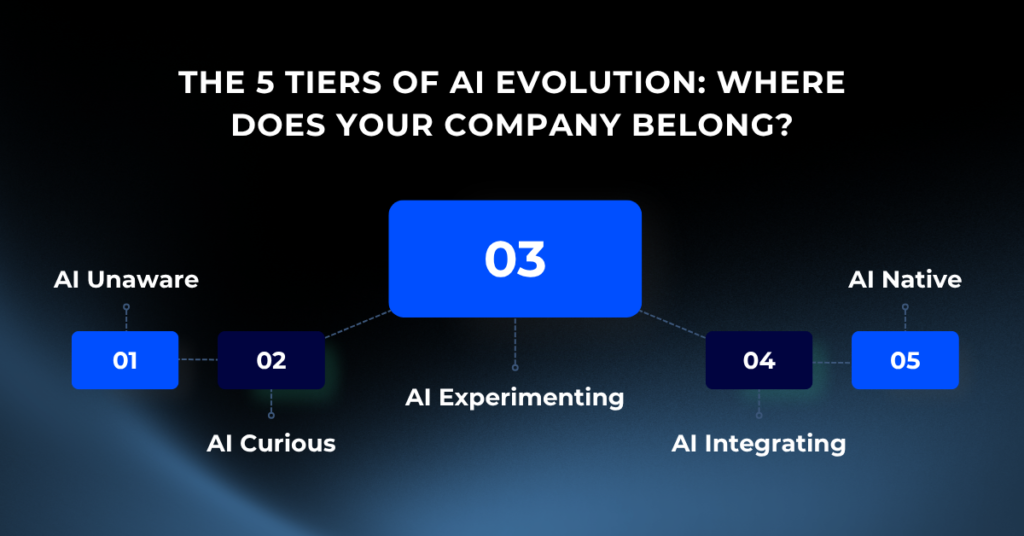
Understanding your tier is the first step toward building a credible AI implementation roadmap. Most companies dramatically overestimate their tier, which is exactly why projects fail.
Tier 1: AI Unaware
- No formal AI strategy exists
- Data is fragmented across tools with no governance model
- Leadership views AI as a trend to monitor, not a capability to build
- Risk: Being structurally unable to compete within 24 months
Tier 2: AI Curious
- Leadership has recognized AI as a priority but no concrete steps have been taken
- Occasional AI tool experimentation at the individual level (ChatGPT for copywriting, Notion AI for notes)
- No integration between AI tools and core business systems
- Risk: Expensive reactive investment when competitive pressure peaks
Tier 3: AI Experimenting
- Defined AI pilot projects underway, typically in one or two departments
- Some data infrastructure improvements in progress
- Early wins exist but have not scaled or connected to revenue metrics
- Risk: Pilot purgatory: the inability to move from experiments to production
Tier 4: AI Integrating
- AI is embedded in at least two to three core workflows with measurable KPIs
- Dedicated AI maturity score tracking and quarterly review cadence
- Cross-functional team alignment on AI priorities and data governance standards
- Opportunity: Ready to build proprietary AI advantages that are difficult to replicate
Tier 5: AI Native
- AI is a core component of the product, operations, and growth strategy
- Continuous AI model monitoring and improvement pipelines are running
- The organization has compounding AI advantages: better data leads to better models leads to better outcomes
- Opportunity: Market leader position that compounds over time
Most companies reading this are somewhere between Tier 2 and Tier 3. The gap between where you think you are and where you actually are is precisely what the AI Readiness Assessment is designed to close.
Key Benefits of Conducting an AI Readiness Assessment
Skipping the assessment does not make the gaps disappear. It just means you discover them after you have already spent the budget.
Here is what changes when you run a structured AI Readiness Assessment before committing to implementation.
Eliminate Wasted AI Spend From Day One
Most companies that fail at AI spend the majority of their budget in the wrong place first. They invest in a model before fixing their data pipeline. They buy a platform their stack cannot integrate with. They launch a tool their team never adopts.
An AI Readiness Assessment front-loads the discovery process:
- Identifies your highest-cost gaps before procurement begins
- Prioritizes investments that unblock multiple use cases, not just one
- Prevents the single most common AI budget killer: building on a weak foundation
Align Leadership Before Conflict Derails the Project
Most AI projects do not die in engineering. They die in a leadership meeting six months in, when the CTO and the COO disagree on priorities, the data team is overwhelmed, and no one has a clear picture of what was supposed to happen.
A shared AI maturity score gives leadership a common language:
- Surfaces disagreements about priorities before they become expensive
- Creates a single source of truth for where the organization currently stands
- Gives the board and C-suite a credible, evidence-based AI strategy to rally behind
Build a Sequenced AI Implementation Roadmap, Not a Wish List
Without a baseline assessment, AI roadmaps are built on assumptions. With one, they are built on evidence.
- Each initiative is mapped to a specific gap identified in the assessment
- Quick wins are separated from long-term infrastructure investments
- The roadmap becomes defensible to investors, boards, and department heads
Benchmark Your AI Maturity Score Against Industry Peers
Knowing your score in isolation is useful. Knowing how it compares to companies at your stage and in your sector is actionable.
- Understand whether your data infrastructure for AI is ahead of, at par with, or behind your competitive set
- Identify the specific pillars where peers are investing most aggressively
- Use the benchmark to make a compelling internal case for AI investment prioritization
Accelerate Time-to-Value on Every AI Initiative That Follows
Companies that conduct a formal AI Readiness Assessment before implementation consistently reach production faster and with fewer rollbacks:
- Teams enter implementation with a shared understanding of constraints
- Data and infrastructure gaps are resolved in parallel with strategy, not after it
- The gap between pilot and production shrinks because the foundation was built correctly from the start
How an AI Readiness Assessment Works
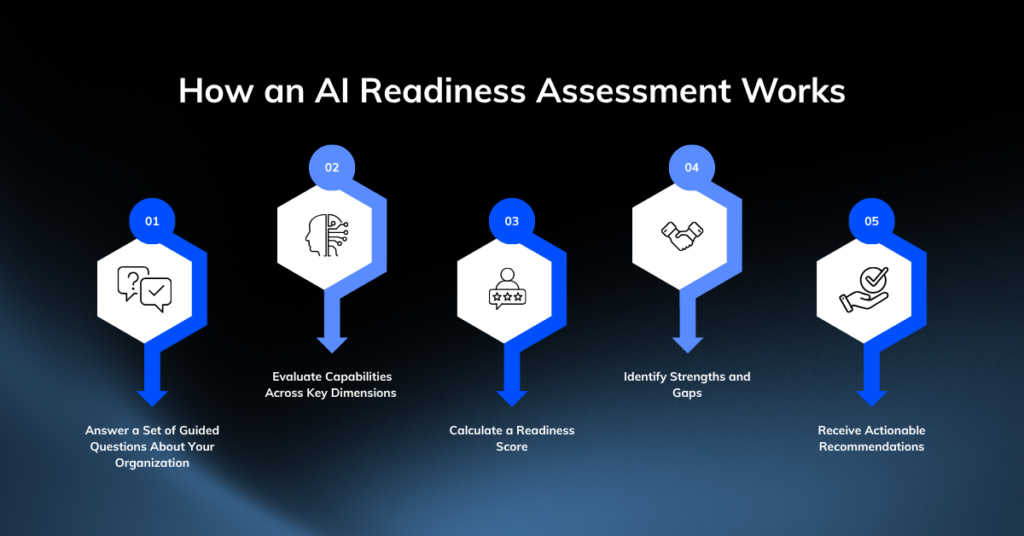
Most assessments are long, painful, and inconclusive. The Enlight Lab AI Readiness Assessment is built differently. It is designed to give founders, CTOs, and non-technical entrepreneurs a precise, honest score in minutes, with zero jargon and zero ambiguity. Here is exactly what happens when you start.
Answer a Set of Guided Questions About Your Organization
The assessment opens with 12 short, multiple-choice questions covering four core areas: data, team, process, and strategy.
There are no trick questions and no technical prerequisites. Every question is written in plain language so that a founder without an engineering background can answer with the same confidence as a CTO.
The goal at this stage is an honest snapshot of where your organization actually stands today.
Result: The more accurately you represent your current state, the more precise and useful your output will be.
Evaluate Capabilities Across Key Dimensions
As you answer, the tool evaluates your organization simultaneously across all four AI readiness dimensions in real time. Each answer contributes to a dimension-level picture that reflects your actual capability.
The four dimensions being scored in parallel are:
- Data: The quality, accessibility, and governance of the data your organization currently holds
- Team: The AI literacy, change readiness, and capability of the people who will work alongside AI systems
- Process: The maturity, documentation, and repeatability of the workflows AI is expected to improve
- Strategy: The clarity, alignment, and ambition of your organization’s approach to AI adoption
A company can have strong data infrastructure and a completely unready team. Both facts matter equally, and both show up in your results.
Calculate a Readiness Score
Once your answers are submitted, the tool calculates your composite AI maturity score on a 0 to 100 scale.
- 0 to 25: Foundational gaps across most dimensions
- 26 to 50: Early-stage readiness with identifiable strengths in one or two dimensions
- 51 to 75: Intermediate readiness
- 76 to 100: Advanced readiness
The organizations with the highest long-term AI ROI are the ones that found out their real score early and acted on it.
Identify Strengths and Gaps
The score alone is not the output. What follows is a dimension-by-dimension breakdown that shows exactly where your organization is performing well and where specific gaps are limiting your AI readiness.
This breakdown is the most operationally useful part of the assessment. It tells your leadership team not just that you are at a certain score, but precisely which of the four dimensions is holding you back and by how much. That specificity is what makes the output actionable rather than decorative.
Receive Actionable Recommendations
Based on your score and your dimension-level profile, the tool generates three specific, contextual recommendations tailored to exactly where your organization sits today.
These are not generic AI tips. They are prioritized next steps calibrated to your actual gap profile:
- If your data dimension is the weakest, your recommendations will address data infrastructure and governance first
- If your team dimension is lagging, your recommendations will focus on AI literacy, upskilling, and change management
- If your strategy dimension is underdeveloped, your recommendations will guide leadership alignment and use case prioritization
Each recommendation is designed to be the highest-leverage action available to your organization given its current state, so you are never left wondering what to do next.
Get a Shareable Results Link
When your assessment is complete, you receive a shareable results link that captures your full AI maturity score and dimension breakdown in a single URL. You can:
- Post that link on LinkedIn to show your team and investors where your organization stands
- Share it internally with leadership to align everyone on the same baseline
- Use it as a reference point in board meetings or AI vendor conversations
- Revisit it in 90 days after implementing your recommendations to track measurable progress on your score
Your results do not disappear after the session. The shareable link means your AI Readiness Assessment becomes a live artefact your organization can return to, reference, and build from over time.
Take Your AI Readiness Assessment Today
You are already operating in an environment where AI readiness is a competitive differentiator. Every quarter you delay the diagnostic is a quarter your roadmap stays undefined.
This is not about fear. It is about precision.
Not sure where your organization stands? Take our free AI Readiness Assessment and receive an instant AI maturity score along with personalized recommendations. No credit card. No sales call. Just a clear, actionable score in under 10 minutes.
Gain a clear picture of your highest-priority gaps and start building your AI implementation roadmap today.
Frequently Asked Questions
What is an AI readiness assessment?
An AI Readiness Assessment is a structured diagnostic that evaluates whether a company has the foundations needed to adopt, implement, and scale artificial intelligence successfully. It measures capability across four core dimensions: data infrastructure, technology stack, organizational culture, and process maturity.
What exactly will I get after taking an AI Readiness Assessment
You will get a clear understanding of where your organization stands in terms of AI readiness. This usually includes a readiness score, identified gaps across your strategy, data, and systems, and practical recommendations on what to fix first.
Why do you need an AI Readiness Assessment before implementing AI?
Because jumping into AI without understanding your data, systems, and capabilities often leads to failed projects and wasted investment.
An AI Readiness Assessment gives you clarity on gaps and priorities, so you can implement AI with confidence and real business impact.
What are the 4 pillars of AI readiness?
The four pillars that determine AI readiness are:
- Data Infrastructure: The quality, accessibility, consistency, and governance of the data your organization holds
- Technology Stack: Whether your existing platforms, APIs, and architecture can support AI workloads and integrations
- Organizational Culture: The AI literacy, change readiness, and leadership alignment of your team
- Process Maturity: Whether your core workflows are documented, repeatable, and structured enough for AI to improve
Can small businesses use AI readiness assessments?
Yes. Assessments help businesses at any stage understand gaps and opportunities.