Across several industries, organizations are rapidly experimenting with AI. Although AI adoption is easy, making it actually deliver business growth is not. A clear plan, expert guidance, and consulting with the right partner is the foundation of scaling AI with confidence.
That’s where AI consulting services step in to bridge the gap between ambitious AI ideas and real, measurable outcomes.
According to McKinsey’s State of AI research, 78% of organizations use AI in at least one business function, yet most remain in the experimentation or pilot stage and struggle to scale AI across the enterprise. That’s not a technology problem. It’s a strategy problem.
Whether you’re exploring AI opportunities or planning your next investment, this guide explains what AI consulting is, why it matters, and how to choose the right partner.
What Are AI Consulting Services, and Why Are They Different?
AI consulting services are expert-led advisory and implementation services that help businesses identify, design, deploy, and optimize AI solutions tailored to their goals. Unlike generic software vendors, AI consultants assess your specific operations, identify where AI can generate the most value, build a phased roadmap, and guide execution from pilot to full-scale deployment. With the right consulting partner, you won’t waste time or budget on the wrong technology.
Core AI Consulting Services Includes:
- AI readiness assessment
- AI strategy & roadmap development
- Custom AI/ML solution development
- AI integration with existing systems
- AI governance & compliance
- Continuous optimization
That last part is what separates AI consulting from general tech consulting.
General technology consultants help you choose software, manage IT infrastructure, or migrate systems. AI consultants go deeper. They connect business outcomes to specific AI applications and understand both the technical side (model selection, data infrastructure, integration) and the business side (ROI measurement, change management, compliance).
How AI Consultants Differ from In-House AI Teams
Hiring an in-house AI team is expensive, time-consuming, and often impractical for early-stage businesses. A senior machine learning engineer commands an average base salary of over $150,000 in the US. Building a full team of data scientists, ML engineers, AI product managers, and data engineers can cost millions annually before you’ve shipped a single feature.
AI consulting services offer an alternative: access to a cross-functional team of specialists at a fraction of the cost, with the flexibility to scale engagement up or down based on your needs.
| Factor | AI Consulting Services | In-House AI |
| Time to Value | Fast – experts accelerate execution | Slow – hiring & setup takes time |
| Upfront Cost | Flexible, project-based investment | High (hiring, tools, infrastructure) |
| Expertise Access | Immediate access to specialized talent | Limited to hired team capabilities |
| Scalability | Easily scalable across projects | Requires additional hiring |
| Risk Level | Lower (guided by proven frameworks) | Higher (trial-and-error learning) |
| Strategic Direction | Strong (consultants bring industry insights) | Depends on internal leadership maturity |
| Long-Term Ownership | External partnership model | Full internal control |
Why Businesses Are Turning to AI Consulting for Growth
The global AI consulting market was valued at $14.1 billion in 2026 and is projected to surpass $116.81 billion by 2035, growing at a compound annual growth rate of 26.49%, according to Business Research Insights. That growth reflects a fundamental shift in how businesses think about competitive advantage.
Here’s what’s driving that demand.
Strategic AI Roadmap Development
An AI consultant’s first job is to shift the conversation from “What AI tools should we use?” to “Where can AI create the most measurable impact in our business?” They help you align AI initiatives with core business objectives, ensuring you don’t waste resources on trendy tools that don’t solve a real problem.
This strategic process involves:
- Auditing operations to identify bottlenecks and opportunities for automation.
- Assessing data infrastructure to ensure readiness for AI implementation.
- Prioritizing AI use cases based on potential return on investment (ROI).
- Tying every initiative to a key objective, like cutting operational costs or reducing customer churn.
The result is a phased implementation plan that delivers early wins, builds organizational confidence, and reduces risk.
Enhance Decision-Making with Data
Data is the fuel that makes AI work. But raw data, siloed in disconnected systems, is almost useless. AI consulting services help businesses build the data infrastructure needed to turn information into decisions.
- Predictive Analytics: Forecast future trends instead of just reacting to past events.
- Real-Time Data Processing: Adjust pricing, manage inventory, and respond to market changes instantly.
- Centralized Data Infrastructure: Break down data silos to create a single source of truth for decision-making.
By acting on predictive insights instead of gut instinct, your business gains a significant structural advantage over competitors.
Boost Operational Efficiency and Reduce Cost Reduction
Automating routine, high-volume tasks is one of the fastest ways to see a clear ROI from AI. This is where businesses tend to see the clearest, most quantifiable results from AI adoption and where AI consulting services pay for themselves.
Consultants identify key opportunities for automation, freeing up your team to focus on strategic, high-value activities that drive growth.
- Administrative Work: Automate data entry, invoice processing, and customer query routing.
- Customer Service: Use AI chatbots to handle common inquiries, reducing costs and scaling capacity without increasing headcount.
- Scale Efficiently: Even for smaller businesses, automating just 30% of support tickets can significantly boost operational capacity.
Driving Innovation and Gain a Competitive Edge
Here’s the uncomfortable truth: your competitors are not waiting for AI to mature. They’re deploying it now to gain an advantage.
An AI consultant can help you move beyond simply optimizing existing processes to creating entirely new, AI-powered revenue streams. By integrating AI now, you can:
- Develop new revenue streams: An AI consultant can help you identify opportunities to launch AI-driven products or features.
- Enhance customer experiences: Move beyond basic support. Evolve a customer service chatbot into a personalized sales assistant that offers tailored recommendations and drives sales.
- Future-proof your business: Establishing AI capabilities today ensures you stay ahead of market trends and maintain a competitive edge.
Mitigate Risk and Improve Compliance
In regulated industries like fintech and healthtech, AI’s role in risk management is critical. AI consultants can help you deploy sophisticated fraud detection models, navigate complex compliance requirements, and build your systems with data governance and privacy regulations in mind.
- Proactively Detect Threats: AI models analyze massive datasets in real time to identify and prevent fraud before it happens. PayPal, for instance, cut its fraud-related losses by 11% using deep learning models.
- Navigate Complex Regulations: Consultants ensure your AI systems adhere to industry-specific data governance and privacy rules, helping you avoid costly penalties.
- Build Trust and Security: By embedding robust security and compliance measures from the start, you protect your customers and your reputation.
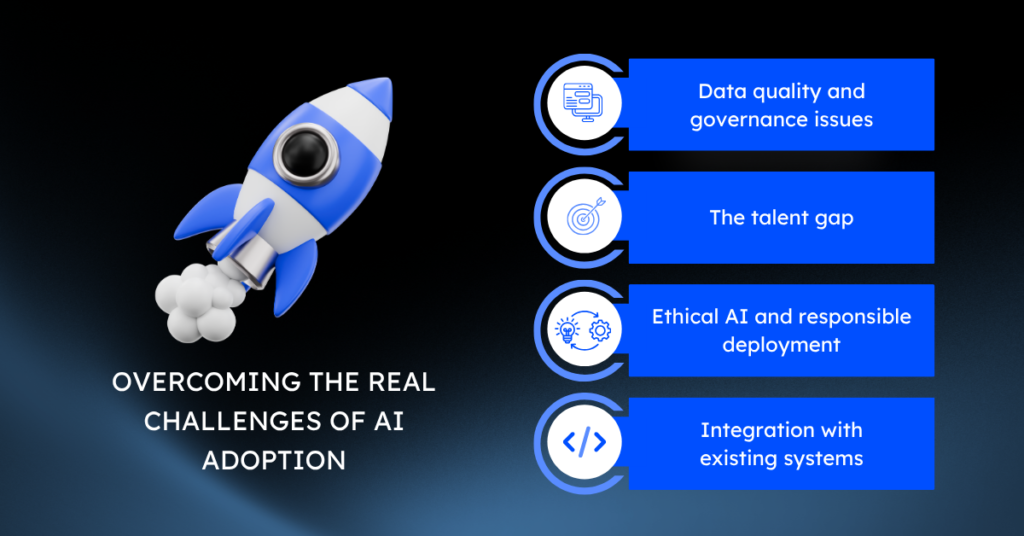
Overcoming the Real Challenges of AI Adoption
Let’s be honest about the obstacles. AI adoption is hard. If it were easy, every company would already be doing it well.
Data Quality and Governance Issues
AI systems are only as good as the data they’re trained on. Messy, incomplete, or biased data produces unreliable outputs.
AI consultants conduct data audits early, establish governance frameworks, and build data pipelines that ensure model quality over time.
The Talent Gap
Most businesses don’t have in-house AI expertise. That’s not a weakness. It’s a reality for the vast majority of startups and mid-size companies.
AI consulting services bridge this gap, providing the specialized skills needed without the full-time hiring cost.
Ethical AI And Responsible Deployment
Algorithmic bias, data privacy, and transparency in AI decision-making are not abstract concerns. They’re reputational and legal risks.
Responsible AI consultants build ethical frameworks into their methodology from day one, not as an afterthought.
Integration With Existing Systems
AI tools that can’t talk to your existing CRM, ERP, or data warehouse create more problems than they solve.
Experienced AI consultants design integrations that work with your current stack, not against it.
When Should You Hire an AI Consulting Company?
Not every business needs AI consulting at the same time but there are clear signals that indicate when it becomes essential.
- You’re unsure where to start with AI
- Your AI projects aren’t delivering measurable outcomes
- You lack in-house expertise
- You want to scale AI across your Organization
- You need faster results without high risk
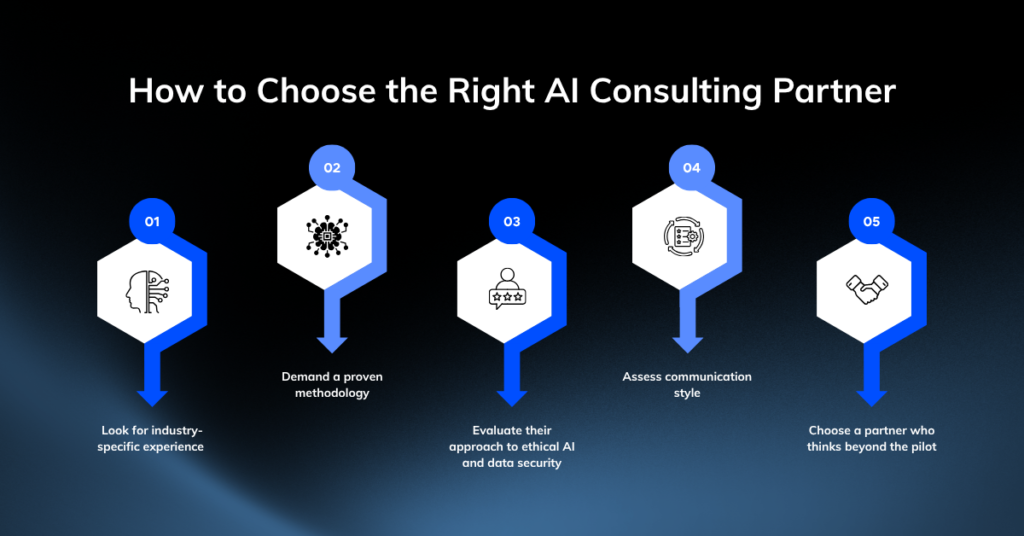
How to Choose the Right AI Consulting Partner
Not all AI consulting firms are equal. Here’s what to evaluate before signing a contract.
Look For Industry-specific Experience
An AI consultant who has worked in your industry understands the regulatory landscape, the data challenges, and the competitive dynamics. Generic AI expertise is less valuable than context-specific expertise. They’ll know the right questions to ask and the common pitfalls to avoid.
Demand a Proven Methodology
- Request case studies with quantifiable results: A reputable AI consulting firm should provide documented outcomes and metrics, not just a gallery of client logos.
- Look for clear, repeatable processes: Their methodology should demonstrate how they move from discovery and strategy to implementation and ongoing optimization.
Evaluate Their Approach To Ethical AI And Data Security
Ask the following questions:
- How do they handle data privacy?
- What’s their framework for identifying and mitigating algorithmic bias?
- How do they ensure compliance with regulations like GDPR or HIPAA?
Their responses to these questions will separate serious partners from vendors selling hype.
Assess Communication Style
If you’re a non-technical founder or entrepreneur, your consulting partner needs to communicate in plain business language, not machine learning jargon. A good AI consultant translates technical complexity into clear business decisions.
Choose A Partner Who Thinks Beyond the Pilot
The biggest risk in AI adoption isn’t failure; it’s success at pilot stage with no plan to scale. Your partner should have a clear framework for moving from a small-scale proof-of-concept to an enterprise-wide deployment.
Red Flags to Watch For
- Promises of unrealistic ROI timelines (“10x revenue in 3 months”)
- Consultants who lead with tools before problems
- No structured process or methodology on offer
- Inability to explain AI concepts in plain language
- No references from similar clients
Future Trends Shaping AI Consulting
Businesses that understand what’s coming next in AI will have a significant advantage.
Generative AI Is Raising the Stakes
Generative AI, the technology behind tools like ChatGPT and GPT-4, is creating new consulting opportunities in content generation, code development, customer interaction, and knowledge management. Businesses that understand how to deploy generative AI strategically will outpace those that treat it as a novelty.
Rise of AI Agents and Autonomous Systems
AI is moving beyond tools into intelligent agents that manage workflows independently.
- Multi-step task automation
- Decision-making systems
- End-to-end process management
This will redefine how businesses operate at scale.
Hyper-Personalization at Scale
Customer expectations for personalized experiences are accelerating. AI consulting services are increasingly focused on building the data infrastructure and personalization engines that enable truly individualized customer journeys at scale, in real time.
AI In Sustainability and Social Impact
ESG (Environmental, Social, and Governance) pressures are pushing businesses to find AI applications that reduce waste, optimize energy consumption, and improve supply chain sustainability.
AI consulting services are expanding to include sustainability-focused use cases as a core practice area.
What AI Consulting Looks Like with Enlight Lab
At Enlight Lab, we don’t believe in one-size-fits-all AI. We work with startups and growing companies who know they need to make better technology decisions but don’t want to drown in complexity to do it.
Here’s what a typical engagement looks like:
Phase 1: AI Readiness Assessment
Every successful AI initiative starts with a thorough AI Readiness Assessment. Before recommending solutions, we evaluate your current technology stack, workflows, data infrastructure, and team capabilities to understand where your organization stands today.
The outcome is a clear, objective roadmap that identifies opportunities, gaps, and priorities for AI adoption.
Phase 2: Use Case Identification and Prioritization
Using a value-vs-effort matrix, we identify the 2–3 AI applications that will generate the highest ROI in the shortest time.
Quick wins matter — they build internal confidence and justify further investment.
Phase 3: Solution Design and Vendor Selection
We design the right solution architecture for your stage and budget and if off-the-shelf tools meet your needs, we’ll tell you. No unnecessary custom builds.
Phase 4: Implementation and Integration
Our engineering team works alongside yours to deploy, integrate, and test AI solutions in your actual environment, not a sandbox.
Phase 5: Training, Adoption, and Optimization
We train your team, document processes, and establish performance dashboards. Then we stay engaged, monitoring outputs, improving models, and scaling what’s working.
Make AI Your Business Growth Engine with Reliable AI Consulting Services
Businesses that actually benefit from AI aren’t the ones that buy the most tools. They’re the ones that build the right strategy, execute with discipline, and measure every step of the way. That’s what AI consulting services deliver.
They give you:
- Clarity on where to invest
- Speed in execution
- Confidence in outcomes
At Enlight Lab, we combine deep technical expertise with business strategy thinking to help companies like yours build AI capabilities that actually move the needle. If you’re ready to move beyond AI experimentation and start driving real growth, schedule a discovery call with us to see where AI can move the needle for your business.