
Shipping code quickly is a survival mechanism for early-stage startups. Founders and technical decision-makers face relentless pressure to meet product launch deadlines, respond to increased customer demand, and scale infrastructure without burning through runway. Software development practices have evolved rapidly to meet these demands. You can no longer afford isolated development and operations teams throwing code over the proverbial wall.
The conversation has now shifted toward securing that rapid delivery. Cyber threats are accelerating, and a single data breach can permanently damage customer trust and drain financial resources. Understanding the strategic divide in DevOps vs. DevSecOps is critical for CTOs and founders trying to bridge the gap between business vision and software execution.
This guide breaks down the core principles, benefits, and challenges of both methodologies. We will help you determine which approach aligns with your current growth stage, budget constraints, and risk tolerance.
Understanding The Foundation Of Devops
DevOps merges software development and IT operations. It replaces siloed departments with a unified, cross-functional approach. The primary goal is to shorten the systems development lifecycle and provide continuous delivery with high software quality.
By automating infrastructure and code deployment, teams remove manual bottlenecks. This approach relies heavily on Continuous Integration and Continuous Delivery (CI/CD) pipelines, infrastructure as code, and proactive system monitoring.
Startups adopt this methodology to achieve critical business outcomes.
Faster product iterations allow you to test market fit rapidly. Automated scalability features ensure your infrastructure efficiently handles sudden spikes in customer demand. Furthermore, improved cross-functional collaboration limits communication breakdowns, which is especially valuable when managing a team with varied technical expertise.
However, traditional DevOps methodologies carry inherent limitations. Speed often takes precedence over software security. Because security reviews typically happen at the very end of the development cycle, finding a vulnerability right before a launch deadline forces a painful choice: delay the release or ship insecure code. Identifying and fixing architectural flaws late in the process dramatically increases technical debt and developer frustration.
Embracing DevSecOps for Secure Scaling
DevSecOps stands for Development, Security, and Operations.
It embeds security practices directly into the DevOps workflow. Rather than treating security as an isolated final checkpoint, this framework introduces the “shift left” mentality. You integrate security protocols from the initial design phase and maintain them through deployment and production.
The methodology operates on “security as code,” automating compliance and threat detection so they match the speed of agile development. This continuous security monitoring happens without slowing down your engineers.
Key pillars of this methodology include:
- Automated security testing integrated directly into CI/CD pipelines
- Proactive threat modeling during the initial architecture design
- Continuous compliance checks to satisfy regulatory requirements
- Mandatory security training to upskill developers
The benefits directly impact your bottom line.
According to the Systems Sciences Institute at IBM, fixing a vulnerability found post-production can cost up to 100 times more than fixing it during the design phase.
By catching flaws early, you drastically reduce remediation costs and manage technical debt efficiently. You also build a culture of shared security responsibility, reducing the burden on a single security engineer and making talent acquisition highly efficient.
What Changes in DevSecOps?
Security becomes:
- Continuous instead of periodic
- Automated instead of manual
- Shared instead of siloed
DevOps vs. DevSecOps: Key Differences That Actually Matter
Here is a side-by-side comparison that enterprise leaders actually care about:
| Factor | DevOps | DevSecOps |
|---|---|---|
| Primary Goal | Faster delivery | Secure + fast delivery |
| Security Approach | Post-development | Embedded throughout lifecycle |
| Responsibility | Ops + Dev teams | Dev + Ops + Security teams |
| Risk Handling | Reactive | Proactive |
| Testing | Functional & performance | Functional + security + compliance |
| Pipeline | CI/CD focused | CI/CD with security gates |
| Cost of Fixing Bugs | Higher (late-stage fixes) | Lower (early detection) |
| Compliance Readiness | Limited | Continuous compliance |
The Real Differences Between Devops Vs. Devsecops
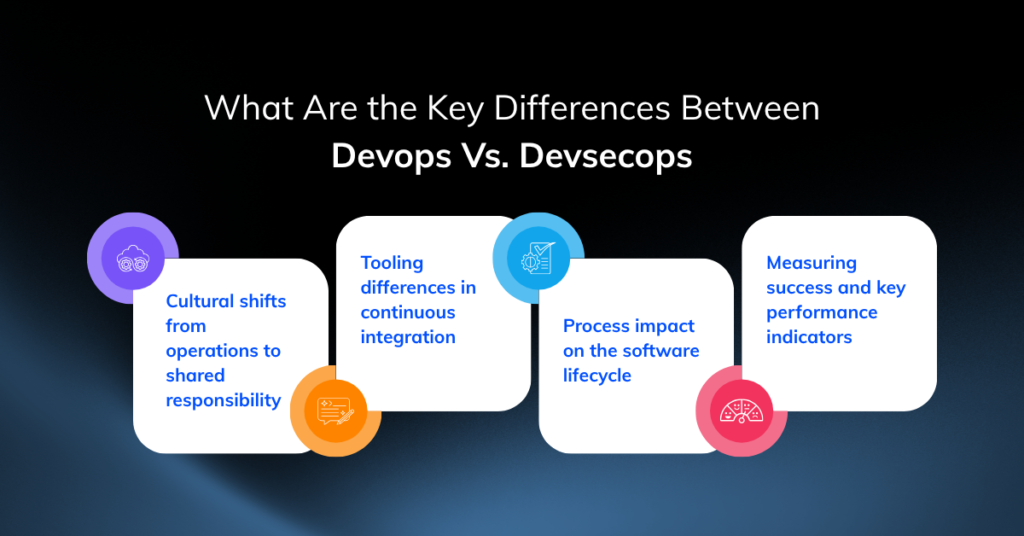
Choosing between these frameworks requires understanding how they alter your daily operations. While both prioritize automation and collaboration, their core focus areas dictate how your engineering team functions.
Cultural shifts from operations to shared responsibility
Traditional DevOps focuses on breaking down the barrier between software engineers and IT operations. The metric for success is deployment frequency and system uptime. DevSecOps expands this cultural shift. Security becomes everyone’s job, from the junior developer writing a function to the CTO approving the architecture.
Tooling differences in continuous integration
DevOps tooling centers on code repositories, containerization, and configuration management. DevSecOps requires additional layers. It injects automated security scanners directly into those existing CI/CD pipelines. Security controls act as pipeline outcomes, standardizing allow, warn, and block decisions across cloud environments.
Process impact on the software lifecycle
In a standard DevOps environment, a developer commits code, automated tests verify functionality, and the code moves to production. Security audits happen periodically or right before a major version release. In a DevSecOps environment, that same code commit triggers immediate vulnerability scans and dependency checks. If the code contains exposed secrets, the pipeline automatically halts the deployment.
Measuring success and key performance indicators
DevOps performance relies on metrics like deployment frequency, lead time for changes, and mean time to recovery. DevSecOps tracks those same indicators but adds security-specific metrics. You will monitor the mean time to detect a vulnerability, the mean time to remediate a flaw, and the percentage of code covered by automated security scans.
When Should a Startup Choose DevOps
Not every early-stage company needs military-grade security protocols on day one. A standard DevOps approach provides a highly cost-effective solution for startups prioritizing rapid market validation over complex infrastructure protection.
Choose this methodology if you are building lower-risk applications, such as internal productivity tools or consumer apps that do not handle sensitive personal data. If your primary goal is validating a Minimum Viable Product (MVP) to close a funding round, the speed of DevOps empowers your growth journey.
To succeed with this approach, you must have strong foundational engineering practices. You need a functioning CI/CD pipeline, automated functional testing, and a team comfortable with agile methodologies. Ensure your cloud infrastructure is budget-friendly but capable of scaling before pushing code to production.
Still confused which one to use? Connect with Enlight Lab today! We work with engineering leaders to evaluate not just what model businesses should adopt, but where their delivery ecosystem stands today and how it needs to evolve.
When Should Organizations Transition to DevSecOps
As your startup matures, the risk profile changes. Scaling your user base introduces new vulnerabilities, and enterprise clients will demand rigorous security audits before signing contracts.
You must transition to DevSecOps if you operate in regulated industries like healthcare or finance. Handling sensitive customer data makes security breaches an existential threat to your business.
The cost of delaying this transition is severe. Relying on manual security reviews creates massive bottlenecks.
Adopting this methodology does come with hurdles. Non-technical entrepreneurs struggling to bridge the gap might find the initial setup complex. You can overcome this by utilizing talent acquisition platforms to hire specialists or by implementing user-friendly, automated security tools that integrate seamlessly with your current stack.
Why Is Shifting from DevOps to DevSecOps Is Essential
Modern enterprises are not abandoning DevOps. They are evolving it.
Here is why.
1. The Cost of Late Security Is Exponentially Higher
Fixing vulnerabilities in production can cost significantly more than during development. This is not just a cost issue. It is also about:
- Downtime
- Reputation damage
- Customer trust loss
2. Security Threats Are Growing Faster Than Development Speed
Cloud adoption, microservices, and open-source dependencies have increased the attack surface.
Examples of real risks include:
- Supply chain attacks
- Misconfigured cloud storage
- Dependency vulnerabilities [ksolves.com]
DevOps alone cannot address these risks.
3. Compliance Is Now Continuous, Not Periodic
Modern regulations such as GDPR, HIPAA, and SOC 2 require:
- Continuous monitoring
- Real-time auditing
- Proof of compliance
DevSecOps embeds these controls directly into pipelines.
4. DevSecOps Improves Security Outcomes
- 92% of organizations report improved security posture with DevSecOps
- Many organisations using DevSecOps reduce risk and improve response times
This is why DevSecOps is becoming a business necessity, not just a technical upgrade.
How Can You Implement DevSecOps Practically
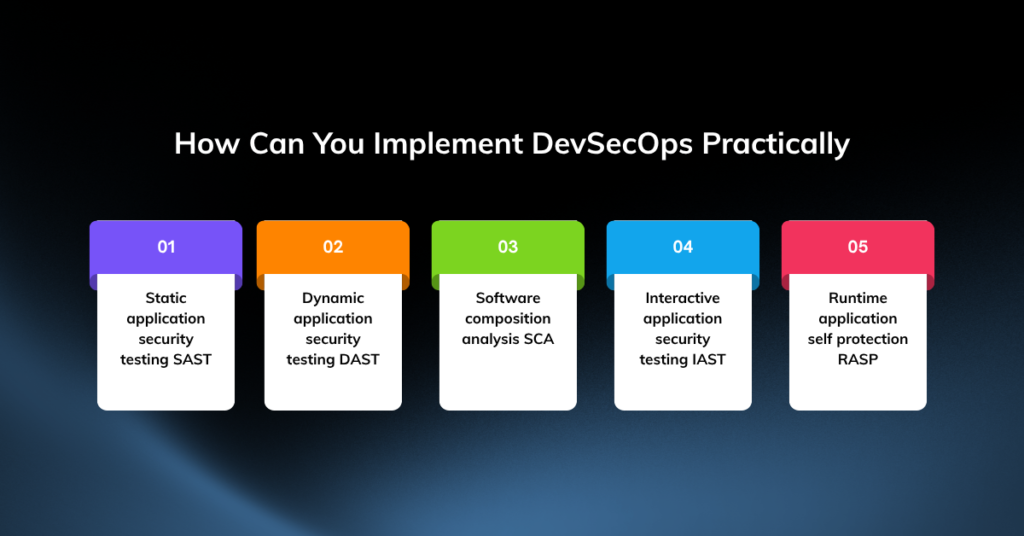
Integrating security into an established workflow requires a deliberate, step-by-step approach. Do not attempt to overhaul your entire infrastructure overnight. Start by automating low-friction security tasks within your CI/CD pipeline.
Static application security testing SAST
SAST tools analyze your source code for known vulnerabilities without executing the program. By integrating SAST into your developers’ Integrated Development Environments (IDEs), you provide immediate feedback on insecure coding patterns before the code is even committed.
Dynamic application security testing DAST
DAST tools interact with your running application from the outside, mimicking a malicious attacker. This identifies runtime vulnerabilities like cross-site scripting or SQL injection flaws that static analysis might miss.
Software composition analysis SCA
Startups rely heavily on open-source libraries to accelerate development. SCA tools automatically scan these third-party dependencies for known security flaws and licensing compliance issues, mitigating supply chain risks.
Interactive application security testing IAST
IAST combines elements of SAST and DAST. It works inside the application during automated functional testing, observing behavior and reporting vulnerabilities in real-time.
Runtime application self protection RASP
RASP technology lives inside your production environment. It monitors application traffic and behavior, actively blocking attacks and providing an essential layer of defense for live applications.
Beyond tooling, focus on building a security-first culture. Provide budget-friendly training for your developers. Celebrate teams that proactively reduce technical debt and document security improvements.
What Are the Future Trends for AI In DevSecOps
Artificial intelligence is reshaping how technical teams manage infrastructure and security. According to GitLab’s Global DevSecOps Report, 97% of surveyed organizations are using or planning to use AI in their software development lifecycle.
Predictive security analytics use machine learning to analyze historical data, forecasting where vulnerabilities are most likely to occur in upcoming code deployments. AI-powered threat detection tools monitor network traffic and user behavior, identifying anomalies that traditional rule-based security software misses. Furthermore, automated compliance checks powered by large language models help non-technical decision-makers navigate complex regulatory frameworks efficiently.
Making An Informed Decision for Your Organization
Choosing between DevOps vs. DevSecOps is ultimately about aligning your technology strategy with your business reality. If you are racing to build an MVP with zero sensitive data, DevOps delivers the cost-effective speed you need.
However, as your startup scales, the risks multiply. DevSecOps provides the scalable, secure foundation required to protect your customer data, satisfy enterprise clients, and prevent catastrophic security breaches. By embedding security into your daily workflows, you empower your engineering teams to deliver innovative features without compromising on safety. Evaluate your current growth stage, assess your infrastructure needs, and implement the framework that secures your company’s future.
Still, confused either DevOps or DevSecOps is best fit for your business? Connect with Enlight Lab! We work with engineering leaders to evaluate not just what model they should adopt, but where their delivery ecosystem stands today and how it needs to evolve.