
Most DevOps failures don’t happen because of bad code. They happen because of bad decisions made long before a single pipeline is built.
That’s the uncomfortable truth facing engineering leaders right now. The promise of DevOps is real with faster releases, fewer outages, and happier teams. But the gap between that promise and reality is where budgets quietly disappear.
For early-stage startups, the math is even more brutal. When you’re operating with limited runway and tight launch deadlines, one botched transformation can wipe out months of progress.
This guide breaks down the topmost common DevOps transformation mistakes and exactly how to avoid them before they drain your resources in 2026 and beyond.
What is DevOps Transformation?
DevOps transformation is the organizational shift that integrates development and operations teams to improve how software is built, tested, and delivered. It combines culture, processes, and automation to enable faster releases, better collaboration, and continuous improvement.
It goes beyond implementing tools. It requires breaking down silos, automating workflows like CI/CD, and aligning teams around shared goals to deliver high‑quality software quickly and reliably.
Key aspects of DevOps transformation:
- Integrates development and operations into one workflow
- Focuses on collaboration, automation, and continuous delivery
- Breaks down silos between teams
- Enables faster, more reliable software delivery
- Requires cultural, strategic, and process changes
Why 2026 Raises the Stakes for DevOps Transformation
The ground is shifting fast. DevOps trends for 2026 point toward AI-driven automation, platform engineering, and tighter security baked into every release decision. These advances make high-performing teams faster than ever. But they also widen the gap between organizations that get DevOps right and those that don’t.
If your transformation is built on a shaky foundation, layering AI and automation on top only accelerates the chaos. That’s why understanding DevOps adoption challenges now matters more than it did even two years ago.
Why DevOps Transformation Mistakes Become More Expensive
The price of getting this wrong has gone up. Three forces are driving that shift.
Speed Is Now Table Stakes
When your competitor ships fixes in hours and you ship them in weeks, customers notice. Speed is the baseline for survival in modern product delivery.
AI Raised Expectations
AI doesn’t just improve performance; it reflects and amplifies your current capabilities.
- Strong teams get stronger.
- Weak processes get exposed faster.
Wasted Spend Compounds
Every dollar wasted on unused tools, every week lost to slow rollouts, and every engineer who quits due to a chaotic process adds up. This compounding waste can lead to significant setbacks for a startup, such as:
- Missing a critical launch window
- Failing to hit a funding milestone
The Foundation of DevOps Transformation Failure: Strategic Missteps
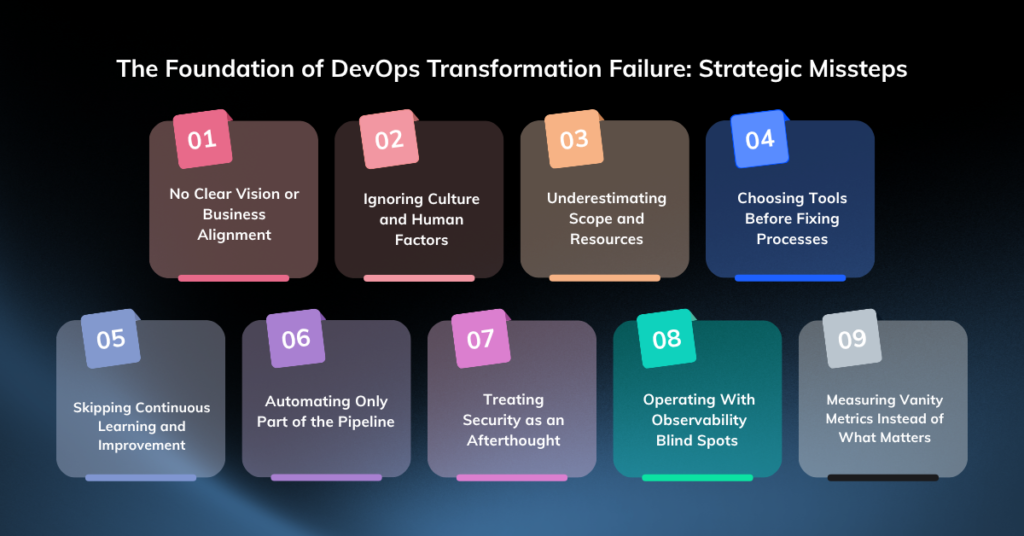
The teams that thrive in 2026 won’t be the ones with the flashiest tools. They’ll be the ones who avoided the costly missteps.
Here are the nine mistakes to avoid in DevOps transformation.
Mistake 1: No Clear Vision or Business Alignment
A fuzzy “why” produces a chaotic “how.” When teams can’t explain how DevOps connects to revenue, retention, or growth, the effort drifts into tool-buying for its own sake.
We’ve watched companies invest heavily in a shiny CI/CD platform, declare victory on adoption, and then wonder why deployment frequency barely moved. They optimized for IT metrics nobody outside engineering cared about. Meanwhile, lead time to deliver a customer-facing feature stayed exactly the same.
Tie your transformation to outcomes the whole business feels:
- Faster product iterations that let you respond to customer demand
- Fewer outages that protect revenue and reputation
- Lower infrastructure costs through better automation and resource use
- Shorter time-to-market for the features that win deals
When everyone can name the business result, technical decisions get easier.
Mistake 2: Ignoring Culture and Human Factors
DevOps is more about people than pipelines. The biggest of all DevOps adoption challenges is rarely a technology gap. It’s resistance to change, fear of job loss, and teams that have spent years protecting their silos.
If your engineers think automation means their roles are next on the chopping block, they will quietly resist it. If developers and operations still throw work over a wall at each other, no tool will fix the friction.
Building a healthier culture takes deliberate effort:
- Create psychological safety so people can surface problems and failures without blame
- Share ownership of both shipping and supporting software across teams
- Communicate the “why” clearly, especially what change means for individual roles
- Celebrate small wins to build momentum and trust
A culture of shared ownership turns DevOps from something done to your team into something done by your team.
Mistake 3: Underestimating Scope and Resources
The “lift and shift” mindset, treating DevOps as a simple technical swap, is one of the most expensive mistakes to avoid in DevOps transformation. It almost guarantees budgetary shortfalls, talent gaps, and timelines that slip month after month.
Real transformation touches process, people, and platforms at once. That requires sustained investment and, critically, executive buy-in that lasts beyond the kickoff meeting. When leadership treats DevOps as a quarter-long initiative instead of an ongoing capability, funding dries up right when the hard, valuable work begins.
Before you start, get honest about three things:
- Budget: Can you fund tooling, training, and the time it takes to change how people work?
- Talent: Do you have the skills in-house, or do you need to hire or partner?
- Timeline: Are your deadlines realistic, or are you setting the team up to cut corners?
Mistake 4: Choosing Tools Before Fixing Processes
The “shiny new tool” syndrome is everywhere. A team adopts the platform everyone’s talking about, expecting it to fix their delivery problems. Instead, they automate a broken process and now run it faster.
Process should inform tool selection, not the other way around.
Map how work actually flows from commit to production before you buy anything.
- Where are the handoffs?
- Where do things wait?
- Where do errors creep in?
Skipping this step leads to fragmented toolchains that don’t talk to each other. Each integration becomes its own headache, and your engineers spend more time gluing tools together than shipping features.
Mistake 5: Skipping Continuous Learning and Improvement
DevOps isn’t a destination you arrive at. It’s a practice you keep refining. Teams that treat rollout as “done” stop iterating, and that lack of continuous improvement quickly leads to stagnation.
The fix is building feedback into how you work:
- Run blameless post-mortems after incidents to learn, not to point fingers
- Hold regular retrospectives to spot friction and act on it
- Experiment in small batches so failures stay cheap and lessons stay clear
The strongest teams treat every failure as data. That mindset of constant, incremental improvement is what separates a real transformation from a one-time tooling refresh.
Mistake 6: Automating Only Part of the Pipeline
The “pseudo-DevOps” trap is automating the easy 60% and leaving manual handoffs everywhere else. You get a continuous integration pipeline that still needs someone to manually approve, configure, or deploy at the worst possible moment.
Partial automation creates a false sense of progress while the real bottlenecks stay put. Worse, manual steps introduce human error, which can lead to outages and delayed releases.
- Hunt down every manual handoff and repetitive task in your delivery flow.
- Automate the testing, the provisioning, the deployments, and the rollbacks.
The goal isn’t automation for its own sake; it’s removing the friction and risk that slow your team down and inflate your costs.
Mistake 7: Treating Security as an Afterthought
DevOps without DevSecOps is a breach waiting to happen. When security is bolted on at the end, vulnerabilities slip through and compliance gaps surface at the worst time often right before a big launch or audit.
The financial and reputational cost of a breach can sink an early-stage company. Customer trust, hard-won over years, evaporates in a single incident.
Shift security left. Integrate it into every stage of the pipeline:
- Scan code for vulnerabilities as it’s written
- Check dependencies automatically for known issues
- Bake compliance checks into the deployment process
- Manage secrets properly instead of hardcoding them
Security built into the pipeline costs far less than security retrofitted after a breach.
Mistake 8: Operating With Observability Blind Spots
You can’t fix what you can’t see. Without comprehensive logging, monitoring, and tracing, your team is debugging in the dark.
Observability blind spots show up as long resolution times, repeat incidents, and a support team that can’t tell leadership what’s actually wrong. The impact lands directly on customer experience and your operational efficiency.
Invest early in:
- Centralized logging so you can search across services
- Real-time monitoring with alerts that fire before customers complain
- Distributed tracing to follow a request through your whole system
Good observability turns a two-hour outage into a five-minute fix. That difference is measured in retained customers and protected revenue.
Mistake 9: Measuring Vanity Metrics Instead of What Matters
Among common DevOps mistakes, tracking the wrong numbers is one of the quietest and most persistent. Counting commits or lines of code feels productive but tells you nothing about whether you’re actually delivering value.
The DORA metrics give you a proven set of indicators that connect engineering work to real outcomes:
- Deployment frequency: How often you successfully release to production
- Lead time for changes: How long it takes code to go from commit to production
- Change failure rate: What percentage of deployments cause a problem
- Time to restore service: How quickly you recover from incidents
DORA’s guidance is to apply these at the application and service level, not as a single org-wide score. Used well, these metrics drive continuous improvement and give you the hard data to demonstrate ROI to investors and leadership.
A Proactive Approach to DevOps Success
Avoiding mistakes is half the battle. The other half is building the structure that keeps your transformation on track as you scale.
Build a Cross-Functional Center of Excellence
A small, dedicated group, blending development, operations, and security, can set standards, share knowledge, and guide teams through the change. Even at a startup, a lightweight version of this keeps your practices consistent as you grow instead of fragmenting team by team.
Invest in Continuous Training
Skills don’t stay current on their own. Budget for ongoing training so your team keeps pace with new tools and techniques rather than scrambling to catch up. Foundational practices like creating clear internal policies and maintaining a user-centric focus can multiply your chances of success.
Leverage External Expertise
You don’t have to learn every lesson the hard way. Partnering with experienced DevOps consulting services gives lean teams access to senior expertise without the cost of building it all in-house.
The right partner helps you avoid expensive missteps, scope work realistically, and move faster than trial-and-error would ever allow—a direct way to manage technical debt and protect your runway.
Lead From the Top
Transformation sticks when leadership champions it consistently. That means protecting the budget, reinforcing the cultural shift, and keeping the team focused on business outcomes long after the initial excitement fades. Without sustained leadership, even a well-planned effort drifts back to old habits.
Turn DevOps Transformation Mistakes into Your Advantage
The companies that win with DevOps especially in today’s AI era aren’t the ones with the biggest tool budgets. They’re the ones that avoid the predictable mistakes that derail most transformations.
The pattern across all nine DevOps transformation mistakes is clear:
The costliest failures are rarely caused by technology alone. They usually come from gaps in people, planning, and execution.
- Buying tools before building the right culture
- Automating inefficient processes instead of fixing them
- Ignoring technical debt until it becomes a bigger challenge
- Expecting transformation without a strategy and execution
Avoid these traps, and DevOps stops being a money pit. Instead, it becomes what it was always meant to be: a cost-effective engine for faster delivery, stronger collaboration, and reduced technical debt.
As you move forward, keep these principles front of mind:
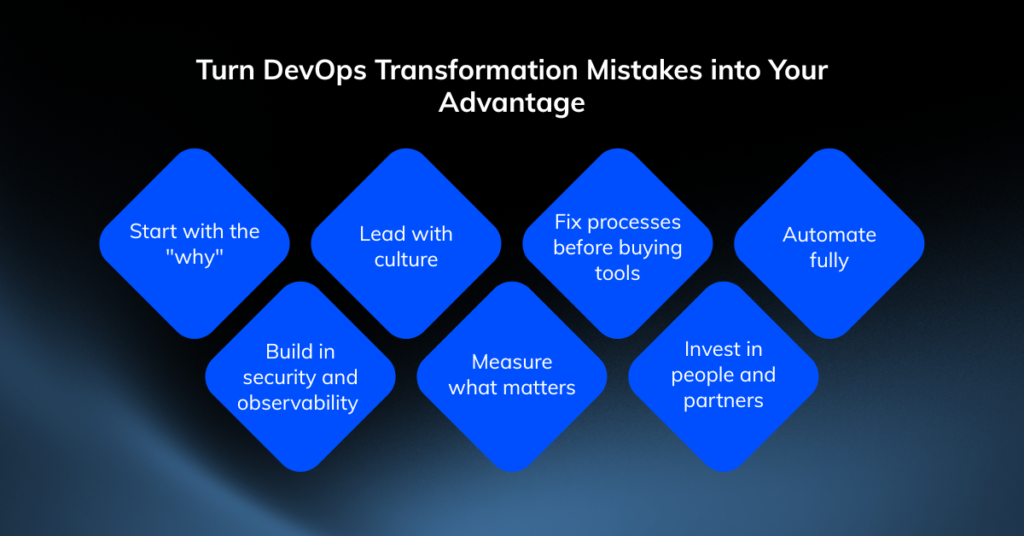
- Start with the “why”—tie every decision to measurable business outcomes
- Lead with culture—people make or break a transformation
- Fix processes before buying tools
- Automate fully and eliminate manual bottlenecks
- Build security and observability from day one
- Measure what matters using DORA metrics
- Invest in the right DevOps expertise to sustain the change
Ready to Avoid Costly DevOps Transformation Mistakes?
If you’re scaling fast and can’t afford to learn these lessons the hard way, get expert eyes on your roadmap before you commit to your budget.
Partner with Enlight Lab today to build a proactive roadmap for your business that delivers results.
We help you:
- Define a clear DevOps transformation roadmap aligned with business goals
- Build a culture of collaboration and shared ownership
- Simplify your toolchain and eliminate unnecessary complexity
- Implement scalable CI/CD, DevSecOps, and observability frameworks
- Track the metrics that actually drive ROI
Your DevOps transformation doesn’t have to cost you millions. With the right strategy, it can save you them.