Shipping software faster used to mean cutting corners. Now, AI is making that tradeoff obsolete.
Startups and scaling tech teams are under relentless pressure. Customers expect flawless products. Investors want faster releases. Engineers are already stretched thin. And somewhere in the middle of all that pressure sits your CI/CD pipeline, the backbone of everything you ship.
The problem? Traditional CI/CD pipelines weren’t built for the speed, complexity, or code volume that modern software teams operate at.
According to GitLab’s Global DevSecOps Report, DevSecOps professionals lose an average of 7 hours per week to inefficient processes caused by tool fragmentation and manual coordination overhead. That’s nearly a full workday, every week, per person gone.
AI changes the equation. By embedding intelligence directly into your pipelines, you gain faster builds, smarter testing, proactive anomaly detection, and automated deployments that don’t require constant human babysitting. This guide covers everything you need to know about AI-powered CI/CD pipelines: what they are, why they matter, how to implement them, and where the technology is headed.
What Are CI/CD Pipelines and Why Do Traditional Pipelines Fall Short?
Before we explore AI’s role, let’s establish a shared foundation.
What Is Continuous Integration (CI)?
Continuous Integration is the practice of automatically building and testing code every time a developer pushes a change to a shared repository. The goal is to catch bugs early before they compound and become expensive to fix.
What Is Continuous Delivery and Deployment (CD)?
Continuous Delivery automates the release of tested code to a staging environment. Continuous Deployment takes it a step further, pushing validated code directly to production without manual approval.
Together, CI/CD creates a streamlined pipeline from code commit to live product.
The Core Problem with Traditional CI/CD
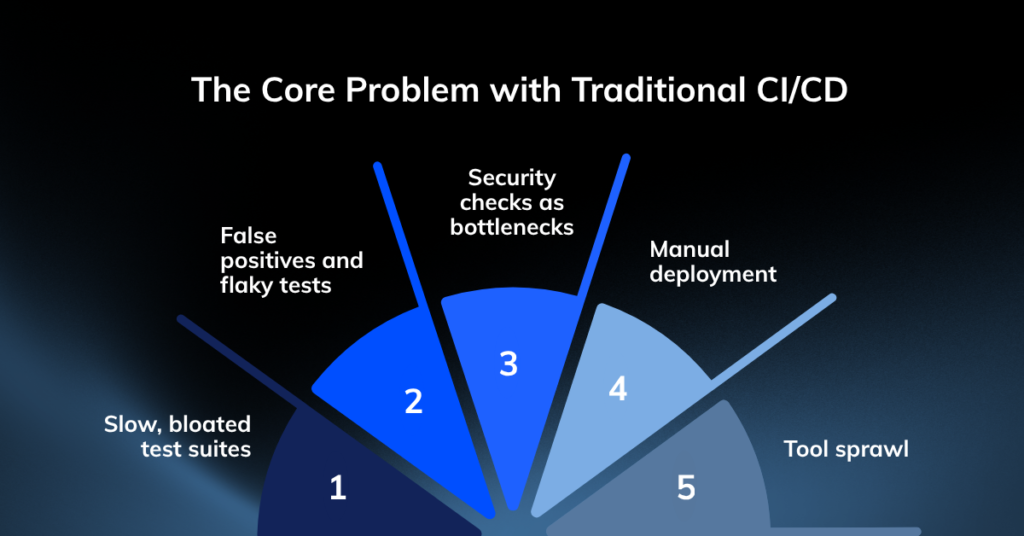
Here’s the uncomfortable truth: most CI/CD pipelines are held together by outdated scripts, manual handoffs, and institutional knowledge stored in one developer’s head.
A few common failure points:
- Slow, bloated test suites — Running every test on every commit takes time that teams don’t have
- False positives and flaky tests — Engineers learn to ignore alerts, which means real issues slip through
- Security checks as bottlenecks — Vulnerability scans happen at the end of the cycle, when fixes are most expensive
- Manual deployments — Human-dependent steps introduce inconsistency and slow release cadence
- Tool sprawl — According to GitLab’s research, 60% of development teams use more than five tools in their software development workflow, creating fragmentation and delays
AI-powered CI/CD pipelines solve these problems not by adding more tools, but by making existing processes smarter. Partner with expert DevOps consultanting services to adopt and scale these AI-driven improvements.
Traditional pipelines follow fixed rules. AI-powered pipelines learn.
Here’s the difference in practice:
| Traditional CI/CD | AI-Powered CI/CD |
| Runs all tests every time | Predicts which tests are likely to fail and prioritizes them |
| Alerts you after something breaks | Detects anomalies before they cause failures |
| Requires manual configuration tuning | Self-optimizes pipeline performance over time |
| Static security scans | Adaptive vulnerability detection based on code context |
| Fixed deployment windows | Intelligent rollout timing based on risk scoring |
How AI Transforms CI/CD Pipelines: Key Applications
AI doesn’t replace your pipeline. It amplifies it.
Here are the four most impactful core capabilities of AI-driven CI/CD excellence:
1. Predictive Analytics in Testing
Traditional pipelines run every test, every time. AI changes that with selective, risk-based test execution.
Here’s how AI enhances testing:
- Identifies High-Risk Code Changes: AI models analyze past commits to predict which changes are most likely to cause bugs. Instead of running thousands of tests, the pipeline can prioritize the most relevant ones, significantly cutting execution time while maintaining coverage.
- Optimizes Test Case Selection: AI can detect and flag “flaky tests” that pass or fail inconsistently. By removing or isolating these tests, teams reduce false alarms and build more trust in the pipeline’s results.
- Practical Outcome: Teams implementing AI-driven test selection experience faster feedback loops and more reliable test results.
2. Automated Code Review and Quality Gates
Manual code review is a knowledge bottleneck. One senior engineer reviewing every merge request is not a scalable model.
- Static Code Analysis with AI: AI-augmented static analysis tools automatically scan code for vulnerabilities, anti-patterns, and style violations at every commit. Tools like GitLab Duo provide AI-powered root cause analysis, code review summaries, and vulnerability explanations directly within the development workflow.
- Dynamic Application Security Testing (DAST) Enhancements: AI improves DAST by learning the normal behavior of running applications and flagging anomalies that simple rule-based scanners would miss. This is especially critical for fintech and healthtech startups in regulated industries.
- Why this matters for your business: Shifting security left into the pipeline is a competitive financial advantage. Security remediation costs are 6x higher when vulnerabilities are found post-deployment compared to during development.
3. Anomaly Detection in Deployment
Even the best-tested code can cause problems in production. AI gives teams a faster, smarter response mechanism.
- Real-Time Monitoring and Issue Identification: AI-powered tools establish a baseline for normal system behavior (CPU usage, memory, error rates). They provide instant alerts, measured in seconds, when metrics deviate from this baseline.
- Automated Rollback Strategies: Advanced systems can automatically roll back to the last stable version when anomalies are detected, without human intervention. This is crucial as AI coding tools increase commit frequency, making rollbacks a key risk management variable. As Northflank noted, “When a bad commit reaches production, the speed at which you can roll back is a meaningful risk variable.”
4. Intelligent Resource Allocation and Optimization
Infrastructure costs are a rapidly growing expense for scaling startups, and AI-driven resource optimization can directly address this issue.
Cloud Resource Management:
- AI analyzes workload patterns to dynamically scale cloud resources based on actual demand.
- It increases capacity during peak build times and scales down during off-peak hours.
- This approach helps eliminate overprovisioning, which often leads to inflated cloud bills.
Build Process Optimization:
- AI identifies bottlenecks within your build configuration, such as slow stages, redundant steps, and inefficient caching.
- It then recommends specific optimizations to improve performance.
- For instance, Harness CI has reported achieving build acceleration up to 4x by using AI-driven pipeline insights.
Designing and Implementing AI-Powered CI/CD Pipelines
Understanding the theory is one thing. Implementation is where most teams stall. Here’s a pragmatic roadmap.
Prerequisites Before You Integrate AI
Rushing AI into a broken pipeline will only produce smarter failures. Get these foundations right first.
Data Collection and Preparation
AI models need data to learn from. Before integration, ensure you are collecting:
- Build logs — Historical records of pass/fail outcomes, execution times, and error types
- Test results — Coverage metrics, flakiness rates, and failure patterns
- Deployment history — Release timelines, rollback events, and incident logs
- Code change metadata — Commit frequency, file change patterns, author history
The richer and cleaner your historical data, the more accurate your AI models will be.
Choosing the Right AI/ML Models
Not every problem requires the same solution:
- Classification models — Best for predicting test outcomes and flagging risky commits
- Anomaly detection models — Best for production monitoring and infrastructure alerting
- Recommendation systems — Best for test selection, resource allocation, and pipeline optimization
- Large language models (LLMs) — Best for code review assistance, failure analysis, and documentation generation
For most startups, starting with pre-built AI capabilities embedded in platforms (rather than training custom models) is the faster, more cost-effective entry point.
Step-by-Step Integration Process
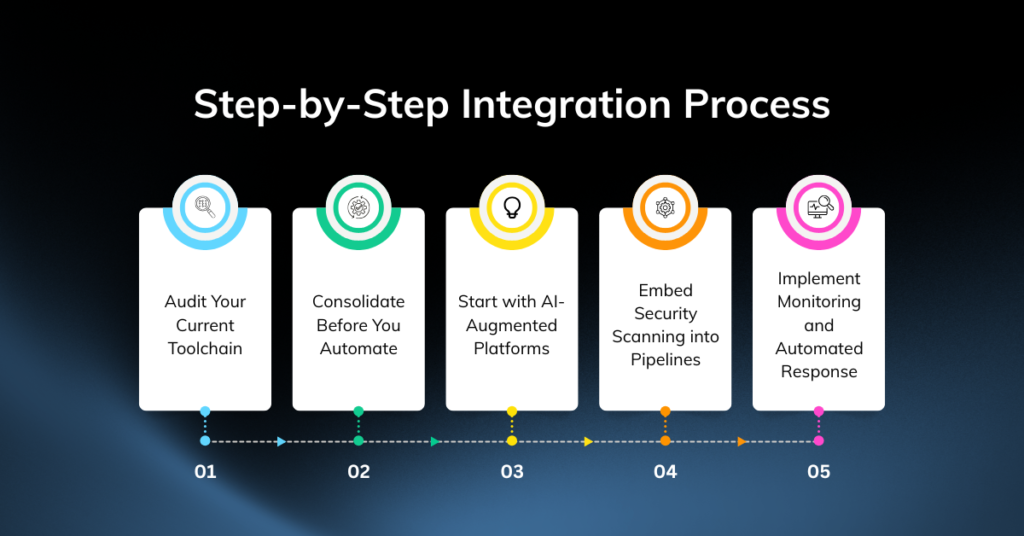
Step 1: Audit Your Current Toolchain
Map every tool, handoff, and manual step in your current pipeline. Identify where the most time is lost and where failures most commonly originate. This audit becomes your implementation priority list.
Step 2: Consolidate Before You Automate
Fragmented toolchains are the primary source of CI/CD inefficiency. Before adding AI, reduce tool sprawl. As GitLab’s research highlights, 49% of DevSecOps teams use more than five AI tools alone creating more coordination overhead, not less. Platform consolidation is the prerequisite for effective AI integration.
Step 3: Start with AI-Augmented Platforms
Rather than building AI capabilities from scratch, adopt platforms with embedded AI features:
- GitLab Duo — Root cause analysis, code review summaries, vulnerability explanations, and pipeline insights within GitLab’s CI/CD engine
- CircleCI — Flaky test detection, pipeline insights, and failure analysis
- Harness — AI-assisted pipeline configuration, deployment analysis, and build acceleration
- GitHub Actions with Copilot — AI-powered log analysis and failure root cause analysis inside GitHub’s widely-used CI automation layer
Step 4: Embed Security Scanning into Pipelines
Add automated dependency scanning, static application security testing (SAST), and secret detection directly into your pipelines. Run these checks on every commit, not just before release.
Step 5: Implement Monitoring and Automated Response
Deploy AI-powered monitoring that establishes behavioral baselines for your production environment. Configure automated alerts and, where appropriate, automated rollback triggers. Measure mean time to recovery (MTTR) before and after implementation.
Measuring Success: KPIs for AI-Driven DevOps
Track these metrics to validate your AI-powered CI/CD investment:
| Metric | What It Measures |
| Deployment frequency | How often you successfully ship to production |
| Lead time for changes | Time from code commit to production |
| Change failure rate | Percentage of deployments causing incidents |
| Mean time to recovery (MTTR) | How quickly you recover from failures |
| Test execution time | Duration of your test suite per build |
| Pipeline flakiness rate | Percentage of false-positive failures |
| Infrastructure cost per deployment | Cloud spend efficiency |
These are the DORA (DevOps Research and Assessment) metrics, the industry’s gold standard for measuring DevOps performance. AI-powered pipelines should improve all four core DORA indicators.
The Business Case: Benefits of AI-Powered CI/CD Pipelines
For CTOs and founders evaluating this investment, the benefits translate directly into competitive advantage.
Enhanced Speed and Efficiency
AI-driven CI/CD automation can significantly accelerate deployment cycles and reduce manual intervention by automating testing, delivery, monitoring, and recovery workflows. Faster deploys mean faster iteration. Faster iteration means faster product-market fit.
Improved Code Quality and Reliability
Automated code review and AI-powered testing catch issues that manual processes miss. It is not because humans are careless but because humans are limited by time and attention. AI is neither.
Reduced Infrastructure Costs
Ally Financial implemented AI-driven security and DevOps modernization and achieved a 55% increase in deployments, 100 hours per month reduction in downtime, and $300,000 in annual savings. Those numbers translate directly to runway for early-stage startups.
Faster Time-to-Market
Ericsson consolidated their fragmented toolchain into a unified DevSecOps platform and saved 130,000 engineering hours in six months, cutting release cycles from years to months. Fewer manual steps and smarter automation mean releases happen on your schedule, not your pipeline’s.
Proactive Problem Solving
Reactive DevOps is expensive. Detecting and resolving a production incident costs far more in time, credibility, and customer trust than preventing it. AI-powered anomaly detection shifts teams from firefighting to forward planning.
Challenges and Key Considerations for CI/CD Excellence
No technology comes without tradeoffs. Here’s what to plan for.
Data Privacy and Security
AI models require access to sensitive data, including proprietary code and infrastructure details, creating significant security and privacy risks.
- Challenge: AI tools can expose intellectual property and sensitive customer data if not properly secured, leading to breaches and loss of competitive advantage.
- Solution: Before integrating any AI tool, thoroughly vet its security protocols. Prioritize solutions with robust end-to-end encryption, strict access controls, clear data residency policies, and verifiable compliance with industry standards like SOC 2 or ISO 27001.
Model Explainability
- Challenge: AI models often act as “black boxes,” making it difficult for engineers to understand why a decision was made (e.g., flagging a code change as high-risk). This lack of transparency erodes trust and can lead to compliance issues, as unexplained actions are hard to justify or audit.
- Solution: Implement tools that prioritize explainable AI (XAI). Look for features that visualize decision-making processes and always include a “human-in-the-loop” override mechanism.
Skill Gaps and Training Requirements
- Challenge: AI-powered DevOps demands new expertise in areas like model behavior analysis, anomaly alert interpretation, and configuring AI-driven security policies. This creates a significant skill gap.
- Solution: Proactively address the skill gap by investing in your team.
- Earmark funds specifically for workshops, certifications, and courses on AI, machine learning, and relevant security practices.
- Encourage knowledge sharing through internal demos, mentorship programs, and peer reviews of AI configurations.
- Begin with targeted training for a pilot team and expand the program as you scale your AI adoption.
Future Trends in AI-Powered DevOps
The trajectory is clear. Here’s what forward-looking teams are watching.
AIOps and Fully Autonomous CI/CD
AIOps, the application of AI to IT operations, is converging with CI/CD platforms to create systems that can diagnose failures, remediate issues, and optimize pipelines with minimal human intervention.
The organizations building toward this vision now will compound their advantage over those that wait.
Edge AI in DevOps
As software increasingly runs at the edge on IoT devices, mobile platforms, and distributed infrastructure, CI/CD pipelines must support deployment to environments that look nothing like traditional cloud servers.
AI-powered orchestration will handle the complexity of testing and deploying to heterogeneous edge environments automatically.
Ethics and Governance in AI-Assisted Development
The GitLab survey found that 73% of development teams have experienced problems with “vibe coding,” where natural language prompts are used to generate code without a full understanding of its underlying functionality.
As AI-generated code enters production at scale, governance frameworks that enforce quality, security, and compliance standards automatically become non-negotiable.
The Competitive Advantage of AI-Powered CI/CD Pipelines Starts Now
The evidence is clear: teams that integrate AI into their CI/CD pipelines ship faster, spend less, and recover from failures more quickly than those still running purely manual workflows. The gap between early adopters and late movers is widening every quarter.
For startups and scaling enterprises, the stakes are especially high. You’re competing against organizations with larger engineering teams and bigger budgets.
AI-powered CI/CD is one of the few levers that genuinely levels the playing field. This allows a 10-person team to ship with the reliability and speed of a 100-person team.
The question isn’t whether to adopt AI-powered pipelines. The question is how fast you can close the gap between where your delivery process is today and where it needs to be.
The pipeline that gets you to your next milestone doesn’t look like the one that got you here. It’s smarter, faster, more resilient, and available to you right now.
At Enlight Lab, we audit your current CI/CD pipeline and identify where AI can deliver the fastest wins for your team. If your pipeline is slowing you down, book a free strategy call with our DevOps consulting team to design, implement, and scale AI-powered CI/CD systems tailored to your business goals.