Every week, founders invest thousands of dollars into MVPs that ultimately fail due to a lack of market demand. Meanwhile, a competitor ships a working prototype in four days, puts it in front of real users, gathers honest feedback, and starts their second iteration.
The difference isn’t the size of their budget. The difference is their build model.
If you are a founder, a product manager, or an overworked CTO trying to balance feature velocity with limited resources, you already know the traditional MVP lifecycle is broken. Waiting three to six months to test a core assumption is a massive business risk. You need a way to collapse the distance between your intention and a working product.
This brings us to a fundamental shift in how software is built: vibe coding for MVP development. Originally coined by former Tesla AI director Andrej Karpathy in early 2025, vibe coding has matured into a predictable, high-ROI development model in 2026. It allows founders to use natural language to direct AI agents to build functional software, entirely bypassing the initial need for complex syntax and weeks of sprint planning.
In this guide, you will learn how to effectively leverage this approach to build and launch products faster, validate ideas cost-effectively, and recognize the right time to bring in senior engineering leadership to scale successfully.
What Is Vibe Coding for MVP Development?
Vibe coding for MVP development is an AI-assisted approach where founders use natural language prompts to direct large language models (LLMs) to generate functional application code. Instead of manually writing syntax, users describe the desired product outcome or “vibe,” allowing them to build and launch testable software prototypes in 3 to 14 days at a fraction of traditional development costs.
Deconstructing Vibe Coding for MVP Development: The Core Philosophy
The term “vibe” in software engineering might sound unusual, but it represents a highly technical shift. It is the transition from declarative programming (telling the computer exactly how to do something) to intentional programming (telling the AI what emotional and functional outcome you want).
The “Vibe” Defined: Emotional Resonance Meets Technical Execution
When you build a product, you are ultimately trying to solve a user’s problem in a way that feels intuitive. Vibe coding allows you to focus entirely on that user experience. You define the flow, the logic, and the constraints. The AI handles the boilerplate code, database connections, and basic routing.
Key Pillars of Vibe Coding
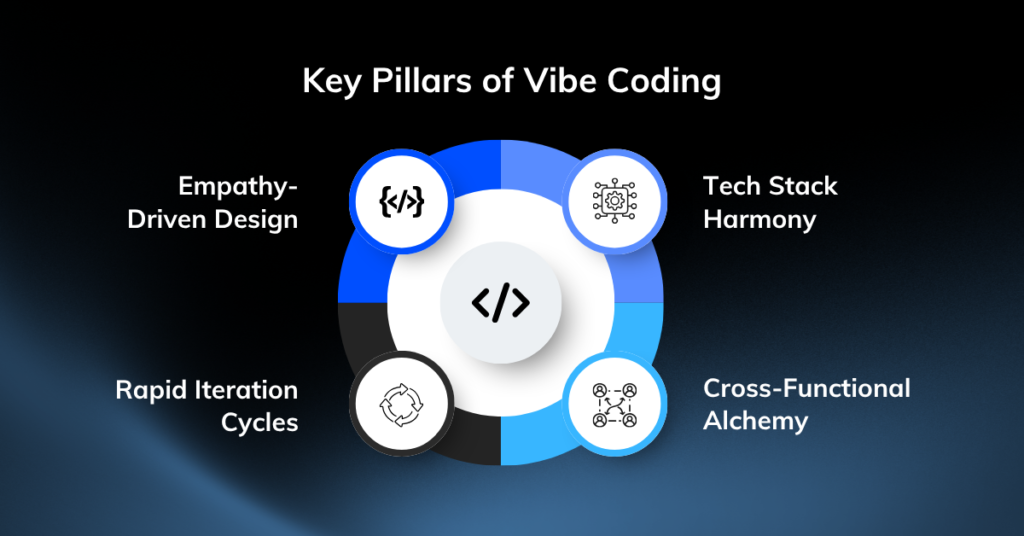
To successfully implement this methodology, your approach must rest on four specific pillars:
- Empathy-Driven Design: You spend your time understanding the user’s unspoken needs rather than fighting with API documentation. Your prompts are based on user stories, not technical specs.
- Rapid Iteration Cycles: You build, fail, and learn in days. A typical iteration cycle drops from two weeks to two hours.
- Tech Stack Harmony: You rely on AI tools that automatically select compatible, lightweight frameworks (like React and Supabase) that work together seamlessly for prototyping.
- Cross-Functional Alchemy: Product managers, designers, and domain experts can actively participate in the codebase generation, unifying the team’s vision without a technical bottleneck.
Vibe Coding vs. Agile vs. Lean: A Synergistic Evolution
This is not a replacement for Lean startup principles; it is Lean on steroids. While Agile focuses on incremental delivery through engineering sprints, vibe coding accelerates the first delivery. You reach the “build-measure-learn” loop faster, reducing your initial sunk cost from $50,000 to under $5,000.
When Should You Use Vibe Coding for Building MVP?
Vibe coding is the ideal approach when you need to move from concept to a functional MVP quickly. It’s best suited for scenarios where:
- Speed, simplicity, and flexibility are crucial
- You’re validating a new idea or gauging market interest
- You need to concentrate on user flow and business value
- You prioritize lean development and cost efficiency|
The “Why Now?” The Impetus Behind Vibe Coding’s Rise
Why has this specific approach taken over the startup ecosystem in 2026? A few massive industry shifts finally converged, making AI-generated applications robust enough for market testing.
The AI-Augmented Developer
AI models like Claude 3.5 and GPT-4o have evolved past basic autocomplete. They now understand entire repository structures. Software developers are currently contributing to a massive 19% total labor productivity gain directly from AI tools. By utilizing vibe coding, non-technical founders can tap into this exact same productivity wave for their initial builds.
Hyper-Personalization Demands
Users expect software that understands them immediately. If your MVP feels clunky, users churn before experiencing your core value. Because vibe coding speeds up development time, founders have more bandwidth to refine the onboarding flow, copy, and user interface, driving deeper emotional connections.
The Saturated Market
Standing out requires shipping unique solutions fast. Vibe coding collapses the execution timeline, allowing you to test highly differentiated, niche features that would normally be cut from a traditional MVP scope due to budget constraints.
Data-Driven Intuition
Analytics tell you what users are doing, but your founder intuition tells you why. Vibe coding bridges this gap. You can test a gut feeling—a new feature, a different workflow—by generating it over a weekend, pushing it live, and letting the data validate your intuition by Monday morning.
Efficient Resource Allocation
Scaling an engineering team is expensive and time-consuming. Vibe coding allows existing senior developers to operate at an incredibly high leverage point. By automating repetitive tasks, your technical leadership can focus entirely on system architecture, security protocols, and long-term scalability. This is how you build an MVP faster with AI. If you need to scale your team, you can also hire AI developers who are proficient in this new paradigm.
Your 2026 Playbook: Implementing Vibe Coding for MVP Development
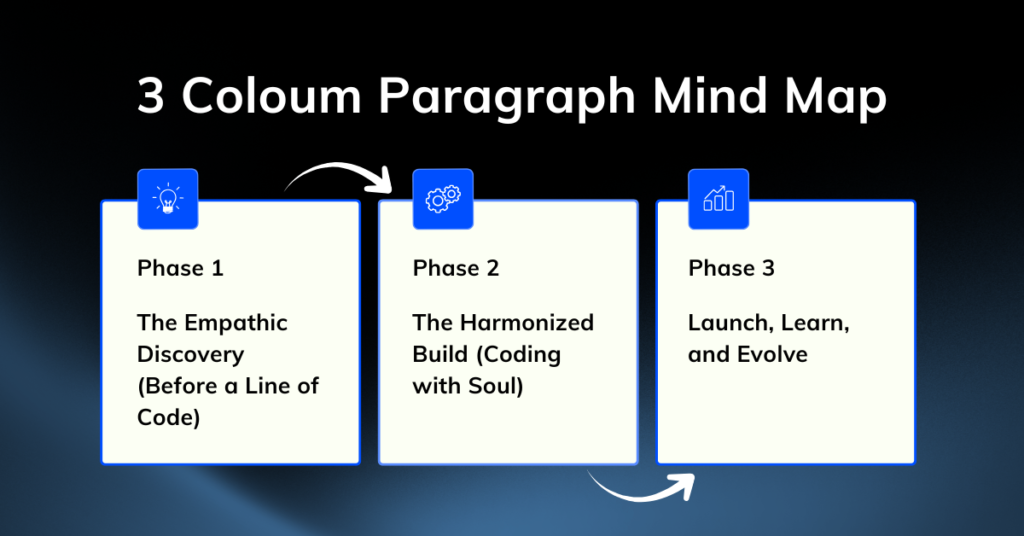
Shipping a product without a developer requires strict discipline. If you skip the definition phase, the AI will generate messy, directionless code. Follow this specific three-phase playbook.
Phase 1: The Empathic Discovery (Before a Line of Code)
Do not open an AI code editor until you have total clarity on what you are building. The AI will do exactly what you say, which is dangerous if you are unsure of your goal.
Deep User Immersion
Talk to 10 specific people who experience the problem you want to solve. Document their exact phrasing, their frustrations, and the workarounds they currently use.
Vision Boarding the Vibe
Write a single paragraph defining the product. For example: “A web app where freelance designers upload their portfolio and get an AI-generated client outreach email. Success equals a designer sending 5 emails using it in their first week.”
Defining Your “Core Vibe Feature”
Identify the one non-negotiable action the user must take to get value. Cut everything else. Authentication, user profiles, and complex settings are secondary. The core feature is your MVP.
Phase 2: The Harmonized Build (Coding with Soul)
This is where you open your tools and start generating the product.
Micro-Frontend Architecture
Keep the stack simple. Ask the AI to build a single-page application using React or basic HTML/Tailwind. Keep the logic contained to prevent the AI from getting confused across multiple files.
AI-Assisted Prototyping
Start with a foundational prompt describing the layout and the core feature. Once the AI generates the first pass, test it immediately.
Real-time Feedback Loops
Run iterative prompts to fix bugs. If a button doesn’t work, tell the AI: “The submit button on the intake form does not save data to the database. Fix the connection.”
The “Vibe Check” Review
Once functional, step back. Click through the app as a user. Does it make sense? Is the core action obvious without explanation? If yes, freeze development.
Phase 3: Launch, Learn, and Evolve
An MVP is useless if nobody sees it.
Measuring Emotional Engagement
Put the app in front of your 10 target users. Watch them use it via screen share. Do not explain how it works. Note where they hesitate, where they smile, and where they abandon the task.
Iterative Vibe Enhancements
Take the user feedback back to your AI editor. Prompt the system to adjust the UI or simplify the workflow based directly on the friction points you observed.
Scaling the Vibe
Here is the hard truth: vibe coding produces functional prototypes, not scalable infrastructure. Once you validate demand—meaning people are actually paying for your product or using it daily—you must transition away from AI-generated monolithic code.
Essential Tools & Technologies for the 2026 Vibe Coder
Choosing the right environment dictates your success rate. Here are the tools dominating the landscape.
Replit / Bolt.new
Perfect for non-technical founders. These platforms host the environment, handle the dependencies, and allow you to prompt full-stack web applications into existence without setting up servers.
Cursor / Windsurf
Ideal for technical founders or PMs with basic coding knowledge. These IDEs integrate AI directly into the codebase, allowing for precise architectural control.
v0 by Vercel
The best tool for rapid UI prototyping. You prompt a visual design, and it outputs clean React components.
Supabase / Firebase
The go-to database solutions for vibe-coded MVPs, offering easy integrations that AI models understand perfectly.
Vibe Coding Success Stories
“Bloom”: A Mental Wellness App
A non-technical founder wanted to test a daily journaling app that used AI to summarize emotional trends. Using Replit, they generated a functional MVP in 6 days. They acquired 500 beta users in two weeks, validated the core assumption, and successfully raised a pre-seed round based on the traction.
“Synapse Finance”: Simplifying Complex Investments
A product manager at a mid-sized fintech company used Bolt.new to prototype a new data visualization dashboard over a weekend. By presenting a working, interactive prototype instead of a static Figma file, they secured immediate executive buy-in and fast-tracked the feature’s official engineering roadmap.
Overcoming Vibe Coding Challenges: A Realistic Outlook
Vibe coding is a validation tool. Treating it as a substitute for professional software engineering will severely damage your business.
The “Lost in Translation” Risk
LLMs hallucinate. They will occasionally invent libraries that do not exist or write functions that silently fail. Always test every feature manually after an AI generation cycle.
Avoiding Feature Creep
Because it is so easy to ask the AI to “add a chat feature,” founders often build bloated MVPs. Stick strictly to the core definition you established in Phase 1.
Balancing Speed with Sustainability
AI-generated code is often unoptimized, repetitive, and difficult to maintain long-term. Security vulnerabilities (like SQL injections) are common because the AI optimizes for function, not enterprise-grade security.
The Future of MVP Development
The trajectory is clear. AI will handle the 0-to-1 prototyping phase for almost all new software products. Product managers and founders will spend their time optimizing business logic and user experience rather than managing development sprints.
However, the 1-to-100 scaling phase will heavily rely on elite technical leadership.
Companies will need senior engineers who know how to take a validated, vibe-coded prototype, untangle the AI-generated technical debt, and architect a secure, scalable infrastructure.
Scale Your Vibe-Coded MVP with Enlight Lab
Vibe coding for MVP development gets you to market in record time. It helps you prove that users want your product and are willing to pay for it. But what happens when you actually hit product-market fit?
Your database starts slowing down. The AI-generated codebase becomes too fragile to update. You want to add complex, proprietary AI features, but the generic coding agents can’t handle the architecture.
This is where Enlight Lab steps in.
We partner with SaaS founders, CTOs, and product managers to transition validated MVPs into robust, scalable software products. Our senior engineering teams provide the technical leadership required to eliminate technical debt, integrate advanced AI automations, and deliver reliable feature velocity without internal bottlenecks.
You proved the business model. Let us build the foundation that scales your revenue. Contact Enlight Lab today to seamlessly transition your MVP to an enterprise-grade SaaS platform.