Your executive team approved a massive budget for a new generative AI initiative. For six months, your data scientists have built and trained a model that performs flawlessly in the lab. Accuracy is high, latency is low, and the board is thrilled.
Then, you deploy it into production.
Suddenly, the model cannot access the real-time data it needs from your legacy CRM. The API calls time out. End users abandon the tool within two weeks because it disrupts their existing workflow. The project stalls, and the budget evaporates.
This scenario is not an outlier; it is the statistical norm. According to recent industry reports, 59% of companies spend more than $1 million annually on AI, yet only 29% report seeing meaningful ROI from their investments.
The root cause of this massive failure rate rarely has anything to do with the underlying machine learning models. Instead, these initiatives collapse because organizations misunderstand the critical difference between AI Integration vs AI Development.
If you are a startup founder, CTO, or product owner trying to extract actual P&L value from artificial intelligence, you must shift your focus away from the algorithms and toward your infrastructure.
What Is The Difference Between AI Integration vs AI Development?
To understand why so many projects stall, you first need to draw a hard line between building a model and making that model useful.
AI Development: The controlled lab environment
AI development is the process of creating, training, and refining a machine learning model. This phase belongs to data scientists and machine learning engineers. During development, teams work in highly controlled environments with curated, static datasets.
Success in AI development is measured by theoretical metrics: prediction accuracy, precision, recall, and F1 scores. The focus is strictly on the algorithm’s ability to learn from the data provided. Developers select the right neural networks, tweak hyperparameters, and optimize the math.
AI Integration: The real-world application
AI integration is the process of embedding that trained model into your company’s live operational environment. This phase belongs to software engineers, DevOps specialists, and product managers.
Integration requires connecting the model to automated data pipelines, ensuring it communicates securely with legacy APIs, and embedding its outputs directly into the software your employees or customers use daily. Success in AI integration is measured by business metrics: workflow adoption, system uptime, and measurable return on investment.
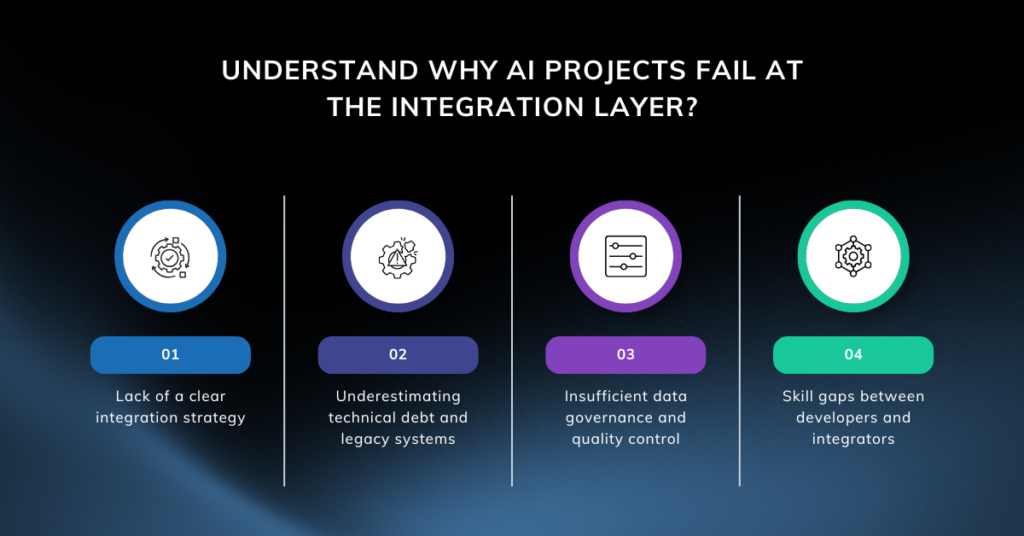
Understand Why AI Projects Fail at the Integration Layer
Organizations routinely forecast millions in revenue from AI, only to abandon the projects months later. By mid-2025, S&P Global Market Intelligence reported that 42% of U.S. companies had scrapped most of their AI initiatives.
These failures happen at the integration layer for several specific, avoidable reasons.
Lack of a clear integration strategy
Many tech leaders adopt a technology-first mentality. They select a powerful Large Language Model (LLM) based on industry hype, then look for a problem to solve.
This approach ignores the operational reality of the business. Successful AI implementations follow a standard 10/20/70 resource allocation model, as noted by industry best practices in 2025. You should spend 10% of your resources on algorithms, 20% on technology and data infrastructure, and 70% on people and process redesign. When leaders fail to plan how the AI will alter daily workflows, user adoption drops to zero.
Underestimating technical debt and legacy systems
Your AI model needs real-time data to function. However, most enterprise data is trapped in fragmented, legacy systems that were never designed for modern AI workloads.
Integrating a high-speed inference engine with a 15-year-old on-premise database often results in severe latency issues. If your core architecture relies on brittle APIs or batch processing, your AI model will fail under production load.
Insufficient data governance and quality control
Gartner predicts that through 2027, 60% of AI projects lacking AI-ready data will be abandoned.
In the lab, data scientists use perfectly cleaned, structured datasets. In production, data is messy, incomplete, and constantly shifting.
If your organization lacks active metadata management and continuous quality assurance pipelines, the model will ingest garbage data and output unreliable predictions.
Skill gaps between developers and integrators
Data scientists are not necessarily software engineers. A data scientist knows how to train a model using Python and PyTorch. A software engineer knows how to build scalable microservices, manage Kubernetes clusters, and secure API endpoints.
When organizations ask their data scientists to deploy models into production without support from specialized integration engineers, the resulting architecture is often unscalable and insecure.
Real-world Case Examples of AI Integration Failures
Looking at historical failures helps clarify the severe disconnect between theoretical AI development and practical AI integration.
Example 1: Large enterprise with legacy infrastructure
Consider the highly publicized failure of IBM Watson for Oncology. IBM developed a groundbreaking AI system designed to recommend cancer treatments. The AI development phase was a massive success, with the system proving capable of processing vast amounts of medical literature.
However, the integration phase failed completely. The system could not seamlessly ingest patient records from the highly fragmented, unstructured electronic health record (EHR) systems used by hospitals. Because the AI integration into the clinical workflow was too difficult, doctors stopped using it. The project, which cost billions to develop, was ultimately scaled back drastically.
Example 2: AI-native startup scaling too quickly
A common pitfall for modern AI startups involves scaling. A promising startup built a computer vision model to detect manufacturing defects on assembly lines. The pilot program, running on a local server with pre-recorded video, achieved 99% accuracy.
When the startup tried to integrate the solution across 50 live factory floors, the system collapsed. They had not built the necessary edge-computing infrastructure to handle the massive ingress of live 4K video data. The startup failed because they mastered AI development but completely ignored the data pipeline and scalability requirements of AI integration.
AI Development vs Integration: What Common Mistakes Businesses Make
Following are the common mistakes organizations make:
Overemphasis on Cutting-Edge Models
Businesses often chase the most advanced AI models, assuming “cutting-edge” means “best for business.” But a state-of-the-art model is useless if it doesn’t solve a real problem. This obsession leads to neglecting simpler, more practical solutions. Common mistakes include:
- Chasing Hype: Prioritizing models that are popular or technically impressive over those that fit a specific business case.
- Ignoring ROI: Failing to connect the model’s capabilities to clear financial or operational returns.
- Underestimating Simplicity: Overlooking simpler, well-integrated models that can often deliver better results more efficiently.
Ignoring Data Quality and Pipeline Readiness
AI models are only as good as the data they’re trained on. Organizations often underestimate the work needed to prepare and maintain their data, leading to poor AI performance. Key areas of neglect include:
- Data Cleaning: Removing or correcting inaccurate, incomplete, or irrelevant data.
- Standardization: Ensuring data is in a consistent format across all systems.
- Pipeline Maintenance: Continuously monitoring and managing the flow of data to prevent degradation.
Without high-quality data, even the most advanced AI will produce unreliable results.
Skipping Stakeholder Collaboration
AI integration is not just a technical initiative—business teams, IT, and end-users all need to work together to identify pain points and desired outcomes. Businesses often focus solely on the technical implementation while neglecting the input and training required for those who will use and manage the system.
Disregarding Scalability and Maintenance
A significant mistake companies make is neglecting to design solutions with long-term scalability and easy maintenance in mind. AI models evolve, and infrastructure needs change as businesses grow. Without proper planning, businesses end up with solutions that are costly to update or cannot handle increased demand.
Lack of Defined KPIs for Success
Businesses frequently fail to establish clear Key Performance Indicators (KPIs) for measuring the success of AI initiatives. This oversight leads to projects without clear goals or a return on investment. Defining measurable outcomes from the start ensures alignment with business objectives and accountability for results.
Follow the Best Practices for AI Integration vs AI Development
To ensure your AI initiatives reach production and generate revenue, you must change how you sequence your projects.
Start with an integration-first mindset
Before writing a single line of code for model training, define the exact business problem and the workflow changes required. Co-design the AI tool with the end-users. If the people whose jobs will change are not involved in the planning phase, they will actively route around the tool once it goes live.
Build a comprehensive data strategy
Do not wait for production to discover your data is fragmented. Audit your data readiness specific to your use case. Build automated data pipelines with Service Level Agreements (SLAs) for data freshness. Implement active metadata management so your AI models can reliably interpret the data they consume.
Utilize robust API design and management
Treat your AI model as a microservice. Build secure, version-controlled APIs that allow your existing enterprise software to request predictions from the model seamlessly. This decouples the AI logic from your core applications, making it easier to update the model later without breaking your entire software ecosystem.
Plan for phased rollouts and continuous testing
Do not launch enterprise-wide on day one. Deploy the integrated model to a small, controlled group of users. Monitor both the inputs (to catch pipeline data drift) and outputs (to catch model hallucinations). Implement a strict 90-day review gate to decide whether to scale, pivot, or terminate the project based on hard financial metrics.
Successful AI implementation requires more than just powerful models. It demands the right strategy, scalable infrastructure, seamless integration, and continuous optimization. Enlight offers reliable AI consulting services to help you move from experimentation to real business impact through generative AI integration, workflow automation, and AI-driven product development.
When to Choose AI Development vs AI Integration
Choose AI Development When:
- You need custom solutions: If you need machine learning models or algorithms built to solve unique business problems.
- You’re exploring cutting-edge technology: If you’re innovating in areas like computer vision, NLP, or deep learning that require original research.
- You’re seeking a long-term strategic advantage: If proprietary AI capabilities could become a core differentiator for your company.
- You have the resources: If you have enough talent, time, and funding to build and maintain custom AI models.
Choose AI Integration When
- Pre-built tools will work: If existing AI solutions or APIs (like Google Cloud AI or OpenAI) can efficiently meet your business needs.
- Speed is essential: If you need to deploy AI quickly, leveraging pre-trained models is much faster.
- You have limited AI expertise: If your team lacks deep data science or AI skills, ready-made solutions are more practical.
- You need to be cost-effective: If budgets are tight, integration has lower development costs than building models from scratch.
How MLOps Bridges the Gap Between AI Development and Integration
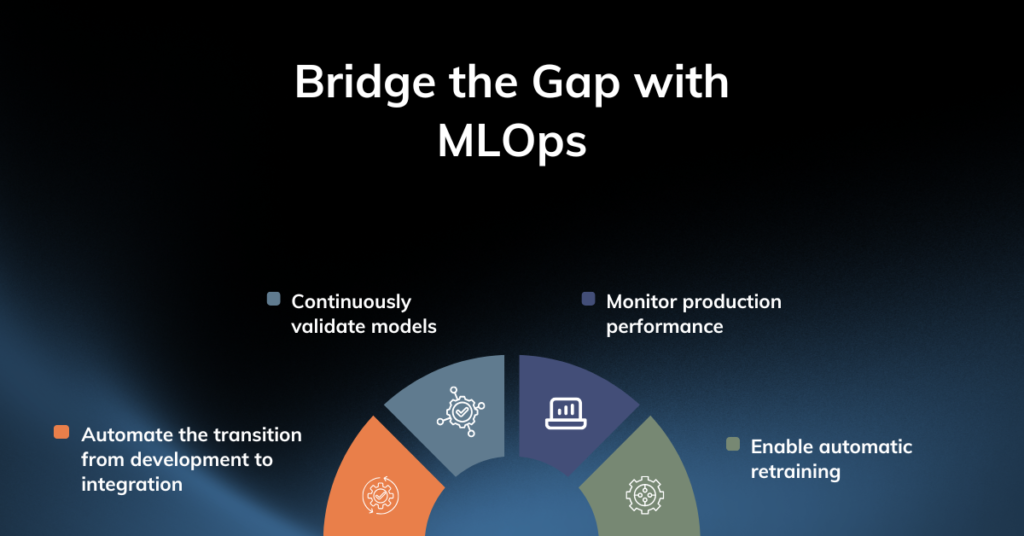
Machine Learning Operations (MLOps) is the solution to the integration crisis, applying the automated practices of DevOps to the machine learning lifecycle.
By implementing MLOps, organizations can:
- Automate the transition from development to integration: Set up Continuous Integration and Continuous Deployment (CI/CD) pipelines specifically for machine learning models.
- Continuously validate models: Automatically test new models against live data.
- Monitor production performance: Keep an eye on production systems for any performance degradation.
- Enable automatic retraining: Trigger retraining loops when data shifts occur.
Prioritizing AI Integration Over AI Development
The era of launching AI pilot programs just to prove a technology works is over. Today, executive boards and investors demand measurable business value.
While AI development remains a crucial scientific endeavor, it is no longer the primary barrier to market success. The true bottleneck is the integration layer. Organizations that successfully bridge the gap between AI Integration vs AI Development do so by prioritizing data infrastructure, workflow design, and cross-functional engineering teams over algorithmic hype.
Plan for the complexities of integration on day one, secure your data pipelines, and ensure your technology actually serves your people.