
Choosing the right technical leadership can dictate the survival and growth trajectory of your company. Many founders and executives reach a critical juncture where they need high-level technical strategy, but they hesitate on exactly how to fill that gap. Making the wrong choice drains capital, delays product launches, and burns out existing engineering teams.
Business leaders generally face two primary options for securing top-tier technical guidance: hiring a traditional full-time Chief Technology Officer (CTO) or engaging a fractional tech leader through a CTO-as-a-Service model. Both avenues offer distinct financial implications, strategic benefits, and operational risks.
This guide provides a comprehensive breakdown of the costs, benefits, and Return on Investment (ROI) for both models. By understanding the true financial commitment and strategic outcomes of each path, you can make a calculated decision that protects your budget and accelerates your technology roadmap.
The Traditional Path: In-House CTO Hiring
An in-house CTO acts as the dedicated, full-time architect of your company’s technology strategy. They align technical decisions with business goals, manage engineering teams, and oversee product architecture from the ground up.
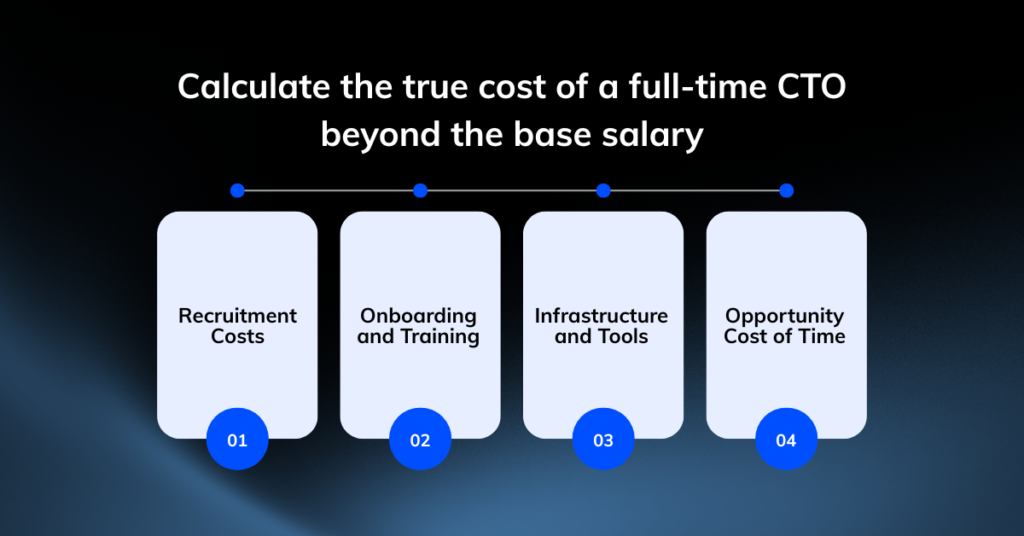
Calculate the true cost of a full-time CTO beyond the base salary
The sticker price of a full-time CTO rarely reflects the actual financial drain on your organization. Industry reports indicate that CTO base salaries can vary significantly depending on company size, industry, location, and growth stage, with compensation often ranging from the mid-six figures to well above that level for senior leadership roles.
Beyond base compensation, you must account for several hidden expenses:
-
- Recruitment Costs: Executive search firms typically charge 20% to 30% of the candidate’s first-year base salary. For a $250,000 CTO, that is a $75,000 recruitment fee.
-
- Onboarding and Training: Executive integration takes time. You lose weeks of productivity while a new CTO learns your existing architecture, company culture, and market positioning.
-
- Infrastructure and Tools: High-level executives require enterprise-grade software licenses, premium hardware, and a budget for continuous professional development. According to [CTO Academy], standard executive CTO programs can cost upwards of $29,000.
-
- Opportunity Cost of Time: The average time to hire has increased to roughly 44 days globally. During this month-and-a-half gap, strategic technical decisions stall.
Explore the benefits of hiring an in-house CTO
An in-house CTO offers several key advantages:
-
- Unmatched Dedication: A full-time CTO is wholly committed to your brand, developing a long-term vision that evolves with the market.
-
- Cultural Integration: They embed themselves within your company culture, which helps foster loyalty and trust among the engineering team.
-
- Strategic Alignment: Their hands-on leadership ensures that daily technical operations connect seamlessly with broader, multi-year business goals.
Consider the drawbacks of hiring a full-time CTO
-
- High Cost: A full-time CTO’s salary and benefits can exceed half a million dollars, diverting critical funds from marketing, sales, and product development.
-
- Limited Perspective: A permanent CTO might rely on familiar technologies, overlooking more innovative or efficient solutions that could accelerate growth.
-
- Single Point of Failure: If your full-time CTO leaves unexpectedly, it can derail your entire technology strategy and create a significant leadership vacuum.
The Alternative: Understanding CTO-as-a-Service
CTO-as-a-Service, often referred to as a fractional CTO, provides businesses with on-demand, part-time technical leadership. These senior executives split their time across a handful of companies, delivering high-level strategic guidance without the requirement of a full-time employment contract.
How much does CTO-as-a-Service cost in 2026?
CTO-as-a-Service relies on value-driven pricing models, allowing businesses to scale their investment up or down based on current needs. Monthly fractional CTO retainers typically range from $3,000 to $15,000 depending on scope and hours, according to Rewired. For businesses preferring an hourly arrangement, rates generally run between $150 and $500 per hour.
This model eliminates hidden recruitment fees, benefits packages, and expensive severance payouts. You pay strictly for the expertise and the hours utilized.
What are the key advantages of using CTO-as-a-Service?
Engaging a fractional technical leader offers immediate access to senior expertise. Instead of waiting 44 days to fill a role, you can onboard a fractional CTO within a week.
-
- Cost-Effectiveness and Predictable Spending: You control the budget through predefined hourly blocks or fixed retainers.
-
- Flexibility and Scalability: You can increase the CTO’s hours during a major product launch, then scale back during maintenance periods.
-
- Diverse Industry Experience: Fractional CTOs work across various industries. They bring an unbiased external perspective and introduce you to best practices learned from diverse tech ecosystems.
-
- Reduced HR Burden: Because the CTO operates as an external vendor or consultant, your HR team saves time on payroll processing, benefits administration, and performance reviews.
What are the disadvantages of CTO-as-a-Service?
-
- Limited Day-to-Day Involvement: A fractional CTO focuses on high-level strategy rather than daily tasks like coding or managing scrums. This means less direct interaction with your junior developers.
-
- Potential for Misalignment: Without constant involvement, there’s a risk of misalignment if internal teams don’t communicate roadblocks effectively.
-
- Dependency Risks: Relying on an external resource who isn’t always available can be problematic during minor operational issues. Strong communication protocols are essential to manage this.
How Do You Calculate the ROI Of an In-House CTO Versus a Fractional CTO?
Quantifying your investment requires mapping your direct expenses against tangible business outcomes. A strong ROI framework looks at both financial savings and revenue generation driven by technical leadership.
Measuring the ROI of an In-house CTO
To calculate the ROI of an in-house CTO, subtract their total compensation package (salary, bonus, equity, benefits) from the financial gains directly linked to their technical improvements. Success is measured through innovation, productivity, and team stability.
-
- Reduces technical debt: A full-time CTO will aggressively tackle legacy issues, leading to faster product release cycles.
-
- Improves developer retention: Strong, hands-on leadership boosts morale, saving the company significant costs associated with hiring and training new software engineers.
-
- Drives innovation: They build and manage internal innovation pipelines that lead to new revenue-generating features.
Example: A healthcare tech company’s full-time CTO overhauled their legacy database. This initiative, costing $450,000 in total compensation, reduced server downtime by 90% and led to $1.2 million in new contracts within a year.
Measuring the ROI of CTO-as-a-Service
The ROI for a fractional CTO is primarily measured by cost savings and speed. Subtract their monthly retainer from the capital saved on executive hiring, overhead, and avoided missteps.
-
- Lowers overhead: Avoids the high cost of a full-time executive salary, benefits, and equity, preserving capital for other growth areas.
-
- Accelerates time-to-market: Leverages proven frameworks and an established network to bypass common startup pitfalls and launch products faster.
-
- Provides immediate expertise: Offers specialized knowledge for specific projects like security audits or vendor negotiations, delivering quick wins and cost savings.
Example: An early-stage startup paid a fractional CTO $6,000 a month. The executive secured their cloud infrastructure and saved them $40,000 in SaaS fees, helping them close their Series A round without the burden of a $250,000 executive salary.
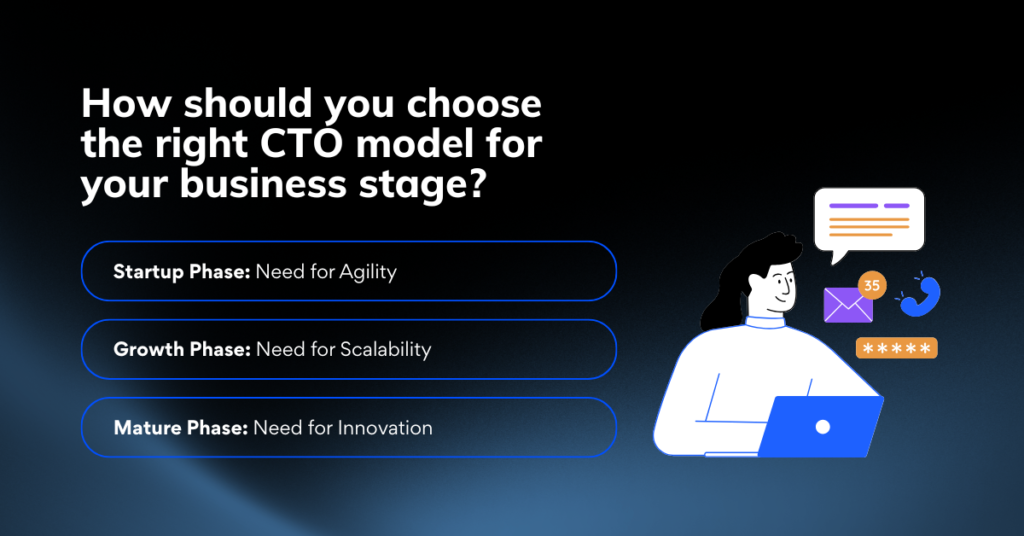
How Should You Choose the Right CTO Model for Your Business Stage?
Your company’s current lifecycle stage dictates the type of leadership required. Choose an in-house CTO if cultural integration and daily team mentorship matter more than immediate capital preservation. Choose CTO-as-a-Service if budget efficiency and rapid strategic pivots matter more than having an executive physically present in the office every day.
Startup Phase: Need for Agility
Startups prioritize agility and lean operations With tight cash flow, the main goal is to find product-market fit. CTO-as-a-Service for startup is typically the better option here, offering several advantages:
-
- Cost-Effective: It provides senior architectural guidance to build a Minimum Viable Product (MVP) without depleting seed funding on an executive salary.
-
- Strategic Oversight: Ensures the initial product is built on a solid technical foundation.
Growth Phase: Need for Scalability
During the growth phase, the focus shifts from finding customers to managing a large volume of user data, which requires robust scaling strategies. At this point, your leadership needs change.
-
- Full-Time CTO: A well-funded company might hire a full-time CTO to lead expansion efforts.
-
- Fractional CTO: A fractional CTO can also manage this phase effectively by increasing their hours in line with the company’s growth.
Mature Phase: Need for Innovation
Mature businesses concentrate on innovation, digital transformation, and modernizing legacy systems. With a stable budget, these organizations can support a full-time, permanent CTO who provides the dedicated, long-term focus needed to lead complex, multi-year initiatives and manage a large engineering department.
The Stepwise Procedure to Maximizing Your Technical Leadership Partnership
Making the hire is only the first step. You must actively manage the relationship to extract the maximum value from your technical leader.
Align on business goals, not technical details
Whether you have an in-house or fractional CTO, your role is to define the “what” and the “why,” not the “how.” Avoid dictating specific technologies or micromanaging engineering decisions. Instead, set clear business objectives. For example, instead of saying “We need to use React for our new front-end,” say “We need to reduce customer churn by 10% by improving app load times.” This empowers your technical leader to devise the most effective technical strategy to achieve the business outcome.
Provide the necessary resources
Your technical leader’s success depends on having the right tools and support. For a full-time CTO, this means allocating an adequate budget for developer tools, team training, and new hires. For a fractional CTO, this involves granting them immediate access to your codebase, analytics platforms, and key stakeholders. Removing administrative roadblocks ensures they can focus on delivering strategic value, not chasing permissions.
Establish clear communication and reporting cadences
Effective collaboration hinges on clear and consistent communication. Set up a regular rhythm for check-ins and reviews.
-
- For an in-house CTO: Weekly or bi-weekly syncs to discuss progress against the roadmap, address blockers, and ensure alignment with other departments are essential.
-
- For a fractional CTO: Communication needs to be more structured. Define specific KPIs and deliverables from the outset. Schedule weekly syncs with the internal product team to maintain alignment and review progress against contracted outcomes, such as a completed cloud migration roadmap or a finalized hiring plan.
By following this procedure you can build a strong partnership with your technical leader and ensure they can effectively drive your company’s technological growth.
Make the Right CTO Choice at the Right Time
Choosing between a fractional and a full-time CTO is a critical decision that depends on your company’s stage, budget, and long-term goals. A full-time CTO offers dedicated, in-house leadership ideal for complex, ongoing technical needs. In contrast, a fractional CTO provides specialized expertise on a flexible, cost-effective basis, perfect for startups and businesses needing strategic guidance without the commitment of a full-time hire.
Need help building software that scales? Connect with Enlight Lab! Our CTO-as-a-Service model gives you immediate access to enterprise-level technical leadership at a fraction of the cost.
We are here to guide your product journey. Stop guessing and start building future-proof software solutions today.