Generative AI has moved from buzzword to boardroom priority faster than almost any technology before it. Yet for every success story you read about, there are dozens of quiet failures: pilots that never reach production, budgets burned on the wrong use case, and tools nobody on the team actually uses.
According to Gartner, only 53 percent of AI projects make the leap from prototype to full production. That’s a coin flip, and the difference often comes down to one decision: who you partner with.
If you’re a founder, CTO, or decision-maker at an early-stage company, the stakes feel even higher. You’re working with tight budgets, critical deadlines, and a team that’s already stretched thin. You can’t afford an expensive experiment that goes nowhere. What you need is a partner who understands your business, respects your constraints, and delivers measurable results.
This guide breaks down everything you need to know about generative AI consulting services:
- What they include
- Why they matter for growing businesses
- How to evaluate a partner
- And, the costly mistakes that derail even well-funded projects
By the end, you’ll have a clear framework for making a confident, data-driven decision.
What Are Generative AI Consulting Services?
Generative AI consulting services are specialized advisory and development offerings that help businesses adopt, customize, and scale AI systems that generate content like text, images, code, and synthetic data. A good generative AI consulting company combines deep technical expertise with practical business understanding to guide you through every stage of adoption, from first idea to production deployment.
Unlike generic IT consulting, this work focuses specifically on the unique demands of large language models (LLMs) and generative systems. These projects are inherently exploratory and require a different approach than traditional software development.
Core Services You Can Expect
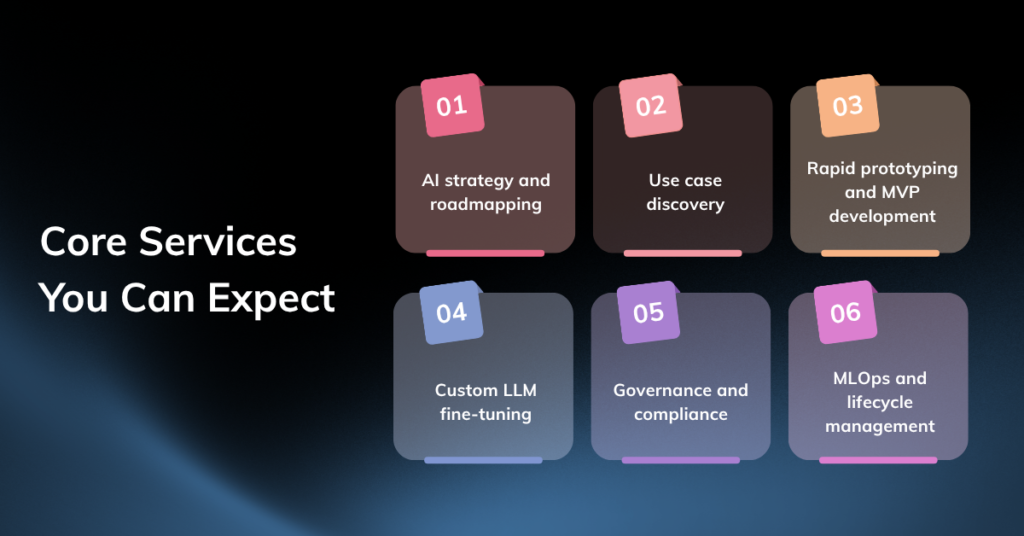
A reputable partner typically offers the following:
- AI strategy and roadmapping: Identifying where generative AI fits your business model and building a realistic adoption plan.
- Use case discovery: Pinpointing high-impact opportunities, from customer support bots to document summarization.
- Rapid prototyping and MVP development: Building working prototypes to validate ideas before heavy investment.
- Custom LLM fine-tuning: Training models on your company data to improve accuracy and relevance.
- Governance and compliance: Establishing protocols for responsible use across regulations like GDPR, HIPAA, and the EU AI Act.
- MLOps and lifecycle management: Monitoring, retraining, and governing models so they stay accurate over time.
Why This Market Is Exploding
The numbers tell the story. The AI consulting market is experiencing rapid growth as organizations increasingly adopt artificial intelligence to improve operations, automate processes, enhance decision-making, and accelerate digital transformation initiatives. Businesses are investing heavily because they recognize a simple truth: the technology is powerful, but knowing how to apply it is where the real value lives.
Why Your Business Needs a Leading Generative AI Consulting Partner
You might be wondering whether you can just hire an in-house team or experiment with off-the-shelf tools. For some companies, that works. But for most early-stage businesses, a dedicated partner solves problems that would otherwise stall your growth.
The Expertise Gap Is Real
Most growing companies lack the in-house specialists needed to build and deploy generative AI effectively. Machine learning engineers are expensive and hard to find, and the field changes monthly. Working with experienced generative AI consultants gives you immediate access to that expertise without the cost and delay of building a team from scratch.
Speed Matters When Deadlines Are Critical
Time is rarely on your side. A capable partner compresses your timeline dramatically:
- An AI strategy workshop takes 1 to 2 weeks.
- A proof of concept or MVP can be built in 4 to 8 weeks.
- Production-ready solutions typically take 3 to 6 months.
Compare that to the months it takes to recruit, onboard, and train an internal team, and the math becomes clear.
Cost Efficiency Through Focus
A good partner helps you avoid the single most expensive mistake in AI: building the wrong thing. By validating ideas early with lightweight pilots, you protect your budget and prove value before committing serious resources. This is exactly the kind of disciplined, cost-effective approach that growing companies need.
How Do You Choose the Right Generative AI Consulting Partner?
Choosing a partner is the most important decision in your AI journey. Get it right, and you unlock real business value. Get it wrong, and you join the 47 percent of projects that never make it to production.
Here’s what to evaluate.
Industry-Specific Experience
Look for a partner who understands your sector. A firm that has solved problems in fintech, healthcare, or logistics will move faster and avoid rookie mistakes. Ask directly: “Have you done this in my industry, and can you show me?”
A Structured, End-to-end Approach
The best generative AI consulting solutions follow a clear path from strategy to scale. A strong process usually looks like this:
- Executive workshops to align leadership and surface real use cases.
- Opportunity mapping to analyze your processes, goals, and data.
- Strategy and roadmap tailored to your business model.
- Prototyping to validate before building.
- Production and MLOps to deploy and maintain solutions.
Be wary of any firm that wants to skip strategy and jump straight to building. That’s a red flag.
Technical Depth Across Multiple Technologies
Your partner should be fluent in more than one model or platform. Generative AI moves fast, and a team committed to a single tool may push you toward solutions that fit their comfort zone rather than your needs.
Clear Communication
This one is easy to overlook. The right partner explains complex concepts in plain language. If you can’t understand what they’re proposing, you can’t make an informed decision, and you certainly can’t get your stakeholders on board.
Proven Results And Case Studies
Ask for relevant case studies and references. A credible firm will happily show you what they’ve delivered for businesses like yours. Vague claims without evidence are a warning sign.
What Are the Most Common Generative AI Mistakes to Avoid?
Even with the right partner, certain pitfalls trip up organizations again and again. Knowing these in advance gives you a major advantage. Here are the four mistakes most likely to derail your project, based on patterns observed across countless implementations (Neoteric, 2025).
Mistake 1: Writing Premature Requirements and RFPs
Drafting a detailed request for proposals before you understand the technology is like charting a map before you’ve seen the terrain. You’ll miss critical opportunities and lock yourself into use cases that may not be viable.
Do this instead: Start with an expert-led workshop. It uncovers considerations you didn’t know existed and helps you build a realistic roadmap grounded in actual organizational needs.
Mistake 2: Excluding End-Users and Stakeholders
Building on assumptions rather than real user needs is one of the most expensive errors you can make. A siloed approach leads to tools that don’t fit how people actually work, causing costly rework later.
Do this instead: Form an interdisciplinary team that includes end-users or the people closest to them, like your support staff. Their input drives better solutions and stronger adoption.
Mistake 3: Demanding A Rigid Blueprint
Generative AI projects are exploratory by nature. Your first hypothesis may fail. Your chosen model may not fit the use case. A detailed blueprint that scripts every step works for fixed-price projects with low uncertainty, but it suffocates an AI initiative.
Do this instead: Use a flexible project roadmap. It provides direction and key milestones while leaving room to iterate, test, and adapt as you learn.
Mistake 4: Skipping the Proof of Concept
Jumping straight to full implementation assumes your initial assumptions are flawless. In the unpredictable world of AI, that’s a dangerous bet. A proof of concept validates feasibility, exposes technical hurdles, and gathers user feedback before you commit serious budget.
Do this instead: Always run a PoC. Think of it as a reality check that saves you from pouring resources into a solution that may not deliver.
Generative AI in Action: What Success Looks Like
Real-world results make the value concrete. Across industries, businesses are using generative AI to solve specific, measurable problems. Here are examples of how the technology delivers when applied thoughtfully:
- Customer support: AI assistants handle inquiries across chat, email, and voice, reducing response times and freeing human agents for complex cases. Major brands have used generative AI to humanize and scale their support experience.
- Financial services: Machine learning models trained on transaction data detect fraud in real time, while NLP tools scan contracts to flag compliance risks.
- Healthcare: Generative AI summarizes medical records and powers chatbots for appointment scheduling, all within HIPAA-compliant frameworks.
- Logistics: Demand-prediction models prevent stockouts and overstocking, while virtual agents keep customers updated on deliveries.
- E-commerce: Personalized recommendation engines and intelligent assistants increase conversion and reduce cart abandonment.
The common thread across these wins is focus. Each one targets a repetitive, high-volume process where AI delivers clear, trackable returns. That’s the recipe you want your partner to follow.
The Future of Business With Generative AI
Generative AI is shifting from a competitive edge to a baseline expectation. The companies pulling ahead aren’t the ones chasing every shiny new tool. They’re the ones building practical, scalable solutions tied to real business outcomes.
A few trends are shaping what comes next:
- Custom LLMs over off-the-shelf models: Businesses increasingly fine-tune models on their own data for sharper, more relevant results.
- AI agents: Autonomous systems are starting to handle entire workflows, from lead qualification to invoice processing, with minimal human input.
- Multi-modal AI: Systems that combine text, vision, and speech are creating richer, more capable assistants.
- Stronger governance: As regulation tightens, responsible AI practices are becoming non-negotiable.
For early-stage companies, this is encouraging news. As the technology matures, it grows more affordable and accessible. The barrier to entry keeps dropping, which means the advantage now belongs to those who move thoughtfully rather than those with the deepest pockets.
Partner With Confidence in the AI Era
Generative AI offers a genuine opportunity to scale faster, serve customers better, and compete above your weight class. But the technology alone won’t get you there. Success depends on choosing a partner who understands your business, respects your budget and timeline, and guides you with a structured, proven approach.
Start with these next steps:
- Clarify your goals. Identify the specific problems you want AI to solve before you talk to anyone.
- Run a discovery workshop. Let experts help you find high-value use cases grounded in your real needs.
- Validate with a PoC. Prove the concept works before committing your full budget.
- Choose a partner with proof. Demand relevant case studies and clear communication.
The businesses that win with generative AI aren’t necessarily the biggest or the best funded. They’re the ones that pair the right strategy with the right partner. Make that choice well, and you set yourself up for results that genuinely move your business forward.
Ready to explore what generative AI can do for your business? Let’s make Enlight Lab your generative AI partner today and start turning your goals into a practical, results-driven roadmap. We specialize in delivering scalable, cost-effective generative AI solutions tailored to your startup’s unique challenges.