Software delivery has become a boardroom conversation.
You are under pressure to ship features faster, integrate AI into your product, and scale your SaaS application without massively inflating your engineering headcount. As a CTO or product manager, you know that the gap between aggressive business goals and actual technical delivery usually comes down to internal friction.
If your team ships slowly, your customers feel it. If your systems break often, your brand feels it. If your cloud costs keep rising, your margins feel it. And if your developers are buried under manual work, your product roadmap feels it.
That is why understanding the top DevOps Trends for 2026 matters. The teams winning in today’s market are adopting structured processes and end-to-end project ownership that align perfectly with business outcomes like reduced churn and increased Monthly Recurring Revenue (MRR).
This guide breaks down the ten critical movements reshaping software delivery. By adopting these strategies, you can provide the senior technical leadership your team needs to deliver complex projects on time, every time.
Understanding DevOps in 2026: Snapshot Overview
In 2026, DevOps is not only about automation and faster deployments. It is also about building smarter engineering systems that help companies move faster without creating chaos. It helps leaders reduce risk, improve developer productivity, control cloud spending, and make better technology decisions.
For non-technical entrepreneurs, this may sound overwhelming. But it does not have to be. The real goal of DevOps is simple: help your business deliver better software, faster, safer, and with fewer surprises.
At Enlight Lab, we help companies turn DevOps from a technical challenge into a business advantage through expert DevOps Consulting Services.
DevOps Trends for 2026 at a Glance
The top DevOps Trends for 2026 include AI-driven DevOps, platform engineering, DevSecOps, GitOps, advanced observability, cloud-native modernization, FinOps, value stream management, Everything as Code, and developer experience. These trends help IT leaders improve software delivery speed, reduce operational risk, strengthen security, control cloud costs, and align technology investments with business goals.
Quick summary for decision-makers
- AI-driven DevOps will help teams detect issues faster and automate routine operations.
- Platform engineering will simplify developer workflows with self-service tools.
- DevSecOps will make security part of every stage of software delivery.
- GitOps will improve control, visibility, and consistency in deployments.
- Observability will help leaders understand system health and customer impact.
- Cloud-native DevOps will support scalable, flexible, and resilient infrastructure.
- FinOps will connect cloud spending with business value.
- Value stream management will reveal bottlenecks across the delivery lifecycle.
- Everything as Code will bring consistency to infrastructure, policies, and compliance.
- Developer experience will become a key driver of productivity and innovation.
Why DevOps Trends for 2026 Matter for Business Leaders
The companies that win in 2026 will not be the ones with the most tools. They will be the ones that know how to use technology with clarity, discipline, and purpose.
DevOps sits at the center of that shift.
You may be building a SaaS product, modernizing legacy software, scaling an eCommerce platform, or trying to reduce outages that damage customer trust. In all cases, your DevOps maturity will affect how quickly and safely you can move.
The business pressure behind modern DevOps
- Customers expect reliable digital experiences all the time.
- Product teams need faster release cycles to stay competitive.
- Founders need technology investments to support growth, not slow it down.
- CTOs need better visibility into performance, risk, and cost.
- Engineering teams need fewer manual tasks and clearer workflows.
- Businesses need stronger security without blocking innovation.
DevOps helps connect these priorities.
When done right, it reduces firefighting. It gives your team repeatable processes. It helps leaders make decisions based on data instead of guesswork. Most importantly, it creates a healthier link between technology and business outcomes.
The leadership shift happening in 2026
- DevOps will move from a technical function to a strategic business capability.
- IT leaders will be expected to explain DevOps value in business terms.
- Automation will be judged by outcomes, not by how advanced the tool looks.
- Security, cost, and reliability will become part of every delivery decision.
- Developer productivity will become a leadership priority, not just an engineering concern.
As a leading DevOps Consulting partner, we help companies implement practical DevOps strategies without unnecessary tool overload. Our focus is to build systems that are secure, scalable, cost-aware, and aligned with your business goals.
The Top 10 Essential DevOps Trends to Watch in 2026
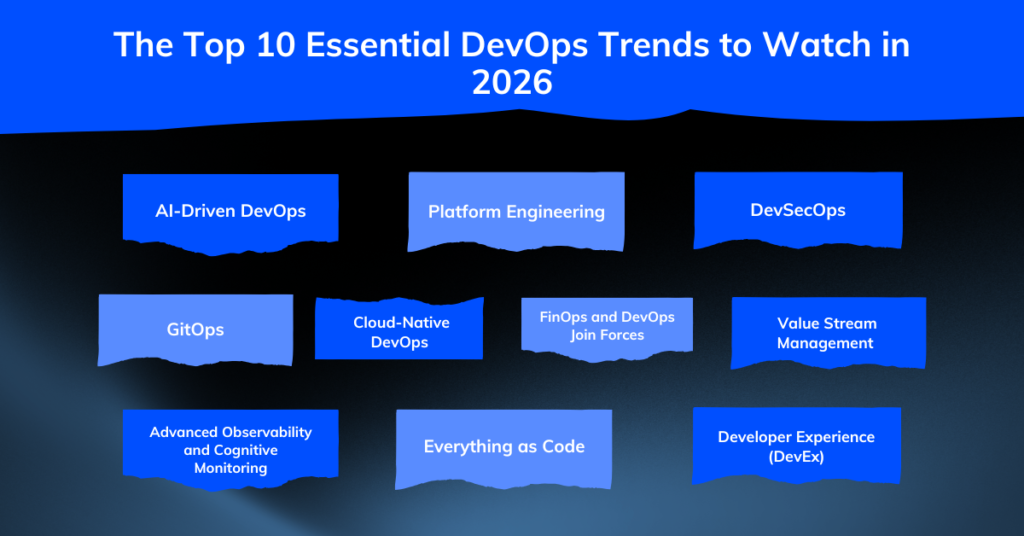
To keep your SaaS business competitive, you need to master the latest DevOps trends. By leveraging these advancements, you can accelerate feature delivery, minimize deployment risks, and directly link your tech operations to key business goals like MRR growth and customer retention.
Here are the top DevOps trends to consider for empowering your teams to work smarter and deliver measurable results.
1. AI-Driven DevOps
Engineering teams can no longer afford to react to system failures after they impact customers. AI-driven DevOps transforms delivery chains from passive dashboards into predictive, automated systems. Most of DevOps teams have already integrated AI into their CI/CD pipelines.
AI can analyze logs, detect unusual patterns, suggest root causes, reduce alert noise, and help teams respond to incidents before they turn into major problems. It can also support test automation, code reviews, documentation, and deployment checks.
What this means for you
- You can reduce downtime by identifying issues earlier.
- Your team can spend less time on repetitive operational tasks.
- Developers can move faster with AI-assisted workflows.
- CTOs can gain clearer insights into system behavior.
- Business owners can reduce the cost of avoidable incidents.
Action steps for IT leaders
- Start with one high-value use case, such as incident detection or alert reduction.
- Avoid giving AI full control without human review.
- Create clear rules for AI-generated recommendations.
- Measure impact through downtime, response time, and support costs.
- Train teams to use AI as an assistant, not a replacement for judgment.
AI-driven DevOps works best when it is connected to real business pain. Enlight Lab helps companies identify where AI can create measurable DevOps value without adding unnecessary complexity.
2. Platform Engineering
Platform engineering is one of the biggest shifts shaping DevOps.
As companies grow, development teams often face tool sprawl, unclear processes, slow environment setup, and repeated manual work. Platform engineering solves this by creating internal developer platforms that make software delivery easier and more consistent.
Think of it as giving your development team a well-designed operating system for building, testing, deploying, and managing software.
Why platform engineering matters
- Developers get self-service access to approved tools and environments.
- Teams follow standard workflows without needing to reinvent the process.
- Deployment becomes faster and more predictable.
- New developers can onboard more easily.
- Leaders gain better consistency across teams and projects.
Action steps for IT leaders
- Identify the biggest workflow pain points your developers face.
- Build internal platforms around real team needs, not assumptions.
- Treat your platform as a product with users, feedback, and ownership.
- Start small with repeatable templates, automation, and shared pipelines.
- Track success through deployment speed, developer satisfaction, and fewer support requests.
For startup founders, platform engineering may sound like something only large enterprises need. But even growing startups can benefit from simple platform foundations. The earlier you standardize delivery, the easier it becomes to scale without chaos.
3. DevSecOps
Security can no longer be something your team checks at the end of development.
By then, it is often too late, too expensive, or too risky.
DevSecOps brings security into every stage of the software delivery lifecycle. In 2026, this will become even more important as companies face stricter compliance needs, rising cyber risks, and more complex software supply chains.
For business leaders, DevSecOps is about protecting trust.
Your customers trust you with data, payments, workflows, and business operations. One security failure can damage that trust quickly.
What DevSecOps changes
- Security checks happen early in development.
- Vulnerabilities are detected before production.
- Compliance becomes more automated.
- Developers get faster feedback on security issues.
- Security becomes a shared responsibility across teams.
Action steps for IT leaders
- Add automated security scanning to your CI/CD pipelines.
- Use secrets management to protect sensitive credentials.
- Review third-party dependencies regularly.
- Create security policies that developers can follow easily.
- Build a culture where security supports speed instead of blocking it.
A common mistake is treating security as a separate department that says “no.” Modern DevSecOps works differently. It gives teams guardrails so they can move quickly and safely.
Enlight Lab’s DevOps Consulting Services help businesses embed security into delivery workflows without slowing down innovation.
4. GitOps
GitOps is becoming a standard approach for managing deployments and infrastructure, especially in cloud-native environments.
The idea is simple: your system configuration lives in Git, and Git becomes the source of truth. Changes are reviewed, tracked, approved, and applied in a consistent way.
For non-technical leaders, GitOps can be understood as a better way to manage change. It gives your team a clear record of what changed, who changed it, when it changed, and how to roll it back if needed.
Why GitOps is gaining momentum
- It improves visibility into infrastructure and application changes.
- It reduces manual deployment errors.
- It makes rollbacks faster and safer.
- It supports better audit trails.
- It helps teams manage Kubernetes and cloud environments more consistently.
Action steps for IT leaders
- Start GitOps with one environment or application.
- Standardize approval workflows for infrastructure changes.
- Train teams on version-controlled operations.
- Use GitOps to improve compliance and change tracking.
- Keep access controls strict and well-defined.
GitOps is especially useful for companies that want more confidence in their release process. If your team often struggles with deployment mistakes or unclear environment changes, GitOps can bring order and control.
5. Advanced Observability and Cognitive Monitoring
Monitoring tells you when something is wrong. Observability helps you understand why it is wrong and how it affects users.
That difference matters.
In 2026, observability will become a leadership priority because systems are becoming more distributed, cloud-based, and complex. You may have microservices, APIs, containers, third-party tools, databases, queues, and user-facing applications all working together.
When something breaks, your team needs more than an alert. They need context.
What modern observability includes
- Metrics that show system performance.
- Logs that capture detailed system events.
- Traces that follow requests across services.
- User experience data that shows customer impact.
- Business metrics that connect performance to revenue or retention.
Action steps for IT leaders
- Define what healthy performance means for key services.
- Create service-level objectives for critical systems.
- Connect technical alerts to user and business impact.
- Reduce tool sprawl where possible.
- Use observability data to prevent recurring issues.
For founders and business owners, observability helps reduce uncertainty. Instead of asking your team to guess what went wrong, you give them the visibility needed to act with confidence.
6. Cloud-Native DevOps
Cloud-native DevOps is about building and operating software in a way that fully uses the flexibility of the cloud.
This includes containers, Kubernetes, microservices, automated scaling, infrastructure as code, and resilient deployment practices. But the business meaning is simpler: your systems can grow, recover, and adapt faster.
In 2026, more companies will use hybrid cloud, multi-cloud, and edge environments. This makes strong DevOps practices even more important.
Why cloud-native DevOps matters
- It helps applications scale with user demand.
- It improves reliability through better architecture.
- It supports faster releases and updates.
- It reduces dependency on manual infrastructure work.
- It gives teams more flexibility across environments.
Action steps for IT leaders
- Assess whether your current architecture can support future growth.
- Standardize cloud deployment practices across teams.
- Use containers and orchestration where they create real value.
- Automate infrastructure setup and environment management.
- Build cost and security controls into your cloud strategy.
Cloud-native adoption should not mean moving everything to the cloud without a plan. It should be a careful, business-aligned modernization journey.
At Enlight Lab, we help companies move to cloud-native DevOps with the right balance of speed, cost control, scalability, and operational safety.
7. FinOps and DevOps Join Forces
Cloud bills can quietly become one of the biggest pain points for growing companies.
At first, cloud spending feels manageable. Then usage grows, teams spin up resources, environments are left running, and costs rise faster than expected.
This is where FinOps and DevOps come together to control cloud costs.
FinOps helps teams understand, manage, and optimize cloud spending. When combined with DevOps, it makes cost awareness part of engineering decisions.
Why this trend matters to founders and CTOs
- Cloud waste directly affects profitability.
- Engineering teams need visibility into cost impact.
- Budget overruns can slow down growth plans.
- Cost optimization should happen continuously, not once a year.
- Better cloud governance helps leaders make smarter investments.
Action steps for IT leaders
- Give engineering teams access to cloud cost dashboards.
- Set budgets and alerts by team, product, or environment.
- Automate shutdown of unused resources.
- Review architecture choices for cost efficiency.
- Include cost checks in deployment and infrastructure workflows.
FinOps is not about cutting costs blindly. It is about spending smarter. The goal is to make sure every cloud dollar supports performance, growth, or customer value.
8. Value Stream Management
Many companies measure technical activity, but not business flow.
They know how many tickets were closed, how many deployments happened, or how many bugs were fixed. But they may not know where work slows down, why releases take too long, or how engineering efforts connect to customer value.
Value stream management helps solve this.
It gives leaders a clear view of how ideas move from planning to production. It reveals delays, bottlenecks, handoffs, rework, and waste.
What value stream management helps you see
- How long it takes to deliver new features.
- Where work gets stuck.
- Which processes slow down delivery.
- How quality issues affect release timelines.
- Whether engineering work supports business goals.
Action steps for IT leaders
- Map your software delivery process from idea to release.
- Track lead time, cycle time, deployment frequency, and defect rates.
- Identify where approvals, handoffs, or manual tasks create delays.
- Align delivery metrics with revenue, retention, or customer satisfaction.
- Use data to improve flow, not to blame teams.
This trend is especially useful for CTOs and founders who feel delivery is slower than it should be but cannot clearly see why.
9. Everything as Code
Infrastructure as Code has already changed how teams manage servers, networks, and cloud resources. In 2026, this idea will expand further into “Everything as Code.”
That means infrastructure, security policies, compliance rules, configurations, monitoring, and deployment workflows can all be managed through code.
For leaders, the benefit is consistency.
Manual work creates risk. People forget steps. Environments drift. Documentation gets outdated. Everything as Code reduces those issues by making systems repeatable, reviewable, and easier to control.
Areas moving toward Everything as Code
- Infrastructure provisioning.
- Security policies.
- Compliance checks.
- Deployment pipelines.
- Monitoring configuration.
- Access controls.
- Environment setup.
Action steps for IT leaders
- Standardize coding practices for infrastructure and configuration.
- Store policies and configurations in version control.
- Add automated testing for infrastructure changes.
- Create approval workflows for high-risk changes.
- Document ownership for each code-managed area.
Everything as Code helps growing companies avoid the pain of inconsistent systems. It also supports better governance, faster onboarding, and safer scaling.
10. Developer Experience (DevEx)
Your developers are not just writing code. They are building the future of your product.
If they are slowed down by unclear processes, broken tools, poor documentation, constant interruptions, and manual tasks, your business slows down too.
Developer experience will become one of the most important DevOps priorities in 2026. Strong developer experience helps teams work with less friction, more focus, and better morale.
This is not a “nice to have.” It affects delivery speed, product quality, hiring, retention, and innovation.
What poor developer experience looks like
- Developers wait too long for environments.
- Deployments require too many manual steps.
- Documentation is missing or outdated.
- Teams use too many disconnected tools.
- Engineers spend more time fixing pipelines than building features.
- Onboarding new team members takes too long.
Action steps for IT leaders
- Ask developers where they lose the most time.
- Simplify tools and workflows where possible.
- Invest in internal documentation and self-service systems.
- Automate repetitive setup, testing, and deployment tasks.
- Measure developer satisfaction along with delivery performance.
When developers have better systems, your customers get better products. That is the real business case for developer experience.
How These DevOps Trends Help You Make Better Technology Decisions
The most important DevOps trends for 2026 are not isolated ideas. They are connected.
- AI helps teams respond faster.
- Platform engineering improves developer flow.
- DevSecOps protects trust.
- GitOps brings control.
- Observability gives clarity.
- FinOps protects margins.
- Value stream management connects delivery to business impact.
Together, these trends help you make better technology decisions.
Business outcomes these trends support
- Faster product releases.
- Lower operational risk.
- Better system reliability.
- Stronger security posture.
- Reduced cloud waste.
- Improved developer productivity.
- Better customer experience.
- More predictable scaling.
- Stronger alignment between technology and business strategy.
Practical leadership priorities for 2026
- Focus on outcomes before tools.
- Build automation where it removes real friction.
- Treat security and cost as part of delivery.
- Invest in visibility across systems and teams.
- Improve developer experience to improve business speed.
- Choose DevOps partners who understand both technology and growth.
You do not need to adopt every trend at once. In fact, you should not.
The smarter approach is to assess your current maturity, identify the biggest business risks, and build a roadmap that fits your stage of growth.
How You Can Prepare for DevOps Trends in 2026
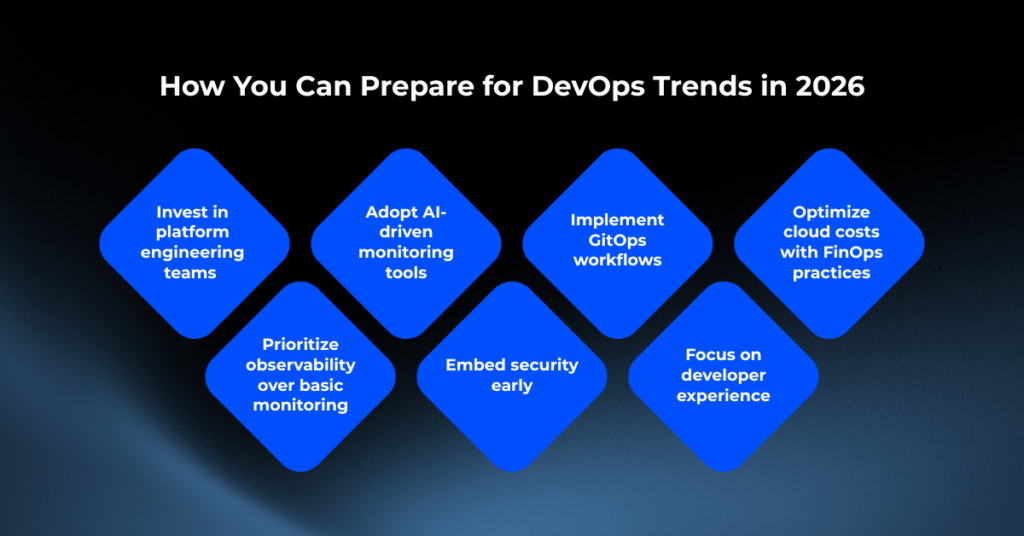
- Invest in platform engineering teams
- Adopt AI-driven monitoring tools
- Implement GitOps workflows
- Optimize cloud costs with FinOps practices
- Prioritize observability over basic monitoring
- Embed security early
- Focus on developer experience
How Enlight Lab Helps You Turn DevOps into a Growth Engine
DevOps can feel complex when you are trying to scale a business, lead a technical team, or make smart technology decisions without being deeply technical yourself.
That is where the right consulting partner matters.
Enlight Lab provides DevOps Consulting Services designed to help businesses build secure, scalable, automated, and cost-efficient software delivery systems. We do not focus on tools for the sake of tools. We focus on outcomes that matter to you.
What Enlight Lab can help you improve
- CI/CD pipeline design and optimization.
- Cloud infrastructure automation.
- DevSecOps implementation.
- Kubernetes and container adoption.
- Infrastructure as Code.
- Observability and monitoring.
- Cloud cost optimization.
- Deployment reliability.
- Platform engineering strategy.
- DevOps maturity assessment and roadmap planning.
Why leaders choose Enlight Lab
- We simplify complex DevOps decisions.
- We align technical improvements with business goals.
- We help reduce operational risk and delivery delays.
- We build systems that support long-term scale.
- We work as a strategic partner, not just an implementation vendor.
Evaluate Your DevOps Strategy Against 2026 Trends and Take Action
The leading DevOps Trends for 2026 show a clear direction: companies need smarter automation, stronger security, better visibility, cost-aware cloud practices, and healthier developer workflows.
As AI-driven operations, platform engineering, and GitOps reshape modern infrastructure, IT leaders must shift from reactive operations to proactive, data-driven decision-making.
If you want to make DevOps a real business advantage, a clear roadmap is extensively required and the listed trends should be strategically integrated into your business.
So, the next step is simple but critical: evaluate your current DevOps maturity, identify gaps, and prioritise initiatives that deliver the highest impact. By taking a structured, forward-looking approach today, you can position your organisation to lead.
Connect with Enlight Lab to know where you are today and build a practical roadmap for where you need to go next. Our team of experts can guide you through the process of implementing DevOps principles, tools, and practices to improve your software delivery and overall business performance.