Building a mobile app might be the most consequential decision your startup makes this year. Get it right, and you have a product that delights users, attracts investors, and scales with demand. Get it wrong, and you join a crowded graveyard of well-intentioned ideas that never found traction.
The numbers tell a sobering story. According to analysis cited by Medium, just 0.5% of mobile apps are considered successful—meaning 9,999 out of every 10,000 apps fail to gain meaningful traction. For founders working with tight budgets and tighter deadlines, that statistic isn’t meant to scare you. It’s meant to sharpen your focus. Mobile app development for startups demands a different approach than the one large enterprises use, because you’re playing a different game with different rules.
This mobile app development guide for startups is built for founders, CTOs, and non-technical entrepreneurs who need to turn a business vision into working software—without burning through runway or accumulating technical debt that haunts you later. At Enlight Lab, we’ve spent years helping early-stage teams move from idea to product to scale, and we’ve distilled those lessons into a practical roadmap. Let’s walk through it together.
Why Mobile App Development for Startups Needs a New Playbook in 2026
The old way of building apps no longer works for resource-constrained startups. Five years ago, you could spend a year building a feature-rich product, launch with fanfare, and hope users came. That model is dead. Today’s users decide whether to keep an app within minutes, and investors expect proof of traction before writing checks.
Several shifts have changed the rules:
- AI is now table stakes. Users expect personalization, smart recommendations, and conversational interfaces. AI integration that once felt futuristic is now an expectation.
- User patience has collapsed. App store competition is brutal. If your onboarding confuses people or your app feels slow, they leave—and rarely return.
- Funding favors evidence. Investors want validated demand, not just a polished pitch deck. A lean, working product with real users beats a beautiful prototype every time.
For startups, this means the priority is no longer building everything. The priority is building the right thing fast, learning from real users, and iterating. Enlight Lab calls this value-first engineering: every line of code should map to a business outcome or a validated user need. When you operate with limited resources, discipline isn’t optional—it’s your competitive advantage.
How to Build a Mobile App for Startups: The Strategic Foundation
Before a single developer writes code, the most important work happens. Knowing how to build a mobile app for startups starts with strategy, not technology. Skip this phase, and you risk building something nobody wants.
Define The Core Problem and Target User
Successful apps solve one painful problem exceptionally well. Resist the urge to serve everyone. Get specific about who your user is, what frustrates them today, and how your app removes that friction. A sharp problem statement keeps your team aligned and your scope under control.
Validate The Market Before You Build
Talk to potential users. Run surveys. Study competitors and the gaps they leave open. Market validation costs a fraction of full development and saves you from building features nobody will use. The goal is simple: prove demand exists before you invest serious money.
Scope Your Minimum Viable Product
Your MVP is the smallest version of your app that delivers real value and lets you learn from actual users. List every feature you can imagine, then ruthlessly cut to the few that solve the core problem. Everything else goes on a roadmap for later. A tight MVP gets you to market faster, controls costs, and gives you data to guide what comes next.
Why 99.5% of Startup Apps Fail and How to Join the 0.5%
That sobering success rate from earlier isn’t random bad luck. Most failures trace back to a handful of avoidable mistakes.
Building Features Instead of Solving Problems
Founders fall in love with features. Users fall in love with solutions. Apps that try to do everything end up doing nothing well. Stay obsessed with the core problem and resist feature creep until your users ask for more.
Neglecting Marketing and Retention
A great app nobody knows about still fails. Plan for user acquisition and retention from day one. Onboarding, push strategy, and ongoing engagement matter as much as the build itself often more.
Choosing The Wrong Development Partner
The team you build determines whether you ship something users love or something that drains your budget. A partner who understands startups brings more than code – they bring strategic judgment, cost discipline, and the ability to make smart tradeoffs under pressure.
Navigating the Startup App Development Process Step by Step
A clear, repeatable Startup App Development Process turns chaos into momentum. Here’s how Enlight Lab structures the journey from concept to launch.
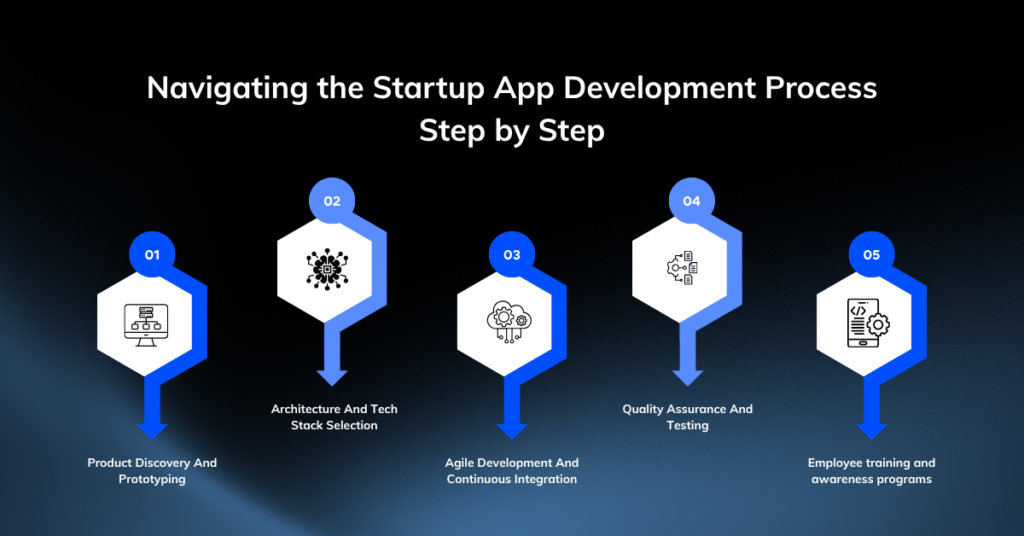
Phase 1: Product Discovery And Prototyping
This phase translates your strategy into tangible designs. Teams map user journeys, wireframe key screens, and build interactive prototypes. Testing prototypes with real users catches expensive mistakes before development begins.
Phase 2: Architecture And Tech Stack Selection
Engineers design the technical foundation and choose the technologies that fit your goals, budget, and scaling needs. Good architecture decisions here prevent the technical debt that slows startups down as they grow.
Phase 3: Agile Development And Continuous Integration
Development happens in short, focused sprints. Each sprint produces working features you can review and test. Continuous integration keeps the codebase stable and lets you adjust direction quickly as you learn—exactly what a fast-moving startup needs.
Phase 4: Quality Assurance And Testing
Rigorous testing across devices, operating systems, and real-world conditions ensures your app performs reliably. Bugs caught before launch protect your reputation and your user retention. First impressions are unforgiving.
Phase 5: Deployment And App Store Optimization
Launching means more than hitting publish. App store optimization—smart titles, keywords, screenshots, and descriptions—helps users actually find your app. Deployment also includes monitoring tools so you can track performance and respond to issues fast.
Choosing the Right Technology Stack: Native vs. Cross-Platform in 2026
Your technology choice shapes your budget, timeline, and the experience you deliver. There’s no universally correct answer only the right answer for your specific situation.
Native Development for Performance-critical Apps
Native development builds separate apps for iOS and Android using platform-specific tools.
Choose native if raw performance, complex animations, or deep access to device hardware matter more than speed to market. The tradeoff is higher cost, since you’re essentially building two apps.
Cross-platform Frameworks for Speed and Cost Efficiency
Cross-platform frameworks like Flutter and React Native let you write one codebase that runs on both platforms.
Choose cross-platform if controlling costs and reaching both audiences quickly matter most, which describes the majority of early-stage startups. You get near-native performance for most use cases at a meaningfully lower cost.
Progressive Web Apps for Low-friction Acquisition
A Progressive Web App runs in the browser but feels like a native app, with no download required.
Choose a PWA if you want to remove install friction, test demand cheaply, or reach users on low-end devices. It’s often a smart first step before committing to a full native build.
For most startups balancing budget against ambition, cross-platform development offers the best return. It cuts development time, reduces costs, and still delivers an experience users love—freeing up resources for the marketing and iteration that actually drive growth.
What Mobile App Development for Startups Actually Costs in 2026
Cost is the question every founder asks first, and the honest answer is: it depends on what you build. But you deserve realistic ranges to plan against.
The opportunity is enormous. According to Itransition, the global mobile application market is estimated to reach $378 billion in 2026, driven by rising demand across every industry. That growth is exactly why getting your investment right matters so much.
Main Cost Drivers to Plan For
Several factors determine your final budget:
- App complexity: A simple MVP costs far less than an app with custom AI, real-time features, or complex integrations.
- Platform choice: Building native for two platforms costs more than a single cross-platform codebase.
- Design requirements: Custom, polished UX adds value but also adds hours.
- Backend and infrastructure: Servers, databases, and APIs carry both build and ongoing costs.
- Maintenance: Budget for updates, bug fixes, and platform changes after launch.
Realistic Timeline Expectations
A focused MVP typically takes a few months to design, build, test, and launch. More complex products take longer. The smartest move is to launch your MVP quickly, gather real user data, and reinvest in features that prove their worth. This approach protects your runway and keeps your roadmap grounded in evidence rather than guesswork.
How Startups Can Prevent Burning Money on App Development
One of the biggest challenges founders face is building an app without wasting months of time and thousands of dollars on features users may never need. The solution is not simply spending less. It is making smarter decisions before development begins.
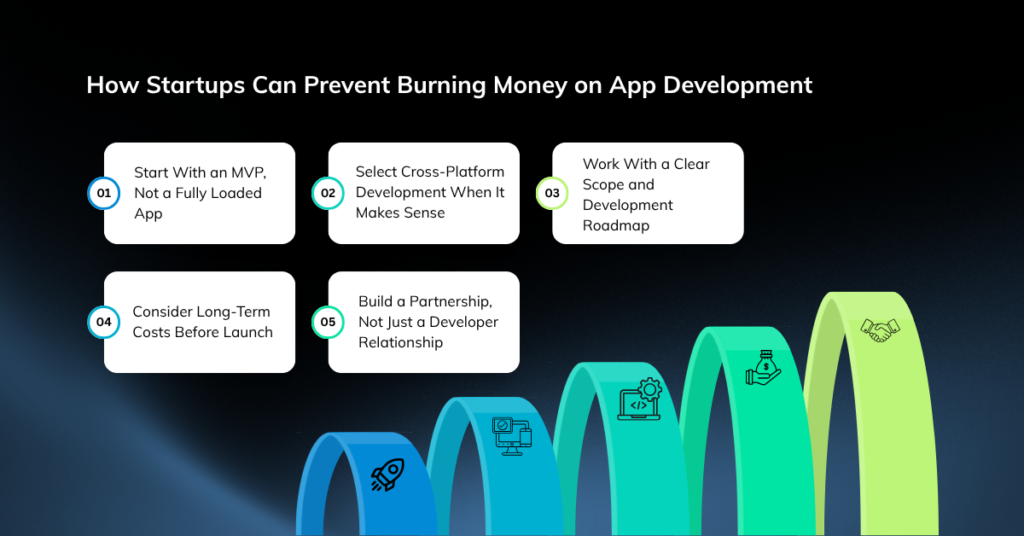
1. Start With an MVP, Not a Fully Loaded App
Many startups make the mistake of trying to launch a “perfect” product from day one. A better approach is to build a Minimum Viable Product (MVP) focused only on solving the core problem.
Your first version should answer one important question: Do users actually need this solution?
By validating your idea early, you reduce unnecessary development costs and gain real user feedback before investing heavily.
2. Select Cross-Platform Development When It Makes Sense
Building separate apps for iOS and Android can quickly double your development expenses. For most startups, cross-platform frameworks provide a faster and more cost-efficient way to launch.
The money saved can be invested where it creates more growth like customer acquisition, marketing, product improvements, and testing new ideas.
3. Work With a Clear Scope and Development Roadmap
Unclear requirements are one of the fastest ways to lose control of your budget. Open-ended hourly development often leads to unexpected costs, delays, and constant changes.
A structured process that begins with discovery, planning, and a fixed scope helps everyone stay aligned. You know what is being built, why it is being built, and what the expected outcome should be.
4. Consider Long-Term Costs Before Launch
Launching an app is only the beginning. Every application requires updates, security improvements, bug fixes, and compatibility changes as technology evolves.
A smart startup plans ongoing maintenance from the beginning and keeps aside a yearly budget for improvements. This prevents situations where your app breaks after a major operating system update with no resources available to fix it.
5. Build a Partnership, Not Just a Developer Relationship
Founders should focus on growing the company, understanding customers, and building the business.
The right development partner should take ownership of the technical process, communicate clearly, solve challenges, and help turn your vision into a reliable product.
Your role should be guiding the direction of the business, not becoming a full-time project manager.
The startups that succeed are not always the ones that spend the most money. They are the ones that make better decisions before spending it.
Build Your Mobile App the Smarter Way with Enlight Lab
At Enlight Lab, we help startups transform ideas into powerful, scalable mobile applications. From building MVPs to creating fully developed products, we provide ultimate support throughout your app development journey.
As an experienced mobile app development partner for startups, we begin with in-depth discovery to understand your goals, users, and business objectives. This helps us create solutions that are aligned with your vision and built for long-term success.
Over the years, we have helped businesses across industries such as healthcare, fintech, e-commerce, SaaS, and enterprise technology bring their digital products to life. We understand the common challenges startups face because we have worked on projects at every stage.
Whether you need a dedicated product development team, additional engineering support, or a flexible technology partnership that balances quality and budget, Enlight Lab provides the right approach for your business needs.
Our goal is simple: help you build a reliable mobile application, avoid unnecessary development mistakes, and create a product that is ready for real users and future growth.
Ready to turn your app idea into reality? Schedule a free strategy consultation with the Enlight Lab team. No pressure and no complicated sales process. Just a focused discussion about your product vision, timeline, and the best way to move forward.