
Every small business reaches the same wall. Revenue is climbing. Your product roadmap is ambitious. But your team is stretched thin, and the cost of hiring full-time engineers feels like a gamble you can’t afford. You post a job, wait three months, make an offer and by then, you’ve already missed the window.
Staff augmentation for small businesses solves exactly that problem. Rather than going through drawn-out recruitment cycles, you plug vetted, senior-level talent directly into your existing team, keep full control of your project, and pay only for what you need. No benefits packages. No long-term employment commitments. No delay.
This guide explains what staff augmentation is, how it compares to traditional hiring, how to implement it, and why it’s one of the most strategic decisions a growing small business can make.
Whether you’re preparing for a product launch, managing a surge in demand, or filling a critical skills gap, the answer might be simpler and more cost-effective than you think.
What Is Staff Augmentation and Why Do Small Businesses Need It?
Staff augmentation is a flexible hiring model that allows businesses to add external talent to their teams on a contract basis. Unlike outsourcing, where you hand off a project entirely to a third party, staff augmentation keeps you in control. Augmented staff work within your workflows, attend your standups, use your project management tools, and operate as extensions of your in-house team.
Think of it less as hiring and more as scaling. You identify the skill gaps, and your augmentation partner fills them fast.
The global staff augmentation services market was valued at USD 122.54 billion in 2025 and is expected to reach USD 131.25 billion in 2026, according to 360iResearch. That growth reflects one clear reality: businesses of all sizes are moving away from rigid hiring structures and toward more agile workforce models.
For small businesses specifically, this shift is critical. You don’t have the HR infrastructure, time, or capital that large enterprises use to attract and retain top engineering talent. Staff augmentation levels the playing field.
Staff Augmentation vs. Traditional Hiring: Key Differences
| Factor | Traditional Hiring | Staff Augmentation |
| Time to hire | 2–4 months | 5–10 business days |
| Overhead costs | Salary + 30–40% in benefits | Predictable contract rate |
| Flexibility | Low (permanent) | High (scale up/down) |
| Control | Full | Full |
| Risk | High (wrong hire = expensive) | Low (trial periods available) |
Hiring full-time employees often involves additional costs beyond salary, including benefits, taxes, insurance, administrative expenses, and recruitment efforts, which can make contractors a more flexible and cost-effective option for certain business needs.
For a software engineer earning $120,000 annually, that adds up to $36,000–$48,000 in hidden overhead every year. Staff augmentation eliminates most of that.
Common Myths About Staff Augmentation
Several misconceptions still hold small business owners back from exploring this model:
- “Augmented staff won’t understand our culture.” Reputable augmentation partners match candidates to your working style, time zone, and communication norms. Providers like Enlight Lab align developers to your existing tools like Slack, Jira, GitHub, so integration is seamless from day one.
- “It’s only for large enterprises.” Staff augmentation is specifically designed to support companies at every stage, from early-stage startups building their first MVP to scaling companies accelerating product development.
- “We’ll lose control of the project.” Unlike outsourcing, staff augmentation leaves all project direction in your hands. You manage the work; your partner provides the talent.
How to Identify Your Staff Augmentation Needs
Before reaching out to a provider, you need clarity on what you’re actually trying to solve. Jumping straight to “we need developers” is too vague. The more specific you are about your gaps, the faster and more effective the match will be.
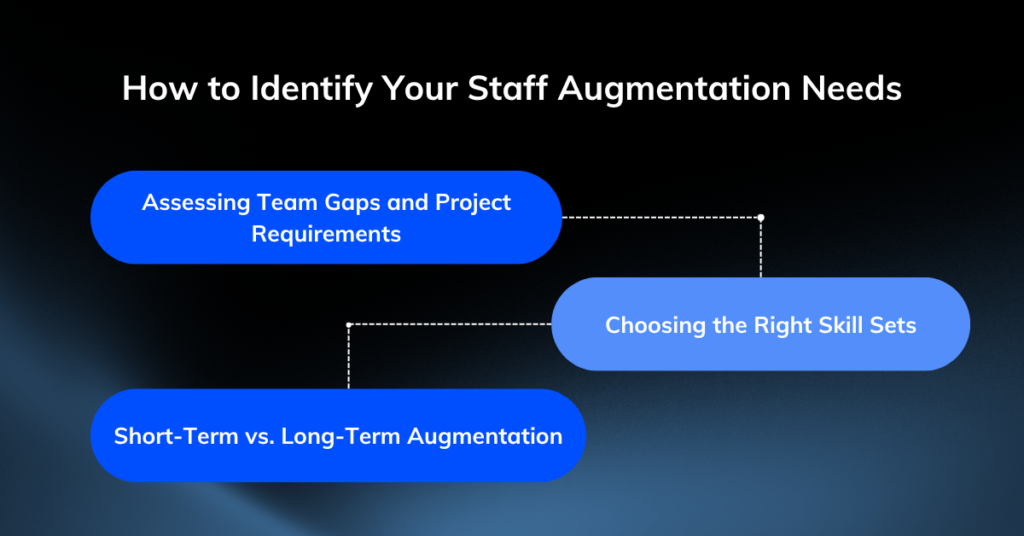
Assessing Team Gaps and Project Requirements
Start by asking direct questions:
- Which deliverables are currently delayed because of a skill shortage?
- Are there technical decisions being made by people who shouldn’t be making them?
- Is your core team spending time on tasks that fall outside their expertise?
- Is a critical deadline at risk because you simply don’t have enough capacity?
If you can answer “yes” to any of these, staff augmentation is worth evaluating seriously.
Choosing the Right Skill Sets
Once you’ve identified the gaps, get specific about the skills needed. Common areas where small businesses augment include:
- Backend engineering: APIs, microservices, database architecture
- Frontend engineering: React, Next.js, Vue—turning designs into responsive applications
- Mobile engineering: iOS, Android, Flutter, React Native
- Cloud & DevOps: CI/CD pipelines, AWS, Azure, GCP infrastructure
- Cybersecurity: Vulnerability assessments and security controls
- QA engineering: Manual and automated testing to keep releases production-ready
Enlight Lab, for example, maintains a talent network organized by development stack including JavaScript/TypeScript, Python, Java, C#/.NET and by platform, from DevOps to e-commerce. This specificity ensures that the developer you bring on isn’t a generalist stretched across unfamiliar territory; they’re a specialist who hits the ground running.
Short-Term vs. Long-Term Augmentation
Not all augmentation needs are the same. Two broad scenarios shape how you approach the engagement:
Short-term augmentation works best for:
- Product launches with hard deadlines
- Seasonal demand spikes
- One-time system migrations or integrations
- Covering a team member’s departure while permanent recruitment continues
Long-term augmentation works best for:
- Sustained product development without the cost of full-time hires
- Teams that need ongoing specialized expertise (e.g., a dedicated DevOps engineer)
- Companies scaling rapidly and needing consistent engineering output
The Staff Augmentation Process: From Requirement to Integration
The process doesn’t have to be complicated. With the right partner, it follows a clear path.
Finding the Right Augmentation Partner
Not every provider is the same. When evaluating the partners offering reliable staff augmentation services, look for:
- Pre-vetted talent: Developers should go through technical screening, coding assessments, and communication evaluations before they’re presented to you
- Speed of placement: A strong partner can provide interview-ready candidates within 5–10 business days, with urgent requests fulfilled in 48–72 hours
- Trial periods: The ability to evaluate fit before committing long-term reduces your risk significantly
- Replacement guarantees: Quick replacements ideally within two weeks if a match doesn’t work out
Enlight Lab’s augmentation model, built on 18+ years of software expertise, is structured around exactly these criteria: pre-vetted engineers, fast onboarding within 2–4 weeks, and quick replacements in less than two weeks when needed.
Onboarding Augmented Staff Effectively
Effective onboarding isn’t just about access credentials. It’s about context. The faster an augmented developer understands your product, your codebase, and your team dynamics, the faster they contribute.
- Share your product roadmap and current sprint goals on day one
- Introduce them to your core team through a brief kickoff call
- Set clear expectations about communication norms and availability
- Give them access to documentation, repositories, and project management tools upfront
Integrating Augmented Staff With Your Core Team
Integration is where many small businesses stumble. Here’s how to avoid common friction points:
- Treat augmented staff as full team members in standups, retrospectives, and planning sessions
- Assign a primary point of contact from your internal team
- Use shared tools consistently—don’t create separate workflows for augmented staff
- Establish weekly software update expectations to maintain delivery momentum
Cost-Benefit Analysis: What Does Staff Augmentation Actually Save?
This is the question every small business owner asks. The honest answer: the savings are significant, but they depend on how you structure the engagement.
Direct Cost Comparison
According to the U.S. Bureau of Labor Statistics, benefit costs for employees in the U.S. average approximately $15.60 per hour on top of wages. For a full-time engineer working 2,000 hours a year, that’s $31,200 annually in benefits alone before you factor in recruitment fees (typically 15–25% of first-year salary), onboarding time, and the productivity gap during the first 90 days.
Staff augmentation contracts eliminate most of these costs. You pay a transparent rate for the hours worked. No benefits. No payroll taxes. No recruitment agency fees.
Measuring ROI From Specialized Skills
The ROI calculation goes beyond cost avoidance. Consider:
- Faster time-to-market: Enlight Lab’s SaaS clients report 86% faster time-to-market when augmenting their engineering teams with specialists
- Improved delivery efficiency: Healthcare clients see 74% faster implementation cycles with augmented technical teams
- Better platform performance: E-commerce businesses report 80% improvement in platform performance after augmenting development capacity
These aren’t incremental gains. For a small business, getting a product to market months earlier—or significantly improving platform reliability—can directly impact customer acquisition and retention.
Avoiding Hidden Costs
Cost-effective staff augmentation services should come with full transparency. Watch out for:
- Vague billing structures that change mid-engagement
- Partners who can’t guarantee time zone alignment
- Providers without clear replacement policies
- Contracts that limit your ability to scale down quickly
A reputable provider will outline costs clearly, offer flexible scaling with reasonable notice periods (typically 30 days), and give you trial periods before long-term commitments.
Real-World Applications: Who Benefits Most From Staff Augmentation?
Early-Stage Startups
A startup building its MVP doesn’t need a team of five full-time engineers. It needs three to four strong developers for six months. Staff augmentation gives founders access to exactly that, without the overhead of permanent headcount. The focus stays on launching the product, not managing HR.
Scaling Companies
Once traction is proven, companies enter a growth phase where engineering demand fluctuates significantly. Flexible staffing solutions for small businesses allow scaling companies to expand their development capacity during high-demand periods and contract it afterward, maintaining efficiency without carrying excess payroll.
Enterprise Teams Modernizing Legacy Systems
Larger small businesses and mid-market companies often have legacy systems that nobody on the current team wants to touch. Bringing in specialists for a defined modernization project is a clean, cost-effective approach that doesn’t require permanent headcount additions.
Legal and HR Considerations You Can’t Ignore
Staff augmentation is flexible, but it’s not without structure. Small businesses need to get a few things right upfront.
Contractual Agreements and Intellectual Property
Ensure that every augmentation agreement includes clear IP ownership clauses. Any code written by augmented staff during the engagement should belong to your company—not the individual developer or the augmentation provider. Review contracts carefully before signing.
Compliance With Labor Laws
Augmented staff are contractors, not employees. Misclassifying them can trigger legal and tax consequences. Work with a provider that handles worker classification correctly and operates within the legal frameworks of the jurisdictions involved.
Managing Communication and Performance
Performance expectations should be documented before the engagement begins. Set clear KPIs, define acceptable response times, and agree on how progress will be reviewed. Regular check-ins—not just sprint demos—keep augmented staff aligned with your evolving priorities.
Future Trends in Staff Augmentation for Small Businesses
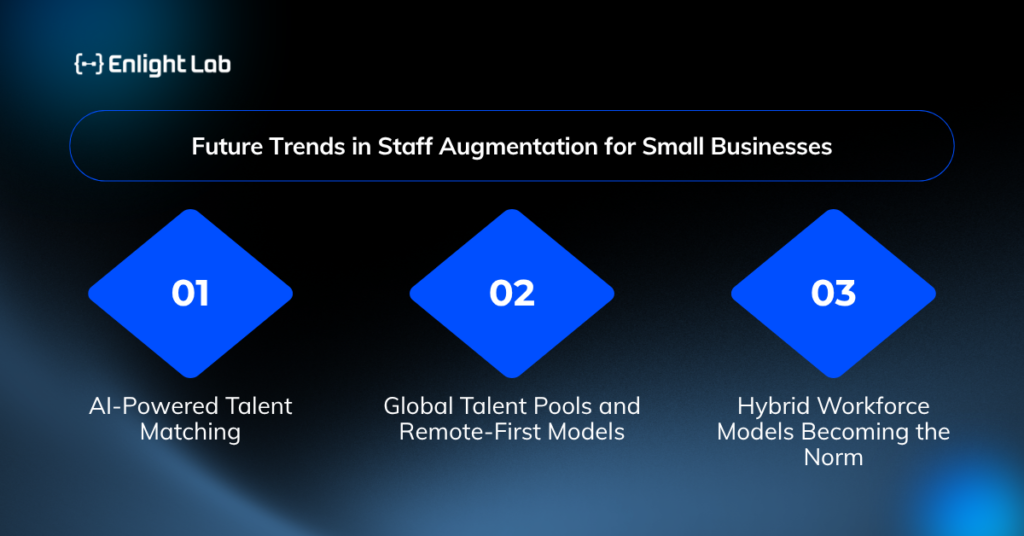
AI-Powered Talent Matching
Providers are increasingly using AI to match businesses with candidates based not just on technical skills but on communication style, working preferences, and domain experience. This means faster, more accurate placements and fewer mismatches.
Global Talent Pools and Remote-First Models
Geographic boundaries matter less each year. Small businesses in the U.S. can now access senior engineers in Eastern Europe, Southeast Asia, and Latin America at competitive rates—without sacrificing quality or communication. Time zone alignment, once a major barrier, is now a standard feature of reputable augmentation providers.
Hybrid Workforce Models Becoming the Norm
The future workforce won’t be purely full-time or purely augmented. Smart small businesses are already building hybrid models: a lean, permanent core team supplemented by a flexible layer of augmented specialists who expand and contract as the roadmap demands. This structure provides stability without rigidity.
The Smartest Way to Scale Is Also the Most Flexible
Growth doesn’t require massive headcount. The most resilient small businesses aren’t the ones with the most employees—they’re the ones that deploy the right talent at the right time.
Staff augmentation for small businesses makes that possible. It removes the financial and operational weight of traditional hiring, replaces it with a model built for speed and flexibility, and gives you access to a global pool of specialized talent that your competitors are still trying to recruit through conventional channels.
The global market for staff augmentation is accelerating. The businesses that understand this model now and build it into their growth strategy are the ones that will ship faster, scale smarter, and spend less doing it.
Enlight Lab helps small businesses and startups extend their engineering capacity with pre-vetted technical talent, fast onboarding, and full flexibility. If your team has gaps that are slowing down your roadmap, book a free consultation and find out how quickly you can close them.