Phones still ring. The difference now is who or what picks up. AI voice agents have moved from clunky demos to dependable infrastructure, handling support calls, qualifying leads, and booking appointments without a human on the line. The market reflects the shift: the voice and speech recognition sector is projected to grow from $14.8 billion in 2024 to over $61 billion by 2033 (Straits Research).
For founders and tech leaders watching every dollar and every deadline, that growth raises a practical question. How do you build one without burning your runway or your engineering team’s bandwidth?
This guide breaks down exactly how to build an AI voice agent for your business, the process, the real costs, and the features that separate a useful agent from a frustrating one. You’ll walk away knowing what to budget, what to build, and where a development partner saves you months of trial and error.
What an AI Voice Agent Actually Is
An AI voice agent is a conversational system that understands spoken language and responds with natural, human-like speech to complete real tasks. It listens, figures out what the caller wants, takes an action, and replies – all in near real-time.
How Voice Agents Differ from Chatbots
Traditional chatbots and phone trees follow rigid scripts. Press 1 for sales. Type your account number. Deviate from the path, and they break.
Voice agents work differently:
- Natural input – Callers speak however they want instead of pressing buttons or using single-word commands.
- Dynamic conversation – The agent handles interruptions, topic changes, and follow-up questions in one exchange.
- Real actions – It can pull data from your CRM, book a slot, or process an order—not just answer FAQs.
- Context memory – It remembers what was said earlier in the call, so customers never repeat themselves.
The practical result: voice agents don’t just route calls; they resolve them.
Why Businesses Are Adopting Voice Agents
For early-stage companies, three benefits stand out:
- Operational efficiency – AI-powered automation helps businesses streamline repetitive support tasks, reduce manual workload, and allow teams to focus on more complex customer needs. By handling routine interactions efficiently, automation improves productivity and helps optimize operational resources.
- Better customer experience – AI agents provide faster responses and more consistent support, helping customers get answers without unnecessary delays. They improve service availability, enhance engagement, and create smoother support experiences across different channels.
- Scalability without headcount – A voice agent handles thousands of concurrent calls without performance drops, so you grow without hiring linearly.
How to Build an AI Voice Agent: The Four-Phase Process
Building a voice agent isn’t one giant project. It’s four focused phases. The biggest predictor of success across all of them is a narrow, well-defined scope.
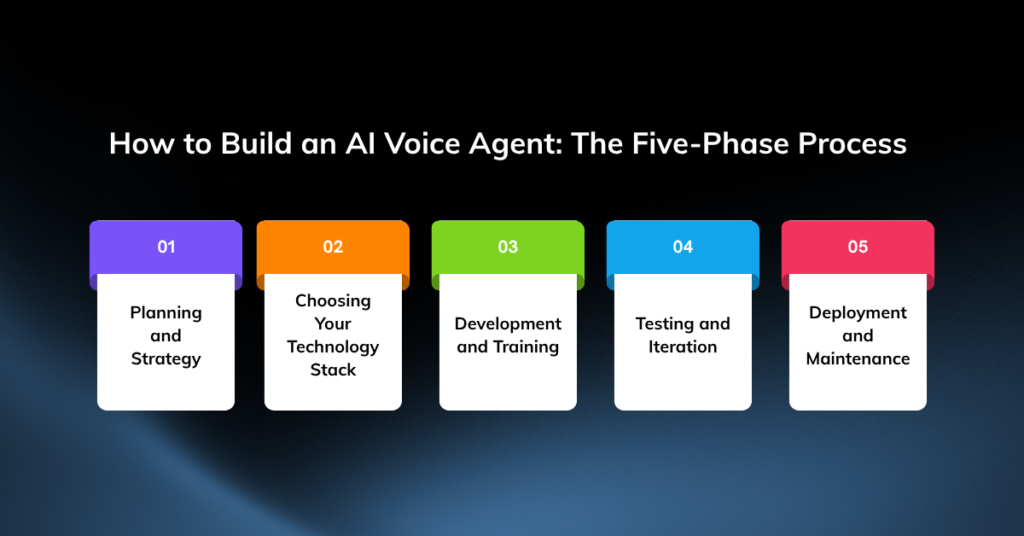
Here’s the process of building an AI voice agent:
Phase One: Planning and Strategy
Skip this phase, and you’ll pay for it later in rework. Get it right, and everything downstream moves faster.
- Define objectives and use cases – Pick one high-friction workflow after-hours support, appointment scheduling, lead qualification instead of trying to automate everything at once.
- Map common queries – Identify your audience and the questions they ask most. These become your agent’s core competencies.
- Choose a persona and tone – Decide how the agent sounds. Warm and casual fits hospitality; precise and calm fits finance.
- Plan your data strategy – Determine what data the agent needs including past call transcripts, knowledge base articles, and product details and how you’ll feed it in.
Set your success metrics here, too. Resolution rate, escalation rate, and average handling time give you something concrete to measure against once you launch.
Phase Two: Choosing Your Technology Stack
Most teams don’t build voice agents from scratch. They assemble them from proven components, then orchestrate the timing between each one. A working agent chains three technologies in real time:
| Component | Function | Technology |
| Speech-to-text | Converts spoken audio to text | Automatic Speech Recognition (ASR) |
| Language understanding | Interprets intent, generates a reply | Large Language Models (LLMs) |
| Text-to-speech | Turns text back into natural audio | Voice synthesis (TTS) |
A few decisions shape your stack:
- Speech accuracy is non-negotiable – It feeds everything downstream. The gap between 85% and 95% accuracy means cutting errors from 15 per 100 words to just 5. Real-time agents need transcripts back in under 300ms to feel natural.
- Integrations decide usefulness – Connect the agent to your CRM, calendar, and databases so it can take real action, not just talk.
- Cloud vs. on-premise – Cloud deployment is faster and cheaper to start, which suits most startups. On-premise makes sense only when strict data residency or compliance rules demand it.
This is where professional AI Agent Development Services add real value. They help businesses choose the right AI models, integrate essential technologies, and manage complex processes. This allows teams to focus on improving customer experiences instead of backend challenges.
Phase Three: Development and Training
Now you turn strategy into a working agent.
- Script the conversation flows – Map the “happy path” first—the ideal call from start to finish. Then build in clarifications, error recovery, and edge cases.
- Train the model – Feed it your collected data so it understands your products, policies, and the way your customers actually talk.
- Test and refine, repeatedly – Run real conversations through it, find where it stumbles, and tighten the logic.
- Handle the unexpected. Build guardrails to keep the agent on-topic and a clean handoff path to a human. This matters: internal research from AssemblyAI shows nearly 95% of users have been frustrated by a voice agent at some point. Good design is the difference.
Phase Four: Testing and Iteration
Thorough testing is non-negotiable. Before going live, your agent should be stress-tested across:
- Functional testing: Does it handle all intended use cases correctly?
- Edge case testing: What happens when callers go off-script?
- Performance testing: How does it handle concurrent calls at high volume?
- Security testing: Are sensitive data flows properly protected?
Plan for multiple iterations. The first version of your agent will reveal gaps that weren’t visible in design. Building a feedback loop into your testing process allows real call transcripts to guide continuous model improvements and significantly enhance overall quality.
Phase Five: Deployment and Maintenance
A voice agent is never truly done. Launch it carefully, then keep improving.
Track key metrics including:
- Call containment rate
- Average handle time
- Customer satisfaction scores on AI-handled calls
- Error and fallback rates
Use these metrics to continuously retrain and improve the agent. The most successful voice AI deployments treat launch as a starting point, not an endpoint.
So, deploy gradually, connect your channels, monitor performance by tracking completion rates, and optimize your strategy based on real call data and user behavior.
Key Features of an Effective AI Voice Agent
Not all voice agents are created equal. These features separate the ones customers trust from the ones they hang up on.
Natural Language Understanding and Intent Recognition
The agent must grasp what a caller means, not just match keywords. Strong intent recognition lets it handle “I need to check my order and ask about returns” as two requests in one breath.
Context Management and Personalization
By pulling from your CRM, the agent greets customers by name, references past interactions, and tailors responses. Generic replies feel robotic; personalized ones build trust.
Seamless Human Handoff
When a call gets complex, the agent should pass it to a person smoothly with full context attached, so the customer never has to start over.
Multi-Language Support
Serving customers in multiple languages widens your reach without hiring multilingual staff for every shift.
Analytics and Reporting
Dashboards showing call outcomes, sentiment, and bottlenecks turn every conversation into data you can act on.
Security and Compliance
For regulated industries, certifications like SOC 2 Type 2 and HIPAA aren’t optional. A 2024 FCC ruling confirmed that AI-generated voices fall under the Telephone Consumer Protection Act, so consent and data privacy must be built in from day one.
Cost Factors When You Build an AI Voice Agent for Business
Here’s the question every decision-maker asks first. The honest answer: it depends on scope, but the numbers are more predictable than you’d think.
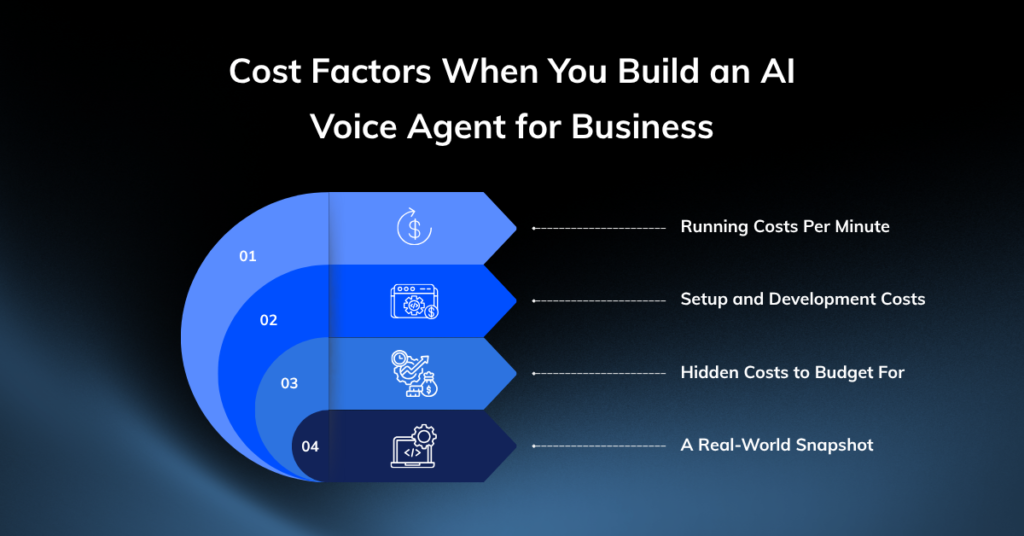
Running Costs Per Minute
A full-stack voice agent typically costs $0.01–$0.05 per minute when you combine speech-to-text, the LLM, and text-to-speech.
The spread comes down to choices:
- Voice quality – Basic TTS runs about $0.004/minute and sounds robotic. Premium voices from providers like ElevenLabs cost $0.05–$0.10/minute and sound convincingly human.
- LLM choice – Older models are cheaper but less capable. Newer models produce noticeably better conversations at a higher token cost.
- Real-time vs. Batch – Live conversation costs more than processing recordings after the fact.
Setup and Development Costs
Upfront costs vary widely:
- No-code platforms let non-technical teams launch fast with minimal setup, often free to start.
- Developer-led platforms carry low per-minute rates but require engineering time to build and maintain.
- Enterprise platforms charge setup fees ranging from $2,000 to as high as $200,000, with annual contracts often starting near $50,000–$150,000.
Hidden Costs to Budget For
The base price rarely tells the whole story. Watch for:
- Telephony and carrier fees for phone numbers and call minutes.
- LLM token costs, billed either bundled or as a separate pass-through charge.
- Integration fees, especially for legacy or proprietary systems.
- Compliance surcharges for HIPAA or PCI-DSS, often gated behind higher tiers.
Calculating Your ROI
The math is straightforward.
ROI = (annual savings − first-year cost) ÷ first-year cost × 100.
For example, if an AI solution helps a business save $144,000 annually and the first-year investment is $62,556, the calculated ROI would be approximately 130%. Actual results will vary depending on factors such as automation scope, operational costs, and usage volume.
For a budget-conscious startup, that math is the whole point. The right build pays for itself before the year is out.
A Real-World Snapshot
The pattern across successful deployments is consistent. A company picks one painful workflow say, missed after-hours calls leaking revenue and ships a contained agent to handle just that. They measure, refine, and only then expand.
The returns follow. Businesses that automate routine voice interactions free their people to focus on the complex, high-value conversations that actually need a human. That’s the leverage early-stage teams need most: more output without more headcount.
If you’d rather skip the months of trial and error, you can partner with a team to build your AI voice agent and get to a working pilot far faster.
Future Trends in AI Voice Technology
Emotion Recognition
Next-generation voice agents are beginning to detect emotional cues in a caller’s tone and adapt responses accordingly. This capability narrows the gap between AI and human empathy and enables smarter escalation decisions.
Multilingual Support
Businesses serving global markets are deploying voice agents with real-time multilingual capability. The ability to switch languages mid-conversation and adapt to regional accents is becoming a baseline expectation rather than a premium feature.
Advanced Personalization
As AI systems accumulate more interaction history, personalization moves beyond recognizing a returning caller. Future agents will adapt communication style, proactively surface relevant information, and anticipate needs based on behavioral patterns across every touchpoint.
Making Sure AI Tools Surface Your Voice Agent Content
A quick note for anyone publishing about their own deployment. To get cited in AI Overviews and conversational search, structure content the way these systems read it:
- Lead with direct answers. Put a concise, self-contained answer right under each heading.
- Use specific, verifiable facts. Statistics, named sources, and dates get extracted and cited more often than vague claims.
- Write conversational subheadings. Phrase them the way people actually ask questions.
- Name entities clearly. Use product and company names instead of pronouns so AI systems build accurate associations.
Building Smarter, Not Harder
Learning how to build an AI voice agent comes down to discipline: define a narrow scope, choose the right stack, train it on real data, and improve it continuously. The technology is mature, the costs are predictable, and the ROI lands within months for most businesses.
The companies winning with voice agents aren’t the ones with the biggest budgets. They’re the ones who started with a single high-friction problem and solved it well. Whether you build in-house or lean on AI Agent Development Services to compress the timeline, the move now is the same – pick one workflow, ship a contained pilot, and measure the results.
Phones still ring. The question is whether you’re ready to answer every one of them.
It’s time to take control of your customer interactions and turn them into opportunities for growth. At Enlight Lab, we specialize in creating scalable, cost-efficient AI-driven solutions tailored to your startup’s unique needs. Whether you’re bridging skill gaps or racing against deadlines, our team enables you to launch impactful pilots and iterate faster. Don’t wait! Empower your business to be the one that answers every call. Contact Enlight Lab today to get started with building and deploying an AI voice agent tailored to your business workflows, customer needs, and growth objectives.