
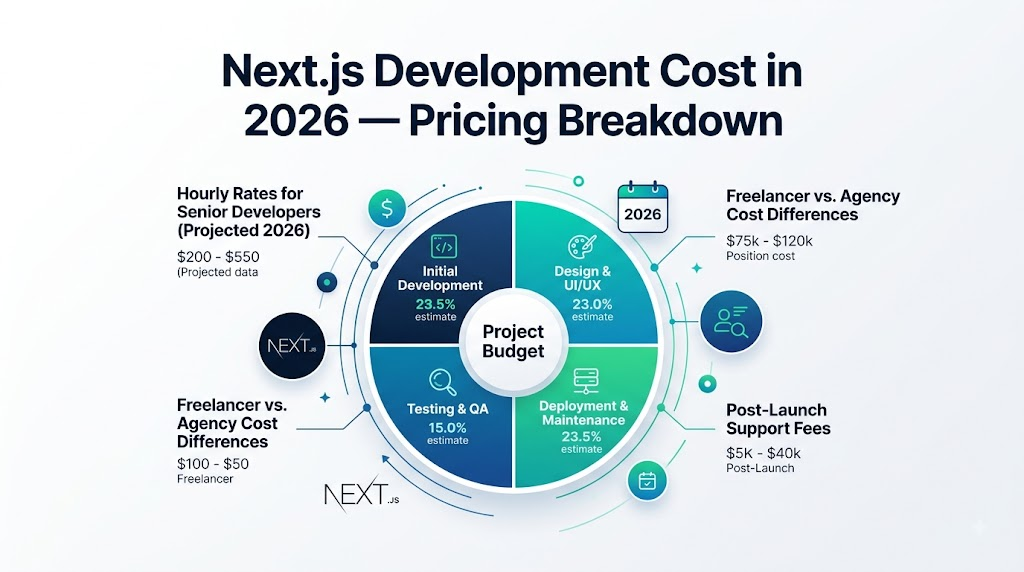
Next.js development cost typically ranges from $8,000 for a simple marketing site to $150,000+ for an enterprise-grade application, and there’s no single number that applies to every project. The final figure depends on project complexity, the number of pages or screens, backend and API requirements, third-party integrations, UI/UX design depth, the location and seniority of your development team, and ongoing maintenance needs. This guide breaks down realistic pricing by project type, the factors that move the needle, and how to build your own estimate before requesting quotes.
What Is Next.js?
Next.js is an open-source React framework, maintained by Vercel, used to build websites and web applications. React handles the user interface, while Next.js adds the structure needed for production: routing, server-side rendering (rendering pages on the server before sending them to the browser), static site generation (pre-building pages at deploy time for speed), and built-in API route support for lightweight backend logic.
Businesses choose Next.js because it combines strong SEO performance, fast page loads, and a single JavaScript/TypeScript codebase that can power both the frontend and parts of the backend. It’s not a full backend framework on its own — most real applications still pair it with a database, authentication provider, and cloud infrastructure — but it significantly reduces the engineering overhead of stitching those pieces together.
How Much Does Next.js Development Cost in 2026?
There is no universal Next.js development cost — pricing scales with scope, not with the framework itself. The table below reflects estimated industry ranges based on typical project scopes, not fixed or quoted prices.
| Project Type | Estimated Cost | Typical Timeline |
|---|---|---|
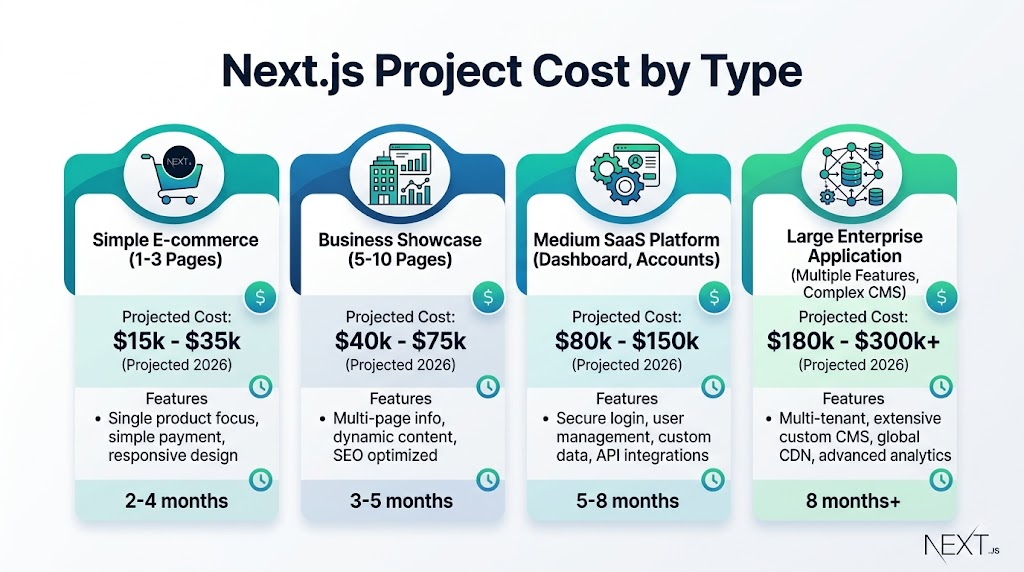
| Simple Next.js website (brochure/landing page) | $8,000 – $18,000 | 2–4 weeks |
| Business website (multi-page, CMS-driven) | $15,000 – $35,000 | 4–8 weeks |
| SaaS MVP | $25,000 – $70,000 | 8–16 weeks |
| Custom web application | $40,000 – $90,000 | 3–6 months |
| E-commerce application | $35,000 – $100,000 | 3–6 months |
| Enterprise Next.js application | $100,000 – $250,000+ | 5–9+ months |
These ranges vary significantly based on design complexity, backend requirements, integrations, compliance needs, and where your development team is based. A simple site built by a solo freelancer and an enterprise platform built by a distributed team with dedicated QA and DevOps engineers are not comparable projects, even though both technically “use Next.js.”
What Factors Affect Next.js Development Cost?
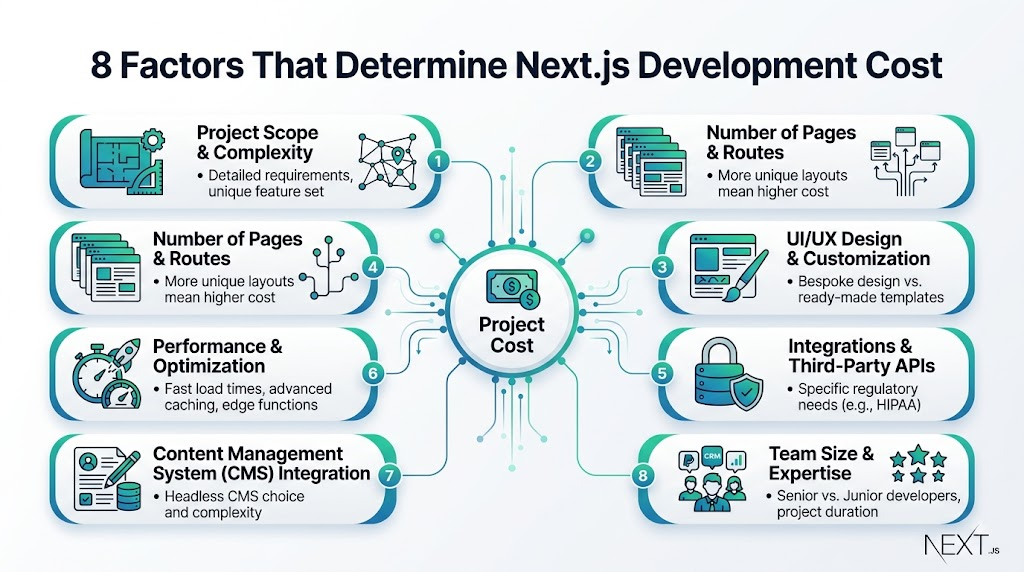
- Project complexity — the number of user flows, business rules, and edge cases.
- Number of pages/screens — more screens mean more design and development hours.
- UI/UX design — custom design systems cost more than template-based layouts.
- Frontend functionality — interactive dashboards cost more than static content.
- Backend/API development — custom APIs and business logic add significant hours.
- Database architecture — schema design and data relationships affect scalability and cost.
- Authentication and authorization — role-based access adds complexity beyond basic login.
- Third-party integrations — CRMs, ERPs, analytics, and marketing tools each require dedicated effort.
- Payment integration — checkout flows, subscriptions, and compliance (like PCI-DSS) add cost.
- AI/ML functionality — model integration, prompt engineering, or custom pipelines increase scope.
- Real-time features — live chat, notifications, or collaborative tools require additional infrastructure.
- Testing and QA — thorough testing takes time but reduces long-term cost.
- DevOps and cloud infrastructure — CI/CD pipelines, staging environments, and scaling setup.
- Security and compliance — GDPR, HIPAA, SOC 2, or similar requirements add engineering and audit work.
- Post-launch maintenance — ongoing updates, bug fixes, and dependency management.
Next.js Development Cost by Project Type
Next.js Website
Appropriate for marketing sites, portfolios, or informational businesses. Cost drivers are primarily design quality, CMS integration (like Contentful or Sanity), and SEO setup rather than backend complexity.
Next.js SaaS MVP
Requires authentication, a dashboard, subscription billing, and a database from day one. Cost is driven by how many core workflows the MVP needs to validate — not by how polished it looks.
Next.js E-commerce Application
Involves a product catalog, cart and checkout, payment gateway integration, inventory management, and customer accounts. Costs rise quickly with multi-currency support, marketplace features, or custom fulfillment logic.
Enterprise Next.js Application
Involves complex integrations (ERP, CRM, legacy systems), strict security and compliance requirements, role-based access control, observability tooling, and architecture built for scale across teams and regions.
| Project Type | Key Cost Drivers |
|---|---|
| Website | Design, CMS, SEO |
| SaaS MVP | Auth, database, subscription logic |
| E-commerce | Payments, catalog, inventory |
| Enterprise | Integrations, security, scalability |
Next.js Developer Cost: Freelancer vs Agency vs In-House
| Option | Typical Cost Model | Advantages | Limitations | Best For |
|---|---|---|---|---|
| Freelancer | Hourly, often $20–$80/hr depending on region | Lower cost, flexible | Limited accountability, capacity constraints | Small, well-defined projects |
| In-house developer | Salary + benefits | Full control, long-term ownership | High fixed cost, slow to hire/scale | Companies building long-term product teams |
| Development agency | Project-based or hourly, often $50–$150/hr | Full team (design, dev, QA), structured delivery | Higher cost than freelancers | Businesses needing end-to-end delivery |
| Dedicated development team | Monthly retainer per team member | Scalable, integrates with your process | Requires clear management involvement | Growing SaaS and product teams |
Hourly rates vary considerably by geography, seniority, and specialization — a senior Next.js developer in North America or Western Europe typically costs more per hour than an equally experienced developer in Eastern Europe, Latin America, or South/Southeast Asia. Rate alone isn’t a reliable predictor of total project cost.
What Is the Cost of Hiring Next.js Developers?
Developer seniority directly affects both hourly rate and total project cost:
- Junior developers — lower hourly rate, but typically need more oversight and produce more rework.
- Mid-level developers — balance of speed and independence for standard feature development.
- Senior developers — higher rate, but faster delivery and fewer architectural mistakes.
- Architects/technical leads — highest rate, responsible for system design decisions that affect scalability and long-term maintenance cost.
Hiring the cheapest available developer is not automatically the lowest-cost path. Architecture mistakes made early — like poor database design or unscalable API structure — often cost more to fix later than they would have cost to prevent with a more experienced developer from the start.
Next.js Development Cost by Feature
| Feature | Complexity Level | Impact on Cost |
|---|---|---|
| Authentication | Low–Medium | Low–Moderate |
| Admin dashboard | Medium | Moderate |
| Payment gateway | Medium–High | Moderate–Significant |
| API integrations | Medium | Moderate |
| Real-time notifications | High | Significant |
| Search functionality | Medium | Moderate |
| AI integration | High | Significant |
| Multi-tenancy | High | Significant |
| Analytics | Low–Medium | Low–Moderate |
| Role-based access control | Medium–High | Moderate–Significant |
How Long Does It Take to Build a Next.js Application?
- Simple website: 2–4 weeks
- Business application: 4–8 weeks
- MVP: 8–16 weeks
- SaaS application: 3–6 months
- Enterprise application: 5–9+ months
Development speed depends on how clearly requirements are defined upfront, whether design is finalized before development starts, the number and complexity of integrations, team size, and how much time is allocated for QA. Vague requirements are one of the most common causes of timeline (and cost) overruns.
How to Reduce Next.js Development Costs
- Define a focused MVP scope instead of building every feature at once.
- Use reusable, well-documented UI components.
- Choose managed cloud and database services instead of building custom infrastructure.
- Avoid premature microservices — a modular monolith is usually cheaper to build and maintain early on.
- Prioritize integrations that are business-critical; postpone “nice to have” ones.
- Finalize design before development begins to avoid rework.
- Use automated testing to catch issues early rather than after launch.
- Lock in requirements before development starts.
- Avoid changing your technology stack mid-project.
Cutting corners on QA, security, or architecture to save money upfront typically increases total cost later through bugs, rework, or security incidents.
Next.js vs Other Frameworks: Does It Affect Development Cost?
| Framework | Development Complexity | Hiring Pool | SEO/Performance | Best Fit |
|---|---|---|---|---|
| Next.js (React) | Moderate | Large | Strong (SSR/SSG built in) | SaaS, content sites, e-commerce |
| React (CSR only) | Moderate | Large | Requires extra setup | Internal tools, dashboards |
| Angular | Higher (steeper learning curve) | Moderate | Requires additional configuration | Large enterprise apps with existing Angular teams |
| Vue | Moderate | Moderate | Good, with additional tooling | Small-to-mid apps, teams preferring Vue |
| Traditional server-rendered apps | Varies | Moderate | Strong by default | Content-heavy sites with simpler interactivity needs |
Next.js generally offers a favorable balance of hiring availability, performance out of the box, and development speed, which can offset a somewhat higher initial setup cost compared to simpler static-site tools.
When Should You Choose Next.js?
Next.js is a strong fit for SaaS products, SEO-sensitive websites, high-performance web applications, e-commerce platforms, dashboards, content-heavy platforms, and startups building scalable MVPs on the React ecosystem.
It may not be the most efficient choice for extremely simple static pages with no growth plans, or for teams with no JavaScript/React experience where a simpler CMS-based solution would be faster to launch and cheaper to maintain.
Hidden Costs to Consider
Development cost is not the same as total cost of ownership. Businesses often overlook:
- UI/UX design (sometimes budgeted separately from development)
- QA and testing cycles
- Cloud infrastructure and hosting costs
- Domain, SSL, and DNS management
- Third-party API usage fees
- Monitoring and error-tracking tools
- Security audits and compliance reviews
- Ongoing maintenance and dependency updates
- Feature updates post-launch
- Technical debt from rushed early-stage decisions
- DevOps setup and CI/CD pipelines
- Database hosting and scaling costs
How to Estimate Your Next.js Project Cost
Use this framework before requesting quotes:
- Project scope — what problem does the application solve?
- Features — list must-have vs nice-to-have functionality.
- Design — how much custom UI/UX work is needed?
- Backend/API — what business logic and data processing is required?
- Integrations — which third-party systems must connect?
- Team composition — freelancer, agency, in-house, or dedicated team?
- Development hours — estimated based on the above scope.
- QA + DevOps — testing, staging environments, deployment pipelines.
- Maintenance — post-launch support and updates.
- Estimated total project cost — the sum of all the above.
How Much Does It Cost to Build a Next.js MVP?
A Next.js MVP typically costs $25,000–$70,000 and takes 8–16 weeks, depending on how many core workflows it needs to validate. A solid MVP scope usually includes authentication, a core dashboard or product experience, essential integrations, and basic analytics — while advanced features like AI functionality, multi-tenancy, or extensive customization are best postponed until after the idea is validated.
The goal of MVP development isn’t to build every possible feature — it’s to validate the core business hypothesis with real users as efficiently as possible. Overbuilding an MVP is one of the most common ways startups overspend before they’ve confirmed product-market fit.
How Enlight Lab Can Help With Next.js Development
Enlight Lab is a software development and technology consulting company that works with startups and enterprises on Next.js application development, including MVP development, UI/UX implementation, API and backend development, cloud architecture, third-party integrations, AI-powered application features, enterprise web applications, and ongoing maintenance.
Rather than applying a one-size-fits-all package, the right approach depends on your specific scope, team structure, and growth plans.
Need a more accurate estimate? Share your product requirements, features, target users, and preferred timeline with Enlight Lab to discuss the right architecture and development approach.
Frequently Asked Questions
How much does Next.js development cost in 2026?
Next.js development cost typically ranges from $8,000 for a simple website to $150,000+ for an enterprise application. The exact cost depends on project complexity, features, integrations, design requirements, and the development team you choose.
How much does it cost to build a Next.js website?
A simple Next.js website generally costs between $8,000 and $18,000, while a more complex business website with CMS integration can range from $15,000 to $35,000. Costs depend on the number of pages, design complexity, and content management needs.
How much does it cost to build a Next.js SaaS application?
A Next.js SaaS MVP typically costs $25,000–$70,000, while a full-featured SaaS application can exceed $90,000. Cost depends on authentication, subscription billing, database complexity, and the number of core features required at launch.
How much does a Next.js developer charge per hour?
Hourly rates vary widely by region and experience, generally ranging from $20–$80/hr for freelancers to $50–$150/hr for agency developers. Rates alone don’t determine total project cost — efficiency and architecture decisions matter just as much.
How long does it take to build a Next.js application?
Timelines range from 2–4 weeks for a simple website to 5–9+ months for an enterprise application. Timeline depends on scope, design readiness, integration complexity, and how clearly requirements are defined upfront.
Is Next.js expensive to develop?
Next.js itself is free and open-source — there’s no licensing cost for the framework. Development cost comes from the engineering work required to build features, integrations, and infrastructure around it, similar to any modern web framework.
Is Next.js good for startups?
Yes, Next.js is commonly used by startups because it supports fast MVP development, strong SEO performance, and a large hiring pool of React developers, making it easier to scale a team as the product grows.
Should I hire a Next.js developer or a development company?
It depends on project scope. A single developer may suit small, well-defined projects, while a development company or dedicated team is generally better for projects requiring design, backend, QA, and DevOps working together.
Conclusion
Next.js development cost in 2026 generally falls between $8,000 for simple websites and $150,000+ for enterprise-grade applications, but the final number always comes down to your specific project: scope, complexity, team composition, integrations, design requirements, and infrastructure needs. Rather than searching for a single “correct” price, the more useful exercise is mapping your requirements against the cost drivers outlined in this guide.
If you’re evaluating Next.js for your next project, Next.js development services outlines how Enlight Lab approaches architecture, timeline, and cost planning for teams at different stages of growth.