Key points:
- Traditional plan selection forces people to manually compare premiums, deductibles, copays, coinsurance, out-of-pocket maximums, network tiers, and prescription formularies often without adequate context
- AI-powered recommendation engines can process these variables simultaneously and weight them against individual health needs and financial constraints
- Personalization goes beyond demographics AI evaluates prescription histories, expected care utilization, provider preferences, and subsidy eligibility
- Key benefits include faster decision-making, reduced cognitive load, and more accurate plan-to-person matching
- Core limitations include data privacy concerns, the risk of algorithmic bias, and the absence of licensed advice
- The technology is advancing toward real-time plan matching, integration with electronic health records, and deeper insurer-side underwriting applications
Health insurance plan selection sits at an uncomfortable intersection: it’s one of the most consequential financial decisions a person makes each year, yet most people approach it with incomplete information and limited time. For insurers and InsurTech companies, that friction represents both a problem and an opportunity.
This guide examines how AI for health insurance plan selection is evolving technically, practically, and commercially. It’s written for technology leaders and insurance professionals who need more than a surface-level overview. You’ll find a breakdown of how recommendation engines work, where they genuinely add value, where they fall short, and what a responsible AI-powered selection platform looks like in practice.
Why Is Choosing Health Insurance So Difficult?
The challenge isn’t just complexity it’s the specific type of complexity involved. Selecting a health plan requires a person to simultaneously evaluate:
- Premiums — the monthly cost regardless of care usage
- Deductibles — how much they pay before coverage kicks in
- Copays and coinsurance — their share of costs after the deductible
- Out-of-pocket maximums — the annual cap on their exposure
- Provider networks — whether their doctors and hospitals are in-network
- Prescription drug formularies — whether their medications are covered, and at what tier
- Exclusions and riders — what the plan doesn’t cover
- Subsidy eligibility — whether income-based premium tax credits apply under the Affordable Care Act
Each of these dimensions interacts with the others. A plan with a low premium may carry a high deductible that proves expensive for someone who visits specialists regularly. An HMO may be cheaper than a PPO but irrelevant if the enrollee’s primary care physician isn’t in-network. Most people don’t have the actuarial background to model these trade-offs accurately — and they shouldn’t need to.
According to HealthCare.gov, eligible consumers can compare plans across metal tiers (Bronze, Silver, Gold, Platinum) and plan types, but the comparison interface still requires users to interpret the data themselves. That cognitive burden contributes to suboptimal choices, and those choices have real financial consequences.
How Is AI Changing Health Insurance Plan Selection?
AI can help by doing what humans find difficult at scale: processing multiple variables simultaneously, weighting them against individual circumstances, and surfacing clear, ranked recommendations with explanations.
The shift isn’t from “bad tools” to “good tools.” It’s from generic filtering to genuine personalization. Traditional plan comparison tools let users sort by premium or metal tier. AI-powered tools learn from a user’s health profile, financial situation, and preferences to predict which plan will perform best for their specific situation over a coverage year.
For insurers and InsurTech platforms, the downstream implications are significant. Better-matched enrollees tend to use plans as intended, experience fewer billing surprises, and report higher satisfaction. Reducing mismatch is good for both the consumer and the carrier.
Explore more:AI consulting services for healthcare and insurance organizations
How Does AI Compare Health Insurance Plans?
A health insurance AI comparison engine typically ingests a set of structured inputs ZIP code, household size, income, expected care utilization, prescriptions, and plan preferences and runs them against a database of available plans.
The comparison process involves several simultaneous evaluations:
- Eligibility filtering — eliminating plans unavailable in the user’s county or outside their enrollment window
- Subsidy calculation — estimating premium tax credit eligibility based on income relative to the Federal Poverty Level (FPL)
- Cost modeling — projecting total annual costs (not just premiums) based on expected healthcare usage
- Network matching — flagging plans where preferred providers are out-of-network
- Formulary analysis — checking whether specific medications appear on a plan’s drug list and at which cost tier
- Fit scoring — aggregating all factors into a ranked output with plain-language explanations
The result is a ranked list of plans with individual match scores, trade-off disclosures, and enrollment links rather than an unsorted spreadsheet of options.
What Factors Can AI Analyze When Recommending a Health Insurance Plan?
| Factor | What AI Evaluates | Why It Matters |
|---|---|---|
| Location (ZIP code) | Available carriers, county-level plan options | Plan availability varies significantly by geography |
| Household composition | Single, couple, family; dependents’ ages | Affects premium calculation and coverage scope |
| Estimated income | FPL percentage, subsidy eligibility | Determines premium tax credit and cost-sharing reductions |
| Health status | Chronic conditions, expected visit frequency | Predicts likely plan utilization and cost exposure |
| Prescriptions | Drug names, dosage frequency | Matches against formularies; identifies coverage gaps |
| Provider preferences | Named physicians, hospital systems | Flags network compatibility |
| Plan type preference | HMO, PPO, EPO, HDHP | Filters by referral requirements and flexibility |
| Deductible comfort | Preferred deductible range | Balances premium against out-of-pocket risk tolerance |
| Monthly budget | Maximum affordable premium | Constrains recommendations to financially viable options |
| Telehealth usage | Frequency of virtual visits | Identifies plans with strong telehealth benefits |
How Does AI Personalize Health Insurance Recommendations?
AI personalization works by building a user profile from self-reported inputs and then running that profile against plan attributes to generate context-specific recommendations. The same plan can rank very differently for two people with different health situations.
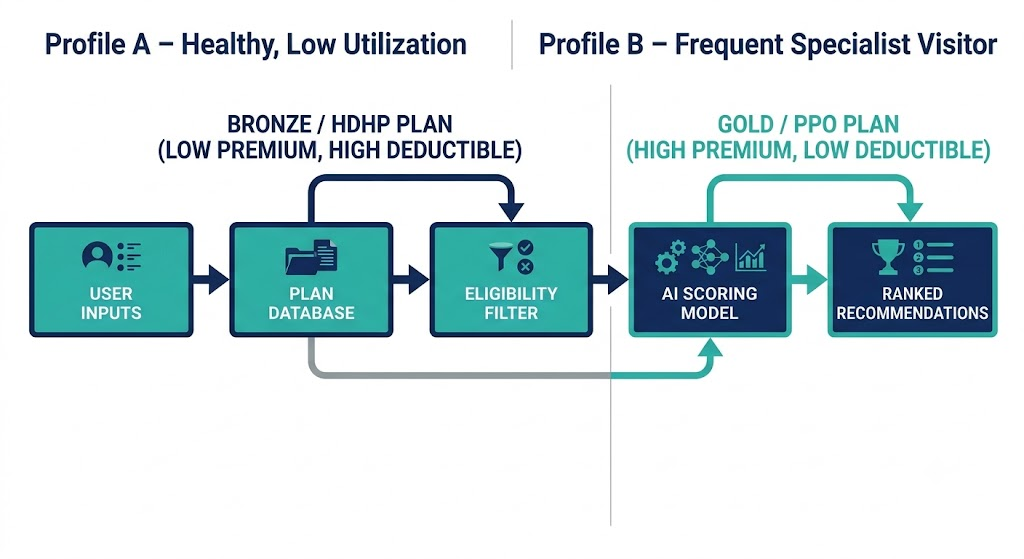
Healthy individual with low expected utilization: AI surfaces high-deductible health plans (HDHPs) paired with Health Savings Account (HSA) eligibility. The low monthly premium and tax advantages outweigh the deductible risk when anticipated care costs are minimal.
Frequent specialist visitor: The AI weights network depth heavily and may recommend a PPO over an HMO even at higher premium cost because the flexibility to see specialists without referrals reduces friction and total out-of-pocket exposure.
Family with children: Cost-sharing reductions, pediatric dental coverage, and family out-of-pocket maximums become primary ranking factors. A Silver plan that qualifies for cost-sharing reductions under the ACA may outperform a Bronze plan even if the premium is nominally higher.
Person with regular prescriptions: The AI cross-references the drug list against each plan’s formulary and identifies tier placement. A plan with a lower premium but Tier 4 specialty drug coverage may cost significantly more annually than a Gold plan where the same medication sits at Tier 2.
These examples illustrate why one-size-fits-all plan comparison breaks down and why AI-driven personalization is a meaningful improvement over standard filtering.
AI Insurance Recommendation Engine How Does It Work?
A health insurance AI recommendation engine typically follows a layered architecture:
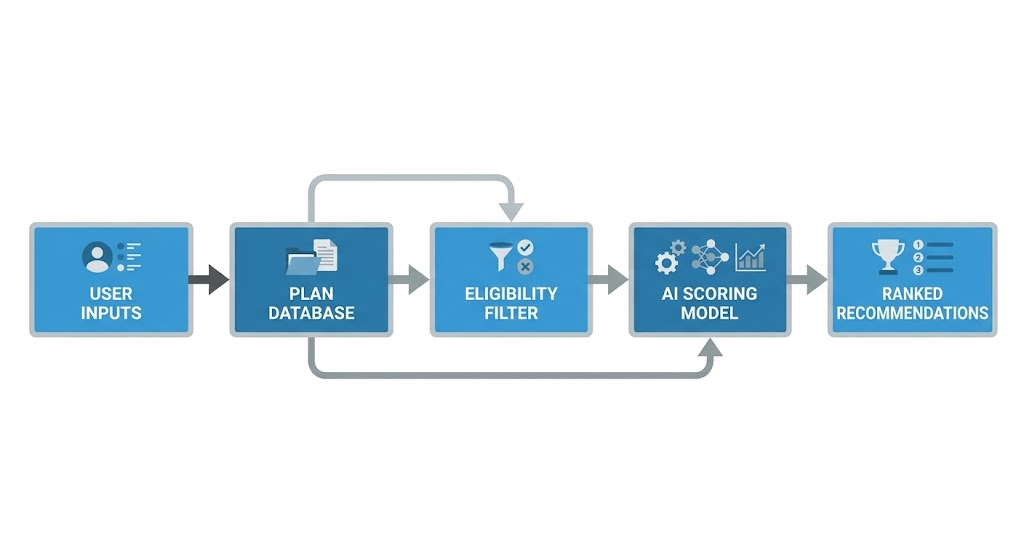
1. Data ingestion layer
The system collects structured user inputs ZIP code, household size, income estimate, prescriptions, preferred providers, and plan preferences. This data is processed locally where possible to minimize privacy exposure.
2. Plan database and enrichment layer
The engine queries a regularly updated plan database containing premium rates, deductibles, formularies, network directories, and subsidy eligibility thresholds. In the U.S. ACA market, this data is partially standardized through CMS machine-readable files, though quality varies by carrier.
3. Eligibility and filtering layer
Plans outside the user’s geographic market or enrollment eligibility are excluded. Subsidy calculations are applied based on income and household data.
4. Scoring and ranking layer
A weighted scoring model often a combination of rule-based logic and machine learning assigns a fit score to each eligible plan. Weights are calibrated against factors like projected total annual cost, network match rate, formulary coverage, and deductible risk alignment.
5. Explanation layer
The system generates plain-language summaries explaining why each plan scored as it did and what trade-offs the user is accepting. This is critical for trust and informed decision-making.
6. Enrollment handoff
Rather than collecting sensitive enrollment data, a well-designed engine links directly to the carrier’s official enrollment page or to HealthCare.gov, keeping sensitive data out of the recommendation platform entirely.
Explore: AI development services and data engineering for recommendation systems
What Are the Benefits of AI-Powered Health Insurance Selection?
Reduced decision complexity. Condensing dozens of plan variables into a ranked, explained shortlist dramatically lowers the cognitive effort required from the consumer.
More accurate cost projection. Most people underestimate their annual healthcare costs when selecting a plan. AI models that factor in expected utilization produce more realistic cost estimates than premium-only comparisons.
Subsidy surfacing. A significant portion of ACA-eligible consumers don’t realize they qualify for premium tax credits. AI tools that calculate subsidy eligibility as part of the recommendation process can materially reduce what a consumer pays.
Speed. A recommendation process that previously required hours of research or a consultation with an insurance broker can be compressed to minutes.
Explainability. Good AI recommendation engines don’t just rank they explain. That transparency supports informed decision-making rather than blind trust in an algorithm.
Scalability for insurers. On the insurer side, AI-powered selection tools can handle high-volume open enrollment periods without proportional increases in staffing.
What Are the Risks and Limitations of AI in Health Insurance?
Acknowledging limitations isn’t a weakness in this discussion it’s a prerequisite for responsible deployment.
Algorithmic bias. If training data reflects historical disparities in healthcare access or plan availability, the model may systematically underserve certain demographic groups. Regular auditing against fairness benchmarks is necessary, not optional.
Data quality dependencies. Formulary data, network directories, and premium rates change frequently. A recommendation engine operating on stale data can produce confidently wrong results.
Absence of licensed advice. AI tools can inform they cannot advise in the legal or fiduciary sense. A platform recommending a specific plan to a specific individual without licensed insurance broker involvement operates in a regulatory gray area that varies by state.
Input accuracy. The quality of recommendations is directly tied to the quality of user inputs. Income estimates, prescription lists, and expected visit frequencies are self-reported and often imprecise.
Black-box risk. Complex machine learning models can produce recommendations that are difficult to explain or audit. In a domain with direct financial and health consequences, explainability isn’t a nice-to-have.
Privacy exposure. Health-related data carries significant sensitivity. Any platform handling prescription information or health status inputs must align with applicable privacy frameworks, including HIPAA where relevant.
Can AI Replace Human Insurance Advisors?
The short answer is: no and for most deployment contexts, that’s the wrong question.
Licensed insurance brokers and navigators provide services that AI tools currently cannot replicate. They understand nuanced life circumstances, can interpret plan documents in context, carry legal accountability, and can advocate on behalf of a client in disputes with carriers. They’re also required in many regulated contexts.
What AI can do is handle the information-processing and comparison work that currently consumes much of an advisor’s time freeing them for the judgment-intensive conversations where human expertise is irreplaceable. For consumers who don’t have access to a broker at all, an AI tool provides a meaningful improvement over unassisted comparison.
The more productive framing for insurers and InsurTech founders: AI augments the selection process. It doesn’t replace the regulatory, relational, or judgment-based dimensions of insurance advisory.
AI in Health Insurance: Use Cases for Insurers and InsurTech Companies
Beyond consumer-facing plan selection, AI is finding traction across several insurer-side applications:
Member onboarding personalization. AI can tailor onboarding communications based on a new member’s plan type, demographics, and expected care patterns improving early engagement and reducing avoidable confusion.
Renewal recommendation. At plan renewal, AI can compare a member’s current plan against updated options, flagging meaningful changes in cost or coverage before auto-renewal locks in a suboptimal choice.
Broker enablement tools. Rather than replacing brokers, some InsurTech platforms use AI to give brokers a faster, more accurate comparison capability helping them serve more clients without sacrificing recommendation quality.
Call center deflection. AI-powered plan comparison tools embedded in member portals reduce inbound inquiries during open enrollment periods, which represent significant operational load for carriers.
Underwriting and risk stratification. In markets where it’s permissible, AI is being applied to group plan underwriting to better model risk at the population level though this application carries significant regulatory sensitivity under ACA non-discrimination provisions.
Explore more: AI agent development and custom software development for insurance carriers
How HealthMatchAI Can Simplify Health Insurance Plan Selection
For organizations looking at how a focused AI recommendation tool works in practice, HealthMatchAI built by Enlight Lab offers a useful reference point.
The platform asks eight short questions covering ZIP code, household size, estimated income, prescriptions, and care preferences. From those inputs, its local AI scores every ACA plan available in the user’s state and returns a ranked list with match scores from 0 to 100, plain-English explanations of why each plan fits (or doesn’t), and explicit trade-off disclosures. Direct links to carrier enrollment pages are included; the platform doesn’t collect or store personal health data beyond the session.
It’s free, requires no account, and takes under three minutes which positions it as both a consumer tool and a demonstration of what a lean, explainable AI recommendation engine looks like at the product layer.
For insurers and InsurTech builders evaluating the technical and UX approach, the product illustrates a key design principle: transparency in scoring and trade-off disclosure builds user trust far more reliably than hiding the model’s reasoning.
What Does the Future of AI-Powered Health Insurance Selection Look Like?
Several near-term developments are likely to shape how AI for health insurance plan comparison evolves:
EHR integration. As interoperability standards mature (particularly under CMS and ONC rules governing FHIR-based data exchange), AI recommendation tools may be able to incorporate actual claims history and care patterns significantly improving cost projection accuracy.
Real-time plan data. Formulary and network data updates lag behind reality in most current implementations. Tighter API connections with carriers will reduce the stale-data problem.
Multilingual and accessibility-first design. A significant portion of ACA-eligible consumers are non-English speakers or have limited health literacy. AI tools that adapt explanations to language preference and reading level will reach underserved segments more effectively.
Regulatory clarity. As AI-powered insurance tools proliferate, state insurance regulators and federal agencies (CMS, HHS, and potentially the FTC) are likely to develop clearer guidance on disclosure requirements, algorithmic fairness standards, and the boundaries of unlicensed plan recommendation.
Embedded decision support. Rather than standalone tools, AI plan recommendation is likely to become embedded within employer HR platforms, healthcare provider portals, and state marketplace experiences.
How to Evaluate an AI Health Insurance Recommendation Platform
For product leaders and technology buyers assessing platforms in this space, the following checklist covers the dimensions that matter most:
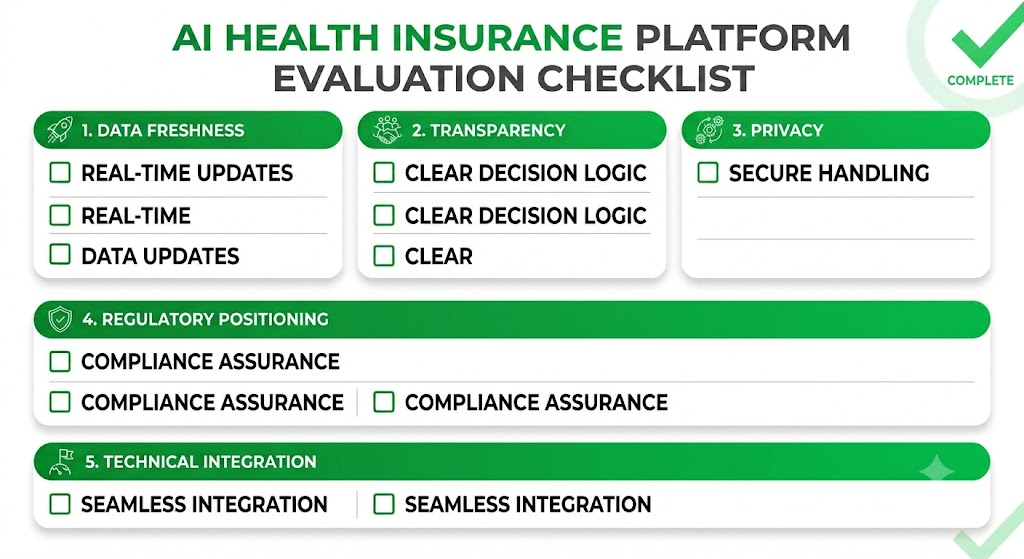
Data freshness
- How frequently are plan databases (premiums, formularies, networks) updated?
- Is there a documented data refresh schedule?
Transparency and explainability
- Does the platform explain why each plan received its score?
- Are trade-offs disclosed, or does the system only surface positives?
Privacy and data handling
- Where is user input data stored, and for how long?
- Is the platform HIPAA-aligned where applicable?
- Does it sell leads or user data to carriers?
Regulatory positioning
- Does the platform clearly disclose that recommendations are not licensed insurance advice?
- Is there a licensed broker integration or referral pathway for users who need one?
Accuracy and auditability
- Can the scoring model be audited for bias?
- Is there a process for identifying and correcting recommendation errors?
Enrollment handoff
- Does the platform link to official carrier or marketplace enrollment pages?
- Is the transition to enrollment seamless and unambiguous?
Technical integration
- Does the platform offer an API for embedding in existing insurer or employer platforms?
- What are the data input requirements, and can they be satisfied programmatically?
Selecting the Right Path Forward
AI for health insurance plan selection is past proof-of-concept. Functional tools exist, real consumers are using them, and insurers are beginning to operationalize recommendation AI at scale. The infrastructure is there. What separates strong implementations from weak ones is explainability, data quality, and an honest acknowledgment of what the technology can and cannot do.
For InsurTech founders and insurance technology leaders, the opportunity is clearer than it’s been at any prior point. The barriers stale plan data, opaque scoring, and regulatory uncertainty are solvable engineering and product problems, not fundamental objections to the concept.
For healthcare organizations and digital transformation leaders exploring this space, the question isn’t whether AI belongs in health insurance selection. The more useful question is: what does a responsible, technically rigorous implementation look like for your specific context?
If you’re building in this space or evaluating AI-powered tools for your organization, Enlight Lab’s team works with insurers, InsurTech companies, and healthcare organizations on the design, development, and deployment of AI systems.