Data pipeline development in 2026 typically costs $15,000 to $150,000+ for the initial build, depending on scope, data volume, your tech stack, and your team model. Basic pipelines start around $15k–$30k. Advanced, real-time systems can push well past $150k.
This guide is written for CTOs, VP Engineering, Heads of Data, and technical founders who need honest numbers before they commit budget. No fluff. Just clear cost bands, a factor-by-factor breakdown, and a simple way to estimate what your own pipeline should cost.
Here’s what you’ll walk away with:
- Realistic 2026 price ranges for basic, intermediate, and advanced pipelines
- The real cost difference between in-house teams, freelancers, and agencies
- The hidden and ongoing costs most people forget to budget for
- A step-by-step method to estimate your own project
What Is a Data Pipeline? (And Why Does It Cost So Much?)
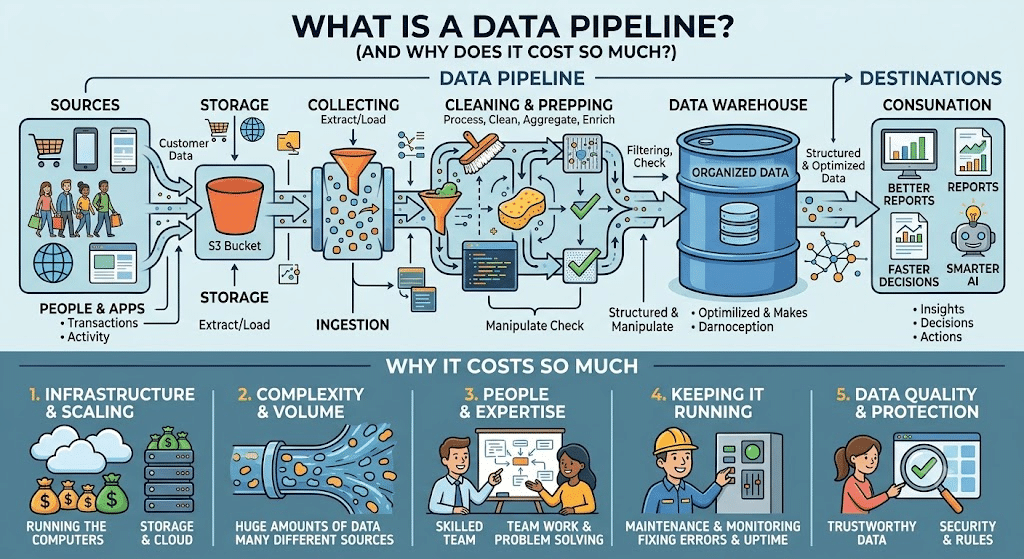
A data pipeline is the system that moves data from your sources into a place where it becomes useful — a warehouse, a dashboard, or an AI model. It ingests, transforms, loads, orchestrates, and monitors data automatically.
Think of it as plumbing. You pull data from APIs, databases, and SaaS tools. You clean and reshape it. You load it into somewhere like Snowflake or BigQuery. Then you keep it running reliably.
The cost comes from complexity, not the concept. A pipeline with three clean sources and a nightly batch job is cheap. A pipeline handling 40 sources, messy data, real-time streaming, and strict compliance rules is a different animal.
More sources, more transformations, tighter SLAs, and stronger governance all push the price up. That’s the pattern to remember.
How Much Does a Data Pipeline Cost in 2026?
Most data pipeline projects in 2026 fall between $15,000 and $150,000 for the initial build. Simple batch pipelines land at the low end. Real-time, enterprise-grade systems with compliance requirements sit at the top — and sometimes beyond.
Your final number depends on four things: scope, tech stack, team model, and region. A US agency will quote differently than a freelancer in Eastern Europe. A five-source Snowflake pipeline costs far less than a streaming platform feeding live ML models.
Here’s a practical breakdown by pipeline type:
| Pipeline Type | Typical Scope | Timeline | Cost Range (USD) |
|---|---|---|---|
| Basic | 2–5 sources, batch loads, simple transformations, basic monitoring | 3–5 weeks | $15,000 – $35,000 |
| Intermediate | 6–15 sources, some real-time, business logic, data quality checks, alerting | 6–10 weeks | $35,000 – $90,000 |
| Advanced | 15+ sources, streaming, complex logic, strict SLAs, compliance, full observability | 10–20+ weeks | $90,000 – $150,000+ |
These ranges assume a competent team and a modern cloud stack. Legacy systems, dirty data, and heavy compliance can push any project into the next tier.
What Factors Affect Data Pipeline Development Cost?
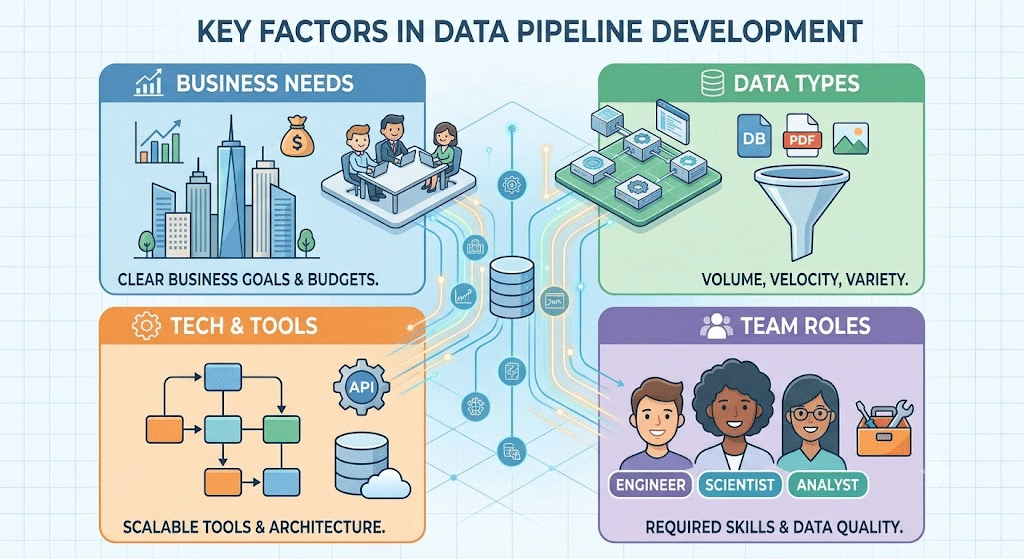
The biggest cost drivers are the number of data sources, transformation complexity, real-time requirements, and your compliance needs. Everything else adjusts around those.
Here are the factors that move your budget the most:
- Number and type of sources. A REST API is easy. A legacy on-prem database with no documentation is not. Event streams and niche SaaS connectors add work.
- Data volume and velocity. Gigabytes per day is routine. Terabytes per hour needs serious engineering and more expensive infrastructure.
- Transformation complexity. Simple field mapping is cheap. Complex business logic, deduplication, and multi-source joins take real time to build and test.
- Real-time vs batch. Batch is simpler and cheaper. Real-time streaming with Kafka or similar tools can add 30–50% to build cost.
- Cloud platform and tools. AWS, GCP, and Azure all work. Your choice of warehouse — Snowflake, BigQuery, or Redshift — affects both build and running costs.
- Monitoring and data quality. Alerting, lineage, and automated quality checks are worth it, but they add scope.
- Security and compliance. GDPR, HIPAA, or SOC 2 requirements add design work, testing, and documentation.
- Team model and region. Where and how you hire changes the math significantly. More on that below.
Basic vs Intermediate vs Advanced Data Pipelines: Cost Breakdown
Scope maps almost directly to cost. As you add sources, real-time processing, and compliance, you move from a few weeks and $20k to several months and six figures. Here’s what each level looks like in practice.
Basic Pipelines ($15k–$35k)
Best for early-stage startups and small teams that need reliable reporting. Usually 2–5 clean sources, nightly batch jobs, and a warehouse feeding a BI tool.
Typical components: managed ingestion (Fivetran or Airbyte), a cloud warehouse, dbt for transformations, and basic monitoring.
Example: A seed-stage SaaS startup with five data sources — Stripe, HubSpot, Postgres, Google Analytics, and a product database — needs everything in Snowflake for dashboards. Batch loads, light transformations. Realistic cost: $18,000–$28,000, delivered in about four weeks.
Intermediate Pipelines ($35k–$90k)
Best for growth-stage companies with more sources and higher expectations. You’ll see some real-time needs, real business logic, and data quality controls.
Typical components: mixed batch and streaming ingestion, orchestration (Airflow or Dagster), automated testing, alerting, and role-based access.
Example: A Series A fintech pulling from 10 sources, running near-real-time fraud signals, with basic SOC 2 controls. Realistic cost: $55,000–$80,000 over roughly eight weeks.
Advanced Pipelines ($90k–$150k+)
Best for enterprises and data-heavy products. High volume, streaming, strict SLAs, and full observability are the norm.
Typical components: streaming infrastructure, complex transformation layers, data lineage, disaster recovery, and compliance-grade security.
Example: An enterprise processing millions of events per hour to feed live ML models, with HIPAA compliance and 99.9% uptime targets. Realistic cost: $120,000–$200,000+, delivered over three to five months.
In-House vs Freelance vs Agency: Which Is Cheapest for Data Pipelines?
Freelancers usually have the lowest hourly rate, but agencies often deliver end-to-end projects more cost-effectively because they need less management. In-house teams cost the most upfront but make sense once your data work becomes continuous.
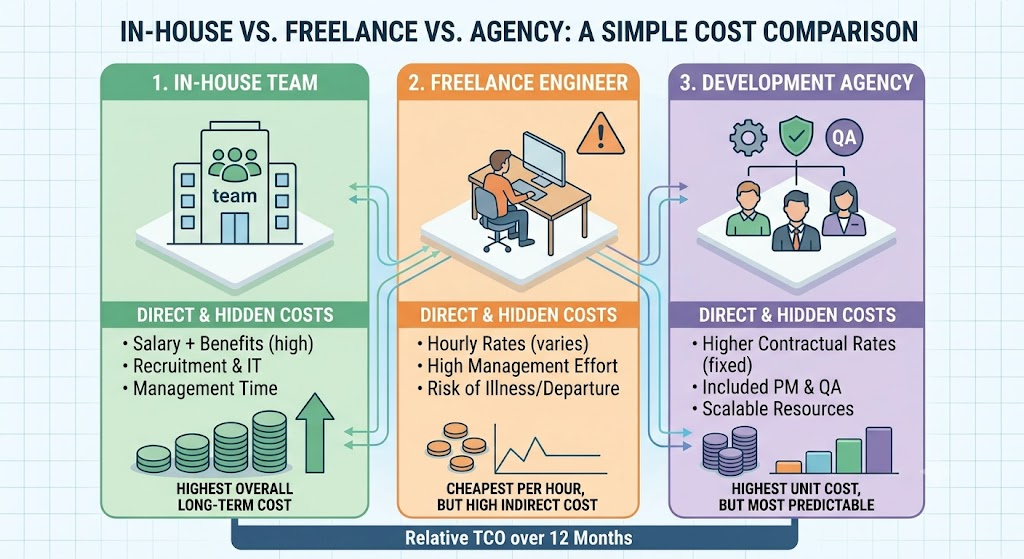
Here’s how the three models compare:
| Model | Typical Cost | Pros | Cons | Best For |
|---|---|---|---|---|
| In-house | $120k–$220k+ per senior engineer/year | Full ownership, deep context, always available | Slow to hire, expensive, hard to scale down | Companies with ongoing, heavy data needs |
| Freelance | $40–$120/hr | Low rates, flexible, fast to start | Variable quality, management overhead, continuity risk | Well-scoped, short-term builds |
| Agency | $80–$200/hr or fixed-price | Full team, reliable delivery, faster, accountable | Higher hourly rate, less day-to-day control | End-to-end builds without hiring |
A quick reality check: an in-house senior data engineer in the US runs $150k–$220k in salary alone, before benefits, tooling, and management time. That’s often $200k+ fully loaded. For a one-time build, that math rarely works. For a permanent data function, it usually does.
Many teams land on a hybrid model — an internal product owner directing external engineers. This keeps context in-house while controlling cost. A fractional data lead or CTO-as-a-Service arrangement can fill the strategy gap without a full-time hire.
Hidden and Ongoing Costs of Data Pipelines
The build is only part of the story. Ongoing costs typically run 15–30% of the initial build cost per year, and cloud bills can surprise teams that don’t monitor usage.
Watch for these recurring costs:
- Cloud infrastructure. Compute and storage for your warehouse and processing. This scales with data volume and can climb fast.
- Managed services. Tools like Fivetran, Airbyte, or monitoring platforms often charge by rows or connectors. Costs grow as you add sources.
- Maintenance and fixes. Sources change their APIs. Schemas drift. Something always needs attention.
- Enhancements. New sources, new metrics, new requirements. Pipelines are never truly finished.
- Governance and security. Access reviews, audits, and compliance upkeep, especially under GDPR or HIPAA.
- Team time for incidents. Someone has to respond when a pipeline breaks at 2 a.m. That time is a real cost.
A useful rule of thumb: budget 20% of your build cost annually for maintenance, then add your cloud spend on top. For a $50k pipeline, plan for roughly $10k/year in upkeep plus infrastructure.
How to Estimate Your Data Pipeline Development Cost
Start by mapping your sources and outputs, then match that scope to the ranges above. A clear scope gets you an accurate estimate — vague requirements get you a wide, useless quote.
Follow these steps:
- List your data sources and targets. Count every source. Note which are APIs, databases, SaaS tools, or event streams. Define where the data needs to end up.
- Define transformations and business logic. Write down what needs to be cleaned, joined, or calculated. Complexity here drives a big share of the cost.
- Decide real-time vs batch. Be honest about whether you truly need streaming. Most teams don’t, and batch saves money.
- Choose your stack. Pick your cloud and warehouse — Snowflake, BigQuery, or Redshift — plus orchestration and ingestion tools.
- Pick your team model. In-house, freelance, agency, or hybrid. This sets your rate structure.
- Get 2–3 quotes or internal estimates. Compare them against the ranges in this guide to spot outliers.
Example calculation: Say you have 8 sources, moderate transformations, batch processing, and a Snowflake warehouse. That’s a solid intermediate pipeline. At an agency blended rate of ~$120/hr over roughly 350 hours, you’re looking at $42,000, plus ongoing costs of around $8k–$10k/year.
How to Reduce Data Pipeline Costs Without Compromising Quality
You can lower costs by simplifying scope, using managed services, and avoiding over-engineering — not by cutting corners on architecture. Bad architecture is what actually costs you later.
Practical tactics that work:
- Start with a minimal viable pipeline. Build for today’s needs, then iterate. Don’t design for scale you don’t have yet.
- Use managed services. Fivetran, Airbyte, and dbt handle work you’d otherwise build from scratch. Buying beats building for common connectors.
- Prioritize high-value sources first. Connect the data that drives decisions now. Add the rest later.
- Avoid over-customization early. Custom logic is expensive to build and maintain. Keep it lean until you’re sure you need it.
- Consider a hybrid team. An internal PM plus external engineers often costs less than a full in-house team.
- Get architecture right upfront. A short engagement with fractional data leadership or CTO-as-a-Service can prevent a costly rebuild. Poor early decisions are the most expensive mistake of all.
The goal isn’t the cheapest pipeline. It’s the pipeline that does what you need without paying for scope you’ll never use.
Typical Data Pipeline Project Timelines in 2026
Most production-ready pipelines take 4 to 12 weeks to build. Simple batch pipelines can be live in a month. Complex, compliant, real-time systems take three to five months or more.
Here’s a rough breakdown:
- Basic pipelines: 3–5 weeks
- Intermediate pipelines: 6–10 weeks
- Advanced pipelines: 10–20+ weeks
Several things stretch timelines. Compliance requirements add design and testing time. Legacy systems slow integration. And dirty source data — the most common culprit — can add weeks of cleanup nobody budgeted for. Build in a buffer if your data has never been centralized before.
FAQ: Data Pipeline Development Cost in 2026
How much does a basic data pipeline cost in 2026?
A basic data pipeline costs $15,000–$35,000 in 2026. This covers 2–5 sources, batch loads, simple transformations, and basic monitoring, usually delivered in 3–5 weeks. Startups feeding a warehouse like Snowflake or BigQuery for reporting typically land near the lower end. Real-time needs or messy source data push the price higher.
Is it cheaper to build a data pipeline in-house or outsource it?
For a one-time build, outsourcing is almost always cheaper. A single in-house senior engineer costs $150k–$220k+ per year, while an agency can deliver a full pipeline for $35k–$90k. In-house teams make financial sense only when your data work is continuous and heavy enough to justify a permanent function.
What is the typical timeline for a data pipeline project?
Most pipelines take 4–12 weeks to reach production. Basic batch pipelines can be ready in 3–5 weeks. Advanced systems with streaming, strict SLAs, or compliance requirements take 10–20+ weeks. Dirty source data and legacy systems are the most common reasons projects run longer than planned.
How can I estimate my data pipeline development cost?
Start by listing every data source and target, then define your transformation needs and whether you require real-time processing. Match that scope to standard ranges: basic ($15k–$35k), intermediate ($35k–$90k), or advanced ($90k+). Then get 2–3 quotes. A clearly scoped project produces a far more accurate estimate than a vague one.
What ongoing costs should I expect after the pipeline is built?
Expect ongoing costs of 15–30% of your build cost per year, plus cloud infrastructure. This covers maintenance, bug fixes, source changes, managed service subscriptions, and monitoring. For a $50k pipeline, budget roughly $10k/year in upkeep plus your compute and storage spend, which scales with data volume.
Does real-time processing cost more than batch?
Yes. Real-time streaming typically adds 30–50% to build cost compared to batch processing. Streaming needs more complex infrastructure, careful error handling, and heavier monitoring. Most teams don’t actually need it — batch handles the majority of analytics and reporting use cases at a much lower price. Only choose streaming when the business truly requires fresh data.
Final Thoughts: Budgeting Smartly for Your 2026 Data Pipeline
The cheapest pipeline is rarely the one with the lowest quote. Under-investing in architecture is what costs you most — through rebuilds, downtime, and data you can’t trust. Spend where it matters: clean design, the right sources, and reliable delivery.
Match your investment to your stage. A startup doesn’t need enterprise streaming. An enterprise can’t run on a nightly batch job. Get the scope right, pick the team model that fits, and budget for the ongoing costs too.
At Enlightlab, we help teams design and build data pipelines that fit their actual needs — from basic warehouse setups on Snowflake, BigQuery, or Redshift to AI-ready data infrastructure. Through CTO-as-a-Service, we also help leaders make the architectural calls that prevent expensive mistakes.
If you want a realistic estimate for your specific stack and use case, book a short discovery call with our data engineering team. You’ll leave with clear numbers, whether or not we build it together.