What Is Agentic AI?
Agentic AI is a category of AI systems designed to accomplish goals with minimal step-by-step human instruction. Instead of responding to a single prompt, an agentic AI system breaks a goal into steps, decides which tools or data it needs, acts, checks the result, and adjusts.
Think of the difference this way. A generative model answers the question “What should this email say?” An AI agent handles the instruction “Resolve this customer’s refund request”—which may involve reading the ticket, checking the order system, confirming the refund policy, issuing the refund, and notifying the customer.
The word “agentic” points to agency: the capacity to act toward a goal. Autonomous AI agents don’t just produce output. They complete work.
One important caveat for business leaders: agentic AI is not fully autonomous AI. These systems operate within boundaries you define. They act on the tools, data, and permissions you grant them, and the best implementations include human checkpoints at critical moments.
Agentic AI vs Generative AI: What’s the Real Difference?
Generative AI and agentic AI are related but distinct. Generative AI is often the “brain” inside an agent, but agentic AI adds planning, tool use, memory, and action. Here’s a side-by-side comparison.
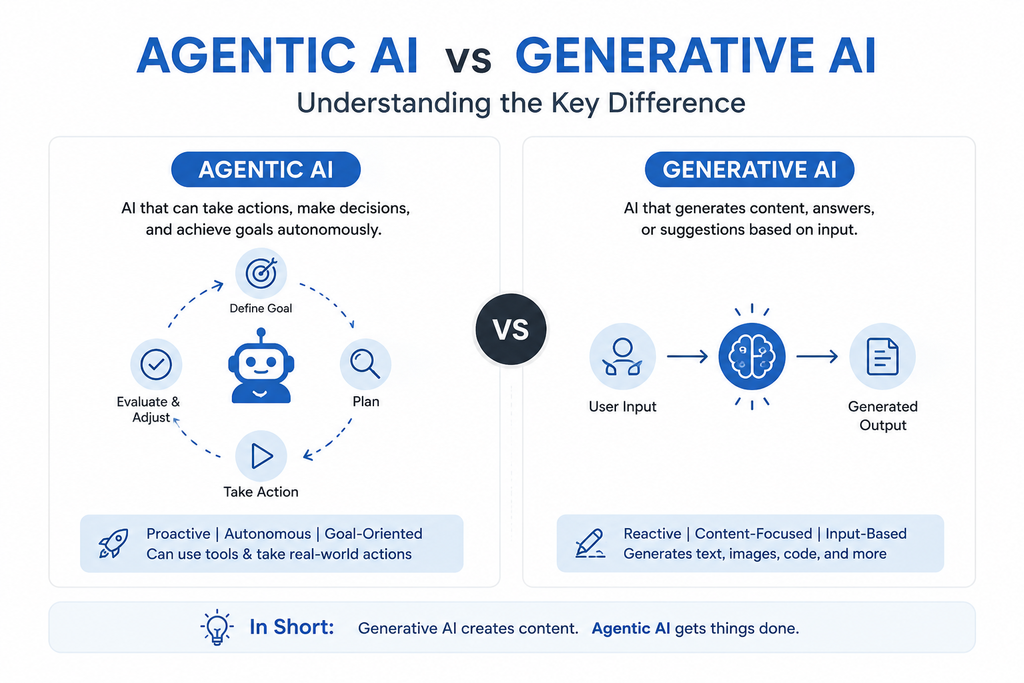
| Dimension | Generative AI | Agentic AI |
|---|---|---|
| Core function | Produces content on request | Pursues a goal across multiple steps |
| Interaction | One prompt, one response | Continuous loop of act and evaluate |
| Tool use | Rarely, unless added | Selects and calls tools, APIs, systems |
| Memory | Usually limited to the session | Can retain context across steps and tasks |
| Action | Suggests or drafts | Executes real changes in systems |
| Human role | Reviews and uses output | Sets goals, monitors, approves key steps |
| Best for | Drafting, ideation, summarizing | Completing workflows end to end |
In short: generative AI helps you produce. Agentic AI helps you complete.
How Do AI Agents Work? A Look at Agentic AI Architecture
Understanding agentic AI architecture helps leaders judge what’s realistic and what’s marketing. Most enterprise AI agents follow a repeating loop:
- Goal — The agent receives an objective (“reconcile these invoices” or “qualify this lead”).
- Reasoning and planning — It breaks the goal into steps and decides on an approach.
- Tool selection — It chooses the right resource: a database query, a CRM update, a search, a calculation.
- API, data, or system action — It executes that step by calling the relevant system.
- Result — It receives output from that action.
- Evaluation — It checks whether the result moves it closer to the goal or signals a problem.
- Next action — Based on the evaluation, it continues, retries, or escalates to a human.
- Final outcome — Once success criteria are met, it completes the task and reports back.
This loop is what separates agentic AI systems from a single generative response. The agent isn’t guessing once. It’s working iteratively, checking itself along the way. That said, the reliability of this loop depends heavily on how well you’ve defined the goal, the tools, and the guardrails.
Why Agentic AI Is Different from a Chatbot
Many leaders first encountered AI through a chatbot, so it’s a natural comparison—but it’s a misleading one.
A chatbot answers questions. It lives inside a conversation and waits for your next message. An AI agent operates inside your systems and takes action. Ask a chatbot to reschedule 40 meetings, and it will explain how. Ask an AI agent, and it can actually check calendars, propose times, send invites, and update records.
The distinction matters for budgeting and expectations. A chatbot improves information access. Enterprise AI agents change how work gets done.
Why Business Leaders Are Paying Attention to Agentic AI
Executive interest in agentic AI isn’t about novelty. It’s about where the value sits. Most large organizations run on repetitive, multi-system processes—claims, onboarding, reconciliation, ticket triage—that are expensive to staff and slow to scale.
Agentic AI targets exactly this territory. Rather than speeding up one task, AI agents for businesses can own an entire workflow, freeing skilled employees for judgment-heavy work. The appeal for CIOs and CTOs is operational leverage: doing more without linearly adding headcount, while keeping humans in control of the decisions that matter.
There’s also a competitive dimension. As AI workflow automation matures, organizations that learn to deploy and govern agents well build institutional capability that’s hard to copy quickly.
Agentic AI Use Cases That Actually Deliver Value
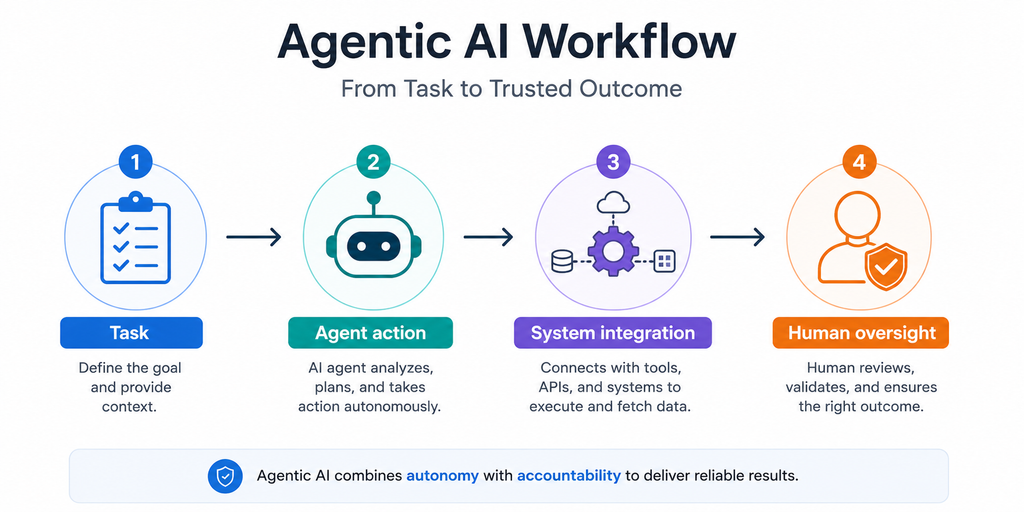
The best agentic AI use cases share a common shape. Below, each example follows a simple structure: Task → Agent action → System integration → Human oversight.
Customer Support
Task: Resolve routine tickets. Agent action: Read the ticket, retrieve account data, apply policy, issue a fix or refund. System integration: Helpdesk, order system, payment platform. Human oversight: Agents escalate edge cases and high-value refunds.
Sales Operations
Task: Qualify and route inbound leads. Agent action: Enrich lead data, score fit, assign owner, schedule follow-up. System integration: CRM, enrichment tools, calendar. Human oversight: Reps approve outreach to strategic accounts.
IT Operations
Task: Triage alerts and incidents. Agent action: Diagnose common issues, run remediation scripts, log the incident. System integration: Monitoring tools, ticketing, infrastructure APIs. Human oversight: Engineers approve production changes.
Finance Operations
Task: Invoice and payment reconciliation. Agent action: Match invoices, flag discrepancies, prepare entries. System integration: ERP, accounting software, bank feeds. Human oversight: Controllers review exceptions before posting.
Healthcare Administration
Task: Handle prior authorizations and claims prep. Agent action: Gather records, check requirements, assemble submissions. System integration: EHR, payer portals. Human oversight: Clinical and compliance staff approve submissions.
HR Operations
Task: Onboard new hires. Agent action: Create accounts, assign training, schedule check-ins. System integration: HRIS, identity provider, learning platform. Human oversight: HR reviews access permissions.
Internal Knowledge Management
Task: Answer employee questions accurately. Agent action: Search approved sources, synthesize an answer, cite policies. System integration: Document stores, intranet, wikis. Human oversight: Subject experts validate sensitive topics.
Software Engineering
Task: Handle routine code tasks. Agent action: Fix bugs, write tests, open pull requests. System integration: Version control, CI/CD, issue trackers. Human oversight: Engineers review and merge all changes.
What Makes a Good Agentic AI Use Case?
Not every process is a fit. Before investing, score candidate workflows against these criteria. A simple 1–5 rating per factor helps you compare and prioritize.
- Repeatability — Does the process follow consistent, definable steps?
- Clear success criteria — Can you define what “done correctly” looks like?
- Structured data access — Are the needed systems accessible via APIs or clean data?
- Volume — Is it frequent enough to justify the effort?
- Risk tolerance — Can errors be caught by human review without severe consequences?
- Measurability — Can you baseline current performance and track improvement?
Workflows that score high across these dimensions are your strongest first candidates. Low scores—especially on data access or risk tolerance—are warning signs.
Should Businesses Build AI Agents or Buy Them?
One of the earliest decisions in any agentic AI initiative is build versus buy. Neither is universally right.
| Factor | Build | Buy |
|---|---|---|
| Speed to value | Slower | Faster |
| Customization | High | Limited to vendor scope |
| Upfront cost | Higher | Lower |
| Integration control | Full | Depends on vendor |
| Maintenance burden | Owned internally | Handled by vendor |
| Differentiation | Can create unique capability | Commoditized capability |
| Best when | The workflow is core and unique | The workflow is common and standard |
Choose to build if the workflow is central to your competitive advantage and existing tools can’t fit your systems. Choose to buy if the need is common, speed matters more than customization, and a proven vendor covers your case. Many organizations do both—buy for standard functions, build for what sets them apart. Read this article : Build vs Buy ai voice agents
Agentic AI and Existing Business Systems
Agentic AI lives or dies by integration. An agent that can’t reach your CRM, ERP, or data warehouse can’t act. This is why enterprise agentic AI is as much an architecture problem as an AI problem.
Practically, this means API access, clean and permissioned data, and clear connections to the systems where work happens. Leaders often underestimate this layer. The model may be impressive, but if your systems are fragmented or your data is messy, agent performance suffers. Investing in integration and data readiness usually pays off more than chasing a newer model.
Security and Governance for Enterprise AI Agents
When AI systems can take real actions, security and governance stop being optional. An agent with write access to production systems needs the same scrutiny as a human employee with those permissions—arguably more.
Key governance practices include:
- Least-privilege access — Grant agents only the permissions each task requires.
- Audit trails — Log every action so decisions are traceable and reviewable.
- Human approval gates — Require sign-off for high-risk or high-value actions.
- Guardrails and constraints — Define what the agent must never do.
- Monitoring — Watch for drift, errors, and unexpected behavior in real time.
Governance isn’t a brake on adoption. Done well, it’s what makes broader adoption safe enough to pursue.
The Risks of Agentic AI
A balanced view requires naming the risks honestly.
- Error propagation — An agent acting on a wrong assumption can compound mistakes across steps.
- Over-automation — Removing human judgment from decisions that need it.
- Security exposure — Broad system access widens the attack surface.
- Data quality dependence — Poor data leads to poor actions.
- Opacity — Complex reasoning chains can be hard to explain after the fact.
- Vendor lock-in — Deep dependence on one platform limits flexibility.
None of these are reasons to avoid agentic AI. They’re reasons to deploy it deliberately, with oversight matched to the stakes.
How to Start an Agentic AI Initiative: A 10-Step Roadmap
- Identify a candidate workflow using the scoring framework above.
- Baseline current performance—cost, time, error rate, volume.
- Define clear success criteria for the agent.
- Assess data and system readiness, including API access.
- Decide build versus buy for this specific case.
- Design the agent’s boundaries, permissions, and human checkpoints.
- Build or configure a scoped pilot, not a full rollout.
- Test against real cases with humans reviewing every action.
- Measure results against your baseline.
- Scale gradually, expanding autonomy only as trust and metrics justify it.
The discipline here is starting narrow. One workflow, well executed, teaches your organization more than a broad program that stalls.
Common Agentic AI Implementation Mistakes
- Starting too big — Trying to automate an entire department at once.
- Skipping the baseline — Without before-and-after metrics, you can’t prove value.
- Ignoring integration — Underestimating the effort to connect systems.
- Granting excessive autonomy early — Removing humans before trust is earned.
- Choosing the wrong workflow — Picking messy, high-risk processes first.
- Treating it as a one-time project — Agents need monitoring, tuning, and maintenance.
Agentic AI ROI: What Should Businesses Measure?
ROI for agentic AI should tie back to the baseline you set. Useful metrics include:
- Cycle time — How much faster the workflow completes.
- Cost per transaction — Savings per unit of work handled.
- Volume handled — Throughput without added headcount.
- Error and rework rates — Quality changes versus the baseline.
- Escalation rate — How often the agent needs a human.
- Employee time reallocated — Hours freed for higher-value work.
Avoid vanity metrics. “Number of AI interactions” tells you nothing about business impact. Tie every measure to outcomes leadership already cares about.
Where Agentic AI Is Heading
Expect agentic AI systems to grow more capable at coordinating with each other—multiple specialized agents handling parts of a larger process. Integration standards will mature, making it easier to connect agents to enterprise systems. And governance tooling will improve as organizations demand more control and transparency.
What likely won’t change soon: the need for human oversight on consequential decisions. The realistic near-term future isn’t AI replacing teams. It’s AI agents in 2026 handling defined workflows while people focus on judgment, strategy, and exceptions.
Moving from AI Idea to Working Agents with Enlight Lab
Most organizations don’t struggle with wanting agentic AI. They struggle with the path from idea to working system. That path runs through workflow identification, architecture, system integration, agent development, deployment, and ongoing optimization.
This is where Enlight Lab works as a technology partner. Enlight Lab helps organizations move from an initial AI idea to a clearly scoped workflow, then designs the architecture, handles enterprise integration, builds the agents, and supports deployment and optimization over time. The focus stays practical: real workflows, real systems, and governance that makes adoption safe.
If your team is weighing where AI agents could deliver value, the strongest first move is a scoped, measurable pilot—and a partner who has done the integration work before.
The Bottom Line for Business Leaders
Agentic AI marks a genuine shift in what business AI can do: from generating content to reasoning, acting, and completing workflows across your systems. The opportunity is real, but so is the need for discipline. The organizations that win won’t be the ones that automate the most the fastest. They’ll be the ones that pick the right workflows, integrate cleanly, govern carefully, and expand autonomy only as trust is earned.
Start with one well-scoped workflow. Measure it against a real baseline. Keep humans in the loop where the stakes are high. Then scale what works.