Businesses evaluating AI sales agent development in 2026 face a practical problem: the gap between a convincing demo and a production-ready system is significant. Most demos show a chatbot answering questions. A real AI sales agent captures leads, qualifies them against defined criteria, updates a CRM, personalizes follow-up sequences, retrieves relevant knowledge, and knows when to hand off to a human.
This guide explains what actually needs to be built, what it costs, how long it takes, and what separates successful implementations from failed ones. It is written for founders, sales leaders, CTOs, and product teams who need a technically grounded view before committing budget.
What Is an AI Sales Agent?
An AI sales agent is an autonomous software system designed to perform specific sales tasks without requiring a human to manage each interaction. It operates across defined workflows, uses large language models (LLMs) for reasoning and communication, and connects to business systems to take actions, not just generate text.
The distinction matters. An AI sales agent does not simply respond to questions. It initiates contact, qualifies leads based on business rules, logs activity in a CRM, schedules meetings, and escalates appropriately. It operates across multiple steps, not a single prompt-response exchange.
How Does an AI Sales Agent Work?
At a high level, an AI sales agent receives an input (a web form submission, an inbound message, or a trigger from a CRM), reasons about what action to take next, executes that action using connected tools, and updates relevant systems with the outcome.
The reasoning layer relies on an LLM. The action layer relies on APIs, integrations, and business logic. Memory and context allow the agent to maintain continuity across a conversation or across sessions. Guardrails and monitoring layers ensure the agent behaves within defined boundaries.
Removing any of these layers produces a system that works in demos but fails in production.
AI Sales Agent vs AI Chatbot vs AI SDR vs Sales Assistant
These terms are used interchangeably in vendor marketing, which creates confusion when evaluating options.
| Term | Primary Function | Autonomy Level | Typical Integration Depth |
|---|---|---|---|
| AI Chatbot | Responds to inbound questions | Low | Minimal |
| AI Sales Assistant | Supports a human rep with suggestions | Low to medium | Moderate |
| AI SDR (Sales Development Rep) | Automates outbound prospecting sequences | Medium | Moderate to high |
| AI Sales Agent | Executes multi-step sales workflows autonomously | High | High |
Choosing the wrong category creates a mismatch between what was built and what the business needs. An AI SDR focused on outbound email sequences is not the same as a full AI sales agent managing inbound qualification and CRM updates.
Key Features of an AI Sales Agent
Lead Capture
The agent collects structured data from inbound sources: web forms, chat widgets, email, and connected lead generation platforms. Clean capture logic reduces downstream qualification errors.
Lead Qualification
The agent scores and qualifies leads against defined criteria, such as company size, industry, geography, or expressed intent. Qualification logic is configured by the business, not inferred freely by the LLM.
Lead Enrichment
The agent pulls additional data from third-party sources or internal databases to fill gaps in a lead record before routing or outreach.
Personalized Conversations
Using retrieved context, the agent generates responses and follow-ups tailored to the lead’s profile, industry, and position in the sales funnel.
CRM Integration
The agent reads from and writes to CRM platforms. Supported integrations typically include Salesforce (via Salesforce REST API), HubSpot (HubSpot API), and Microsoft Dynamics 365 (Dynamics 365 Web API / OData v4.0). Integration depth depends on available APIs and specific business requirements.
Email and Communication Automation
The agent sends, schedules, and sequences emails or messages based on workflow logic and lead behavior, without requiring manual triggering by a sales rep.
Calendar Integration
The agent books meetings directly into a representative’s calendar, eliminating the back-and-forth coordination step that consumes significant sales time.
Knowledge Retrieval
The agent retrieves relevant product information, pricing details, case studies, or objection-handling content from a connected knowledge base to inform its responses.
Memory and Context
The agent maintains context within a session and, where designed to do so, across sessions. Without this, the agent cannot hold a coherent multi-turn conversation or reference earlier interactions.
Human Handoff
When a lead reaches a defined threshold, or when the agent encounters a situation outside its scope, it transfers the conversation to a human representative with full context preserved.
Sales Analytics
The agent logs its activity and outcomes to a reporting layer, enabling measurement of qualification rates, conversion rates, handoff frequency, and response quality.
AI Sales Agent Architecture
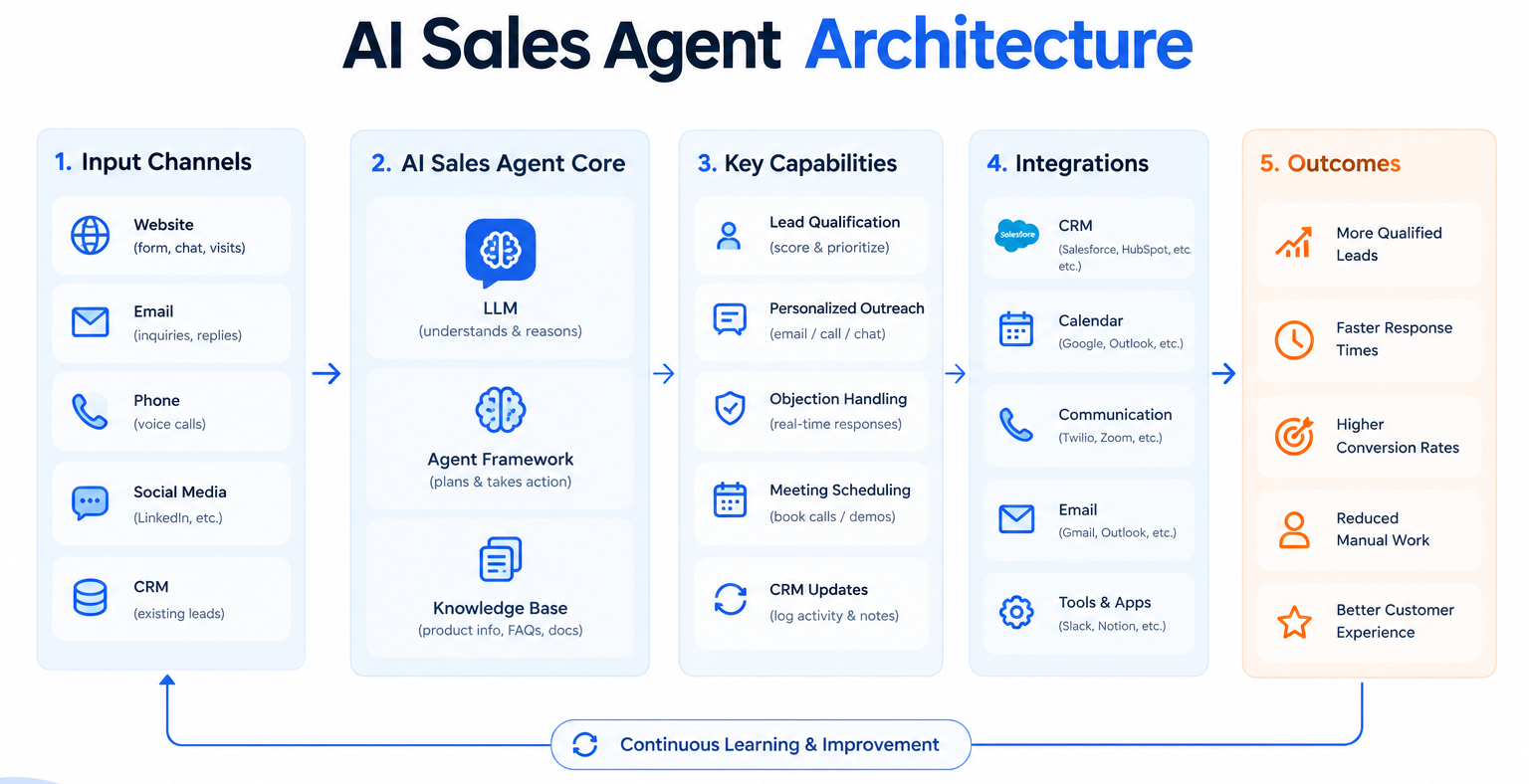
A production AI sales agent requires eight distinct layers working together.
| Layer | Function |
|---|---|
| Interaction Layer | Manages the user-facing interface: chat, email, voice, or API |
| Agent / Orchestration Layer | Controls reasoning, task planning, and tool selection |
| LLM Layer | Provides language understanding and generation capabilities |
| Knowledge / Context Layer | Retrieves and surfaces relevant information at runtime |
| Tool / API Layer | Executes actions: search, send, update, create |
| Business Systems Layer | Connects to CRM, calendar, email, and data platforms |
| Data Layer | Stores conversation logs, lead records, and enrichment data |
| Monitoring / Governance Layer | Tracks behavior, flags anomalies, and enforces guardrails |
Skipping the monitoring layer is one of the most common architecture mistakes. Without it, there is no visibility into how the agent is performing or where it is failing.
AI Sales Agent Development Cost in 2026
Development costs vary significantly based on scope, integration complexity, and the team building the system. The figures below are illustrative estimates based on typical project scope.
Basic AI Sales Assistant
Illustrative range: $15,000 – $40,000
A basic AI sales assistant handles simple inbound queries, captures lead data, and routes conversations to a human. It typically connects to one CRM via a standard API and uses a pre-built LLM with prompt engineering rather than fine-tuning.
Custom AI Sales Agent
Illustrative range: $50,000 – $120,000
A custom AI sales agent includes full qualification workflows, CRM read/write access, email automation, calendar integration, knowledge retrieval, and human handoff. It is built for a specific sales process and requires custom integration work.
Enterprise AI Sales Agent
Illustrative range: $150,000 – $300,000+
An enterprise-grade system adds multi-channel support, advanced memory architecture, role-based access, compliance controls, analytics dashboards, and integration across multiple business systems. Ongoing maintenance, monitoring, and iteration are additional costs.
What Factors Increase AI Sales Agent Development Cost?
Several variables drive cost beyond initial scope estimates:
- Number of integrations: Each CRM, calendar, or data platform requires separate API work and testing
- Custom qualification logic: Complex branching rules require more engineering time than simple scoring
- Knowledge base size and structure: Poorly structured internal content increases retrieval complexity
- Compliance requirements: Industries with data residency or access control requirements add governance overhead
- LLM selection and fine-tuning: Fine-tuned models cost more to train and maintain than prompt-engineered ones
- Multi-language support: Supporting multiple languages multiplies testing and quality assurance effort
- Ongoing iteration: Sales workflows change; agents built without modular architecture become expensive to update
AI Sales Agent Development Process
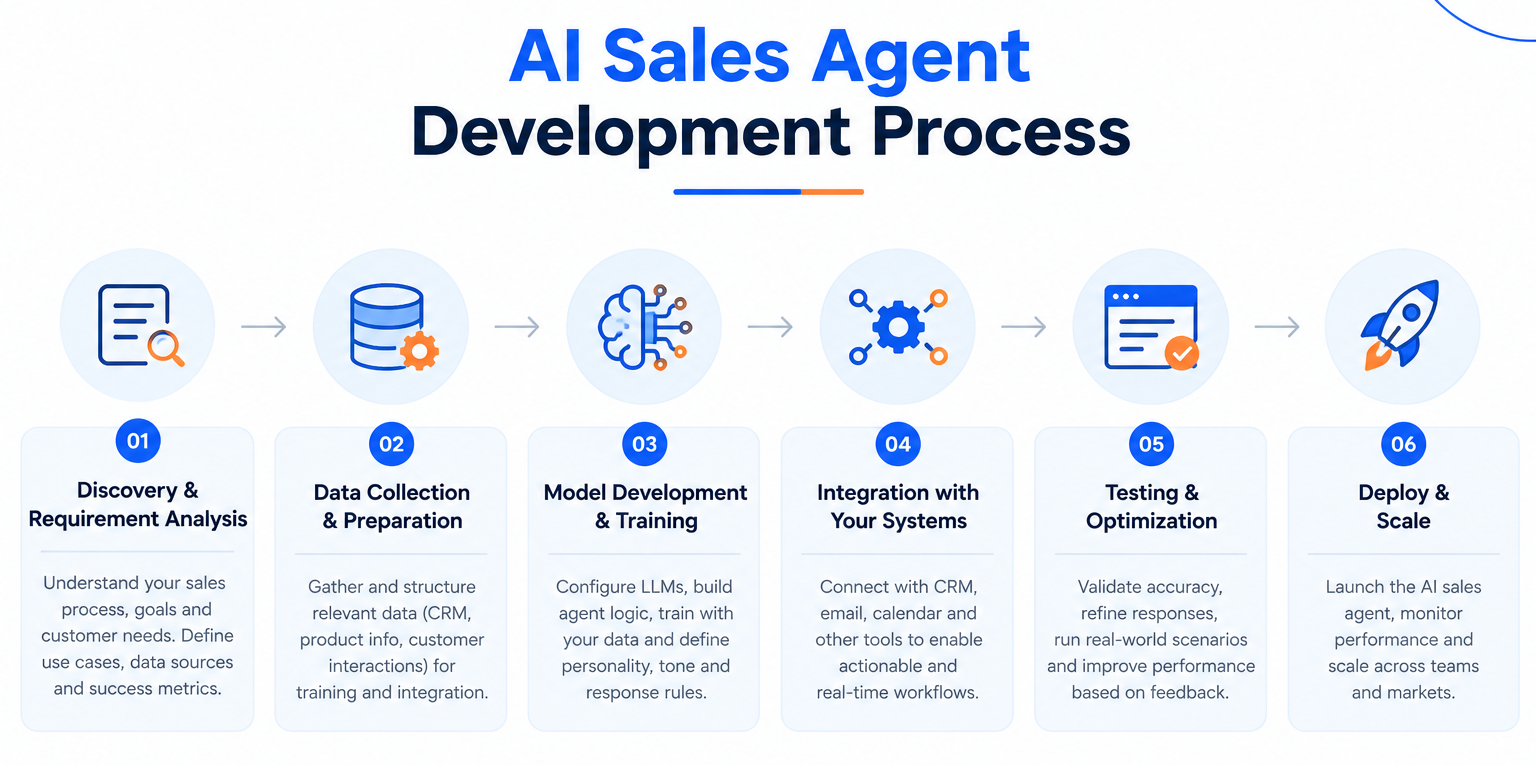
Step 1: Define the Sales Workflow
Map the current sales process from lead capture to opportunity creation. Identify which steps consume the most time and which are most consistent and rule-based.
Step 2: Select the Use Case
Choose a specific, bounded workflow for the first build. Inbound lead qualification is a common and well-understood starting point.
Step 3: Define Agent Boundaries
Document what the agent is allowed to do, what it is not allowed to do, and what triggers a human handoff. This step prevents scope drift and reduces risk.
Step 4: Design the Architecture
Select the LLM, orchestration framework, memory approach, and tool set. Define how each of the eight layers will be implemented.
Step 5: Connect Data and Business Systems
Build and test API connections to CRM, calendar, email, and enrichment platforms. Validate that data flowing into and out of the agent is accurate and complete.
Step 6: Build Agent Workflows and Tools
Implement the qualification logic, communication sequences, and tool calls. Each workflow should be testable in isolation before integration.
Step 7: Add Knowledge and Context
Load the product knowledge base, objection-handling content, and any historical lead data the agent needs to retrieve at runtime.
Step 8: Implement Human Handoff
Build the escalation logic and context-transfer mechanism. A handoff that drops conversation history creates a poor experience for both the lead and the sales rep.
Step 9: Test and Evaluate
Run adversarial testing, edge case testing, and user acceptance testing before deployment. Include tests for prompt injection and off-topic input handling.
Step 10: Deploy and Monitor
Deploy to a production environment with monitoring active from day one. Establish baseline metrics and set alerts for anomalous behavior.
How Long Does It Take to Build an AI Sales Agent?
Build timelines depend on complexity and team experience.
- Basic AI sales assistant: 4–8 weeks
- Custom AI sales agent: 10–20 weeks
- Enterprise AI sales agent: 20–40 weeks or more
The longest delays typically occur during integration work, not model development. CRM APIs, authentication flows, and data quality issues account for a significant share of project time.
Build vs Buy an AI Sales Agent
| Factor | Build (Custom Development) | Buy (SaaS Platform) |
|---|---|---|
| Fit to sales process | High | Low to medium |
| Time to first value | Longer | Faster |
| Integration flexibility | High | Constrained by vendor |
| Ongoing cost | Engineering and infrastructure | Subscription fees |
| Data control | Full | Vendor-dependent |
| Customization ceiling | None | Platform limits |
| Best for | Complex workflows, proprietary data | Standard outbound sequences, small teams |
Neither option is universally better. Buying a SaaS AI SDR tool makes sense for standard outbound sequences with a small team. Building a custom AI sales agent makes sense when the workflow is specific, the data is proprietary, or existing tools cannot support the required integrations.
Common AI Sales Agent Implementation Mistakes
| Mistake | Consequence | Fix |
|---|---|---|
| Building without a defined workflow | Agent scope expands continuously; project stalls | Document the target workflow before writing any code |
| Skipping human handoff design | Leads fall through when agent reaches its limits | Define escalation triggers and context-transfer logic early |
| Underestimating integration complexity | CRM connections break; data is incomplete | Audit API availability and data quality before scoping |
| Over-relying on the LLM for business logic | Qualification rules are inconsistently applied | Separate business logic from LLM reasoning |
| No monitoring layer at launch | Agent failures are invisible until they cause damage | Deploy monitoring on day one, not as a future enhancement |
| Ignoring prompt injection risks | Adversarial inputs manipulate agent behavior | Apply input validation and output filtering per OWASP guidance |
| Training on outdated product content | Agent provides incorrect pricing or feature information | Implement a content refresh workflow for the knowledge base |
| Measuring the wrong metrics | ROI is unclear; stakeholder confidence erodes | Define success metrics before deployment, not after |
Security and Governance Considerations
AI sales agents operate at the intersection of customer data, internal business systems, and publicly accessible interfaces. That combination creates specific risks.
Prompt injection is a documented vulnerability in LLM-based systems. It occurs when adversarial content in user input causes the model to behave in unintended ways. Anthropic and OWASP have both published guidance on mitigating this risk through input validation, output filtering, and sandboxed tool execution.
The NIST AI Risk Management Framework provides a structured approach to identifying, measuring, and managing AI risk across the full system lifecycle. For organizations in regulated industries, aligning the agent’s governance architecture to NIST RMF categories can support internal risk management processes.
Practical steps include: enforcing role-based access to CRM and data systems, logging all agent actions for audit purposes, applying data minimization principles to what the agent can retrieve, and conducting regular red-team testing.
How to Measure AI Sales Agent ROI
ROI measurement requires baseline data from before deployment.
Key metrics to track:
- Qualification rate: Percentage of leads qualified per unit of time, compared to the human baseline
- Time to first response: How quickly the agent engages a new lead
- Handoff rate: Percentage of leads escalated to human reps
- CRM data completeness: Percentage of required fields populated per lead record
- Meeting booking rate: Meetings booked per qualified lead
- Cost per qualified lead: Total system cost divided by leads qualified
Avoid measuring activity volume alone. An agent that sends more emails but produces fewer qualified leads is not performing well.
When Should a Business Build an AI Sales Agent?
Building a custom AI sales agent is appropriate when:
- The sales workflow is consistent enough to be documented and repeated
- Lead volume is high enough that manual qualification creates a measurable bottleneck
- CRM data quality is sufficient to support automated workflows
- The business has the technical resources or a development partner to build and maintain the system
- Existing SaaS tools cannot meet the integration or customization requirements
It is not appropriate when the sales process is undefined, the team is too small to benefit from automation, or the expected volume does not justify the development investment.
If your sales team is spending too much time on repetitive qualification, follow-ups, or CRM workflows, Enlight Lab can help evaluate whether an AI sales agent is technically and commercially appropriate for your business.
Future of AI Sales Agents in 2026 and Beyond
Several trends are shaping how AI sales agents will develop over the next two to three years.
Multi-agent architectures are becoming more common. Rather than a single agent handling all sales tasks, systems are being built where specialized agents handle distinct functions (qualification, enrichment, outreach) and coordinate through an orchestration layer.
Voice-based AI sales agents are moving beyond proof-of-concept. Advances in speech-to-text and text-to-speech latency are making real-time voice qualification viable for inbound call handling.
Memory architectures are improving. Current production systems often treat each session as stateless or use simple key-value stores for context. More sophisticated episodic and semantic memory systems are entering production use.
Governance tooling is maturing. Monitoring, evaluation, and audit platforms built specifically for AI agents are becoming standard infrastructure rather than custom builds.
How Enlight Lab Approaches AI Sales Agent Development
Enlight Lab builds AI sales agents as engineering projects, not consulting engagements. The process starts with a technical and commercial assessment of the target workflow, the existing data landscape, and the integration environment.
From there, the team designs an architecture that fits the specific requirements rather than adapting a generic template. Development follows a structured process across all eight architectural layers, with monitoring and governance built in from the start.
For businesses evaluating whether to build or buy, Enlight Lab provides an objective assessment based on the specific workflow complexity, data environment, and commercial case, without a predetermined conclusion.