Below is a plain-language breakdown of what actually changed, what it costs now, and how small teams are deciding between the two with sources so you can verify the numbers yourself before budgeting.
A note on accuracy: pricing and usage-limit details for both tools have changed multiple times in 2026 alone, and may change again after this article is published. Treat every number below as “true as of the cited source’s date” and confirm current pricing directly on Anthropic’s and Cursor’s pricing pages before making a purchasing decision.
What Are Claude Code and Cursor, in One Sentence Each?
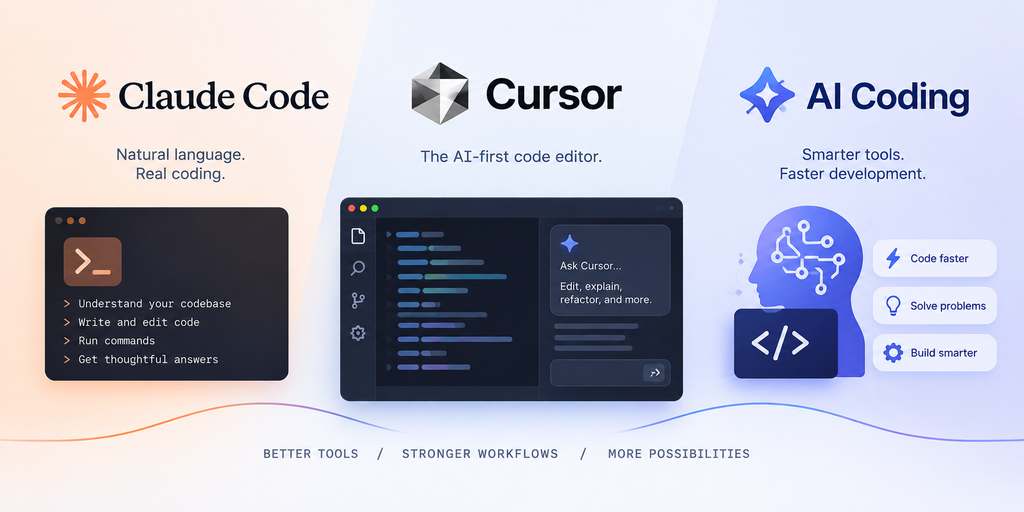
Claude Code is Anthropic’s terminal-native, agentic coding tool it works inside your existing editor (VS Code, JetBrains, or a plain terminal) and is bundled into Claude’s Pro, Max, Team, and Enterprise subscription plans rather than sold as a separate product.
Cursor is a standalone AI-native code editor, forked from VS Code, built around an in-editor agent (“Composer”) that can read, edit, and reason across your whole codebase, with its own independent pricing tiers separate from any chat product.
The core difference small teams should understand: Claude Code rides on top of your Claude subscription and shares a usage pool with Claude’s chat and desktop apps, while Cursor is a dedicated IDE with its own credit system that draws on multiple AI models (its own Composer model, plus third-party models like Claude and GPT).
What Actually Changed in 2026
1. Pricing got more tiered and more confusing
Neither tool has one clean price anymore. Both introduced multiple seat types and usage pools during 2026.
For Claude Code, Claude Team pricing sits at $20 per standard seat per month when billed annually, or $25 billed monthly, with premium seats at roughly $100 annually or $125 monthly, and the plan is listed for teams of two to 150 people. That’s a meaningful change from earlier in the year: the same source notes Claude Team required a five-seat minimum as recently as August 2026, before Anthropic lowered it to two seats a change that specifically matters for very small teams and two-person shops that previously had to buy seats they didn’t need.
Individually, Claude Code plans as of August 2026 run Pro at $20/month, Max 5x from $100/month, Max 20x at $200/month, and Team from $20 per seat billed annually, with every tier sharing one usage pool across Claude Code and the Claude chat apps.
Cursor went through its own restructuring. On June 1, 2026, Cursor introduced a Premium Teams seat at roughly $96 per user per month billed annually (about $120 monthly), alongside its existing Standard seat at about $32 annually ($40 monthly), with each tier now tracking separate “Cursor Models” and “Other Models” usage pools. More significantly for cost predictability, Cursor ended flat-rate unlimited Auto mode on August 24, 2026 every Auto request now bills at the routed model’s list price against one of the two pools, and Teams/Enterprise customers pay an additional surcharge on third-party models.
What this means for a small team: the “sticker price” for either tool ($20/seat for Claude’s standard tier, $20–40/seat for Cursor) is now just the starting point. Real monthly spend depends heavily on how often developers escalate to frontier models (Claude Opus, GPT-5, etc.) instead of using cheaper default/auto modes and both companies now expose usage dashboards specifically because this became a common source of bill shock.
2. Agentic, multi-step coding became the default expectation, not a feature
The bigger shift isn’t pricing it’s what these tools do. In February 2026, several major coding tools shipped multi-agent capabilities within the same two-week window: Windsurf added parallel agents, and Claude Code introduced Agent Teams, reflecting a broader industry move from single-suggestion autocomplete toward tools that can plan and execute multi-file changes with less supervision. For a small team, this changes the buying question from “which autocomplete is smartest” to “which tool can I trust to run for 20 minutes on a real task and come back with something reviewable.”
3. Real-world adoption jumped, but trust did not follow at the same pace
This is the part small teams should weigh most carefully before betting their whole workflow on AI-assisted coding. A JetBrains survey of over 10,000 professional developers conducted in January 2026 found that 90% regularly use at least one AI tool at work for coding tasks, up from 85% just months earlier. But adoption and confidence have diverged sharply. The Stack Overflow 2025 Developer Survey, with more than 49,000 respondents across 177 countries, found that while 80% of developers use AI tools, trust in AI accuracy fell from 40% to just 29% year over year, and positive favorability dropped from 72% to 60%.
The productivity story is genuinely mixed rather than uniformly positive which matters because a lot of marketing content flattens this. A McKinsey survey of 4,500 developers across 150 enterprises found AI coding tools reduce time on routine tasks like boilerplate, test writing, and documentation by 46%, but that figure specifically excludes system design, debugging complex issues, and navigating unfamiliar codebases. At the same time, a Faros AI analysis of more than 10,000 developers across 1,255 teams found that high-AI-adoption teams completed 21% more tasks and merged 98% more pull requests, but pull request size grew 154%, review time rose 91%, and bug counts increased 9% while organization-wide delivery metrics stayed roughly flat.
I am not fully certain how directly these enterprise-scale findings generalize to a 3–5 person startup team, since most of the cited research samples large organizations rather than small teams specifically treat this as a directional signal, not a precise prediction for your team’s outcome.
Claude Code vs. Cursor: What Small Teams Are Actually Choosing
One useful data point on real-world tool preference: a Q1 2026 survey of 2,847 developers by Digital Applied found that while 58% of developers had tried GitHub Copilot at some point, only 17% used it as their primary tool, whereas Claude Code held a 28% primary-tool share and Cursor held 24%, both growing quarter-over-quarter while Copilot’s primary-tool share declined. I’d flag that this is one survey with a specific, not-huge sample size, so treat the exact percentages as approximate rather than a definitive market map but the direction (agent-first tools gaining primary-tool share from completion-first tools) shows up consistently across the sources I reviewed.
Cost comparison at a glance (small team, 2026 pricing)
| Claude Code (via Claude subscription) | Cursor | |
|---|---|---|
| Entry price | Pro at $20/month, shared usage pool with Claude chat | Pro at $20/month, credit pool equal to plan price |
| Team minimum | 2 seats (lowered from 5 as of the source’s September 2026 check) | No stated minimum; recommended for teams of 3+ developers |
| Team seat price | $20/seat standard (annual), $25 monthly; $100/seat premium (annual), $125 monthly | ~$32/seat standard (annual), $40 monthly; ~$96/seat premium (annual), $120 monthly |
| Usage structure | One shared pool across chat and coding, on rolling 5-hour and weekly windows | Two separate pools one for first-party models/Auto, one for third-party models like Claude and GPT |
| Where it runs | VS Code, Cursor, JetBrains IDEs, and the terminal | Standalone AI-native editor (VS Code fork) |
I’m flagging every number in that table as something to re-verify: one source explicitly notes its pricing was checked against the official pricing pages on a specific date in August 2026, and pricing pages for both products have changed more than once this year. If you’re budgeting for a real team, pull the live numbers from claude.com/pricing and cursor.com/pricing on the day you decide, not from any article including this one.
What This Actually Means If You Run a Small Team
If your team is 1–2 people: Several sources converge on the same practical advice a small team with one heavy AI user often does best on individual Pro seats plus one higher-usage seat for the power user, rather than jumping to a Team plan, since Team’s standard seats give only slightly more usage than Pro, and Team-tier admin controls (SSO, centralized billing, role permissions) mostly matter once you have enough people that access management becomes its own chore.
If your team is 3–10 people: This is where Team/Teams plans start earning their keep, mainly for centralized billing and per-developer usage visibility rather than for extra AI capability. Cursor’s Teams tier is specifically pitched at engineering teams of three or more developers who need collaboration features, accountability, and security controls, and the same logic applies to Claude’s Team tier now that its seat minimum has dropped.
Either way, budget for overage risk, not just the seat price. Cursor’s own June 2026 Teams changes were explicitly framed as lowering costs for roughly 90% of teams by splitting usage into a cheaper first-party pool and a separate third-party pool which is a tacit admission that plenty of teams were overspending on the old structure by manually reaching for expensive frontier models by default. On the Claude Code side, field data compiled from real deployments anchors typical spend at $150–250 per developer per month before optimization, with about $13 per developer per active day as a reasonable middle estimate, and the same source flags that a bloated context file or an uncontrolled subagent fan-out can spike that number by 3–50x in a single session. I don’t have a verified source giving an equivalent per-developer cost benchmark specifically for Cursor, so I won’t invent one check your own team’s usage dashboard after the first billing cycle instead of budgeting from a borrowed number.
The Trust Gap Small Teams Should Plan Around
The single most important operational change in 2026 isn’t a pricing tier it’s that AI-assisted coding now produces a review bottleneck that didn’t exist at this scale before. Teams with high AI tool adoption saw pull request volume nearly double while review time rose 91%, meaning the speed gain from generation is partly or fully consumed downstream by review load. For a small team without a dedicated QA function, this is worth building into your workflow deliberately for example, keeping PRs small even when the AI agent could generate a large one, and treating “AI wrote it” as a reason for more scrutiny on unfamiliar or safety-critical code paths, not less.
Separately, one 2026 dataset found that only 48% of developers always review AI-assisted code before committing it, and that projects leaning heavily on AI-generated code saw a 41% rise in bugs in that particular sample. I can’t verify the underlying methodology of every statistic circulating on this topic, and some of the figures I found in different sources didn’t fully agree with each other where sources conflicted, I’ve cited the specific one behind each number so you can weigh its credibility yourself rather than treating “AI coding tools” as having one settled productivity verdict.
Bottom Line
For small teams in late 2026, the real change isn’t that AI coding tools got “better” in some vague sense it’s that they became agentic by default, priced in tiers that reward predictable usage patterns, and widely adopted without a matching rise in trust. The practical move is to pilot on the cheapest tier that includes real usage headroom, watch your actual token/credit burn for a full billing cycle before committing to a Team plan, and build code review capacity into your process assuming AI will increase your PR volume faster than it increases your review bandwidth.