We all remember the first time we used ChatGPT. It felt like watching a magic trick. You typed a few sentences into a text box, and out came a perfectly drafted email, a block of code, or a marketing plan. Suddenly, artificial intelligence was no longer a sci-fi concept reserved for massive tech giants. It was sitting right on our desktops, ready to work.
For many startups and growing businesses, off-the-shelf AI tools have been a massive productivity booster. They help lean teams punch above their weight, speed up content creation, and automate basic administrative tasks. But as organizations start relying on these generic models for heavier lifting, the cracks begin to show.
You might notice that the AI’s responses sound a bit too robotic, lacking your brand’s unique voice. Maybe you realize that feeding sensitive customer data into a public chatbot is a massive security risk. Or perhaps your team is spending more time writing complex prompts and fixing hallucinations than actually doing the work.
Generic artificial intelligence is an incredible starting point, but it is not a complete business strategy. That’s why, many companies begin to rethink their approach.
Instead of using only general AI tools like ChatGPT, they start looking at custom AI solutions. These systems are built for their specific business needs. They can use company data, follow set rules, and match the brand voice more closely.
In simple terms, tools like ChatGPT are a great place to start. But they are not always enough as a business grows.
In this blog, we will explore when your business should move beyond general AI tools and why switching to custom AI can help you work smarter, grow faster, and stay ahead of the competition.
Understanding the Landscape: ChatGPT and Generic AI
To understand where we are going, we need to understand the tools we are currently using. ChatGPT, along with other foundational models like Claude and Gemini, operates on massive datasets pulled from the public internet. They are designed to be generalists.
The undeniable benefits of off-the-shelf tools
There is a reason these tools saw the fastest adoption rates in software history. For businesses, the immediate benefits are clear:
- Zero setup time: You can create an account and start generating value in less than five minutes.
- Low barrier to entry: At roughly twenty dollars a month, the cost-to-value ratio for basic tasks is unbeatable.
- Broad knowledge base: Because they are trained on vast amounts of data, they can answer general questions, draft standard documents, and help brainstorm ideas across almost any industry.
The hidden limitations of generic AI
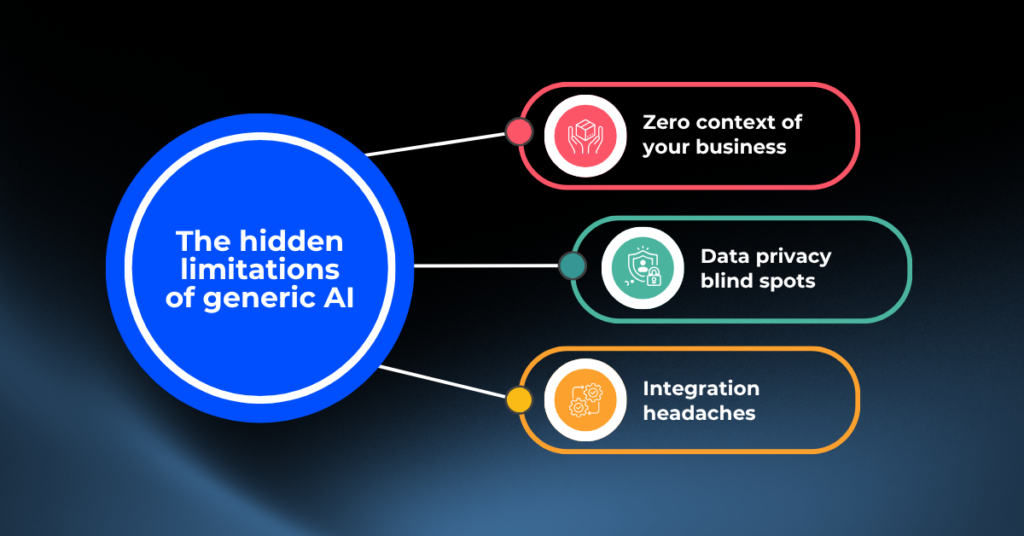
However, the same broad training that makes generic AI so accessible also creates significant limitations for growing companies:
- Zero context of your business: A public model does not know your internal workflows, your specific customer personas, or your company history.
- Data privacy blind spots: Typing proprietary code, financial forecasts, or customer information into a public AI tool can violate compliance frameworks and expose sensitive data.
- Integration headaches: While APIs exist, seamlessly weaving a generic model into your existing tech stack often requires messy workarounds.
- The hallucination tax: Generic models are designed to give confident answers, even when they are wrong. Catching these fabricated facts requires manual human review, which defeats the purpose of automation.
What is Custom AI?
As businesses grow, their needs become more specific. This is where custom AI comes in. It refers to artificial intelligence systems that are tailored for a specific company or use case. Instead of giving generic answers, these systems are trained to understand your business deeply. It is built around your data, your goals, and your workflows.
There are a few key parts that make custom AI different:
- Fine-tuned models: These are AI models that are trained further using your company’s data. This helps the AI give more accurate and relevant responses.
- Private datasets: Custom AI uses your internal data such as customer information, product details, and past interactions. This allows the system to provide answers that are specific to your business.
- Custom workflows: The AI is built to match how your business operates. It can follow your processes, rules, and systems instead of working in a general way.
Together, these components help create an AI system that feels like an extension of your team rather than just a tool.
Types of Custom AI Solutions
Custom AI can take many forms depending on what a business needs. Here are some common types:
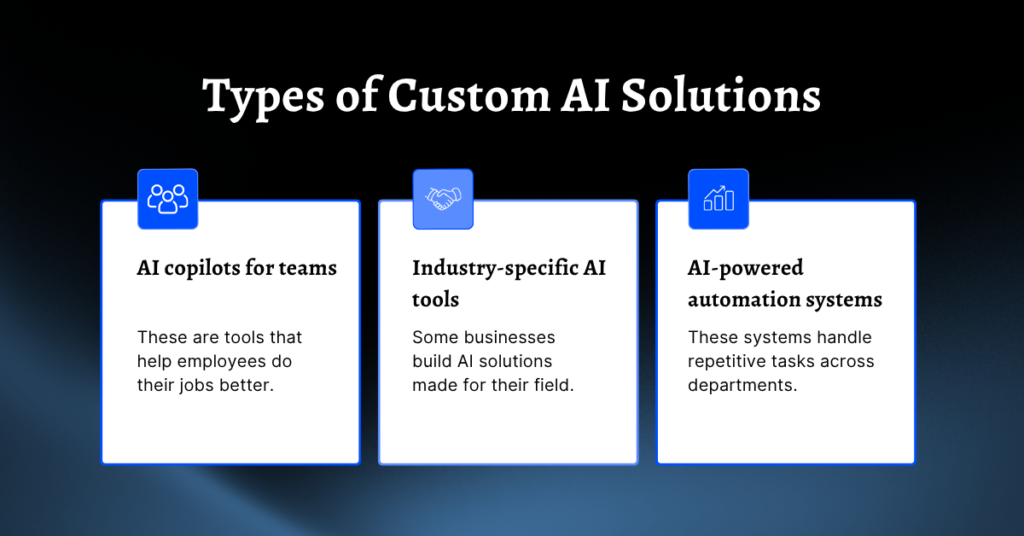
1. AI copilots for teams
These are tools that help employees do their jobs better. For example, a sales copilot can suggest replies to leads based on past conversations.
2. Industry-specific AI tools
Some businesses build AI solutions made for their field. For example, healthcare companies may use AI for patient records, while e-commerce brands may use it for product recommendations.
3. AI-powered automation systems
These systems handle repetitive tasks across departments. They can automate support tickets, manage workflows, or process large amounts of data without human input.
Each of the type is designed to solve a clear problem and improve efficiency in a focused way.
Work with an experienced team like Enlight Lab to design, train, and deploy the solution. We handle the technical heavy lifting so you can focus on leading your company.
How It Differs from ChatGPT
To better understand custom AI, it helps to compare it with tools like ChatGPT.
- Custom vs General: ChatGPT is built to help a wide range of users. Custom AI is built only for your business. This means it can provide more relevant and accurate outputs.
- Control vs Convenience: General AI tools are easy to use and quick to set up. Custom AI gives you more control over how the system works, what data it uses, and how it responds.
- Long-term value vs. short-term gains: ChatGPT is great for quick wins and early experimentation. Custom AI requires more time and effort to build, but it delivers stronger results over time.
In simple terms, general AI helps you get started, while custom AI helps you scale and grow.
When To Consider Custom AI Development
What is the tipping point for building custom AI?
A business should transition to custom AI when generic models can no longer support their scaling operations, when data privacy regulations (like HIPAA or GDPR) prohibit the use of public tools, or when highly specific internal workflows require an AI that understands proprietary company data.
Every company reaches a stage where the tools that helped them launch can no longer help them grow.
Here are the clear signals that your business is ready to graduate to a tailored solution.
Scaling operations are breaking down
When you only handle a few dozen customer inquiries a day, a human using ChatGPT to draft replies works fine. But what happens when that number jumps to thousands? Generic AI cannot route tickets, check inventory databases, and execute refunds autonomously. If your team is manually copying and pasting information between an AI prompt and your internal systems, your operations are bottlenecked.
Your workflows are entirely unique
Off-the-shelf tools handle standard processes beautifully. They fail miserably at highly specialized tasks. If your company uses a unique methodology for scoring sales leads, or a proprietary framework for analyzing legal contracts, a generic model will not be able to follow your specific rules without massive, error-prone prompts.
Data security and compliance become non-negotiable
This is often the hardest tipping point for enterprise growth. If you operate in healthcare, finance, or enterprise B2B software, data privacy is your lifeblood. Sending protected health information (PHI) or personally identifiable information (PII) to a third-party cloud provider is often a direct violation of HIPAA or GDPR. Custom AI can be hosted securely on your own infrastructure, keeping your data entirely under your control.
You need to protect your brand voice
Your brand voice is a massive part of your market positioning. Generic models tend to default to a polite, somewhat sterile corporate tone. While you can prompt a tool to act differently, maintaining a consistent, hyper-specific brand voice across hundreds of daily interactions requires a model that is explicitly fine-tuned on your company’s past communications.
Token costs are eating your budget
Using public APIs like OpenAI is cheap at a small scale. But when you start pushing massive volumes of data through these APIs every single minute, your monthly token costs will skyrocket. At a certain volume, it becomes significantly more cost-effective to host and run your own tailored models.
The “Why”: Advantages of Custom AI for Your Business
Making the leap requires an investment of time and capital. But the return on that investment fundamentally changes how your business operates.
Enhanced accuracy and deep relevance
A custom AI agent does not rely on generic internet data. It relies on Retrieval-Augmented Generation (RAG) tied directly to your company’s vector databases. This means the AI searches through your specific employee handbooks, past customer support tickets, and proprietary technical manuals to formulate its answers. It speaks your industry jargon perfectly and understands the nuanced differences between your product lines.
Superior data security and compliance
When you build a custom solution, you dictate the security parameters. You can implement strict role-based access controls. For example, a junior sales rep querying the internal AI will not be able to access the CEO’s financial forecasting documents. Furthermore, deploying open-source models on your own secure cloud infrastructure ensures that your proprietary data never leaves your company’s ecosystem.
Seamless integration with existing systems
A tailored digital workforce operates directly inside your current environment. Custom agents can read emails, check your CRM for past interactions, draft a response, and schedule a follow-up meeting in your calendar. They act as autonomous decision-makers rather than simple chatbots, drastically reducing manual effort across your organization.
Unlocking niche applications and new revenue
Custom artificial intelligence allows you to build features that your competitors simply cannot replicate. You can create specialized grading assistants for educational platforms, remote patient monitoring analyzers for healthcare, or automated supply chain forecasters that predict inventory needs based on your historical sales data.
Long-term cost efficiency
While the initial build requires capital, custom AI stabilizes your operational costs. You are no longer paying variable API token fees that spike during busy seasons. You also optimize your resource allocation, freeing up your human employees to focus on high-level strategic thinking rather than mind-numbing data entry.
The ROI of Building Your Own AI Solution
Shifting away from a $20-per-month subscription to a custom-built architecture is an investment. But for companies ready to scale, the return on that investment is massive.
Slashing Long-Term Costs and Inefficiencies
Paying for hundreds of individual AI subscriptions across your team adds up quickly. More importantly, the hidden cost of context switching, where employees move between your internal software and an external AI tool, drains productivity. Custom AI integrates directly into your existing dashboards, saving thousands of hours annually.
Automating Highly Specialized Work
Imagine a customer support AI that does not just give generic apologies, but actually checks a user’s shipping status, initiates a refund in your payment gateway, and updates the inventory system. Custom AI acts as a digital employee capable of executing complex, multi-step tasks specific to your operational playbook.
Building a True Competitive Advantage
If you use the same AI as your competitors, your outputs will look exactly like theirs. When you invest in custom AI for businesses, you build a proprietary asset. Your technology becomes a unique selling proposition that competitors cannot simply buy off the shelf.
The Custom AI Development Journey: Key Steps
Building a secure, scalable digital workforce requires a strategic approach. It is not just about writing code; it is about proper systems architecture.
Defining your needs and objectives
You should never build AI simply for the sake of having AI. The process starts by identifying specific operational bottlenecks. Are you trying to reduce customer support resolution times? Are you looking to automate your HR onboarding process? Clear objectives define the technical requirements.
Data collection and semantic chunking
Artificial intelligence is only as smart as the data it consumes. Feeding raw, messy legacy data into a model will result in confident, incorrect answers. You must clean your company data, remove outdated policies, and use semantic chunking to break the information into highly organized vector embeddings. Professional data preparation is the most critical step in this journey.
Model selection and orchestration
Not every problem requires the largest, most expensive foundation model. Sometimes a smaller, faster open-source model like Llama 3 or Mistral is perfect for a specific task. You also need to select orchestration frameworks (like LangChain or CrewAI) that allow multiple specialized agents to collaborate seamlessly without causing system latency.
Integration and deterministic guardrails
Modern AI must connect to your APIs safely. This requires deterministic guardrails. If your AI decides a customer deserves a refund, that decision must pass through strict validation checks before it interacts with your billing software. Building human-in-the-loop escalation paths ensures that edge cases are handled safely.
Continuous monitoring and preventing drift
An AI deployment is never truly finished. As your business data changes over time, old vector representations lose value. You need automated drift detection to monitor the agent’s output and trigger retraining cycles when accuracy starts to slip.
Leveraging Enlight Lab for Custom AI Architecture
Transitioning from generic AI like ChatGPT to a custom system requires deep expertise in AI safety, memory management, compliance, and infrastructure. This is where finding the right technology partner becomes critical.
Enlight Lab provides expert AI consulting services to help businesses design and build custom AI solutions tailored to their specific needs. With over 18 years of technical leadership, we guide organizations through every stage, from a simple idea to a fully scaled, autonomous system. Instead of just offering a one-size-fits-all model, our focus is on building AI systems tailored to your specific business needs.
Our expertise lies in developing the sophisticated architecture required for a truly custom AI workforce. We focus on:
- Custom Model Development: We build and train models on your proprietary data, enabling them to understand the specific nuances of your business and execute tasks with high accuracy.
- Secure Integration: We connect your custom AI to your existing systems, like CRMs or ERPs, ensuring secure and seamless data flow.
- Enterprise-Grade Scaling: We implement the necessary cloud infrastructure and monitoring tools to ensure your AI can scale safely and reliably as your business grows.
Whether you need an intelligent internal knowledge base or a complex multi-agent system to handle regulated data, Enlight Lab builds the future-proof architecture required. We cut through the hype and focus on delivering measurable business outcomes with purpose-built AI.
Embracing the future with tailored intelligence
The shift from generic chatbots to custom digital workforces is happening rapidly. Off-the-shelf tools have proven that the technology works, but it is purpose-built AI that will define the next generation of industry leaders.
By building systems that understand your unique data, integrate with your proprietary workflows, and protect your most sensitive information, you are not just automating tasks. You are building a scalable, intelligent foundation for sustained growth.
Take a close look at how your team is currently using artificial intelligence. If you are constantly fighting against generic outputs, worrying about compliance, or struggling to scale manual processes, it is time to stop adapting to AI tools and start building AI that adapts to you.
Take the next step:
- Discover where custom AI can create the biggest impact in your business
- Turn your data into a competitive advantage
- Build smarter systems that scale with you
Partner with Enlight Lab today and start building AI that works exactly the way your business needs.