If your engineering team spends their days fixing broken automation scripts, you are actively losing money. Relying on rigid, rule-based bots to run complex workflows is a fast track to wasted resources. When inputs change or edge cases arise, outdated automation breaks down, leaving your staff to manually clean up the mess. Reports that should take five minutes end up taking three days to build.
You need a smarter approach. Multi-agent systems transform enterprise automation by replacing single-threaded bots by distributing complex tasks across networks of specialized artificial intelligence. Instead of forcing one massive model to do everything poorly, these systems orchestrate a team of digital workers to handle data, adapt to changes, and execute decisions in real time.
You can think of a multi‑agent system as a digital team. Agents share context, divide responsibilities, and adapt to real‑world changes in real time. This shift moves you from fragile task automation to intelligent, enterprise‑grade automation that keeps improving as your operations grow.
However, choosing the wrong path carries significant risk. Opting for basic task automation when you need dynamic orchestration leads to crippled operations and technical debt. By understanding how multi-agent systems work, you can stop fixing brittle workflows and start building systems that actually scale.
In this guide, you will learn how multi‑agent systems work, where they deliver the highest business impact, and why they are becoming the foundation of modern enterprise automation.
What is a Multi-Agent System?
A multi‑agent system (MAS) is an AI architecture where multiple specialised agents work together to automate complex enterprise workflows. Each agent handles a specific task such as decision‑making, data processing, monitoring, or execution, enabling scalable, intelligent, and autonomous enterprise automation.
It is a network of independent that adapt to new information, delegate tasks among themselves, and execute multi-step workflows without human intervention.
Why Multi-Agent Systems Transform Enterprise Automation More Effectively Than Traditional RPA
Traditional Robotic Process Automation (RPA) is failing your business. It works perfectly for moving data from column A to column B, but the moment a vendor changes an invoice format, the bot crashes. You are left with a broken process and a stalled pipeline.
Moving from rigid RPA to a multi-agent system (MAS) fundamentally shifts how work gets done. RPA relies on blind execution. MAS relies on goal-based reasoning.
When you deploy a multi-agent setup, you stop mapping every possible “if/then” scenario. Instead, you define the objective. The system then determines the best path to reach that goal. This evolution moves your operations from fragile scripts to resilient networks. If one agent encounters missing data, it does not simply fail. It communicates with a research agent to find the missing information, resolves the gap, and keeps the workflow moving.
Why Brittle Bots Are Costing You More Than You Think
Your existing automation might look efficient on the surface, but the hidden costs of maintaining brittle bots are bleeding your budget dry. Every time a script fails, it triggers a cascade of expensive consequences that extend far beyond the initial error.
The True Cost of Maintenance
You are paying a premium for your engineers to perform low-value maintenance. Instead of developing new capabilities, your most skilled technical talent is tied up debugging scripts because an API updated its endpoint or a web form changed its layout. This reactive fire-fighting drains your development budget and cripples your ability to innovate. The cost isn’t just their salaries; it’s the opportunity cost of every strategic project they can’t work on.
The Downstream Impact of Failure
A broken bot doesn’t just stop a single process. It creates downstream bottlenecks that affect entire departments. A failed invoicing bot delays payments, straining vendor relationships and potentially incurring late fees. An error in a data-syncing script can corrupt your CRM records, leading your sales team to make decisions based on inaccurate information. These failures introduce friction across the entire organization and erode trust in your systems.
The Inflexibility of Rule-Based Logic
Rule-based bots are inherently stupid. They cannot handle ambiguity, context, or any scenario that falls outside their pre-programmed instructions. In today’s dynamic business environment, this is a fatal flaw. You need systems that can interpret unstructured data, understand intent, and adapt to unforeseen circumstances. Sticking with rigid RPA in an increasingly complex world is like trying to navigate a city with a fixed-track trolley instead of a fleet of self-driving cars.
Key Benefits of Multi‑Agent Systems for Enterprises
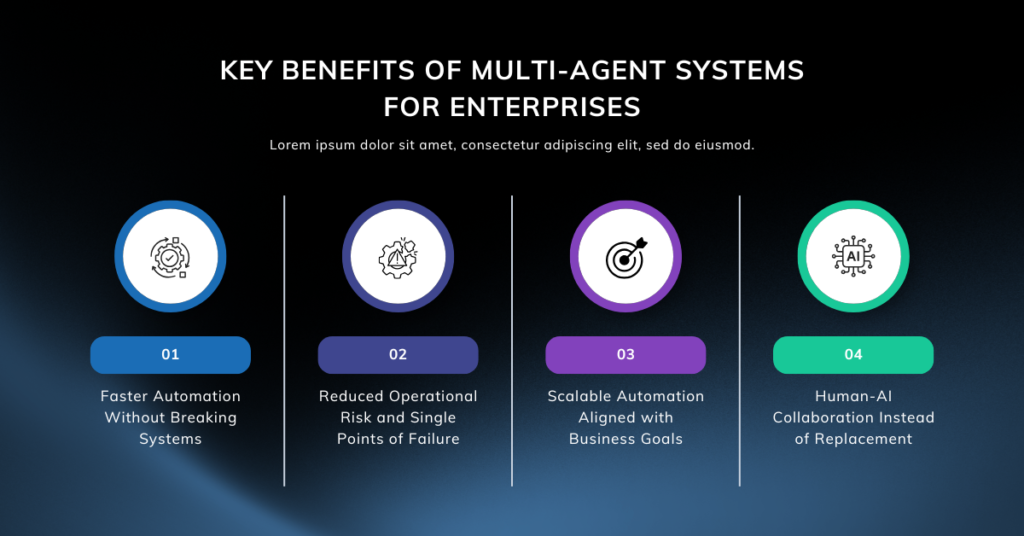
Multi‑agent systems deliver value where traditional automation starts to fail. By distributing intelligence across specialised agents, you gain speed, resilience, and scalability without increasing operational fragility. These benefits are why enterprises are rapidly adopting agent‑based automation for complex, mission‑critical workflows.
Faster Automation Without Breaking Systems
You no longer need to force every task through a single automation pipeline. Multi‑agent systems split complex processes into parallel workloads, allowing agents to plan, execute, and validate actions simultaneously. This reduces automation latency while preventing bottlenecks that commonly break monolithic workflows. Because agents operate independently, changes or failures in one part of the process do not halt the entire system.
Reduced Operational Risk and Single Points of Failure
Traditional automation often creates hidden dependencies that increase risk over time. Multi‑agent systems remove this weakness by design. If one agent underperforms or fails, others continue operating, preserving process continuity. This fault tolerance makes your automation more resilient in dynamic enterprise environments where system outages, data delays, and exceptions are unavoidable.
Scalable Automation Aligned with Business Goals
As your business grows, automation must adapt without full redesigns. Multi‑agent systems scale by adding, removing, or upgrading individual agents rather than rebuilding workflows end to end. You can align each agent with a specific business objective such as compliance, optimisation, or customer experience, ensuring automation evolves alongside strategy rather than lagging behind it.
Human‑AI Collaboration Instead of Replacement
Multi‑agent systems are designed to augment human decision‑making, not replace it. You retain strategic control while agents handle execution, monitoring, and optimisation. This collaboration allows your teams to focus on high‑value judgement, governance, and innovation while AI manages operational complexity at scale.
Core Components of Multi-Agent AI Systems
To build effective multi-agent AI systems, you must integrate four foundational components.
- Specialized AI Agents: You do not hire one person to be your accountant, lawyer, and supply chain manager. Your AI should work the same way. You need distinct agents tuned for niche tasks. One for reading financial tables, another for formatting data, and a third for compliance checking.
- Communication Protocols: Agents must talk to each other to function. Standardized rules dictate how agents share context, hand off tasks, and request help.
- Shared Environment: Your agents need a common workspace. This is the centralized data layer where agents access the same live information, ensuring they do not duplicate work or act on outdated data.
- Coordination Mechanisms: Chaos ensues when multiple agents try to update the same record simultaneously. Coordination layers act as the management structure, setting priorities, managing conflicts, and keeping the agents aligned with your primary business goal.
The Architectural Blueprint: Designing Your First Multi-Agent System
Transitioning from theory to practice requires a clear architectural plan. You do not build a skyscraper without a blueprint, and you should not build an enterprise-grade MAS without a disciplined design process.
Step 1: Define the Overarching Goal
Start with the business outcome, not the technology. What specific, measurable objective are you trying to achieve? “Process invoices faster” is a weak goal. “Reduce invoice processing time from 48 hours to 2 hours while eliminating 95% of manual data entry errors” is a strong one. This goal becomes the north star for your entire system.
Step 2: Deconstruct the Workflow into Sub-Tasks
Break the high-level goal into a sequence of smaller, discrete tasks. For invoice processing, this might include:
- Ingest: Monitor an email inbox for new invoices.
- Extract: Identify and pull key data points (vendor, amount, date, line items).
- Validate: Cross-reference the purchase order number with your ERP system.
- Approve: Route the invoice to the correct manager for approval based on amount.
- Pay: Schedule the payment in your accounting system.
Step 3: Assign Specialized Agents to Each Sub-Task
Map each sub-task to a specialized agent. An Intake Agent handles ingestion. An Extraction Agent with OCR capabilities handles data extraction. A Validation Agent integrates with your ERP’s API. A Routing Agent manages approval workflows. A Payment Agent interacts with the accounting platform. This ensures you have the right “digital worker” for each job.
Step 4: Design the Communication and Coordination Flow
Determine how the agents will interact. The Intake Agent must pass the invoice file to the Extraction Agent. The Extraction Agent must send the structured data to the Validation Agent. If the Validation Agent finds a discrepancy, it must flag it and perhaps notify a human for review. This workflow defines the rules of engagement and ensures a seamless handoff between agents. Without this, you have a collection of powerful tools with no way to work together.
Scaling Workflows with Collaborative AI Agents
Scaling human teams linearly to match data volume destroys your profit margins. Adding headcount to process invoices or triage support tickets burns through capital and stifles agility.
Collaborative AI agents break this cycle. They process complex tasks up to 60% faster than single-model approaches. Because the workload is distributed, they provide massive gains in efficiency, scalability, and flexibility.
- Efficiency: Distributing tasks across specialized agents eliminates bottlenecks. While one agent extracts text from an email, another cross-references the sender’s account history. Work happens in parallel.
- Scalability: When volume spikes, collaborative systems absorb the hit. If your intake doubles during a peak season, the system dynamically spins up more processing agents to handle the load without requiring new hires.
- Flexibility: When business rules change, you do not have to rebuild the entire system. You simply update the instructions for the specific agent handling that rule. The rest of the network adapts automatically.
Real-World Use Cases for Multi-Agent Systems
Anyone can buy a basic software subscription. When you build custom automation using multi-agent architectures, you create a capability your competitors cannot easily replicate. Here is how these systems are currently operating in the real world.
Accelerating Decisions in Finance
Manual document review is bleeding revenue from financial firms. Evaluating a Confidential Information Memorandum (CIM) typically takes an analyst three full days of reading, extracting, and formatting.
Firms deploying multi-agent architectures deploy an intake agent to classify the document, a data-extraction agent to pull metrics from financial tables, and an analysis agent to compare those metrics against investment criteria. This reduces the initial screening time from three days to a single afternoon, generating a 40% time savings in early-stage deal evaluation.
Eliminating Friction in Healthcare
Healthcare staffing and patient coordination suffer from massive administrative drag. Matching nursing professionals to facility shifts requires endless phone calls, compliance checks, and schedule adjustments.
Multi-agent networks absorb this friction. One agent verifies nursing credentials against state databases. Another cross-references facility shift requirements. A third handles the communication and scheduling. This results in faster fill cycles, improved workforce utilization, and a drastic reduction in manual coordination errors.
Improving Predictability in Logistics
Blind spots in supply chain operations lead to delayed shipments and inflated costs. Manual terminal tracking and poor rail scheduling visibility create a chain reaction of delays.
Logistics companies use multi-agent setups to digitize these inland operations. Agents ingest data from terminal workflows, predict rail scheduling conflicts, and issue proactive alerts before a bottleneck forms. AI in logistics and supply chain optimization is helping enterprises improve operational predictability, warehouse efficiency, and delivery performance
Overcoming the Challenges of Autonomous Agents
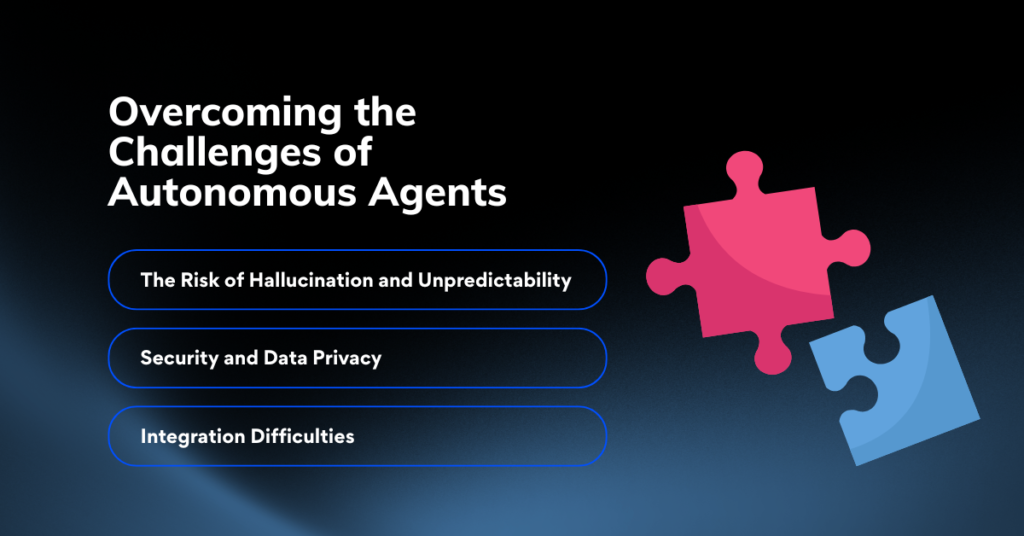
The transition to autonomous agents is not without risk. Deploying agents with access to sensitive enterprise data creates new vulnerabilities. If you ignore these risks, you will face severe operational and regulatory consequences.
The Risk of Hallucination and Unpredictability
When agents communicate with other agents, a single AI hallucination can spiral out of control. If an analysis agent misinterprets a number, the reporting agent will present false data to your executive team. You must implement strict guardrails to mitigate this.
- Mandate Source Citation: Require agents to cite their sources for every piece of data they generate or pass along. If an agent extracts a figure, it must provide a link back to the exact location in the source document.
- Implement Validation Layers: Use deterministic, rule-based validation scripts to check critical AI outputs before they are passed to the next agent or to a human decision-maker. For example, a simple script can verify that an extracted dollar amount falls within a plausible range.
- Use Human-in-the-Loop Workflows: For high-stakes decisions, the system should be designed to flag outputs that fall below a certain confidence threshold and route them to a human expert for final approval.
Security and Data Privacy
Giving autonomous agents access to your internal databases is a massive regulatory risk. Agents must be restricted by the principle of least privilege. Implement strict authentication protocols so an agent can only access the exact data required for its specific task.
- Enforce the Principle of Least Privilege: Agents must be restricted to access only the exact data required for their specific task. An invoice-processing agent should not have access to your employee HR files. Implement strict, role-based access controls for every agent.
- Secure Communication Channels: All communication between agents must be encrypted. Furthermore, implement authentication protocols to ensure that agents can only talk to other authorized agents within the system.
- Maintain Comprehensive Audit Logs: You must log every action taken by every agent. This is non-negotiable for compliance and is critical for debugging and forensics in the event of a security incident.
Integration Difficulties
Connecting new, agile agent architectures to your legacy enterprise infrastructure is often where deployments stall. Do not attempt a “big bang” integration to rip and replace your entire core system at once. This approach is destined to fail.
- Build API-First Bridges: Your first step should be to build stable, well-documented API bridges that allow your new agents to read and write to existing CRM, ERP, and other systems of record smoothly.
- Start with Isolated Workflows: Test your multi-agent system on one isolated, non-critical workflow first. Prove its reliability and value in a contained environment before expanding its scope. This allows you to learn and iterate without risking core business operations.
- Plan for Data Transformation: Legacy systems and modern AI models rarely speak the same language. Allocate resources for building data transformation pipelines that can clean, format, and translate data between your old and new systems.
Building Intelligent, Scalable Enterprise Automation with Enlight Lab
Building multi‑agent systems is not just a technical exercise. It is an organizational decision that affects governance, risk, scalability, and long‑term business outcomes. To succeed, you need a partner who understands how intelligent automation fits into enterprise reality.
At Enlight Lab, we work with enterprises to design and implement multi‑agent systems that are production‑ready from day one. Every agent, workflow, and decision loop is designed to operate reliably in complex, changing environments.
We first help you identify where agent‑based automation creates real value and then build systems that can scale responsibly across teams and platforms. Our focus is on outcomes you can measure, such as operational resilience, reduced manual intervention, and faster decision cycles.
Equally important, we design automation that works with your people.
If you are evaluating how to move beyond brittle automation and toward intelligent, scalable systems, Enlight Lab can help you take that step with confidence. Not through hype, but through thoughtful design, disciplined execution, and enterprise‑grade delivery.
From Fragile to Resilient – Rethink Automation at the System Level
Fragmented workflows and manual data entry are draining your resources. Relying on outdated automation forces your team to manage errors instead of driving growth.
Multi-agent systems offer a definitive way out of this trap. By deploying networks of specialised, collaborative agents, you eliminate the bottlenecks that choke your operations. You reduce processing times, strengthen your compliance, and build a highly scalable infrastructure that handles complexity with ease.
Look at your most error-prone, labour-intensive workflow today. Stop throwing headcount or fragile scripts at the problem. Define the goal, map the required specialities, and begin designing a multi-agent architecture to execute it.
Looking to replace fragile automation with resilient, system‑level execution? Partner with Enlight Lab today to design and deploy multi‑agent systems that actually execute end-to-end workflows, reduce errors, and eliminate constant rework.