In finance, the cost of poor implementation now outweighs the cost of inaction. Poorly executed systems create operational drag, increase compliance risk, and delay strategic decision-making.
Traditional AI in fintech mostly predicts outcomes. It flags a transaction as risky or scores a loan application. Generative AI in FinTech fills this gap by using advanced models such as large language models (LLMs) and retrieval‑augmented generation (RAG) to turn raw data into actionable intelligence across banking, payments, lending, and wealth management. You can ask it questions, review reports in plain language, and understand why a decision was made. This makes complex financial data easier to use across teams.
GenAI is a fundamental shift in how financial institutions handle data, interact with clients, and protect their assets. Ignoring this shift leaves you vulnerable to competitors who can process information faster and serve clients better. Conversely, rushing to deploy untested AI tools without a clear strategy is a fast track to wasted resources and compliance nightmares. You need a deliberate, informed approach.
This guide breaks down exactly how generative AI applies to the financial sector. Explore its most impactful use cases, the undeniable benefits, valuable examples of how real organisations are applying it in production, and the challenges you must prepare for.
Understanding Generative AI: How It Works and Why It Matters for Finance
Generative AI in fintech refers to artificial intelligence systems that can create new text, code, or data models based on large sets of financial data. Financial institutions use it to automate compliance reporting, detect fraudulent transactions, personalize wealth management advice, and streamline back-office operations. Instead of only showing patterns or scores, it generates summaries, explanations, and recommendations that you can act on right away.
How does generative AI work in fintech?
Generative AI works by training neural networks on massive datasets. Once trained, these models can generate original content, summarize lengthy documents, or identify anomalies that human analysts miss.
Why does adopting generative AI matter for fintech?
For a financial institution, this matters because speed and accuracy dictate your profit margins. Relying on manual analysis always leads to bottlenecks. When you build or integrate a generative AI solution, you create a capability your competitors cannot easily replicate. You move from reacting to historical data to proactively generating solutions.
Where generative AI delivers the most value
Generative AI creates the most impact where speed, accuracy, and scale matter the most.
Customer Operations
You can automate customer support, onboarding, and account queries. Generative AI gives clear and personal responses without long wait times.
Risk and Compliance
Risk teams use Generative AI to review alerts, explain risks, and track issues early. Compliance teams use it to summarize rules and prepare reports faster.
Lending and Underwriting
Generative AI in FinTech speeds up application reviews, improves credit assessments, and maintains consistent lending decisions.
Data Intelligence and Reporting
Dashboards show numbers, but they do not explain meaning. Generative AI coverts raw financial data into clear summaries and actionable insights. Reports become easier to read and easier to act on.
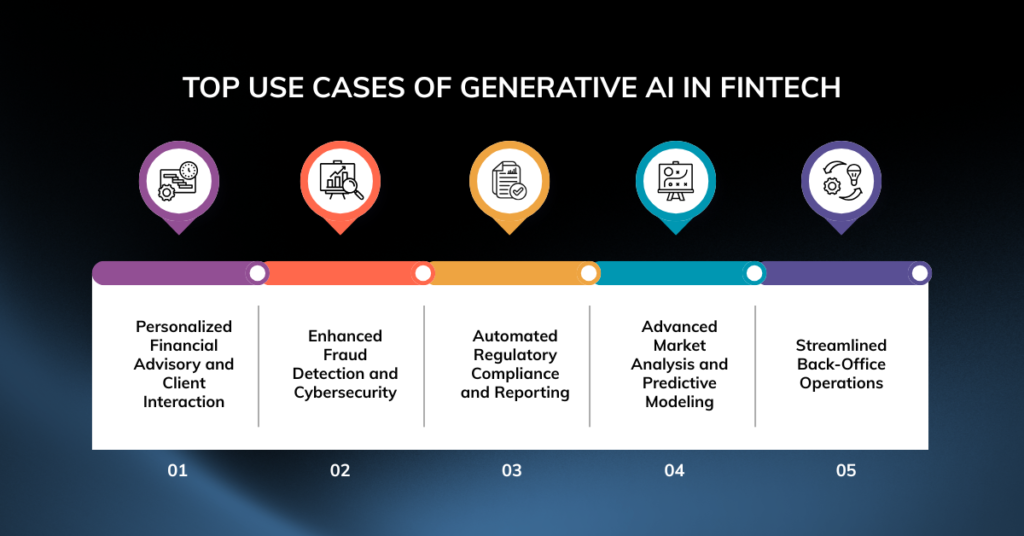
Top 5 Use Cases of Generative AI in FinTech
Buying a simple SaaS subscription might solve a minor workflow issue. But applying generative AI to your core financial processes changes how your entire business operates.
Here are the primary ways you should be applying this technology.
Personalized Financial Advisory and Client Interaction
Generic financial advice alienates high-net-worth clients. If your advisors spend hours manually compiling portfolio reviews, they have less time to actually build relationships.
Generative AI analyzes a client’s spending habits, risk tolerance, and life goals to generate highly personalized investment recommendations in seconds. Your advisors can then review and refine these generated insights, delivering a bespoke experience to every single client without the crippling time investment.
Enhanced Fraud Detection and Cybersecurity
Relying on static rules to catch fraud is a massive regulatory and financial risk. Bad actors adapt faster than traditional rule-based systems can update.
Generative AI models simulate thousands of complex fraud scenarios to train your defense systems. By generating synthetic transaction data, these tools help your security infrastructure recognize the subtle, evolving patterns of synthetic identity fraud and account takeovers before they drain your clients’ accounts.
Automated Regulatory Compliance and Reporting
Failing a compliance audit costs millions in fines and destroys trust. Yet, compliance teams burn thousands of hours manually cross-referencing internal policies with changing global regulations.
Generative AI ingests vast amounts of regulatory text and automatically drafts compliance reports, flags policy violations, and summarizes legal changes. You reduce the risk of human error and free up your legal team to focus on strategic risk mitigation.
Advanced Market Analysis and Predictive Modeling
Market conditions change in milliseconds. Waiting for a human analyst to read earnings reports, news articles, and economic indicators means you act too late.
Generative AI instantly processes unstructured data from thousands of sources, summarizing market sentiment and generating predictive models. You get clear, concise briefs on market movements before the broader market reacts.
Streamlined Back-Office Operations
Inefficient back-office processes stifle growth. Data entry, contract analysis, and customer onboarding are necessary, but they drain operational capital.
Generative AI automates document processing, extracting key entities from loan applications or commercial contracts, and feeding that data directly into your core systems. You cut processing times from weeks to hours.
Benefits of Implementing Generative AI in Financial Institutions
When you invest in a new data initiative, you naturally want to see results fast. Applying generative AI correctly yields direct, measurable improvements to your bottom line.
Here’re the key benefits of generative AI in fintech:
Increased Operational Efficiency and Cost Reduction
Every manual process is an ongoing tax on your revenue. Generative AI eliminates the repetitive tasks that eat up your employees’ time. By automating document drafting, data extraction, and customer support triage, you drastically reduce your operational costs. You do more with the headcount you already have.
Improved Decision-Making and Risk Management
Making decisions based on incomplete data leads to bad loans and poor investments. Generative AI synthesizes fragmented data silos into a single, cohesive view. It provides your credit officers and risk managers with comprehensive risk profiles, highlighting potential defaults or market exposures with extreme precision. You make faster, safer decisions.
Enhanced Customer Experience and Personalization
Customers leave when they feel ignored or misunderstood. Generative AI powers conversational agents that handle complex customer queries instantly, 24/7. Beyond chatbots, it allows you to send hyper-personalized product offers and financial advice. You give every retail banking customer the tailored experience usually reserved for private wealth clients.
Driving Innovation and Competitive Advantage
Institutions that rely on legacy systems will spiral into irrelevance. Generative AI allows you to rapidly prototype new financial products, test synthetic market scenarios, and deploy code faster. You get to market first.
Real-World Examples of Generative AI in Action for FinTech Firms
Abstract frameworks mean nothing without concrete application. Here is how major players are already using generative AI to secure a market advantage.
JPMorgan Chase
JP Morgan Chase developed a proprietary large language model to analyze Federal Reserve speeches and corporate earnings calls. This tool identifies trading signals and market sentiment faster than human analysts, giving their trading desks a distinct time advantage.
Morgan Stanley
They deployed an AI assistant powered by OpenAI to their wealth management division. The tool instantly retrieves and summarizes information from a massive internal database of investment strategies, market research, and commentary. Advisors use it to answer complex client questions in seconds rather than hours.
Stripe
The payment processor uses generative AI to combat fraud and improve the developer experience. They apply AI to analyze transaction patterns to catch sophisticated fraud rings, while also using AI to generate code snippets and answer technical questions for developers integrating their API.
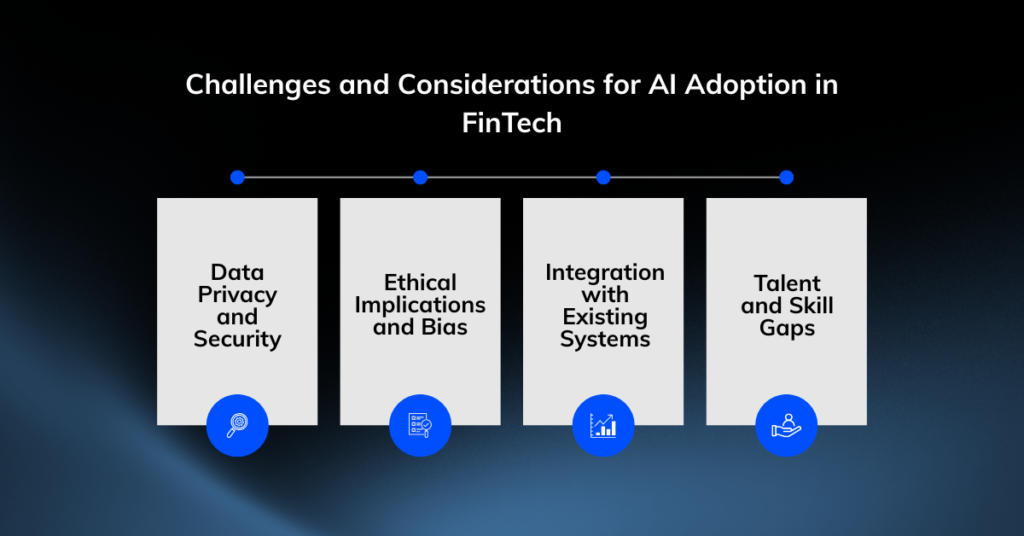
Challenges and Considerations for AI Adoption in FinTech
Moving too quickly without proper architectural design always leads to crippling technical debt down the road. You must address these specific challenges before deploying generative AI.
Data Privacy and Security
Feeding sensitive financial data into public AI models is a fast track to a massive data breach. You must ensure that any generative AI system you deploy complies with strict data residency and privacy laws. This usually requires building secure, private instances of language models where your data is isolated and never used to train public systems.
Ethical Implications and Bias
AI models reflect the biases present in their training data. If a generative AI model uses biased historical data to approve or deny loans, you will face severe legal and reputational damage. You must implement rigorous auditing frameworks to test your models for fairness and compliance with lending laws before they go live.
Integration with Existing Systems
Slamming modern AI on top of a 30-year-old mainframe rarely works. Legacy infrastructure often lacks the API capabilities and data structures required to support generative AI. You need a clear architectural plan to modernize your data pipelines so the AI can actually access the information it needs to function.
Talent and Skill Gaps
You cannot run a modern AI initiative with an outdated workforce. Prompt engineering, model auditing, and AI governance require specialized skills. You will find that hiring AI talent is expensive (costing anywhere from $150,000 to over $300,000 per engineer). You must balance external hiring with aggressive internal training programs.
Best Practices for Adopting Generative AI in Fintech
To use generative AI in fintech effectively, you need strong controls from day one. These best practices help you scale AI safely while meeting business and regulatory needs.
Human‑in‑the‑Loop Design
- Keep humans in control of final decisions
- Use AI to support reviews, not replace judgment
- Apply this model in lending, compliance, and risk
Domain‑Specific Model Tuning
- Avoid generic, open models for finance use cases
- Train models on financial data and rules
- Improves accuracy and reduces wrong outputs
Secure Data Pipelines
- Limit what data AI systems can access
- Protect customer and transaction data end‑to‑end
- Track who uses data and how it is processed
Explainability and Auditability
- Always know why an output was generated
- Log inputs, prompts, and responses
- Make reviews and audits faster
Responsible AI Governance
- Set clear rules for AI use across teams
- Involve risk, legal, and compliance early
- Monitor bias, accuracy, and misuse
The Future of FinTech: What’s Next for Generative AI
The current applications of generative AI are just the baseline.
As financial institutions continue to manage growing volumes of data, rising customer expectations, and stricter regulations, AI-driven systems will play a bigger role in improving efficiency, accuracy, and decision-making across the industry.
Smarter Financial Decision-Making
Future AI systems will do more than automate tasks. They will help finance teams analyze trends, explain risks, generate forecasts, and support faster strategic decisions using real-time data and contextual insights.
More Reliable AI Through RAG and Enterprise Data
Technologies such as retrieval-augmented generation (RAG) will make AI systems more accurate and context-aware by connecting models directly with trusted enterprise data sources. This will improve reliability in high-stakes financial environments.
Stronger Risk Management
Generative AI will enhance fraud prevention by identifying unusual patterns, monitoring transactions in real time, and helping risk teams investigate threats more efficiently.
Generative AI adoption in credit risk is accelerating rapidly. According to McKinsey, around 80% of organizations in the sector plan to integrate Gen AI capabilities over the next year.
AI-Powered Compliance
As regulations become more complex, financial organizations will increasingly rely on AI to monitor policy changes, generate compliance summaries, and support audit preparation. This will make regulatory management faster and more scalable.
How Fintech Leaders Can Get Started with Generative AI
Starting with generative AI in fintech is less about technology and more about strategy. When you focus on value, readiness, and responsible adoption, AI becomes a growth driver instead of a risk.
Build vs Buy Decision
Your first decision is whether to build AI capabilities in‑house or buy ready‑made solutions.
Building gives you more control and long‑term flexibility, but it needs strong data, AI skills, and time.
Buying helps you move faster with proven tools, especially for common use cases like compliance or customer support.
Many fintech leaders start by buying and later build where differentiation matters most.
Pilot Use Cases with Clear ROI
Start small with use cases that show clear business value. Focus on areas where manual effort is high and outcomes are measurable, such as document review, fraud analysis, or reporting.
Pilots should have clear success metrics like time saved, cost reduction, or error reduction. This helps you prove ROI before scaling further.
Internal Readiness Checklist
Before scaling, check if your organisation is ready. You need clean, well‑governed data, clear ownership, and basic AI awareness across teams. Legal, compliance, and risk teams should be involved early.
Choosing the Right AI Partner Like Enlight Lab
If you work with an AI partner, choose one that understands both fintech and regulation. The right partner helps you design safe systems, not just deploy models.
At Enlight Lab, we help financial organizations design and implement AI systems that are secure, scalable, and aligned with compliance requirements. From financial data handling and model explainability to long-term infrastructure planning, our focus goes beyond model deployment to building reliable AI solutions that create measurable business value.
As a trusted AI partner, we help you:
- Build compliant and explainable AI systems
- Protect sensitive financial and customer data
- Scale AI solutions across operations over time
- Reduce implementation risk and operational complexity
- Turn AI adoption into a long-term competitive advantage
Embracing the AI Shift in Finance with Enlight Lab
You know the cost of inaction. Sticking to manual processes, outdated risk models, and generic client interactions will drain your capital and stifle your growth. Generative AI offers a proven, structural fix to the inefficiencies plaguing the financial sector.
But you cannot buy your way to innovation with unvetted subscriptions. You must assess your data infrastructure, identify the processes bleeding the most revenue, and deploy targeted AI solutions that solve specific business problems.
Audit your current workflows. Identify the reporting and analysis tasks taking days instead of minutes. Then, build a roadmap to integrate generative AI into those specific bottlenecks.
Ready to apply generative AI in your fintech strategy? Partner with Enlight Lab to build a clear roadmap and deploy generative AI solutions that are secure, compliant, and built around your highest‑impact fintech workflows.