SaaS MVP Development is no longer about building a basic version of your product and hoping it works. In 2026, it is about making sharp decisions early, so you do not waste time, money, or engineering effort on the wrong features. It focuses on validating real user problems, prioritising essential features, and launching a usable product that can grow with your business.
When you start a SaaS product today, you are entering a crowded market where users have options and very little patience. That means you cannot afford to guess what your users want. You need proof.
This is where SaaS MVP development helps you. It allows you to launch the smallest possible product that still delivers real value, so you can test your idea with real users as early as possible. Instead of building a full platform upfront, you focus on solving one clear problem for one clear audience. You learn what works, what does not, and what users are actually willing to pay for.
If you want to build a SaaS product that scales, attracts users, and convinces investors, your MVP is not optional. It is the foundation that helps you build the right product before you scale the wrong one.
In 2026, successful SaaS MVPs are planned with scalability, user experience, and long‑term value in mind. Founders can no longer afford rushed launches, bloated feature sets, or technical shortcuts that slow growth later.
This guide walks you through how to approach SaaS MVP development the right way in 2026, from idea validation and feature scoping to technology decisions, timelines, and launch readiness, so you can build a product users actually want to use and pay for.
What Is SaaS MVP Development?
SaaS MVP Development is the process of building the smallest workable version of your software‑as‑a‑service product that solves a real problem for a specific group of users. Instead of launching a full‑scale platform, you build only what is necessary to validate your idea, collect real user feedback, and decide what to build next with confidence.
When you invest in SaaS MVP Development, your goal is not to impress users with features. Your goal is to test whether your product delivers real value and whether users are willing to use it, pay for it, and come back to it. An MVP helps you replace assumptions with data before you scale.
It is important to understand what a SaaS MVP is not. A SaaS MVP is not a prototype, wireframe, or demo. Prototypes help you test ideas visually. An MVP is a working product used by real people in real conditions. It must function reliably, feel credible, and solve one clear problem, even if it does not include advanced features yet.
In 2026, SaaS MVP Development has evolved. Markets are more crowded, user expectations are higher, and investors expect early traction, not just ideas. That is why modern SaaS MVPs focus on speed, sharp positioning, and fast learning. You build for validation first, not completeness. You launch early, measure user behaviour, and iterate based on facts instead of opinions.
If you want to build a scalable SaaS business, SaaS MVP Development gives you a safer and smarter starting point. It allows you to learn faster, reduce risk, and ensure you are building the right product before you invest heavily in growth.
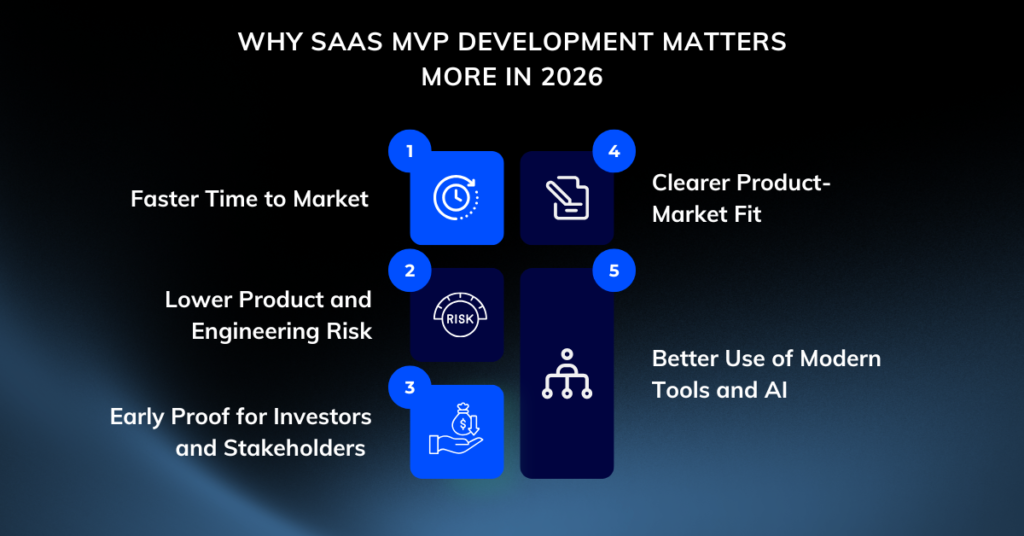
Why SaaS MVP Development Matters More in 2026
The way you build SaaS products in 2026 is very different from even a few years ago. Markets are crowded, users expect value fast, and investors want evidence, not assumptions. That is why SaaS MVP Development is no longer optional. It is the smartest way to reduce risk and build with clarity from day one.
Faster Time to Market
When you use SaaS MVP Development, you stop waiting for the “perfect” product. You focus on launching fast with a usable solution that solves one real problem. This speed helps you reach users earlier, learn sooner, and stay ahead of competitors who are still building behind closed doors.
Lower Product and Engineering Risk
Building a full SaaS product without validation is expensive and risky. An MVP allows you to test your idea with minimal effort and cost. You validate demand before making large technical or financial commitments, which protects you from investing months into features users do not want.
Early Proof for Investors and Stakeholders
In 2026, ideas alone are not enough. Investors want traction, signals, and real usage data. A SaaS MVP gives you proof. You can show how users behave, what they engage with, and whether they are willing to pay. This makes conversations with investors and stakeholders much stronger.
Clearer Product-Market Fit
SaaS MVP Development helps you find product-market fit faster. By observing how real users interact with your MVP, you understand what to improve, what to remove, and where to double down. You stop guessing and start building based on facts.
Better Use of Modern Tools and AI
With today’s development tools, you can validate ideas faster than ever. In 2026, MVPs are leaner, smarter, and easier to iterate. You use technology to learn quickly, not to overbuild early, which keeps your SaaS product focused and scalable.
SaaS MVP vs Prototype vs Full Product
When you are planning SaaS MVP Development, it is critical to understand the difference between an MVP, a prototype, and a full SaaS product. Many teams mix these up, which often leads to overbuilding, wasted budgets, and delayed launches. Each stage serves a different purpose, and choosing the wrong one at the wrong time can slow you down.
A prototype helps you test ideas. A SaaS MVP helps you test the market. A full product helps you scale what already works. If your goal is real validation in 2026, the MVP sits at the centre of your product journey.
Comparison Table: SaaS MVP vs Prototype vs Full Product
| Aspect | SaaS MVP | Prototype | Full SaaS Product |
| Primary purpose | Validate real user demand | Test ideas or UX concepts | Scale and monetise |
| Users | Real users and early adopters | Internal teams or testers | Broad market |
| Functionality | Core features only | No real backend logic | Complete feature set |
| Revenue | Possible | Not possible | Yes |
| Build quality | Production‑ready but lean | Visual or interactive only | Fully polished |
| Risk level | Low | Medium | High |
| Best use case | Market validation | Idea exploration | Growth and scaling |
When Should You Build a SaaS MVP?
SaaS MVP Development works best when it is used at the right moment in your product journey. Building an MVP too late slows learning. Building it too early without clarity creates confusion. In 2026, knowing when to build a SaaS MVP is just as important as knowing how to build one.
Build a SaaS MVP When You Need Market Validation
You should build a SaaS MVP when you are not fully sure that users want your solution. If you have a strong idea but limited proof, an MVP helps you validate demand with real users. You learn whether the problem is real, painful enough, and worth solving before you scale.
Build a SaaS MVP When You Want to Reduce Risk
If building a full SaaS product feels like a big financial or technical bet, that is a clear signal to start with an MVP. SaaS MVP Development allows you to test assumptions with minimal investment. You reduce the risk of building features that users ignore or reject.
Build a SaaS MVP When Speed Matters
In competitive markets, speed is a major advantage. If you need to enter the market quickly, collect feedback, or stay ahead of competitors, an MVP is the fastest path. You launch sooner, learn faster, and improve continuously instead of waiting months for a perfect release.
Build a SaaS MVP When You Need Proof for Investors or Stakeholders
If you are preparing for funding or internal approvals, a SaaS MVP gives you real data to share. Early users, engagement metrics, and behavioural insights are far more convincing than slides or assumptions in 2026.
2026 SaaS MVP Development Checklist
Before you build or scale your SaaS MVP, make sure you can tick these boxes:
- You are focusing on one user type and one clear problem
- You have validated demand before heavy development
- Your MVP scope is intentionally small, not feature-heavy
- Your data model and backend support future scaling
- You are using AI only where it reduces user effort, not as a gimmick
- You have analytics and feedback loops built in from day one
- Every iteration is driven by real user behaviour, not assumptions
If you cannot confidently check most of these, your SaaS MVP Development approach likely needs tightening before you move forward.
Step-by-Step SaaS MVP Development Process
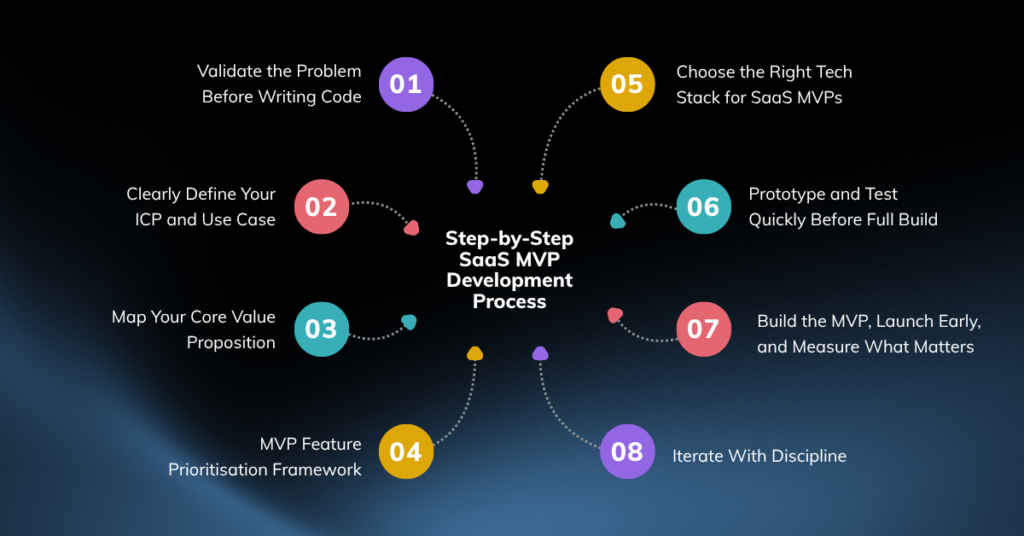
In 2026, SaaS MVP Development works best when you treat your MVP like an experiment, not a smaller version of your final product. You are trying to prove demand, learn fast, and avoid building the wrong thing for months. Many founders fail because there is “no real market need”, so your process must prioritise validation over feature volume.
Below is a practical, step-by-step process you can follow to build the right MVP with less risk and faster learning. The sequence is designed to help you validate the problem, scope the MVP, ship quickly, and iterate with real user feedback.
Step 1: Validate the Problem Before Writing Code
Before you write code, you need proof that the problem is real, painful, and worth paying to solve. A strong MVP starts with user conversations that uncover workflows, frustrations, and current workarounds. The goal is to understand the problem first, not to pitch your solution.
What you should do:
- Speak to people who match your ideal customer profile and ask about their current process, what is slow, what is frustrating, and what they already pay for.
- Run a simple demand test (for example, a landing page with clear positioning and an email sign-up) to see if your messaging resonates.
Outcome you want: clear, repeated pain points in users’ own words and early signs of demand before you commit to building.
Step 2: Clearly Define Your ICP and Use Case
In 2026, winning SaaS MVPs are intentionally smaller and sharper. Instead of serving multiple roles and workflows, you focus on one core user, one painful problem, and one measurable outcome. This reduces build time and increases learning speed.
How to keep this simple:
- Write one sentence: “This product helps [specific user] do [specific job] so they can achieve [specific outcome].” (This one-sentence clarity is a scoping anchor that keeps you from drifting.)
Outcome you want: a narrow scope that is easy to build, easy to explain, and easy to validate with real users.
Step 3: Map Your Core Value Proposition
A useful MVP is not “minimal” in experience. It is minimal in scope. Your MVP should deliver the core value you promise and allow you to test whether users will pay for it.
One practical way to keep scope tight is to define three user flows that must work perfectly:
- Sign-up flow (how users start)
- Core value flow (the main action they came for)
- Return loop (what brings them back)
Outcome you want: a clear “happy path” that users can complete end-to-end without friction.
Step 4: MVP Feature Prioritisation Framework
Feature bloat is the fastest way to kill your MVP timeline. The aim of an MVP is to reduce time-to-market and cost by prioritising essential functionality and deferring non-essential work.
A simple test you can apply: if a feature is not necessary for someone to experience the core value, it does not belong in the MVP.
Your output for this step should be:
- A short “Must-have” list that supports the core value flow
- A “Later” list for everything else
Outcome you want: a credible, working product that solves one problem well, not ten problems poorly.
Step 5: Choose the Right Tech Stack for SaaS MVPs
Your MVP should move fast today without creating a trap for tomorrow. In 2026, many teams think “backend-first” because clean data models and clear APIs make iteration and integrations easier later.
You do not need to over-architect, but you do need a foundation that can evolve. The best stack is often the one that helps you ship quickly, measure behaviour, and iterate without rework.
Outcome you want: an MVP that is easy to change, instrument, and extend after you learn what users actually want.
Step 6: Prototype and Test Quickly Before Full Build
Rapid prototyping and early testing help you catch usability problems before you invest heavily in development. Many practical SaaS MVP guides include prototyping and user testing as a core step before building the MVP fully.
How you benefit:
- You reduce wasted engineering on flows users find confusing
- You get faster feedback on positioning and UX
Outcome you want: confidence that users understand your product and can reach the “aha moment” quickly.
Step 7: Build the MVP, Launch Early, and Measure What Matters
SaaS MVP Development is iterative. The goal is to get the MVP into users’ hands, gather feedback, and improve based on real-world data. Practical guides consistently frame MVPs as a loop: build, launch, measure, learn.
When you launch, focus on signals that show real value and real intent. Your early job is to learn what works and what does not, then iterate.
Outcome you want: a reliable feedback loop that turns assumptions into evidence, and evidence into a roadmap.
Step 8: Iterate With Discipline
In 2026, the MVP mindset is shifting toward “smaller MVPs with sharper focus” and faster validation before more development. That means you should iterate based on what users do, not what you hope they will do.
One internal theme that also aligns with your content direction is accelerating MVP development while still protecting scalability, which is a priority raised in your team discussion.
Outcome you want: each iteration improves a measurable outcome (activation, retention, willingness to pay), not just adds more features.
Common SaaS MVP Development Mistakes to Avoid
In 2026, most SaaS MVP failures come from how decisions are made, not from how code is written. SaaS MVP Development breaks down when assumptions replace evidence and shortcuts replace strategy. Avoiding the following mistakes will significantly improve your chances of building an MVP that leads to real traction.
Designing for Assumed Users Instead of Real Buyer Signals
A common mistake is shaping your MVP around who you believe the user is, rather than who has demonstrated real pain. Internal assumptions, past experiences, or opinions from your team do not equal validation. When your MVP is built for assumed users, adoption drops quickly because the product does not reflect real workflows or urgency.
Treating MVP Engineering as Disposable Work
Many teams label MVP code as “temporary” and ignore structure entirely. This creates fragile systems that slow every future iteration. SaaS MVP Development should aim for minimal scope, not minimal engineering discipline. In 2026, MVPs are expected to evolve, not be rebuilt from scratch every few months.
Choosing Speed Tools That Limit Future Growth
No‑code and low‑code platforms can accelerate early experiments, but they often hide serious constraints. Performance limitations, poor extensibility, and platform lock‑in tend to surface only after users arrive. If your MVP cannot grow with traction, you may be forced into an expensive rebuild at exactly the wrong time.
Deferring Scalability Decisions Until After Traction
Ignoring scalability early does not save time. It shifts risk. This does not mean building enterprise architecture upfront, but it does mean making thoughtful choices around data structure, authentication, and integrations. SaaS MVP Development requires a balance between speed today and flexibility tomorrow.
Relying on Friendly Validation Instead of Unbiased Feedback
Feedback from friends, colleagues, or existing connections is polite by nature. It rarely exposes real objections. True validation happens when people who do not know you choose to use, ignore, or abandon your product. If your MVP only succeeds within your network, it is not validated.
Building More Features Instead of Faster Learning
Overbuilding is not just adding features. It is delaying insight. Every extra feature added before validation increases cost and slows feedback. Your MVP exists to answer a few critical questions quickly: Do users care? Do they return? Are they willing to pay? If it cannot answer these, it is too big.
SaaS MVP Development Cost in 2026
Understanding the cost of SaaS MVP development in 2026 is not about finding a single number. It is about knowing what drives cost, where founders overspend, and how to invest just enough to validate your product without draining your runway. The biggest cost mistakes happen when teams either underbuild for speed or overbuild for perfection.
What Determines the Cost of a SaaS MVP?
Several factors directly influence how much you will spend on your SaaS MVP:
- Problem complexity
A single, well‑defined workflow costs far less than a product covering multiple user roles or integrations.
- Feature scope
More features mean more design, development, and testing effort. A focused MVP is dramatically cheaper than a feature‑rich one.
- Technology choices
Your stack, hosting model, and use of third‑party tools impact both build cost and future scalability.
- Team structure
In‑house teams, freelancers, or experienced MVP development partners all come with different cost profiles and risk levels.
- AI or automation requirements
Adding AI increases scope, testing needs, and operating costs, even at the MVP stage.
Typical SaaS MVP Cost Ranges in 2026
While costs vary by region and team, most SaaS MVPs today fall into these practical ranges:
- Simple SaaS MVP
Core user flow, basic backend, minimal integrations.
Lower cost, fastest validation.
- Standard SaaS MVP
Multi‑step workflows, dashboards, analytics, and basic integrations.
Balanced cost with stronger learning signals.
- AI‑enabled or data‑heavy SaaS MVP
Intelligent workflows, automation, or data processing from day one.
Higher cost, higher validation risk if not tightly scoped.
The mistake is not choosing the wrong range. The mistake is building at the highest cost tier before proving demand.
How to Control SaaS MVP Costs Without Losing Speed
You can keep MVP costs under control by:
- Limiting the MVP to one user and one core outcome
- Deferring non‑essential features, not cutting core quality
- Choosing tools that support iteration, not just launch speed
- Measuring learning speed, not feature delivery
When done right, SaaS MVP Development becomes a strategic investment, not an expense. You spend deliberately to answer critical questions early, so you do not pay much bigger costs later.
How to Choose the Right SaaS MVP Development Partner
A typical SaaS Development Company builds what you ask for. The right SaaS MVP Development partner helps you decide what is worth building in the first place.
Ask These 5 Questions Before You Sign Any SaaS MVP Development Partner
- Do they run a discovery phase before quoting cost or timeline?
- Can they show real SaaS MVP outcomes, not just testimonials?
- How do they prevent scope creep while still enabling learning?
- What does their average SaaS MVP timeline look like, and why?
- Do they understand your industry context?
Red Flags You Should Not Ignore
- Fixed‑price quotes without discovery
- Immediate coding without assumption checks
- No analytics or feedback loop plan
- No ownership beyond launch
These signals often lead to overbuilt MVPs, delayed launches, or forced rebuilds.
Why Enlight Lab Is the Best Fit for Developing Your SaaS MVP
Enlight Lab starts every SaaS MVP engagement with a structured 1–2 week discovery sprint before long‑term commitments. This phase exists to replace assumptions with clarity.
You get:
- A clearly defined MVP scope focused on validation
- Validated users and problem statements
- A tech stack chosen for speed and scalability
- A realistic cost and timeline grounded in evidence
If you are looking for a SaaS Development Company that combines product strategy, disciplined engineering, and outcome‑driven execution, Enlight Lab is a strong choice for SaaS MVP development. Get in touch with us today and build your MVP that validates faster, scales smarter, and avoids costly rework.