
Native vs cross-platform app development is one of the most important decisions you will make when building a mobile application in 2026. Native development means creating separate apps for iOS and Android using platform-specific technologies, while cross-platform development uses a single codebase to run on multiple platforms.
Choosing between these two approaches directly impacts your app’s performance, development cost, launch timeline, and long-term scalability. Get it right, and you can build faster while delivering a great user experience. Get it wrong, and you may face delays, higher costs, or technical limitations as your app grows.
In 2026, this decision has become even more nuanced. The gap between native and cross-platform development is narrowing due to advancements in frameworks like Flutter and React Native.
This guide will help you make that decision using a clear, practical framework based on your app’s capabilities, performance needs, and growth goals.
Native vs Cross Platform App Development: Core Definitions
Before you compare performance, cost, or timelines, you need a clear understanding of what each approach actually means. At its core, Native vs Cross Platform app development is about how your app is built, how it runs, and how efficiently it can scale across platforms.
Let’s break both approaches down in simple, practical terms.
What is Native App Development?
Native app development means building a mobile application specifically for a single operating system, either iOS or Android.
- iOS apps are built using Swift or Objective-C
- Android apps are built using Kotlin or Java
- Each platform has its own tools, such as Xcode for iOS and Android Studio for Android
Because native apps are designed for one platform, they can directly interact with the operating system and device hardware without any intermediary layer.
Key Characteristics of Native Development:
- Built for a single platform (iOS or Android)
- Full access to device features like camera, GPS, and sensors
- Uses platform-specific SDKs and APIs
- Delivers high performance and responsiveness
Why Native Apps Stand Out:
Native apps are highly optimised for their environment. This allows them to offer:
- Smooth animations and faster performance
- Platform-specific UI/UX that feels natural to users
- Strong integration with device-level features
This is why native development is often the preferred choice for high-performance apps such as gaming, AR/VR, and real-time applications.
What is Cross-Platform App Development?
Cross-platform app development takes a different approach. Instead of building separate apps for each platform, developers create a single codebase that runs on both iOS and Android.
This is possible using modern frameworks like:
- Flutter
- React Native
- .NET MAUI / Kotlin Multiplatform
These frameworks allow developers to write code once and deploy it across multiple platforms, significantly reducing development effort.
Key Characteristics of Cross-Platform Development:
- One codebase for multiple platforms
- Shared business logic across devices
- Faster development cycles
- Uses frameworks that bridge native capabilities
Why Cross-Platform is Popular:
Cross-platform development has evolved significantly in recent years. Today, it offers:
- Faster time-to-market
- Lower development and maintenance cost
- Consistent user experience across platforms
In fact, modern cross-platform frameworks now provide near-native performance for most business applications, making them a practical choice for many products.
Understanding these core definitions sets the foundation for making the right decision. In the next sections, we will break down the real-world differences, trade-offs, and decision criteria to help you choose the right approach for your app.
Pros and Cons of Native App Development
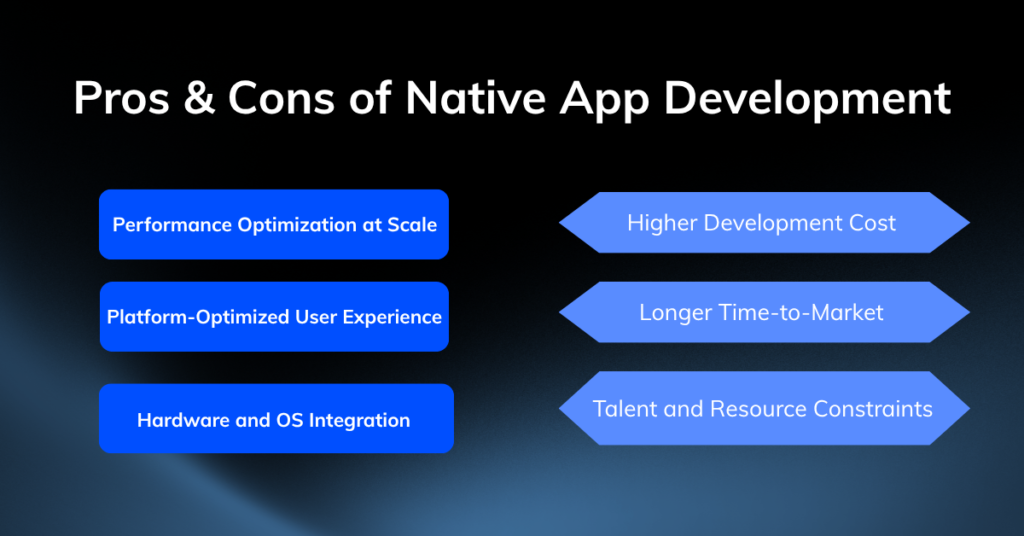
When you evaluate Native vs Cross Platform app development, native development stands out for its ability to deliver premium performance and deep system-level capabilities. But this advantage comes with clear cost and operational implications. Below is a refined, decision-oriented breakdown that goes beyond generic pros and cons.
Benefits of Native App Development
Performance Optimisation at the System Level
Native apps are compiled directly into platform-specific machine code and interact with the operating system without any abstraction layer. This eliminates runtime overhead, reduces latency, and ensures efficient memory and CPU utilisation.
As a result, native apps maintain consistent frame rates, faster response times, and reliable execution under heavy workloads, which is critical for applications involving real-time processing or complex computations.
Platform-Optimised User Experience
Native development allows teams to fully leverage platform-specific design systems such as Apple’s Human Interface Guidelines and Android’s Material Design. This goes beyond visual consistency. It ensures that gestures, transitions, navigation patterns, and system behaviours align precisely with user expectations.
The outcome is a highly intuitive and frictionless experience, which directly impacts user retention and engagement.
Deep Hardware and OS Integration
Native apps access device capabilities through official SDKs, enabling direct use of system-level features such as biometrics, camera processing pipelines, GPS, background services, and sensors. This direct integration avoids dependency on intermediary plugins and ensures real-time capability execution without compatibility delays or limitations.
Drawbacks of Native App Development
Higher Development Cost
Native development requires separate codebases for each platform, which directly increases development effort. This translates into higher costs for engineering resources, testing, and infrastructure. Over time, maintaining independent codebases continues to add to total cost of ownership, especially as features evolve.
Longer Time-to-Market
Because each platform requires independent development, feature implementation, testing, and deployment must be executed twice. This slows down iteration cycles and makes it difficult to respond quickly to market feedback. For businesses that rely on fast experimentation or rapid MVP launches, this can be a significant constraint.
Talent and Resource Constraints
Native development demands platform-specific expertise, requiring organisations to hire and manage separate iOS and Android teams. This increases dependency on specialised talent pools, which can be more expensive and harder to scale, especially for startups or mid-sized companies.
Pros and Cons of Cross-Platform App Development
In the debate of Native vs Cross Platform app development, cross-platform development has evolved from a cost-saving shortcut into a strategic, scalable choice for modern products.
Below is a refined, authority-driven breakdown to help you assess its real-world impact.
Benefits of Cross-Platform App Development
Unified Codebase Driving Cost Efficiency
Cross-platform development allows teams to maintain a single codebase across iOS and Android, reducing duplication across development, testing, and deployment. This directly lowers engineering overhead and minimises long-term maintenance costs. Industry reports and agency estimates suggest cross-platform development can reduce costs by around 30–40% compared to maintaining separate native codebases.
Accelerated Development and Faster Time-to-Market
With one codebase powering multiple platforms, development cycles are significantly shorter. Teams can build features once and deploy them everywhere, reducing iteration time and enabling faster releases. This often results in substantially quicker go-to-market timelines, which is critical for validating ideas, launching MVPs, or responding to competitive market conditions.
Consistent User Experience Across Platforms
Cross-platform frameworks like Flutter and React Native provide standardised UI components and rendering mechanisms. This helps maintain design consistency across iOS and Android environments. For many business applications, this ensures a predictable and uniform user experience, which is particularly valuable when brand consistency is a priority.
Drawbacks of Cross-Platform App Development
Performance Trade-Offs in High-Intensity Use Cases
Although modern frameworks offer near-native performance, cross-platform apps still rely on abstraction layers or rendering engines. This can introduce latency in complex scenarios such as real-time processing, heavy animations, or graphics-intensive applications. As a result, cross-platform development may struggle to match native performance in high-demand environments.
Limited Access to Advanced Native Features
Cross-platform apps access device capabilities through plugins or bridges. While this covers most standard features, there can be delays in supporting newly released platform functionalities. For advanced or cutting-edge requirements, teams may need to write custom native modules, which adds complexity and reduces the benefits of a unified codebase.
Which should you pick?
Pick cross platform if you:
- Need iOS + Android quickly
- Have a small team
- Are building an MVP or business app first
Pick native if you:
- Need AR/VR, heavy graphics, real-time processing, or deep device integration
- Must adopt newest OS features immediately
- Expect complex platform-specific UX
The Detailed Comparison Between Native and Cross-Platform App Development
| Factor | Native App Development | Cross-Platform App Development |
| Performance | Highest performance with direct OS interaction | Near-native performance for most apps (95–98%) |
| Development Cost | High cost due to separate codebases for iOS and Android | Lower cost due to single shared codebase |
| Development Time | Slower, requires building apps separately | Faster, single codebase accelerates delivery |
| Time-to-Market | Longer launch cycles | Up to ~50% faster launches |
| UI/UX Experience | Fully native, highly responsive and platform-specific | Consistent UI across platforms, but may feel slightly less native |
| Maintenance Effort | Complex (two apps, two teams, separate updates) | Easier maintenance with one codebase |
| Scalability | Highly scalable for complex, performance-intensive apps | Scalable for most apps, may have limits in complex scenarios |
| Access to Device Features | Full access to hardware (camera, sensors, GPS, etc.) | Access via plugins; may lag for advanced features |
| Security | Stronger due to platform-level integrations | Good, but depends on framework and third-party libraries |
| Flexibility | Highly flexible for platform-specific innovations | Limited flexibility for cutting-edge features |
| Developer Availability | Requires specialised iOS and Android developers | Larger unified talent pool (JS, Flutter developers) |
Performance
Native app development delivers the highest level of performance because it interacts directly with the operating system and hardware, enabling smoother animations, faster execution, and better handling of complex workloads. In contrast, cross-platform apps have improved significantly and now deliver near-native performance for most standard applications.
Final Verdict: If your app depends on real-time processing, graphics rendering, or heavy computation, native is the clear choice. For most business apps, cross-platform performance is more than sufficient.
Development Speed
Native development requires building separate applications for each platform, which increases development time and slows down iteration cycles. Cross-platform development allows teams to build once and deploy across platforms, significantly reducing delivery timelines and enabling faster updates.
Final Verdict: If speed-to-market is critical, cross-platform clearly wins by enabling faster builds and quicker iterations.
Development Cost
Native development involves higher costs due to separate teams, codebases, and testing processes. Cross-platform development reduces these costs by consolidating development efforts into a single shared codebase, optimising both upfront and ongoing investment.
Final Verdict: For budget-conscious projects or startups, cross-platform is the more cost-effective option. Native is justified only when performance or specialised functionality demands it.
User Experience (UI/UX)
Native apps deliver a platform-perfect experience by fully adhering to OS-specific design guidelines and behaviours. Cross-platform apps provide a consistent interface across platforms but may not always replicate subtle platform-specific interactions perfectly.
Final Verdict: If your product depends heavily on delivering a premium, platform-specific user experience, native is the better choice. Otherwise, cross-platform delivers strong and consistent UX for most use cases.
Scalability
Native development offers greater flexibility when scaling complex systems or adding advanced features. Cross-platform solutions scale well for most business applications but may require additional effort when dealing with highly complex or performance-intensive functionalities.
Final Verdict: For highly complex, large-scale systems, native provides better control. For most scalable business applications, cross-platform is sufficient and more efficient.
AI Integration and On-Device Intelligence
Native app development provides direct access to platform-level AI capabilities such as on-device ML frameworks, hardware acceleration, and system-level AI APIs. This enables faster inference, real-time processing, and better performance for AI-driven features like recommendations, voice recognition, or image processing.
Cross-platform development supports AI integration through third-party libraries and APIs, but may rely on abstraction layers or plugins, which can introduce latency or limit access to the latest platform-specific AI capabilities.
Final Verdict: If your app heavily relies on real-time AI processing, on-device intelligence, or advanced ML capabilities, native development is the superior choice. For apps using cloud-based AI or standard integrations, cross-platform is sufficient and more efficient.
When Native App Development Makes Sense
Native is the right choice when your product depends heavily on performance, precision, and deep system capabilities.
Common Native Use Cases:
- Gaming Apps (3D, high graphics)
→ Require high frame rates, GPU control, and real-time rendering
- AR/VR Applications
→ Need direct access to sensors, camera pipelines, and rendering engines
- Fintech & Banking Apps
→ Require advanced security, biometric integration, and real-time transactions
- Healthcare & IoT Apps
→ Depend on hardware integration, sensors, and device-level data
These apps demand maximum performance, security, and hardware control, where even small delays or limitations can impact user experience or outcomes.
When Cross-Platform App Development Works Best
Cross-platform is ideal when your goal is speed, scalability, and multi-platform reach.
Common Cross-Platform Use Cases:
- E-commerce Apps
→ Focus on reach, consistent UI, and rapid feature updates
- SaaS & Business Applications
→ Dashboard apps, internal tools, CRM platforms
- Social Media & Content Apps
→ Need to scale fast across platforms with frequent updates
- Startup MVPs
→ Prioritise quick launch, validation, and cost efficiency
These apps benefit from faster development, shared codebase, and easier maintenance, making cross-platform a practical solution for most business needs.
Choose Smart Today to Scale Better Tomorrow
The choice between native and cross-platform comes down to a simple rule:
- If your priority is speed, cost, and rapid launch → choose cross platform
- If your priority is performance, capability depth, and long-term control → choose native
There is no one-size-fits-all answer, only the approach that best fits your product, users, and growth strategy.
Need a clear direction based on your mobile app’s requirements? Talk to Enlight Lab team, share your must-have features and timeline, and get a clear, no-fluff recommendation for your product.