Customer expectations have shifted dramatically over the last few years. Buyers no longer want to wait on hold for 45 minutes to update a shipping address, nor do they want to navigate clunky, rigid phone menus that fail to understand simple requests. They expect immediate, accurate, and helpful responses at any time of day. Meeting this demand using human agents alone requires massive overhead, leaving business leaders searching for a more scalable solution.
This operational pressure is exactly why conversational AI has transitioned from experimental technology into an essential business utility. Modern AI systems have moved far beyond scripted chatbots that simply deflect customer queries. Today’s AI agents understand context, detect human sentiment, and autonomously execute complex workflows like booking appointments or processing refunds.
For decision-makers, implementing the right software is a critical strategy for protecting profit margins while elevating the customer experience. But evaluating the crowded software market requires filtering through endless marketing claims to find a tool that actually fits your technical capabilities and business goals.
This guide breaks down the core benefits of conversational AI technology and provides an in-depth review of the top seven platforms dominating the enterprise market in 2026. You will learn exactly what makes each platform unique, so you can make a confident, data-backed decision for your organization.
What Is a Conversational AI Platform And How Does It Work?
A conversational AI platform is a software application that uses natural language processing (NLP) and large language models (LLMs) to understand, process, and respond to human language in real time. Unlike traditional rule-based chatbots that force users down a predetermined path of multiple-choice questions, conversational AI interprets the intent and context behind a user’s words.
When a customer speaks or types a query, the conversational AI platform transcribes the input, analyzes the underlying meaning, retrieves relevant data from integrated business systems like a CRM, and generates a natural-sounding response. Because these platforms continuously learn from past interactions, their accuracy and conversational fluidity improve over time. Businesses deploy these platforms across various communication channels, including phone lines, website chat widgets, SMS text messaging, and social media platforms.
What Are the Key Business Benefits Of Conversational AI?
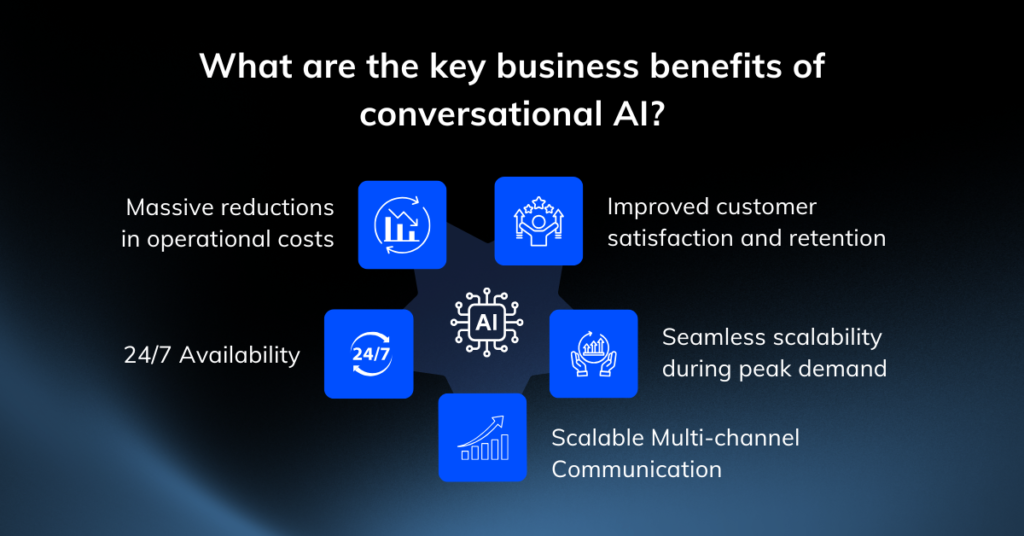
Deploying a conversational AI platform directly impacts both the bottom line and overall customer satisfaction. The financial and operational advantages are significant for organizations willing to modernize their communication stacks.
Massive reductions in operational costs
According to industry research, conversational AI implementations could reduce contact center labor costs by roughly $80 billion globally by 2026 [Gartner, 2022]. By automating routine inquiries like password resets, order tracking, and basic troubleshooting, businesses can dramatically reduce their cost per interaction. This automation allows you to maintain a leaner support team or reallocate human agents to high-value tasks that require genuine human empathy.
Improved customer satisfaction and retention
Speed is a primary driver of customer loyalty. Research indicates that 82% of customers actually prefer interacting with an AI chatbot over waiting in a queue for a human representative [Tidio, 2024]. Conversational AI provides instant answers, eliminating hold times entirely. Because these systems operate 24 hours a day, businesses can offer premium support to customers across different time zones without paying for overnight staffing.
Seamless scalability during peak demand
Call volumes fluctuate wildly based on seasonality, marketing campaigns, or unexpected service outages. Traditional call centers struggle to scale quickly, leading to overwhelmed agents and frustrated callers. Conversational AI platforms handle thousands of concurrent interactions simultaneously without any degradation in service quality. If your company launches a highly successful promotion, the AI system absorbs the sudden influx of inquiries effortlessly.
24/7 availability
Conversational AI platforms operate around the clock, ensuring customers always have access to support, regardless of time zones or business hours. This constant availability improves customer satisfaction and loyalty as users can resolve issues or obtain information anytime without delay.
Scalable multi-channel communication
Modern conversational AI can communicate with customers on their preferred channels, including voice, SMS, and web chat. This flexibility allows businesses to maintain a consistent brand voice and provide a seamless customer experience across all touchpoints, which is crucial for building trust and loyalty.
7 Best Conversational AI Platforms In 2026
The software landscape features a mix of voice-first solutions, omnichannel contact center platforms, and developer-focused APIs. Here is an in-depth look at the seven best conversational AI platforms available for businesses right now.
1. Dialogflow CX
Dialogflow CX is a robust conversational AI platform developed by Google, designed for building advanced virtual agents and chatbots. With its intuitive visual flow builder, it allows developers to create complex, multi-turn conversational experiences. It integrates seamlessly into the Google Cloud ecosystem, providing advanced natural language understanding for engineering teams.
- Features: Dialogflow CX features a state-of-the-art visual flow editor that simplifies the design of conversation logic. It supports multi-platform integration, advanced natural language understanding (NLU), and dynamic routing for seamless user experiences. The platform also provides real-time analytics and integration with Google Cloud services for enhanced performance and security.
- Use Cases: Retail companies use Dialogflow CX to build virtual shopping assistants that provide personalized recommendations. Customer support teams rely on it to automate frequent inquiries and reduce response times. Additionally, healthcare providers deploy it for patient engagement and appointment scheduling.
- Pros: Dialogflow CX excels in its ability to handle complex conversational flows with high precision and flexibility. Its integration with the Google Cloud ecosystem enhances scalability, security, and access to innovative AI tools. The visual flow editor makes it accessible to both developers and non-technical users.
- Cons: While powerful, Dialogflow CX may involve a steep learning curve for beginners unfamiliar with designing complicated flows. Costs can escalate quickly with high messaging volumes, making it less suitable for small-scale projects with limited budgets.
- Best For: Enterprise AI bots
2. Yellow.ai
Yellow.ai stands out for its “Agentic AI” approach, which allows the AI to autonomously execute complex, multi-step workflows across various enterprise systems.
- Features: Yellow.ai provides a visual flow builder, broad channel coverage, and over 100 out-of-the-box integrations with enterprise resource planning (ERP) systems and HR software.
- Use Cases: Large retail brands use Yellow.ai to completely automate return processing, while HR departments use the platform to guide employees through complex onboarding paperwork.
- Pros: Yellow.ai effectively bridges customer experience (CX) and employee experience (EX). The platform’s ability to pull and push data across disparate enterprise tools is highly reliable.
- Cons: Yellow.ai utilizes a complex pricing model that scales aggressively as interaction volume grows. Teams must overcome a moderate learning curve to fully utilize the platform’s automation capabilities.
- Best For: Enterprise-grade conversational AI with omnichannel support
3. Kore.ai
Kore.ai is an all-in-one conversational AI platform known for strict security governance and a highly flexible, no-code dialog builder.
- Features: Kore.ai offers omnichannel support, pre-built AI agents for specific industries, internal team assistants for Slack and Microsoft Teams, and enterprise-grade security protocols.
- Use Cases: Financial institutions and government agencies rely on Kore.ai for highly secure customer interactions. IT departments use the platform to deflect internal support tickets.
- Pros: Kore.ai provides exceptional data governance and role-based access controls. The platform easily manages both external customer inquiries and internal employee requests.
- Cons: Kore.ai’s extensive feature set can cause the interface to feel sluggish when managing particularly large, complex AI models.
- Best For: Complex enterprise workflows
4. IBM watsonx Assistant / Orchestrate
IBM watsonx Assistant is an enterprise-grade conversational AI platform designed to create AI-powered virtual assistants and streamline workflows intelligently. With its advanced natural language understanding (NLU) and integration capabilities, it focuses on providing more accurate and contextual responses to users.
- Features: Supports multiple language models with customization options, strong integration capabilities with third-party applications, and pre-built content libraries to accelerate development. It also includes advanced tools for intent recognition and conversational flow design.
- Use Cases: Ideal for customer service automation, HR support, IT service management, and financial services. It’s frequently used in industries requiring compliance and regulatory adherence due to its data security features.
- Pros: Offers robust AI features tailored for enterprise environments, including tools for secure data handling. The interface allows for flexibility and scalability. Additionally, IBM provides strong support for integration with existing systems and workflows.
- Cons: Setup and customization might require expert knowledge, making it less accessible for smaller teams or businesses. Licensing and implementation costs can also present concerns for budget-conscious organizations.
- Best For: Large enterprises in regulated industries
5. Retell AI
Retell AI specializes in voice-led conversational AI, providing businesses with AI voice agents that handle sophisticated phone interactions. The platform combines a strong telephony infrastructure with natural language understanding to power seamless inbound and outbound calls.
- Features: Retell AI includes a visual agent builder, automated knowledge base synchronization, and robust call controls like warm transfers and branded caller ID. The platform is SOC 2, HIPAA, and GDPR compliant, making it highly secure.
- Use Cases: Healthcare organizations use Retell AI for patient scheduling, while financial services leverage the platform for secure account inquiries. It is heavily utilized for large-scale outbound sales campaigns.
- Pros: Retell AI delivers production-ready voice agents that sound remarkably human. The robust security certifications make it a safe choice for regulated industries.
- Cons: Retell AI is primarily focused on voice interactions. Organizations looking for an equal emphasis on web chat or social media messaging will find the platform’s non-voice features lacking.
- Best For: Building real-time conversational voice AI applications
6. Synthflow AI
Synthflow AI offers a no-code conversational AI environment designed specifically for small to medium-sized businesses and marketing agencies. The platform makes it easy to launch AI receptionists without writing a single line of code.
- Features: Synthflow AI features a drag-and-drop call flow editor, direct integrations with popular CRMs like HubSpot and Salesforce, multi-language support, and white-labeling capabilities for agencies.
- Use Cases: SMBs deploy Synthflow AI to manage inbound appointment scheduling and handle after-hours inquiries. E-commerce brands use the platform to automate order tracking and post-purchase support.
- Pros: The purely no-code interface allows non-technical founders and marketing teams to build and deploy AI agents in hours. The white-labeling feature is highly lucrative for agencies selling AI services to clients.
- Cons: Synthflow AI struggles slightly with off-topic customer questions, requiring careful prompt engineering to keep the AI on track. Customer support response times can occasionally be slow during peak hours.
- Best For: No-code voice AI workflows and call automation
7. Bland AI
Bland AI targets developer-heavy teams that need extreme customization and granular control over their voice AI architecture. It operates as an API-first platform built for massive enterprise scale.
- Features: Bland AI provides a programmable Voice API, live context integration, webhooks, and the ability to inject live data directly into ongoing phone conversations.
- Use Cases: Enterprise engineering teams use Bland AI to build highly customized voice applications, such as dynamic AI dispatchers for logistics companies or automated survey systems that process thousands of calls per minute.
- Pros: Bland AI offers ultra-low latency, making conversations feel incredibly realistic. The platform easily handles massive concurrent call volumes without crashing or lagging.
- Cons: Bland AI requires a dedicated software engineering team to implement and maintain. The pricing model includes extra fees for transcriptions and specialized voice cloning, which can make monthly costs difficult to predict.
- Best For: AI-powered voice agents and outbound calling automation
How To Choose the Best Conversational AI Platform
Selecting the right AI platform requires matching your internal technical resources with your primary customer communication channels. Review these conditional recommendations to guide your procurement strategy.
- Choose IBM watsonx Assistant / Orchestrate if you are a large enterprise that needs to automate complex business processes and connect to a wide range of backend systems and legacy applications.
- Choose Dialogflow CX if your organization is already heavily invested in the Google Cloud ecosystem and you need to build advanced, multi-turn conversational experiences.
- Choose Retell AI if your organization primarily relies on phone interactions and you require strict regulatory compliance (HIPAA/SOC 2).
- Choose Synthflow AI if you are a marketing agency or an SMB with limited technical resources looking to deploy a voice agent rapidly.
- Choose Bland AI if you have an in-house engineering team and need to build highly customized, ultra-low latency voice applications at scale.
- Choose Yellow.ai if you need an AI agent capable of executing complex back-office workflows, like processing returns or updating inventory systems.
- Choose Kore.ai if your organization prioritizes strict data governance and wants a single platform to handle both customer support and internal IT requests.
What Is the Future Outlook For Conversational AI Technology?
The conversational AI market is projected to reach $41.39 billion by 2030, growing at an impressive compound annual growth rate (CAGR) of 23.7%. As the underlying large language models become faster and more accurate, businesses will shift away from reactive chatbots toward proactive, agentic AI.
Agentic AI represents a major shift in how businesses use software. Instead of waiting for a user to ask a question, an agentic AI system monitors business data and takes autonomous action. For example, a future conversational AI platform might notice a delayed shipping route, proactively call the affected customer, apologize for the delay, and automatically process a partial refund without any human intervention. Furthermore, multimodal capabilities will allow AI platforms to process text, voice, and live video simultaneously, creating entirely new avenues for customer support and sales.
Elevate Your Customer Experience with the Right Conversational AI Platform
Adopting conversational AI is no longer a futuristic experiment for massive tech companies. It is a practical, necessary step for any business looking to reduce operational costs, eliminate customer wait times, and remain competitive in a digital-first economy. By carefully evaluating your technical constraints, your primary communication channels, and your specific use cases, you can select a platform that drives immediate ROI.
Start by auditing your current customer service data. Identify the top five most common questions your agents handle daily, and book a demonstration with one of the platforms listed above to see exactly how their AI handles those specific inquiries.
If you’re unsure where to begin, schedule a discovery call with Enlight Lab. We’ll help you assess your workflows, identify high-impact automation opportunities, and design an AI implementation roadmap tailored to your business.