
As a founder or technology leader, you face a massive data bottleneck. Your company collects millions of data points every week, but turning that raw information into actionable business intelligence requires specialized engineers, complex queries, and weeks of reporting time. The sheer volume and velocity of modern data leave you struggling to extract meaningful value before the window of opportunity closes.
Generative AI for data analytics is fundamentally shifting how you interact with your data. Rather than relying solely on traditional predictive models and manual dashboards, you can use large language models to converse directly with your databases. According to research from National University, 77% of companies are currently using or exploring AI, and 83% claim it is a top priority in their strategic plans.
By reading this guide, you will understand exactly why generative AI is no longer just a luxury for massive tech enterprises. You will discover how specific generative tools solve persistent analytical bottlenecks, examine real-world use cases across major industries, and learn how to build an implementation strategy that gives your business a distinct competitive advantage.
What is Generative AI for Data Analytics?
Generative AI for data analytics refers to the application of advanced machine learning models, such as large language models and generative adversarial networks, to create, enhance, and analyze data. This type of AI not only aids in processing existing datasets but also generates new, high-quality synthetic data to fill gaps, identify patterns, and make predictive insights more robust. Its ability to automate and augment complex data operations makes it a powerful tool for modern businesses.
Core Concepts:
- Data Augmentation: Generative AI can create synthetic yet realistic data to supplement existing datasets, enhancing modeling and analysis capabilities.
- Anomaly Detection: It automatically identifies irregularities in data, improving the accuracy of patterns and predictions.
- Natural Language Querying: Enables users to generate complex analytics by simply asking questions in natural language, eliminating the need for advanced technical skills.
- Automation of Insights: Streamlines the process of identifying trends, outliers, and correlations in large volumes of data.
- Enhanced Data Cleansing: Facilitates automated correction and reconciliation of inconsistent or incomplete data.
How It Differs from Traditional AI/ML in Analytics
Here’s how augmented analytics differs from traditional AI/ML:
- Skill Level: Augmented analytics is designed for users of all skill levels, while traditional AI/ML typically requires data scientists or other highly skilled professionals.
- Accessibility: It uses automation and natural language processing to make insights accessible to non-technical users. In contrast, traditional methods often involve complex model development, algorithm tuning, and result interpretation.
- Speed: It provides real-time insights and automates repetitive tasks, allowing for faster decision-making compared to the more time-consuming processes of traditional AI/ML.
- Inclusivity: By reducing the need for specialized knowledge, augmented analytics promotes greater inclusivity and agility in data-driven environments.
What Makes This Powerful
Generative AI compresses the entire analytics workflow:
| Traditional workflow | Generative AI workflow |
| Write SQL queries | Ask a question |
| Build dashboards | Auto-generate insights |
| Interpret charts manually | AI explains findings |
| Hours to days | Seconds to minutes |
What Specific Data Analytics Challenges Does Generative AI Solve?
Startup founders and CTOs frequently encounter structural roadblocks when attempting to scale their analytics capabilities. Generative AI directly addresses these deep-rooted operational issues.
The global data talent shortage
- Problem: Finding and retaining skilled data scientists is expensive.
- Solution: Generative AI tools bridge this gap by enabling your business users to run complex queries using plain English. Instead of waiting weeks for a data engineering team to build a custom dashboard, your product managers can ask a generative model for immediate insights.
Siloed information and legacy systems
- Problem: Many organizations, including yours, may store valuable information across disconnected software platforms.
- Solution: Generative AI systems excel at parsing unstructured data from these legacy systems, harmonizing different formats, and creating a unified analytical view without requiring you to perform massive database migrations.
Sluggish reporting and visualization
- Problem: Traditional reporting is a highly manual process. Your analysts spend countless hours cleaning datasets and building charts.
- Solution: Generative AI automates data preparation and instantly generates visualizations, drastically reducing the time it takes for you to move from raw numbers to boardroom-ready presentations.
Inaccessible predictive modeling
- Problem: Building predictive models traditionally requires deep statistical knowledge and extensive coding.
- Solution: Generative AI platforms can automate the model-building process, allowing your teams to forecast customer churn, predict sales trends, or optimize inventory levels without needing a dedicated team of machine learning engineers.
Inconsistent data quality and governance
- Problem: Poor data quality plagues nearly every organization and leads to unreliable analytics.
- Solution: Generative AI can automatically identify anomalies, suggest corrections for inconsistent entries, and even generate synthetic data to fill gaps in your datasets, ensuring your insights are built on a foundation of clean, reliable information.
Key Technologies Driving Generative AI in Data Analytics
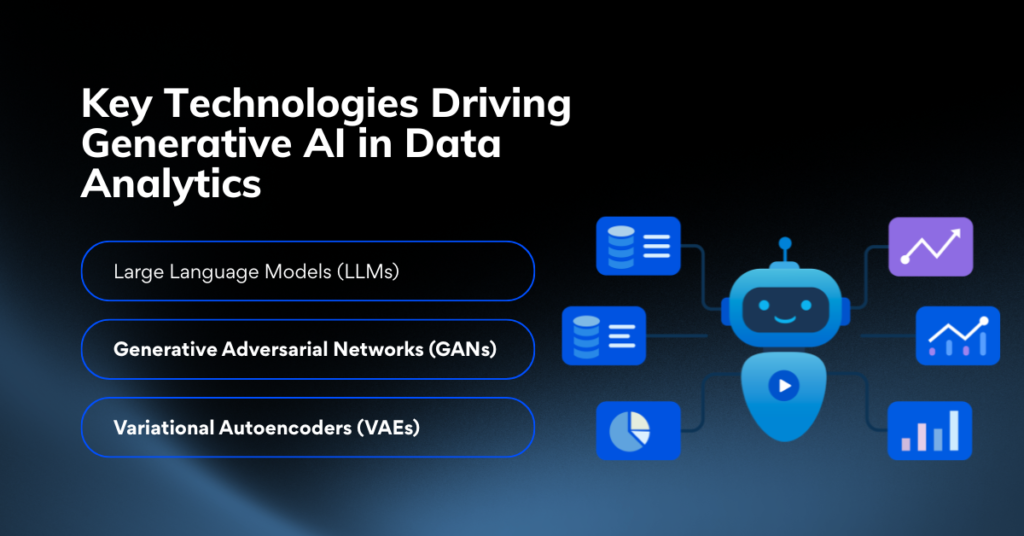
To leverage this technology, it’s helpful to understand the core components that power it. While traditional machine learning focuses on recognizing patterns to make predictions, generative AI takes it a step further by creating net-new content, code, or data structures based on its training. This is made possible by a few key technologies.
Large Language Models (LLMs)
LLMs serve as the translation layer between human intent and complex databases. They process natural language queries and translate them into SQL or Python code to extract specific data. An LLM allows you to type, “Show me the churn rate correlation with our latest pricing update,” and instantly receive accurate analytical outputs.
Benefits of using LLMs include:
- Simplified Data Access: LLMs break down technical barriers, allowing users to query complex databases using everyday language.
- Accelerated Decision-Making: By generating instant insights from natural language queries, LLMs streamline analysis, saving valuable time.
- Enhanced Accessibility: Non-technical team members can contribute to data-driven discussions without prior coding expertise.
- Dynamic Insights: Whether it’s churn rate analysis or performance metrics, LLMs deliver precise outputs tailored to your business needs.
- Scalability: LLMs adapt to growing datasets and evolving queries, ensuring consistent performance as your operations expand.
Generative Adversarial Networks (GANs)
GANs consist of two neural networks competing against each other to create highly realistic synthetic data. Choose GAN technology if privacy regulations restrict your access to real customer profiles. GANs generate statistically accurate, anonymized datasets that data teams can use to train new predictive models without violating user privacy.
Key benefits of using GANs
- Realistic Synthetic Data: Create realistic synthetic data for testing and training machine learning models, reducing dependency on sensitive or private data.
- Enhanced Data Privacy: Enhance data privacy by generating anonymized datasets that mimic real-world characteristics without exposing actual user information.
- Improved Generative Models: Improve generative model quality for applications such as image, video, and text generation, benefiting creative industries and media production.
- Class Balancing Support: Support class balancing by synthesizing underrepresented data, which improves the performance of machine learning models on imbalanced datasets.
- Innovation in Simulations: Enable innovation in simulations, such as virtual environments or gaming, by generating lifelike and diverse scenarios.
Variational Autoencoders (VAEs)
VAEs compress data into a simplified representation and then reconstruct it. Data teams use VAEs to identify anomalies within massive datasets. This technology is highly effective at detecting subtle operational errors or fraudulent activities that standard rules-based systems miss.
- Efficient Anomaly Detection: Enables efficient anomaly detection within large datasets, improving operational accuracy.
- Subtle Pattern Identification: Identifies subtle patterns and errors that might be overlooked by traditional systems.
- Enhanced Fraud Detection: Enhances fraud detection by uncovering irregularities in data.
- Simplified Data Analysis: Simplifies complex datasets into manageable representations for effective analysis.
- Reduced Manual Effort: Reduces manual effort in data inspection, saving time and resources.
Benefits Of Emerging Generative AI In Data Analytics
Implementing generative AI for data analytics offers distinct functional benefits across your entire organization. Here are some of the key advantages:
Automated Data Preparation
Data cleaning typically consumes 70% of an analyst’s time. Generative AI automatically identifies missing values, standardizes formats, and flags outliers, leaving analysts free to focus on strategic interpretation.
Conversational Data Discovery
Democratizing data access means anyone in your company can uncover hidden patterns. Marketing teams can query customer sentiment directly, and sales teams can instantly generate customized pipeline forecasts.
Synthetic Data Generation
Startups often lack the historical data required to train robust machine learning algorithms. Generative AI creates artificial data that mirrors real-world statistical properties, allowing companies to build predictive models from day one.
Prescriptive Decision Support
Generative models do not just tell you what happened; they recommend optimal actions. A generative system can analyze a drop in user engagement and output a step-by-step retention strategy based on historical success metrics.
Why Is 2026 The Tipping Point for Generative AI Adoption?
The current year marks a critical transition period for enterprise technology. AI has moved past the experimental phase and into disciplined, value-driven implementation.
PwC’s 2026 AI Business Predictions report highlights the rise of “agentic workflows.” Organizations are moving away from isolated AI chatbots and toward AI agents that automate multi-step analytical processes. Agentic AI handles demand forecasting and hyper-personalization autonomously.
Furthermore, the technology has reached a level of maturation where ROI is demonstrable. Early adopters are capturing significant market share by reacting to data trends in real time. For CTOs, failing to implement generative AI for data analytics today means fighting a losing battle against competitors who operate with fundamentally faster decision-making capabilities.
How Are Different Industries Using Generative AI For Data Analytics?
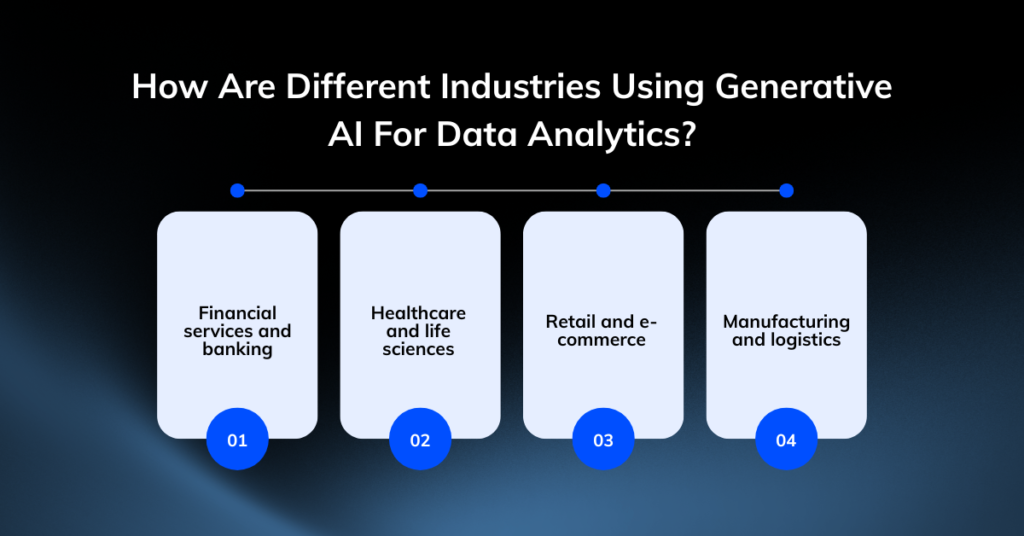
Specific verticals are already proving the transformative power of generative analytical models.
Financial services and banking
Financial institutions process millions of transactions daily. Generative AI tools help analysts detect complex fraud rings by generating synthetic transaction data to train superior anomaly detection systems. Additionally, wealth managers use LLMs to summarize thousands of pages of market research into actionable investment portfolios in seconds.
Healthcare and life sciences
Medical researchers use VAEs and GANs to simulate patient responses to new chemical compounds, accelerating the drug discovery timeline. Hospital administrators also rely on generative AI to analyze unstructured patient notes, predicting readmission risks and personalizing treatment plans.
Retail and e-commerce
Retailers manage volatile supply chains and shifting consumer demands. Generative AI models forecast inventory needs by synthesizing historical sales data with external variables like weather patterns and social media sentiment. This prevents stockouts and reduces warehouse holding costs.
Manufacturing and logistics
Factory operators utilize generative AI to analyze sensor data from production lines. The models predict equipment failures before they happen and recommend proactive maintenance schedules, minimizing costly unplanned downtime.
Main Challenges When Adopting Generative AI for Data Analytics
Technology leaders must navigate specific risks when integrating these advanced models into their analytical workflows.
Data Governance and Security
Feeding proprietary company data into public generative models creates severe security risks. CTOs must implement secure, private cloud environments and strict access controls to protect sensitive intellectual property.
Model Interpretability
Neural networks often operate as “black boxes.” If an AI recommends a massive shift in marketing spend, business leaders need to understand how the model arrived at that conclusion. Choose platforms that provide transparent audit trails for their generated insights.
Integration Bottlenecks
Generative AI must connect seamlessly with your existing data warehouses (like Snowflake or Redshift) and business intelligence tools. Poor integration results in latency and inaccurate outputs.
How Should You Build a Generative AI Strategy for Data Analytics?
Successful implementation requires a structured, phased approach rather than a massive, overnight overhaul.
Assess current capabilities
Evaluate your existing data infrastructure. Generative AI requires clean, accessible data. If your current databases are heavily fragmented, prioritize data consolidation first.
Launch focused pilot programs
Do not attempt to automate every department simultaneously. PwC notes that real results take precision in picking a few spots where AI can deliver wholesale transformation. Start with a high-impact, low-risk use case, such as automating weekly marketing performance reports.
Invest in hybrid talent
The rise of the “AI generalist” changes hiring requirements. Look for professionals who understand your specific business context and possess the skills to prompt, orchestrate, and oversee AI agents effectively.
Foster a data-driven culture
Train your non-technical staff on how to interact with conversational analytics tools. The true ROI of generative AI is realized when every team member uses data to inform their daily decisions.
Your Next Steps with Generative Data Tools
The integration of generative AI for data analytics is an unavoidable evolution in business technology. The ability to instantly generate synthetic datasets, automate tedious data preparation, and converse directly with your business intelligence platforms provides a massive operational advantage.
Startups and established enterprises that implement these agentic workflows in 2026 will strip away operational bloat and accelerate their strategic decision-making. Those who cling to manual reporting will simply move too slowly to compete.
Audit your current reporting bottlenecks today. Identify one critical business question your team struggles to answer quickly, and evaluate how a generative AI tool could reduce that analytical friction.
Are you struggling with data and unable to unlock real value from it fast enough? Start making a strategic conversation with Enlight Lab. We don’t just implement generative AI tools.
We design end-to-end GenAI-powered analytics systems that:
- Connect directly to your data ecosystem
- Understand your business context
- Deliver clear, reliable, decision-ready insights
- Evolve into intelligent agents that guide your strategy
Consult us today to build AI systems that think, analyze, and act with your business in mind.