
Building a mobile application is a high-stakes endeavor for early-stage startups. You are managing tight budgets, strict product launch deadlines, and the constant pressure of competitor technological advancements. According to Business of Apps, more than 90% of users stop using a mobile app within the first 30 days after installation, highlighting the steep drop in early user retention. This staggering abandonment rate proves that simply launching an app is no longer enough to secure market share.
Founders and technical decision-makers must bridge the gap between business vision and software execution to survive. If your infrastructure cannot handle sudden customer demand, or if technical debt slows down your iterations, users will quickly migrate to competitors. Scaling efficiently requires a roadmap built on sustainable technology and deep market understanding.
Implementing proven mobile app success strategies is the most effective way to protect your investment. By focusing on scalable infrastructure, cost-effective development, and data-driven user experiences, startups can build products that truly resonate. Here are ten actionable strategies to help you dominate the mobile landscape.
What Makes a Mobile App Successful in 2026?
A successful mobile app is built on five core pillars: a validated idea that solves a real problem, an intuitive user experience, strong App Store Optimization (ASO), a data-driven retention strategy, and multi-channel marketing.
With over 4 million apps competing for attention, success no longer comes from being first. It comes from being better at keeping users, converting them into paying customers, and continuously improving based on real feedback.
What’s changed in 2026 specifically? Three things:
- AI has raised the bar on personalization. Users now expect your app to “know” them. Generic, one-size-fits-all experiences feel outdated immediately.
- Privacy frameworks have tightened. Apple’s App Tracking Transparency (ATT) and evolving GDPR rules mean the old paid-acquisition playbook no longer works in isolation.
- Retention is the new acquisition. With rising cost-per-install (CPI) across all platforms, apps that can’t hold users quickly burn through budgets.
The strategies below address all three realities and sequence them in the order that matters most.
Top 10 Proven Strategies to Make Your Mobile App Successful in 2026
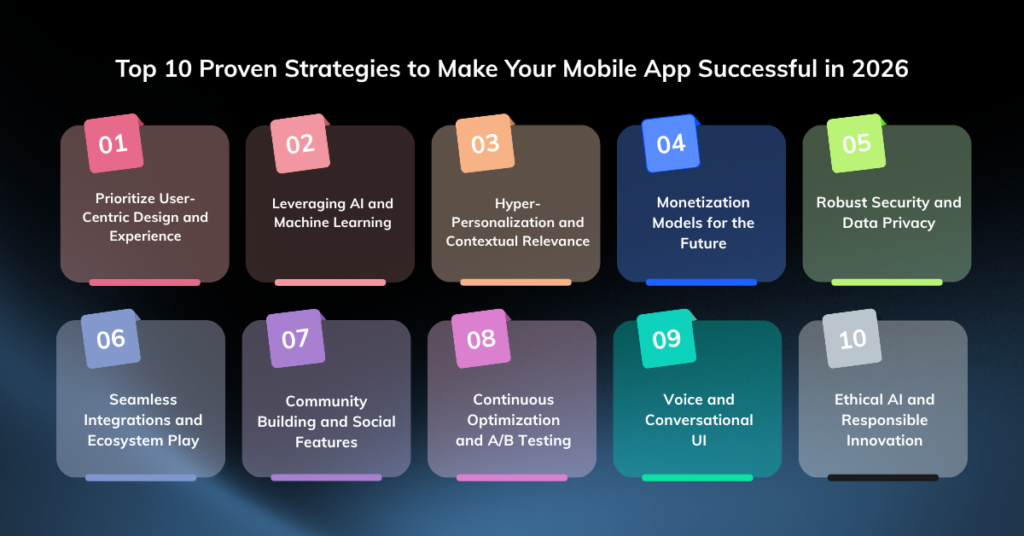
These strategies follow your app’s natural journey from idea to launch to scale. Whether you’re pre-launch or post-launch, each one is independently actionable. Start where you are.
Strategy 1: Prioritize User-Centric Design and Experience
A seamless user interface (UI) and user experience (UX) form the foundation of any profitable application. When non-technical entrepreneurs focus too heavily on feature volume, they often neglect the core user journey, leading to bloated, confusing software.
- The paramount importance of UI and UX
First impressions dictate retention. Users expect fast load times, clear visual hierarchies, and immediate value delivery. If a user struggles to complete their first action, they will abandon the platform. Prioritize clean design systems that guide the user naturally from onboarding to core feature usage.
- Personalization and adaptive interfaces
Modern applications must adapt to the individual. Adaptive interfaces change layout, content, and suggestions based on user behavior and preferences. Provide automated scalability solutions that handle customized data loads efficiently, ensuring that personalization does not negatively impact app performance.
- Minimizing friction and intuitive navigation
Every extra tap reduces your conversion rate. Streamline complex processes like account creation and checkout. Choose single sign-on (SSO) integrations if reducing login friction matters more to your audience than proprietary account management.
Strategy 2: Leveraging AI and Machine Learning
Artificial intelligence is no longer a luxury for enterprise corporations; it is a necessity for early-stage startups aiming to operate efficiently. Enlight Lab integrates AI-powered solutions to help startups automate workflows and understand their audience better.
- Predictive analytics for user behavior
Machine learning models analyze historical data to predict what a user will do next. This capability allows founders to identify churn risks before users leave. You can proactively send targeted interventions, such as a discount code or a helpful tutorial, to re-engage at-risk accounts.
- AI-powered personalization and recommendations
Recommendation engines drive engagement. By analyzing past interactions, AI algorithms serve highly relevant content, products, or connections. This strategy directly increases session length and lifetime value, providing a highly cost-effective way to boost revenue without increasing marketing spend.
- Automation of in-app processes
Automating routine user tasks reduces frustration. Chatbots handle tier-one customer support queries instantly, freeing up your human team for complex problem-solving. This automation directly addresses skill gaps and lowers operational costs.
Strategy 3: Hyper-Personalization and Contextual Relevance
Basic demographic targeting is obsolete. To succeed in mobile app development, applications must deliver hyper-personalized experiences based on real-time context.
- Delivering the right content at the right time
Contextual relevance means understanding a user’s current situation. If a user opens a fitness app at 6:00 AM, the app should instantly present a morning workout routine rather than a generic dashboard. Aligning content with immediate intent drastically improves user satisfaction.
- Geolocation-based features and services
Location data provides powerful context. Retail, delivery, and travel applications use geolocation to trigger relevant push notifications or surface nearby services. Ensure you request location permissions transparently to maintain user trust.
- Understanding user preferences beyond basic demographics
Behavioral data tells a more accurate story than age or gender. Track how users interact with specific features, what times of day they are most active, and which content formats they prefer. Use these data-driven insights to tailor the overall experience.
Strategy 4: Monetization Models for the Future
Traditional banner ads disrupt the user experience and often yield low returns. Startups must implement diversified, value-driven monetization strategies to fund their growth effectively.
- Diversifying revenue beyond traditional ads
Relying solely on advertising limits your revenue potential and alienates users. Explore affiliate partnerships, sponsored content that matches the app’s aesthetic, or transactional fees for facilitated services. Diversification protects your startup from sudden shifts in ad market rates.
- Subscription fatigue and alternative models
Consumers are experiencing subscription fatigue. If your app does not provide continuous, daily value, a monthly fee will cause high churn. Consider usage-based pricing or one-time lifetime unlocks for specific premium tools. Choose a pay-as-you-go model if your users have unpredictable usage patterns.
- In-app purchases, freemium, and value-added services
The freemium model remains highly effective for user acquisition. Offer a robust core product for free, and charge for power-user features. This allows users to experience the application’s value before committing financially, lowering the barrier to entry.
Strategy 5: Robust Security and Data Privacy
With data breaches making daily headlines, consumers are fiercely protective of their personal information. Security is a critical competitive advantage, especially for startups attempting to disrupt established industries.
- Building user trust in an era of data breaches
Transparency builds trust. Clearly communicate what data you collect, why you need it, and how you protect it. A straightforward privacy policy and easily accessible privacy controls reassure users that your startup respects their digital boundaries.
- Compliance with evolving privacy regulations
Adhering to frameworks like GDPR and CCPA is non-negotiable. Non-compliance results in severe financial penalties that can bankrupt an early-stage startup. Enlight Lab helps founders build compliant architectures from day one, avoiding costly technical debt and legal exposure later.
- End-to-end encryption and transparent data handling
Secure sensitive communications and transactions with end-to-end encryption. Implement regular security audits and vulnerability scanning. Proving that your infrastructure is secure is essential when targeting enterprise clients or handling financial data.
Strategy 6: Seamless Integrations and Ecosystem Play
No application exists in a vacuum. Users expect your product to play nicely with the software and hardware they already use daily.
- Interoperability with other apps, devices, and platforms
Integrate with health trackers, smart home devices, or popular productivity suites depending on your niche. Interoperability makes your application an indispensable part of the user’s broader digital ecosystem, making it much harder for them to uninstall.
- Building a holistic user experience across touchpoints
Ensure your mobile application syncs flawlessly with your web platform and tablet app. A user should be able to start a task on their phone and finish it on their laptop without losing progress. Cross-platform consistency is vital for professional and utility applications.
- API-first approach for future extensibility
Building an API-first architecture ensures your product can scale easily. This approach allows your development team to quickly add new front-end interfaces or partner integrations without rewriting core backend logic. It is a highly cost-effective method for managing long-term growth.
Strategy 7: Community Building and Social Features
Fostering a sense of belonging transforms passive users into active brand advocates. Community features drive organic growth and lower customer acquisition costs.
- Fostering engagement through in-app communities
Create spaces for users to connect over shared interests or goals. Forums, discussion boards, or specialized groups within your application encourage daily logins. An active community provides significant value that competitors cannot easily replicate.
- Social sharing and collaborative features
Enable users to share their achievements, lists, or creations directly to external social media platforms or with friends inside the app. Collaborative tools, such as shared workspaces or multiplayer challenges, inherently require users to invite others, fueling viral growth.
- User-generated content and feedback loops
User-generated content (UGC) keeps the platform fresh without requiring constant content creation from your team. Additionally, community feedback loops help founders gather data-driven insights directly from their most loyal customers, guiding the product roadmap accurately.
Strategy 8: Continuous Optimization and A/B Testing
Launching your application is just the beginning. Sustained growth requires a commitment to continuous, data-driven refinement.
- Data-driven decision making
Never rely on assumptions. Implement robust analytics tools to track user journeys, feature adoption, and drop-off points. If users consistently abandon the app at the payment screen, data will highlight the exact point of friction.
- Iterative development based on user feedback
Release small, frequent updates rather than massive, infrequent overhauls. This agile methodology allows your technical team to respond rapidly to user feedback and market changes. Iterative development drastically reduces the risk of building features nobody wants.
- The importance of analytics and performance monitoring
Monitor backend performance as closely as frontend behavior. Slow API response times or frequent crashes destroy user trust. Enlight Lab provides performance monitoring solutions that alert founders to infrastructure issues before they impact the end user.
Strategy 9: Voice and Conversational UI
Typing on a glass screen is not always the most efficient way to interact with software. Voice and conversational interfaces are becoming standard expectations for modern applications.
- The rise of voice assistants and natural language processing
Natural Language Processing (NLP) allows your application to understand conversational phrasing. Users can speak naturally to search for products, navigate menus, or input data. This technology significantly speeds up task completion for users on the go.
- Integrating voice commands and conversational interfaces
Integrate with native device assistants like Siri or Google Assistant. Allowing users to trigger app functions via their device’s default voice assistant embeds your application deeper into their daily routines.
- Enhancing accessibility and user convenience
Conversational UI is critical for accessibility. Voice commands enable users with visual or motor impairments to navigate your software effectively. Designing for accessibility expands your total addressable market and aligns with ethical design principles.
Strategy 10: Ethical AI and Responsible Innovation
As startups integrate AI into their products, they must manage the ethical implications of automated decision-making.
- Addressing biases in algorithms
Machine learning models learn from historical data, which often contains human biases. Technical teams must actively test their algorithms to ensure they do not discriminate against specific user groups. Regular audits help maintain fairness in automated recommendations and approvals.
- Transparency in AI decision-making
When AI makes a significant decision—such as rejecting an application or curating a news feed—provide users with context. Explain briefly why the algorithm made its choice. Transparency prevents user frustration and builds credibility.
- Designing for positive societal impact
Consider the broader implications of your technology. Build software that respects user attention spans rather than relying on addictive, dark patterns. Responsible innovation ensures long-term brand health and attracts socially conscious investors.
Ready To Build Your Mobile Application Successfully? Consult Enlight Lab
Executing these mobile app success strategies requires a blend of business acumen and deep technical expertise. Navigating scalable infrastructure, managing technical debt, and hiring the right talent can easily overwhelm an early-stage startup.
Partnering with an experienced technical team ensures your vision translates into a high-performing product. Through our CTO as a Service and custom software development offerings, Enlight Lab provides founders with the cost-effective, scalable solutions needed to hit product launch deadlines and dominate the market. Reach out to Enlight Lab today to efficiently manage your technology stack and empower your startup’s growth journey.