Every tool on this list beats Claude at something Gemini wins on context length and price-per-token, Cursor wins on in-IDE agentic workflows, Perplexity wins on sourced research, and Mistral wins on data sovereignty. None of them beat Claude at everything, which is exactly why picking “the best AI” is the wrong question. The right question is which model fits the job you’re actually hiring it to do.
We’ll walk through that decision in detail below, but first, a bit of honesty about why teams go looking for a Claude alternative in the first place.
Why Look for a Claude Alternative in 2026?
Claude has a loyal following, especially among engineering teams that like its long-context reasoning and its tendency to produce careful, well-structured output instead of confident-sounding guesses. But no single model wins every benchmark, and by mid-2026 the gap between Claude and its competitors has narrowed on some fronts and widened on others. A few reasons teams start comparing options:
- Cost at scale. Claude’s Opus-tier pricing ($5 per million input tokens / $25 per million output tokens) is noticeably higher than budget-tier competitors like Gemini 3.6 Flash ($0.75 / $3.75) or GPT-5 Chat ($1.25 / $10). For high-volume batch inference or agentic pipelines that fire off thousands of calls a day, that difference compounds fast.
- Ecosystem lock-in. Teams already standardized on Google Workspace or Microsoft 365 tend to get more day-to-day value from Gemini or Copilot, simply because those tools are already wired into Docs, Sheets, Outlook, and Teams.
- Coding-specific tooling. Claude performs well on raw code generation, but purpose-built tools like Cursor and GitHub Copilot offer tighter IDE integration inline diffing, repository-aware context, and multi-file agentic edits that a general chat interface doesn’t replicate as smoothly.
- Real-time, cited answers. Perplexity and Gemini both handle live web retrieval with visible citations more directly than a standard chat interface, which matters for research and fact-checking work.
- Data residency and open weights. Regulated industries, or teams with strict data sovereignty requirements, often need a self-hostable, open-weight option something Claude, as a closed proprietary model, doesn’t offer. That’s Mistral’s whole reason for existing.
None of this makes Claude a bad choice. It just means “best” is context-dependent, which is why a structured comparison not a marketing headline is worth fifteen minutes before you commit a team’s budget to a subscription tier.
How We Evaluated These Claude Alternatives
We scored each tool against six criteria that matter most to the people actually making the purchasing decision CTOs, engineering managers, and technical leads:
- Coding performance, measured primarily via SWE-bench Verified, a benchmark that tests whether a model can resolve real, unmodified GitHub issues autonomously.
- General reasoning, measured via MMLU (Massive Multitask Language Understanding), which spans 57 academic and professional subjects.
- Context window how much text, code, or document content the model can hold in a single session before it starts forgetting the beginning.
- Pricing published API and subscription costs, current as of Q3 2026.
- Integration depth how cleanly the tool fits into existing developer and business workflows: IDEs, cloud platforms, and productivity suites.
- Agentic capability whether the tool can autonomously plan and execute multi-step tasks without a human re-prompting it at every turn.
Benchmark numbers move fast in this market sometimes month to month so treat every score below as directional rather than gospel, and re-check vendor pricing pages before signing an annual contract.
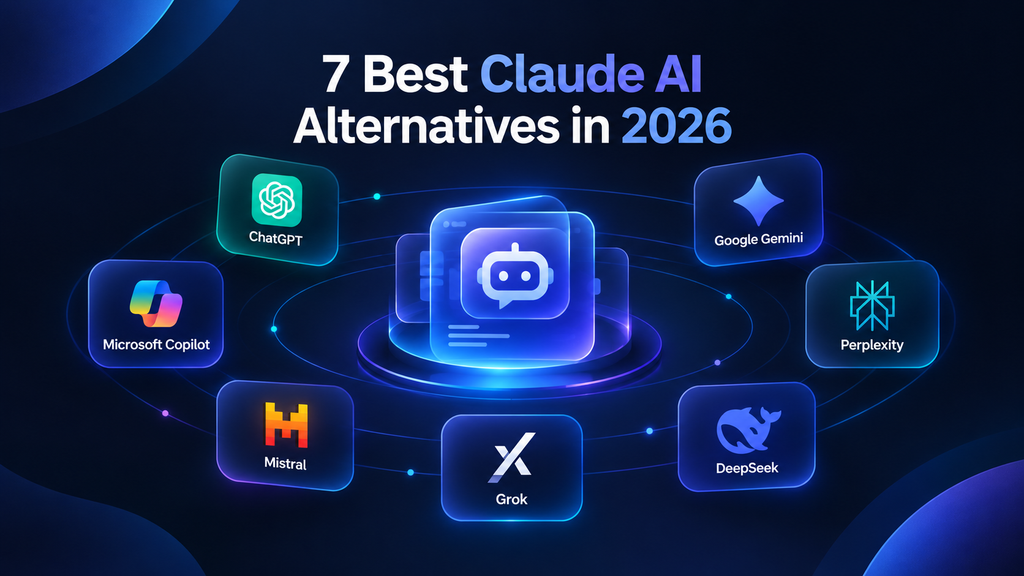
7 Best Claude AI Alternatives in 2026
1. ChatGPT (OpenAI) Best Overall Alternative
ChatGPT, running on OpenAI’s GPT-5.2, is the most well-rounded Claude alternative for teams that want strong performance across coding, writing, and reasoning without switching tools depending on the task.
- SWE-bench Verified: ~80% on GPT-5.2
- MMLU: ~90%
- Context window: Up to 272K tokens (128K on the consumer Chat interface)
- Pricing: ChatGPT Plus at $20/month; a Pro tier at $100–$200/month for heavier individual use; Team plans typically run $25–30/user/month; API pricing starts around $1.75 per million input tokens and $14 per million output tokens for GPT-5.2
- Best for: Teams that want one tool to handle code review, documentation, and general business writing reasonably well, without maintaining three separate subscriptions
ChatGPT’s Custom GPTs marketplace and plugin ecosystem also give technical teams a faster path to building small internal tools than Claude’s more constrained integration surface currently offers.
2. Google Gemini Best for Google Ecosystem Integration
Gemini 3.1 Pro is the strongest choice for organizations already running on Google Cloud, Workspace, or BigQuery. Native integration with Docs, Sheets, Gmail, and Colab removes a lot of the copy-paste friction that other tools still have.
- SWE-bench Verified: Independently reported in the low-to-mid 60% range, though Google has not published a directly comparable official score
- MMLU: ~90%
- Context window: Up to 2 million tokens (still the industry’s largest by a wide margin)
- Pricing: Free tier available; Google AI Pro at $19.99/month (bundles 1M-token context and 5TB of storage); API pricing from $2 per million input tokens and $12 per million output tokens for Gemini 3.1 Pro, with the cheaper Gemini 3.6 Flash tier starting around $0.75 / $3.75
- Best for: Teams processing large codebases or document sets that would otherwise force chunking workarounds on a smaller context window
Gemini’s context window is genuinely a different category of tool for tasks like full-repository analysis or long contract review, where Claude’s 1M-token ceiling (on Sonnet 5) can still mean careful trimming for the largest jobs.
3. Cursor Best AI Code Editor for Developers
Cursor isn’t a chatbot competitor it’s a full IDE built around AI-native workflows, which makes it a favorite among engineering teams that want AI embedded directly into the development environment rather than accessed through a separate browser tab.
- Underlying models: Supports GPT-5.2, Claude, and Gemini via in-editor model switching
- Context window: Repository-aware, effectively unbounded via retrieval rather than a single context limit
- Pricing: Free Hobby tier (~2,000 completions/month); Pro at $20/month; Pro+ at $60/month; Ultra at $200/month; Teams at $40/user/month; custom Enterprise pricing
- Best for: Developer teams who want inline code completion, multi-file editing, and an agentic “compose” mode for larger refactors
Because Cursor lets teams route requests across multiple underlying models, it doubles as a practical hedge against being locked into a single vendor’s pricing or roadmap if Claude’s rates rise, you flip a setting rather than migrate a codebase.
4. Microsoft Copilot Best for Enterprise Microsoft Users
For organizations standardized on Microsoft 365, Azure, and Teams, Copilot delivers the deepest workflow integration on this list, embedding AI directly into Outlook, Excel, and Word rather than asking employees to open yet another app.
- Underlying model: GPT-5-class models via Azure OpenAI Service
- Context window: Typically up to 128K tokens in most enterprise deployments
- Pricing: Microsoft 365 Copilot around $30/user/month (commonly requires an annual commitment); GitHub Copilot is billed separately
- Best for: Enterprises that need compliance-grade AI deployment layered onto existing Microsoft security and identity infrastructure
Copilot’s tight coupling with Azure Active Directory and enterprise data governance tools makes it the lower-friction option for regulated industries that are already fully invested in the Microsoft stack.
5. Perplexity AI Best for Research and Information Discovery
Perplexity is built around real-time, citation-backed answers, which makes it the strongest option for teams that need current information rather than a model working from a static training cutoff.
- Underlying models: Configurable GPT-5, Claude, or Perplexity’s own Sonar models, depending on the query
- Context window: Varies by underlying model
- Pricing: Free tier with limited Pro Search queries; Pro at $20/month (or ~$16.67/month billed annually), which includes daily deep-research queries and $5/month in API credits; Max at $200/month for power users
- Best for: Technical leaders and analysts who need sourced, verifiable answers for market research or competitive analysis
Perplexity’s built-in citation trail reduces the manual verification burden that comes with unsourced chatbot answers a real advantage for teams producing external-facing reports where “where did this number come from?” is a question someone will eventually ask.
6. GitHub Copilot Best for In-IDE Coding Assistance
GitHub Copilot remains the most widely adopted AI pair programmer, with native support across VS Code, JetBrains IDEs, and Visual Studio, and over a million developers using it inside GitHub itself.
- SWE-bench Verified: Varies by backend model configuration, generally trailing the frontier chat models above
- Context window: Up to 128K tokens with a GPT-5-class backend
- Pricing: Individual at $10/month; Pro+ at $39/month; Business at $19/user/month; Enterprise at $39/user/month
- Best for: Development teams standardized on GitHub who want AI-assisted pull requests, code review, and inline suggestions without switching editors
Its deep GitHub Actions and pull request integration makes it particularly strong for teams already managing CI/CD pipelines through GitHub, where Copilot’s suggestions show up right where the review is already happening.
7. Mistral AI Best Open-Source Alternative
Mistral is the clearest choice for organizations that require self-hosting, strict data residency guarantees, or the flexibility to fine-tune an open-weight model rather than depend on a third party’s API forever.
- MMLU: ~84% (Mistral Large 2)
- Context window: 128K tokens
- Pricing: Open-weight models are free to self-host; hosted Le Chat Pro runs about $14.99/month; API pricing starts as low as $0.10–$2 per million input tokens depending on model size
- Best for: Regulated industries finance, healthcare, government or teams with strict on-premises requirements
Because Mistral publishes open weights, it’s also the only tool on this list that eliminates vendor dependency entirely, which matters for anyone doing long-term planning around AI technical debt and wanting an exit ramp that doesn’t involve re-architecting everything.
Claude vs. Top Alternatives: Head-to-Head Comparison
| Tool | SWE-bench Verified | MMLU | Context Window | Starting Price |
|---|---|---|---|---|
| Claude (Sonnet 5 / Opus 5) | ~72–77%* | ~89% | 1M tokens | $2/M input · $10/M output (Sonnet 5, intro pricing) |
| ChatGPT (GPT-5.2) | ~80% | ~90% | 272K tokens | $20/month (Plus) |
| Google Gemini 3.1 Pro | ~60–67%* | ~90% | 2M tokens | Free / $19.99 (AI Pro) |
| Cursor | Model-dependent | Model-dependent | Repo-aware | Free / $20/month |
| Microsoft Copilot | ~60% | ~88% | 128K tokens | $30/user/month |
| Perplexity AI | Model-dependent | Model-dependent | Model-dependent | Free / $20/month |
| GitHub Copilot | Model-dependent | N/A | 128K tokens | $10/month |
| Mistral Large 2 | ~50% | ~84% | 128K tokens | Free (self-host) / $14.99/month (Le Chat Pro) |
*Anthropic and Google have not published directly comparable, apples-to-apples SWE-bench figures for every model tier; the ranges above reflect independent third-party benchmark tracking as of Q3 2026 and should be re-verified before making a purchasing decision.
The short version: Choose ChatGPT if raw coding and reasoning performance matter more than ecosystem fit. Choose Gemini if your team regularly works with document sets or codebases that would blow past a 1M-token context window. Choose Mistral if data sovereignty outweighs chasing the highest benchmark score.
For a broader look at how these models actually perform on day-to-day writing and reasoning tasks not just benchmark charts see our AI writing assistant comparison and our deeper breakdown of prompt engineering techniques that squeeze more accuracy out of any of these tools.
Which Claude Alternative Should You Choose?
The right tool depends heavily on your role and your constraints, not on which model topped a benchmark leaderboard last week.
- CTOs evaluating platform-wide AI strategy should weigh Gemini or ChatGPT for breadth, factoring in how the choice affects longer-term enterprise AI adoption plans across departments not just engineering’s preferences.
- Engineering managers building developer tooling should prioritize Cursor or GitHub Copilot, since both are purpose-built for in-IDE workflows and integrate cleanly with existing CI/CD pipelines.
- Teams with compliance or data residency requirements should default to Mistral AI, since self-hosting removes third-party data exposure as a variable entirely.
- Research and analyst teams benefit most from Perplexity’s sourced answers, which cut down the manual fact-checking overhead that comes with general-purpose chat models.
- Microsoft-standardized enterprises should lean toward Copilot, if only to avoid duplicating identity, security, and compliance work already built around Azure AD.
If your team is still undecided, start by mapping your top three use cases coding, research, or writing against the benchmark table above, then trial the top two candidates against a real internal task before committing to a subscription tier. A two-week pilot tells you more than any comparison article, including this one.