AI coding tools have fundamentally changed how software gets built. GitHub Copilot, ChatGPT, Claude, and similar platforms now assist engineers with everything from boilerplate generation to complex algorithm design. The productivity gains are real, and the adoption numbers reflect that.
But speed creates its own category of risk. When code is generated faster than it can be reviewed, understood, or documented, the quality bar quietly shifts. What appears as a functioning feature today can become an unmaintainable liability six months from now.
This is the core problem of AI technical debt: not that AI-generated code is inherently flawed, but that it compounds existing software engineering challenges in ways that traditional debt management practices were not designed to catch.
This post breaks down what AI technical debt is, how it accumulates, what it costs, and how engineering leaders can build the governance structures to manage it at scale. If you are leading a team that uses AI coding tools, or considering expanding that use, this is the conversation your engineering org needs to have.
What Is AI Technical Debt?
Technical debt in software development refers to the implied cost of rework caused by choosing a fast or easy solution now instead of a better approach that would take longer. The term was coined by software engineer Ward Cunningham in 1992, and it has been a fixture of engineering planning ever since.
AI technical debt is a specific subset of this problem. It describes the accumulated maintenance burden, architectural inconsistencies, security risks, and documentation gaps that arise from integrating AI-generated code into a production codebase without sufficient engineering oversight.
The distinction matters because AI-generated code behaves differently from code written incrementally by a team that owns the architecture. AI tools produce code that is syntactically correct and often functionally adequate, but they do not carry context. They do not know your system’s history, your team’s conventions, your security constraints, or your scaling requirements. That context gap is where technical debt from AI-generated code begins.
Why AI-Generated Code Creates a Different Engineering Challenge
Traditional technical debt usually accumulates through deliberate shortcuts: a deadline forces a workaround, a junior developer writes something that needs refactoring, a team defers a migration. In each case, the team typically knows what they did and why.
AI-generated code creates debt that is often invisible at the point of creation. An engineer accepts a Copilot suggestion, it passes review, it ships. Nobody flags it as a shortcut because, functionally, it was not one. The problem only surfaces when someone tries to modify it, when a dependency breaks, or when a security audit uncovers a vulnerability that was quietly embedded in generated logic.
This dynamic makes AI code technical debt harder to detect, harder to attribute, and harder to prioritize. It also means it accumulates faster, because the volume of code being produced outpaces the capacity of human review.
10 Ways AI-Generated Code Can Create Technical Debt
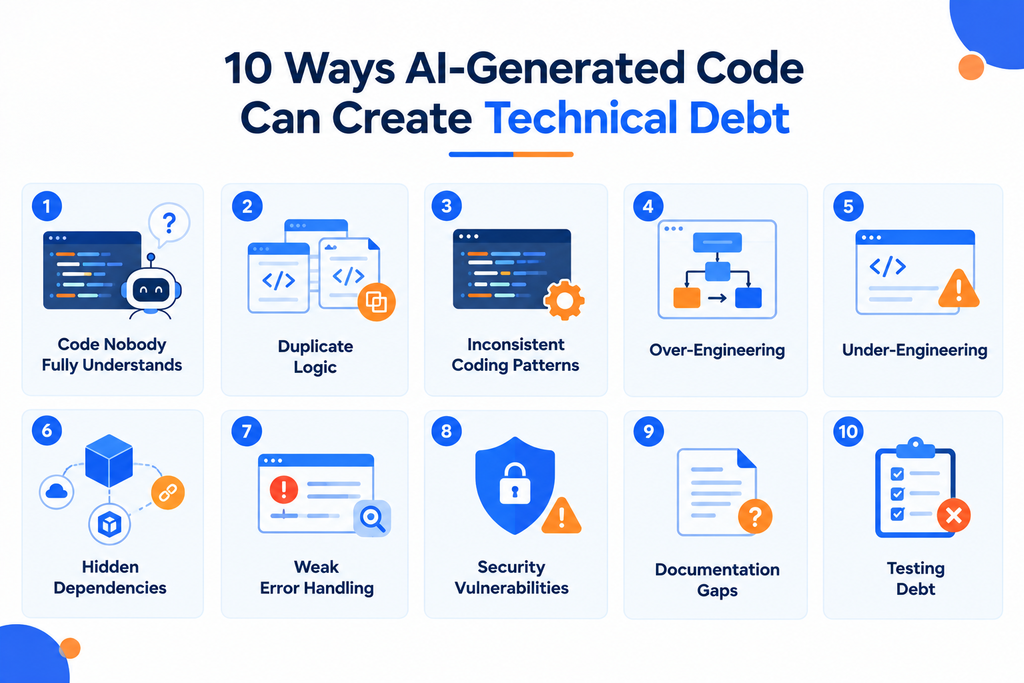
1. Code Nobody Fully Understands
AI tools can generate complex logic quickly. But if the engineer accepting that code does not fully understand it, the team now owns code it cannot confidently debug or extend. This is sometimes called “orphaned understanding” and it is one of the most common AI coding risks in production environments.
2. Duplicate Logic
AI tools generate code based on the immediate prompt, not the full codebase. The same utility function might be generated three times across three files, each slightly different. Over time, this creates inconsistency and maintenance overhead.
3. Inconsistent Coding Patterns
When multiple engineers use AI tools independently, the generated code may follow different patterns, naming conventions, and structural approaches. This erodes the consistency that makes a codebase readable and maintainable.
4. Over-Engineering
AI tools sometimes produce more elaborate solutions than the problem requires. Unnecessary abstraction layers, over-generalized functions, and premature optimization all add complexity without adding value.
5. Under-Engineering
The opposite is equally common. AI-generated code may solve the immediate problem without considering edge cases, scale requirements, or integration points that an experienced engineer would have accounted for from the start.
6. Hidden Dependencies
Generated code frequently introduces third-party libraries or packages without flagging licensing, security, or compatibility implications. These hidden dependencies can create downstream risks that are difficult to trace back to their origin.
7. Weak Error Handling
AI tools tend to generate “happy path” code. Error handling, retry logic, and failure states are often shallow or missing entirely, creating brittle systems that fail unexpectedly under real-world conditions.
8. Security Vulnerabilities
AI-generated code security is one of the most serious concerns in this space. Research from Stanford University found that participants using AI code assistants were more likely to introduce security vulnerabilities than those coding without them. Generated code may include common vulnerabilities such as SQL injection patterns, inadequate input validation, or insecure default configurations.
9. Documentation Gaps
AI tools generate code, not documentation. When teams move fast, inline comments, architecture notes, and decision logs get skipped. Future engineers inherit code with no context for why decisions were made.
10. Testing Debt
AI-generated code is often written without a corresponding test strategy. Even when tests are generated, they may cover obvious cases while missing boundary conditions, integration scenarios, or failure modes.
AI Technical Debt vs Traditional Technical Debt
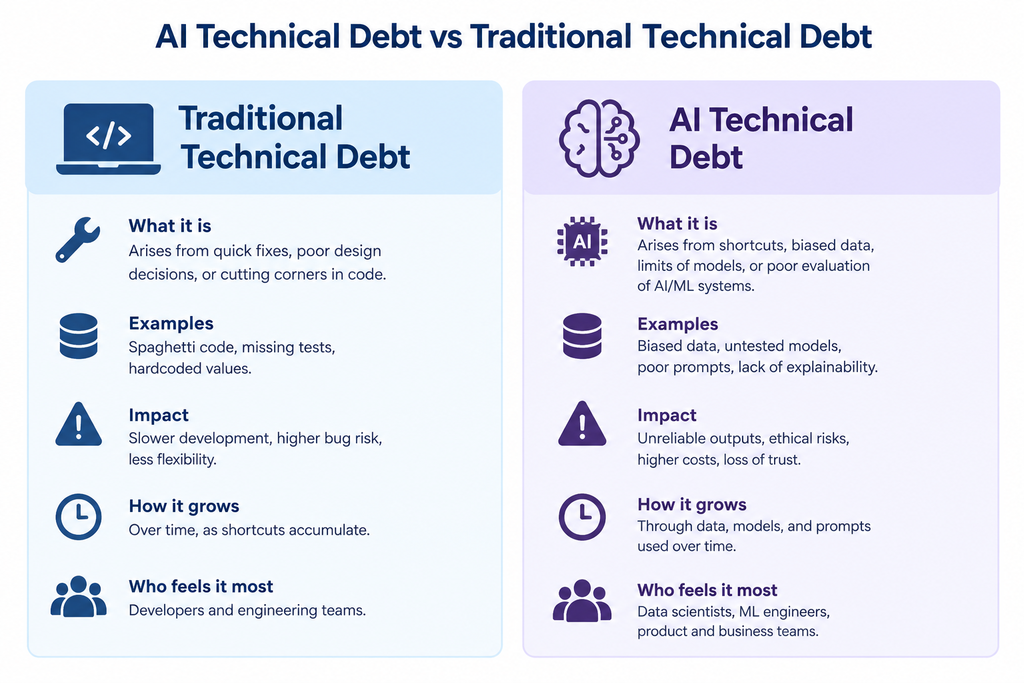
Understanding how AI technical debt differs from traditional technical debt is essential for building the right response to it.
| Dimension | Traditional Technical Debt | AI Technical Debt |
|---|---|---|
| Origin | Deliberate shortcuts, time pressure | Invisible quality gaps in generated code |
| Visibility | Usually known to the team | Often undetected until failure |
| Attribution | Can typically be traced to a decision | Difficult to attribute to a specific point |
| Rate of accumulation | Gradual, tied to team velocity | Rapid, scales with AI adoption |
| Detection method | Code review, refactoring cycles | Requires AI-specific audit practices |
| Mitigation | Refactoring, documentation, testing | Governance frameworks, human review checkpoints |
The Hidden Cost of AI-Generated Code
The financial and operational costs of AI code technical debt are rarely visible on a sprint board. They show up later, in ways that are harder to budget for and harder to explain to leadership.
Consider a scenario where an engineering team adopts AI coding tools across three squads over six months. Velocity increases by 30 percent, and the business responds positively. But over the following two quarters, the team notices that bug resolution is taking longer, new engineers are struggling to onboard, and a security audit surfaces twelve vulnerabilities across AI-assisted modules.
None of these outcomes appear in the original productivity metrics. But the remediation cost, measured in engineer hours, delayed releases, and audit fees, can easily exceed the efficiency gains. This is the hidden cost of AI-generated code: it moves work downstream rather than eliminating it.
Signs Your Team Has AI-Generated Code Debt
The following checklist can help engineering leaders identify whether AI technical debt is already accumulating in their codebase.
AI Technical Debt Warning Signs
- Engineers cannot explain the logic of code they have shipped
- Duplicate utility functions or similar logic across different modules
- Third-party libraries appearing without clear ownership or review
- Inconsistent error handling across services
- Low test coverage in recently shipped features
- Slow or difficult onboarding for new engineers
- Security audit findings concentrated in newer code
- Architecture reviews revealing undocumented integration points
- No clear ownership of AI-generated modules
- Increasing time-to-debug in AI-assisted sections of the codebase
If your team is checking more than three of these boxes, a structured AI code audit is worth prioritizing.
How to Audit AI-Generated Code
A structured audit does not need to be a weeks-long disruption. The following process can be applied incrementally across a codebase.
Step 1: Identify AI-Assisted Code
Use commit history, PR descriptions, and tooling metadata to flag sections of the codebase that were AI-assisted. Some teams introduce tagging conventions at the point of generation to simplify this step later.
Step 2: Review Architecture
Assess whether AI-generated modules fit the intended system architecture. Look for unexpected abstraction layers, misaligned patterns, and integration points that were not formally designed.
Step 3: Review Dependencies
Audit all third-party libraries introduced in AI-assisted code. Confirm licensing compliance, security advisories, and whether each dependency has a designated owner.
Step 4: Review Security
Apply static analysis tools to AI-assisted code with particular attention to input validation, authentication logic, data handling, and known vulnerability patterns. Treat AI-generated code security as a distinct audit category.
Step 5: Review Tests
Assess test coverage for AI-generated modules. Identify gaps in boundary condition testing, integration testing, and failure scenario coverage.
Step 6: Review Maintainability
Evaluate code clarity, inline documentation, and whether a new engineer could understand and modify the code without requiring tribal knowledge.
Step 7: Measure and Prioritize Debt
Use a debt register to log findings, score them by severity and remediation cost, and incorporate them into sprint planning. Treat AI technical debt as a first-class engineering concern rather than a background task.
How to Prevent AI Technical Debt
Prevention is more cost-effective than remediation. The following practices reduce the rate at which AI-generated code becomes a liability.
Establish prompt standards. Structured prompts that include context about architecture, conventions, and constraints produce better-fit code. Teams that invest in prompt engineering reduce inconsistency at the source.
Set a mandatory review threshold. AI-generated code should not bypass human review. Define clear checkpoints where an engineer who understands the system context must approve generated output before it is merged.
Maintain an architecture decision record (ADR). Document decisions made in AI-assisted development the same way you would document any architectural decision. The ADR is what allows future engineers to understand not just what the code does, but why it exists in that form.
Run dependency reviews on every AI-assisted PR. Any PR that introduces a new dependency from AI-generated code should trigger an automated check for known vulnerabilities, license compatibility, and maintenance status.
Integrate testing requirements at the prompt level. Engineers should be expected to generate or write tests alongside any AI-generated feature code, not as a separate step that gets deferred.
AI Code Review: What Human Engineers Should Look For
Not all AI code review is equal. Engineers reviewing AI-generated code need to apply a different lens than they would to code written by a colleague.
Specific review criteria for AI-assisted code include: does the reviewer understand every line of logic; are there hidden assumptions about data shape or system state; does the error handling match production-grade requirements; are there edge cases the AI did not account for; and does this code fit the existing architecture or introduce new patterns without justification.
Engineers should resist the impulse to approve generated code quickly because it “looks fine.” AI-generated code is optimized to look reasonable. It is the reasoning behind the code that requires scrutiny.
AI Coding Tools Need Engineering Guardrails
The problem is never the tool itself. GitHub Copilot, Cursor, Claude, and similar platforms are capable of producing high-quality code. The risk lies in how organizations deploy them.
AI coding tools used without guardrails behave like a very fast, very confident junior developer with no institutional knowledge. The output volume is high, and the error rate may appear low, until the system is tested at scale, under load, or against edge conditions the tool was never prompted to consider.
Guardrails do not slow teams down meaningfully. A clear review process, a defined scope for AI tool use, and a shared understanding of where human judgment is non-negotiable add minimal friction while substantially reducing downstream risk.
Should Companies Stop Using AI-Generated Code?
No. The productivity gains from AI-assisted software development are substantive enough that rejecting these tools would place engineering teams at a competitive disadvantage. The goal is not to eliminate AI-generated code but to govern it.
The question engineering leaders should be asking is not whether to use AI coding tools, but how to integrate them in a way that preserves code quality, security, and maintainability over time. Companies that figure this out gain both the speed advantage of AI and the long-term stability of disciplined engineering.
A Practical AI Code Governance Framework for Engineering Teams
The following maturity model provides a structured path from individual AI tool use to enterprise-grade governance.
| Level | Scope | Key Practices |
|---|---|---|
| Level 1: Individual Use | Single engineers | Personal prompt standards, mandatory self-review before committing |
| Level 2: Team Adoption | Squad or team level | Shared prompt library, AI code flagging in PRs, peer review requirement |
| Level 3: Controlled Production Use | Multi-team or product level | Architecture review checkpoints, dependency audits, security scanning |
| Level 4: Enterprise Governance | Organization level | Formal AI code policy, debt register, audit cycles, training programs |
Level 1: Individual Use
At this stage, the engineer is the primary control. Establish personal conventions for prompting, reviewing, and documenting AI-generated code. Never commit generated code you cannot explain line by line.
Level 2: Team Adoption
At the team level, consistency becomes the primary goal. Shared prompt templates, agreed naming conventions, and a lightweight AI-code flag in pull requests allow the team to track where generated code lives in the codebase.
Level 3: Controlled Production Use
When AI-generated code reaches production regularly, architecture-level controls become necessary. This includes formal review checkpoints before AI-assisted features are merged to main, automated dependency scanning, and security tooling tuned to AI-related vulnerability patterns.
Level 4: Enterprise Governance
At enterprise scale, AI code governance requires policy, tooling, and organizational accountability. A formal policy defines approved tools, usage boundaries, and review requirements. A debt register tracks accumulated AI code quality issues. Audit cycles ensure the codebase stays within acceptable risk thresholds.
AI Technical Debt in Startups vs Enterprises
The risk profile for AI technical debt differs significantly depending on the stage and size of the organization.
Startups move fast by necessity. AI coding tools allow small engineering teams to punch above their weight, and in the early stages, some accumulation of technical debt is a rational trade-off. The risk materializes when the startup scales and the codebase becomes the foundation for production infrastructure that customers depend on. Debt that was manageable at ten engineers becomes a serious operational constraint at fifty.
Enterprises face a different challenge. The scale of AI adoption across large engineering organizations means the volume of AI-generated code in production can be substantial before governance frameworks are in place. The compliance, security, and audit implications are also more significant in regulated industries where code quality carries legal and contractual weight.
For both contexts, the inflection point is the same: the moment AI-generated code moves from experimental use to production infrastructure is the moment governance needs to be in place.
The Future of AI-Assisted Software Engineering
AI coding tools are improving rapidly. Current limitations around context awareness, system-level reasoning, and architectural coherence will narrow as models become more capable and as tooling integrates more deeply with development environments.
The future is not human engineers versus AI-generated code. It is engineering teams that understand how to use AI as a high-leverage tool within a discipline of quality ownership. The teams that build that capability now, developing governance practices, review standards, and audit habits, will be better positioned to absorb future AI capabilities without the associated risk.
Technical debt management has always been a marker of engineering maturity. AI technical debt is simply the next chapter of that discipline.
How Enlight Lab Can Help With AI-Driven Software Engineering
Enlight Lab works with technology organizations at the intersection of engineering quality and AI adoption. For teams navigating the governance challenges of AI-assisted development, Enlight Lab brings senior engineering expertise to the specific problems that AI technical debt creates: codebase audits, architecture review, developer governance frameworks, and technical strategy for scaling AI adoption responsibly.
Whether your organization is in the early stages of adopting AI coding tools or managing the downstream effects of rapid AI-assisted development, Enlight Lab can provide the engineering perspective and structured approach that turns AI capability into sustainable software quality.
Reach out to Enlight Lab to explore how a tailored AI code governance engagement could work for your team.