Building a software product is hard enough. Deciding how to build it and with whom can feel just as complicated.
If you’re planning a software development project and trying to stretch a tight budget while hitting an aggressive product roadmap, you’ve almost certainly come across two terms: outsourcing vs offshoring. They’re often used interchangeably, but they mean different things and lead to very different outcomes.
Should you outsource or offshore your development? Making that one decision will shape everything. Your choice will determine:
- How much control you retain over your product
- How quickly your team can adapt and iterate
- And how sustainable your development process is over time
Make the right choice, and you can gain access to specialized talent beyond your local market while accelerating development cycles. However, choosing the wrong approach can result in missed deadlines, increased costs, communication breakdowns, and code that becomes difficult to maintain.
This guide provides a clear comparison of both models, helping you make an informed decision without confusion.
We’ll explain what each model really means, how they differ in practice, and, most importantly, which one is the right fit for your specific software development project.
Let’s get into it.
What Is Software Development Outsourcing?
Outsourcing in software development means hiring an external company or a third-party vendor to handle entire software development work. That external team could be located down the street or across the globe.
The key distinction: you’re contracting work to a third-party vendor, not relocating operations to another country. The vendor manages its own people, processes, and infrastructure. You define the scope, set expectations, and review the output.
The Three Types of Outsourcing
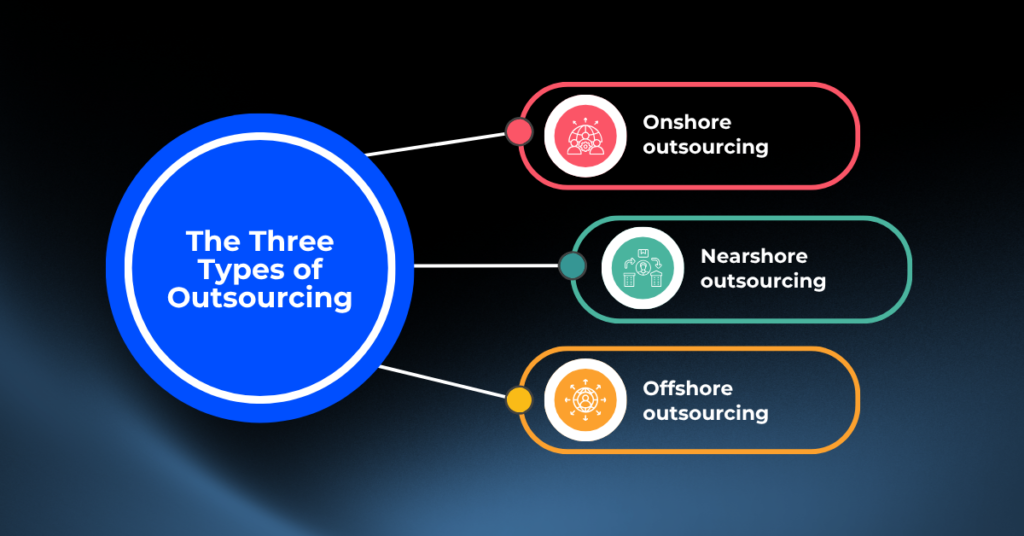
Not all outsourcing arrangements look the same. The geography involved changes the communication dynamics significantly:
- Onshore outsourcing: You hire a vendor in the same country. Communication is easy; costs are higher.
- Nearshore outsourcing: The vendor is in a neighboring country or a similar time zone. A good middle ground for cost and coordination.
- Offshore outsourcing: The vendor operates in a distant country, such as a US startup working with a team in Eastern Europe or Southeast Asia. Costs drop significantly, but time zone gaps widen.
Common Software Outsourcing Models
- Project-based outsourcing: You hand over a complete project with a defined scope, timeline, and budget. The vendor delivers the finished product.
- Dedicated development teams: You hire an external team that works exclusively on your project, often feeling like an extension of your in-house staff.
- Staff augmentation: You plug specific technical talent like a developer, a QA tester, or a DevOps engineer into your existing team to fill skill gaps.
Pros of Outsourcing Software Development
- Access to specialized talent: Need a machine learning engineer for a 3-month sprint? Outsourcing lets you bring in niche expertise without a full-time hire.
- Cost savings: You avoid the overhead of salaries, benefits, office space, and equipment.
- Flexibility: Scale your team up or down based on project demands.
- Focus: Your internal team stays focused on core business priorities rather than getting stretched thin.
Cons of Outsourcing Software Development
- Control gaps: You’re working with a third party. Aligning their priorities with yours takes deliberate effort.
- Communication friction: Vendor teams juggle multiple clients. Your project may not always be top priority.
- Quality variability: Output quality varies widely across vendors.
- IP exposure: Sharing proprietary code and systems with external parties carries inherent risk.
What Is Software Development Offshoring?
Here’s where a lot of people get tripped up.
Offshoring refers specifically to relocating business operations, or setting up a team, in another country. The key distinction? In offshoring, you’re typically building your own team abroad, not hiring an outside vendor to do the work for you.
Many large enterprises establish wholly owned development centers in countries like India, Ukraine, Poland, or the Philippines.
How Offshoring Works in Practice
- Setting up a captive offshore development center (ODC)
- Hiring developers, PMs, and QA engineers abroad as direct employees
- Managing HR, payroll, and operations in another country
- Building company culture across borders
Pros of Offshoring Software Development
- Significant cost reduction: Lower labor costs in offshore destinations can reduce development spend substantially.
- Large talent pools: Countries like India and Eastern Europe produce enormous volumes of skilled software engineers annually.
- 24/7 development cycles: With teams spread across time zones, work can continue around the clock.
Cons of Offshoring Software Development
- Cultural and language barriers: Misaligned communication norms and language differences cause real project delays.
- Time zone friction: A 10-hour gap between your team and an offshore developer means slow feedback cycles.
- Geopolitical risk: Political instability, data privacy laws, and regulatory changes in offshore countries can disrupt operations.
- Data security concerns: Stricter data handling requirements like GDPR make offshoring more complex for companies handling sensitive user data.
- Management overhead: Running an offshore team effectively requires significantly more coordination than a local one.
Outsourcing vs Offshoring: Key Differences at a Glance
| Factor | Outsourcing | Offshoring |
| Team ownership | Vendor-owned | Can be company-owned or vendor-managed |
| Primary driver | Expertise and flexibility | Cost reduction |
| Location | Onshore, nearshore, or offshore | Always international |
| Control level | Lower | Higher (with ODC model) |
| Setup cost | Lower | Higher |
| Best for | Short-term projects, niche skills | Long-term, high-volume development |
Key Factors to Consider When Choosing Between the Two
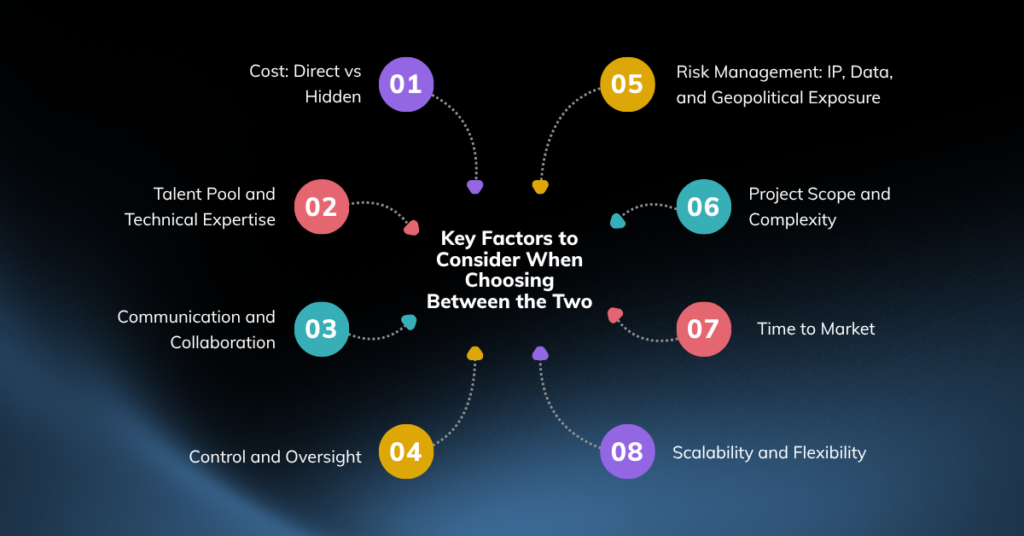
Choosing between outsourcing and offshoring is not a surface-level decision. It directly impacts your product quality, delivery speed, and long-term scalability.
Here are the most important factors you should evaluate before deciding.
Cost Structure: Direct vs Hidden
The sticker price of either model rarely tells the full story.
Direct costs include developer hourly rates, licensing fees, and vendor margins.
Hidden costs are where decisions often go wrong:
- Onboarding and knowledge transfer time
- Legal and compliance setup especially with offshore contracts
- Communication tools and project management infrastructure
- Rework due to miscommunication or quality gaps
- Management hours spent coordinating remote teams
Talent Pool and Technical Expertise
Outsourcing is a strong option when you need access to specialized skills quickly without investing time and resources into building an internal team.
For example, a startup that needs a React Native developer for a short-term project may find it more practical to partner with an experienced external team rather than hire and manage a full-time employee.
Offshoring, on the other hand, is often a better fit for businesses looking to build dedicated development capabilities and scale their engineering resources over time.
The right choice here depends less on where the talent is located and more on your project requirements: do you need one expert or an entire team?
Communication and Collaboration
Communication is one of the most critical factors in the success of any outsourcing or offshoring partnership, yet it is often overlooked during the decision-making process.
Outsourcing can offer smoother collaboration when teams have better alignment in communication styles, working hours, and business practices. This makes activities like daily stand-ups, sprint reviews, feedback sessions, and quick discussions more efficient.
Offshoring can introduce additional challenges, especially when teams work across different time zones. Delayed responses, longer feedback cycles, and slower decision-making can impact project timelines if communication processes are not properly structured.
Control and Oversight
The more you need direct control over how work gets done, the more cautious you should be about offshoring to a vendor-managed team.
Outsourcing gives you output ownership but less process control. Offshoring with a dedicated offshore development center offers more control but requires more setup investment.
Risk Management
No matter which model you choose, protecting your intellectual property (IP) and sensitive business information should be a top priority.
Outsourcing can introduce vendor dependency, while offshoring may involve challenges related to operations, compliance, and managing distributed teams.
The right choice depends on the type of risk your business is better prepared to handle, whether that involves relying on an external partner or managing the complexity of an internal development setup.
Project Complexity and Duration
- Short, specialized project: Outsourcing wins. Bring in the right vendor for the right task.
- Long-term, high-volume product development: Offshoring especially a dedicated ODC becomes cost-effective over time.
- MVP build with limited budget: Nearshore outsourcing often hits the right balance between cost and collaboration.
- Scaling an existing platform: Either model can work, but team integration and documentation quality become critical factors.
Time to Market
Speed matters enormously for startups. Every week of delay is a week a competitor gains ground.
Outsourcing to a proven vendor can accelerate time-to-market significantly, especially when the vendor already has established workflows, tooling, and relevant experience.
Offshoring typically takes longer to set up, particularly with an ODC model that requires hiring, onboarding, and cultural alignment before meaningful output flows.
Scalability and Flexibility
Outsourcing offers on-demand scalability. Need to double the development team for a product launch sprint? A well-connected vendor can source additional resources quickly.
Offshoring builds deeper institutional knowledge over time. An offshore team that has worked on your product for 18 months brings context and continuity that an outsourcing vendor rotated across multiple clients cannot easily match.
Offshoring vs. Outsourcing: When to Choose What
Each model comes with its own advantages, challenges, and impact on your development process, level of control, and scalability. To make the right call, you need to clearly understand your business objectives and development requirements.
Here’s a closer look at both approaches to help you make the right choice.
When Outsourcing Is the Right Call
Choose outsourcing when:
- You have a clearly defined, time-bound project
- You need specialized expertise that doesn’t justify a full-time hire
- Your internal team is small and focused on core product strategy
- Communication overhead needs to be minimized
- You’re building an MVP and need to move quickly
When Offshoring Makes More Sense
Choose offshoring when:
- You need a large, dedicated team for ongoing development
- Cost reduction at scale is a strategic priority
- You can invest in setting up proper management infrastructure
- The project timeline extends over 12+ months
- You’re willing to invest in cultural training and structured communication protocols
5 Questions to Help You Decide Right Now
Still unsure whether outsourcing or offshoring is the right choice for your business? Answer these five questions honestly:
- How fast do you need to start?
- Outsourcing = weeks
- Offshoring = months
- What’s your budget reality?
- Limited runway favors outsourcing
- Long-term capital availability favors offshoring
- Is this a one-time project or an ongoing capability?
- Project = outsource
- Permanent function = offshore
- How sensitive is your IP?
- Extremely sensitive with no vendor trust → offshore your own team.
- Do you have internal management bandwidth to run an international operation?
- If no → outsource first, build capability, then consider offshoring.
Your answers should paint a pretty clear picture.
Essential Tips for a Successful Outsourcing or Offshoring Relationship
- Create clear contracts with well-defined expectations to avoid ambiguity
- Standardize communication tools, establish regular meeting schedules, and document important decisions
- Invest in cultural onboarding to understand communication preferences, work practices, and collaboration styles
- Begin with a paid discovery phase to evaluate capabilities, processes, and compatibility before committing to a long-term engagement.
- Track key performance indicators (KPIs) from week one to find out what success looks like.
Why Enlight Lab Is the Ideal Partner for Your Software Development Needs
Whether you’re looking to scale your in-house capabilities through outsourcing or build a dedicated offshore development team, partner with Enlight Lab.
We provide:
- A skilled team of tech experts with immense experience in building scalable, high-performance solutions.
- Robust security and compliance practices to safeguard your data while meeting industry standards and business requirements.
- Agile and transparent development methodologies that keep projects aligned through continuous communication, collaboration, and measurable progress.
- Flexible engagement models and cost-effective solutions designed around your budget, timeline, and long-term business objectives.
- Proven global delivery experience helping businesses across industries transform ideas into reliable digital products.
Choose The Right Model Depends on Your Specific Situation
There is no universal answer to the outsourcing vs offshoring question. Both models have delivered exceptional results for the right companies under the right conditions.
Outsourcing gives you flexibility, speed, and access to specialized talent. On the other hand, Offshoring gives you cost efficiency and long-term scalability. It is better suited for companies with established processes and extended development roadmaps.
What matters most is matching the model to the reality of your project and making the choice deliberately.
If you’re still unsure about which model is right for your project and searching for a reliable software development company, Enlight Lab can help. Book a free consultation and talk to our software developers right away to build scalable web, mobile, and enterprise-grade solutions. We help businesses access top-tier software development expertise through flexible outsourcing and offshoring engagement models.