Every product decision you make, every customer interaction, every dollar of marketing spend leaves a trail of data behind it. The hard part is not collecting that data. The hard part is turning it into something useful before your competitors do.
That is where data engineering comes in. If you are a startup founder or CTO trying to scale without drowning in messy spreadsheets and broken pipelines, choosing the right data platform is one of the most important calls you will make.
Pick well, and you cut infrastructure costs, ship features faster, and free your team to focus on the product. Pick poorly, and you inherit technical debt that slows everything down.
This guide breaks down the top data engineering companies shaping enterprise digital transformation in 2026. We will walk through what data engineering actually is, the trends driving the market, how to evaluate a vendor, and detailed profiles of ten platforms worth your attention.
What Data Engineering Means for Growing Businesses
Data engineering is the practice of building systems that collect, store, transform, and deliver data so it can be analyzed and acted on. Think of it as the plumbing behind every dashboard, every AI model, and every report your leadership team relies on.
For a non-technical founder, here is the simplest way to picture it. Your app and your tools generate raw data constantly. Data engineering takes that raw, scattered information and shapes it into clean, organized, trustworthy datasets. Without that foundation, your analytics are guesswork and your AI projects fail before they start.
The reason this matters now more than ever is AI. Machine learning models are only as good as the data feeding them.
A modern data pipeline is the difference between an AI initiative that delivers and one that quietly burns your budget.
What Are the Emerging Trends in Data Engineering For 2026?
Tools that streamline workflows, ensure data quality, and provide actionable insights are becoming indispensable. Additionally, cloud-native technologies and decentralized architecture are driving flexibility and scalability, enabling businesses to harness data more effectively.
Streamlining Pipelines with DataOps and MLOps
DataOps and Machine Learning Operations (MLOps) are becoming standard practice. These methodologies apply software engineering principles like continuous integration and continuous deployment (CI/CD) to data pipelines.
Implementing DataOps drastically reduces the time it takes to resolve data pipeline failures and ensures machine learning models receive highly accurate, tested data.
Dominance of Cloud-Native and Serverless Architectures
Organizations are completely abandoning on-premise hardware.
Serverless architectures allow data engineers to run code without provisioning or managing servers. This approach ensures businesses only pay for the exact compute power they consume.
Shaping Ethical AI Through Data Governance and Privacy
You cannot achieve ethical AI without rigorous data governance. New global privacy regulations dictate exactly how consumer data must be handled.
Modern data engineering incorporates automated governance tools that mask personally identifiable information (PII) the moment it enters the data lake.
Impact of Real-Time Processing and Streaming Analytics
Batch processing is no longer sufficient for modern applications. Businesses now rely on tools like Apache Kafka and Apache Flink to process data the millisecond it is generated. Real-time streaming analytics allow financial institutions to detect fraud instantly and enable retailers to adjust pricing dynamically based on current demand.
The Rise of Quantum Computing in Data Engineering
While still in its infancy, quantum computing promises to revolutionize data engineering by solving complex optimization problems exponentially faster than classical computers.
By 2026, leading data engineering companies will begin offering hybrid quantum-classical algorithms specifically designed for complex supply chain routing and advanced cryptographic data security.
How Did We Select the Top Data Engineering Companies
Not every vendor earned a spot on this list. We evaluated each data engineering firm against key criteria that matter most to founders and tech decision-makers working under real constraints.
- Market traction: Revenue, growth rate, and customer adoption backed by verifiable figures
- Scalability: The ability to grow with your business without forcing a costly migration later
- AI and machine learning readiness: Native support for modern analytics and model training
- Breadth of offerings: Coverage across ingestion, storage, transformation, and analytics
- Reliability and trust: A track record of serving enterprise customers at scale
- Value for startups: Pricing flexibility and accessibility for smaller teams
With those filters in place, here are the platforms shaping the future of data engineering.
The Top 10 Data Engineering Companies to Watch in 2026
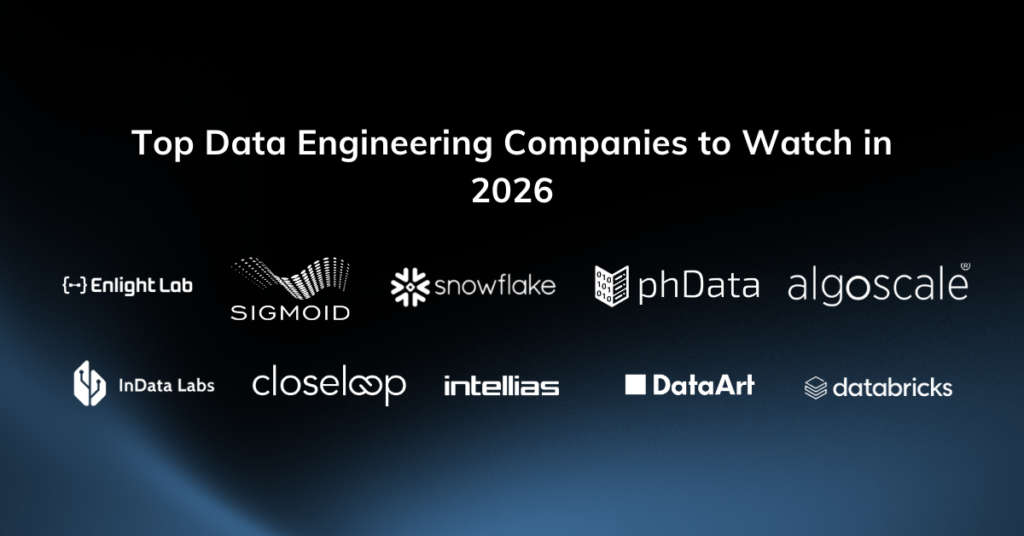
Here’s a curated list of the top 10 data engineering companies, known for their expertise, innovation, and impact in the data ecosystem.
1. Enlight Lab
Enlight Lab has quietly become one of the most talked-about data engineering companies for businesses that want enterprise-grade infrastructure without the enterprise-grade price tag.
What makes Enlight Lab stand out is their philosophy: data engineering should create business outcomes, not just technical outputs. They focus on building end-to-end pipelines that are lean, scalable, and deeply aligned with what decision-makers actually need to see.
Core Strengths:
- Custom data pipeline architecture tailored to your industry
- Cloud-native stack expertise across AWS, GCP, and Azure
- Strong focus on business intelligence enablement
- Rapid deployment cycles — go from chaotic data to clean dashboards faster than most firms promise
Enlight Lab doesn’t just build pipelines; they build pipelines that power decisions.
Best for: Startups and mid-market businesses ready to build a serious data foundation
2. Sigmoid
Sigmoid has built a formidable reputation in the big data solutions space, particularly for large enterprises managing massive volumes of transactional data.
The company’s capabilities lie in combining deep data engineering with applied analytics. They don’t hand you a pipeline and walk away. They stay involved until the data is actually driving revenue.
Core Strengths:
- Proven frameworks for real-time data processing at scale
- Industry-specific accelerators for retail, media, and consumer packaged goods
- Strong AI and ML integration within data pipelines
- Global delivery model with U.S.-based client engagement
If you’re running a high-volume operation where latency in data processing translates directly to lost revenue, Sigmoid belongs to your shortlist.
Best for: Retail, CPG, and media companies with complex data ecosystems
3. Analytics8
For more than 20 years, Analytics8 has been helping clients solve their most complex data challenges and turn data into action. The company is one of the leading data engineering firms that genuinely earns the label “specialist, not generalist.”
Before writing any code, their development team starts focusing on your business goals, challenges, and decision processes. Every engagement is anchored to measurable business outcomes, from new revenue streams to stronger margins and greater operational efficiency.
Core Strengths:
- End-to-end data integration to enable analytics at scale
- AI-powered accelerators that streamline engineering, analytics, and testing workflows
- Cloud data warehouses, ETL design, and business analysis consulting
- Data monetization strategy and data product development
For founders and CTOs who are tired of bloated IT engagements that deliver technical outputs but no business results, Analytics8’s outcome-driven model is a genuine differentiator.
Best for: Mid-market companies needing end-to-end data engineering and modernization.
4. Databricks
Databricks is the engine room where the real transformation happens.
Built on Apache Spark and featuring the open Delta Lake format, Databricks has become the go-to platform for teams that need to move from raw data to trained models without stitching together a dozen different tools.
Core Strengths:
- Unified Lakehouse architecture combining the best of data warehouses and data lakes
- MLflow for end-to-end machine learning lifecycle management
- Native support for real-time streaming and batch processing
- Databricks Unity Catalog for centralized data governance across the entire Lakehouse
- Strong collaboration features for data engineers, scientists, and analysts working in tandem
In 2026, as AI adoption moves from experiment to production, Databricks’ ability to serve as both a data platform and an AI development environment makes it uniquely positioned.
Best for: Organizations building AI and ML pipelines on top of their data infrastructure
5. DataArt
DataArt, founded in 1997, brings deep domain expertise with serious technical chops.
The company has spent decades building software for some of the most highly regulated industries on the planet. That means when they design a data pipeline for a healthcare organization or a financial institution, compliance and auditability aren’t afterthought — they’re foundational design principles.
Core Strengths:
- Specialized data engineering for FinTech, MedTech, and Media & Entertainment
- Strong focus on data security, privacy compliance (GDPR, HIPAA), and auditability
- End-to-end product development capabilities beyond data alone
For businesses where a data breach or compliance failure isn’t just costly but potentially existential. DataArt’s risk-aware approach to engineering is exactly what the situation demands.
Best for: Financial services, healthcare, and media companies with compliance-sensitive data needs
6. PhData
PhData has carved out a powerful niche as one of the most respected implementation and managed services partners in the modern data stack ecosystem.
The company is not trying to do all things to all clients. Instead, they’ve gone deep on a focused set of platforms and built genuine mastery. The result is faster implementations, fewer post-launch surprises, and better ROI.
Key Capabilities:
- Named Elite Snowflake Partner and Databricks Partner
- Automated data migration tools to accelerate legacy modernization
- Managed services for ongoing data platform operations
- Strong talent bench with certified engineers across the modern stack
For organizations that want to avoid the common trap of “big platform, poor implementation,” PhData’s specialization is a major advantage.
Best for: Mid-to-large enterprises seeking Snowflake and Databricks implementation expertise
7. Algoscale
Algoscale sits at an interesting intersection: data engineering meets product intelligence. They’ve built a reputation for helping product-led companies turn raw behavioral and transactional data into genuine competitive intelligence.
Core Strengths:
- Full-stack data engineering from ingestion to visualization
- Strong AI and machine learning integration capabilities
- Expertise in recommendation engines, demand forecasting, and customer analytics
- Cost-conscious architecture design
Algoscale’s ability to combine infrastructure with analytical output is particularly valuable.
Best for: Companies looking to combine data engineering with AI and product analytics
8. InData Labs
InData Labs approaches data engineering from a distinctly AI-forward perspective. Where many firms build the data infrastructure first and bolt on AI later, InData Labs designs pipelines with AI use cases as the primary architectural driver.
Core Strengths:
- Deep expertise in NLP, computer vision, and predictive analytics within pipeline design
- Strong work across retail, manufacturing, and technology sectors
- Custom AI model development alongside data engineering delivery
- European roots with strong privacy-by-design sensibility
If your roadmap includes deploying AI models in production and statistically, it should, working with a firm that bakes AI considerations into the data architecture from day one saves enormous rework later.
Best for: Companies wanting AI-first data engineering with strong computer vision and NLP capabilities
9. Closeloop Technologies
Closeloop Technologies brings a full-stack perspective to the data engineering conversation. They build applications and interfaces that make data useful for humans who need it.
This matters more than most people realize. A perfectly engineered data pipeline that feeds a terrible dashboard has failed at its real job, enabling better decisions.
Core Strengths:
- End-to-end capabilities from data infrastructure to front-end analytics applications
- Strong UI/UX design sensibility applied to data products
- Custom software development that integrates tightly with data systems
- Agile delivery model suitable for fast-moving businesses
For non-technical entrepreneurs who need a single partner to take them from “we have a lot of data” to “we have a product that uses our data,” Closeloop is worth a serious look.
Best for: Digital transformation projects requiring tight integration between data, software, and user experience
10. Intellias
Intellias rounds out our list with a reputation for delivering engineering excellence in some of the most technically demanding industries.
Their work covers connected vehicle data platforms, financial data infrastructure, and telecom analytics. These are high-demand environments where data volumes are enormous, performance expectations are strict, and the impact of errors can be substantial.
Core Strengths:
- Sector-specific data engineering for automotive, FinTech, and Telecom
- Strong IoT and edge computing data integration capabilities
- European engineering talent with global delivery capabilities
- Certified expertise across AWS, Azure, and Google Cloud
If you need a partner that has already solved the hard problems in their space, Intellias brings rare contextual depth.
Best for: Automotive, FinTech, and Telecom companies building data platforms at scale
Comparing Top Data Engineering Companies
The comparison table gives you the at-a-glance view of top 10 trusted data engineering companies. So, you can quickly identify which companies align with your industry, company size, and core need.
| Company | Best For | Core Strength | Industry Focus |
| Enlight Lab | Startups & mid-market | Outcome-driven pipeline architecture | Cross-industry |
| Sigmoid | High-volume data operations | Real-time processing & applied analytics | Retail, CPG, Media |
| Analytics8 | Data modernization projects | End-to-end data engineering & strategy | Cross-industry |
| Databricks | AI & ML pipeline development | Unified lakehouse architecture | Cross-industry |
| DataArt | Compliance-sensitive industries | Secure, regulation-aware engineering | FinTech, HealthTech, Media |
| PhData | Modern stack implementation | Snowflake & Databricks specialization | Cross-industry |
| Algoscale | Product analytics & AI integration | Data engineering + intelligence layer | Tech, eCommerce |
| InData Labs | AI-first data infrastructure | NLP, computer vision, predictive pipelines | Retail, Manufacturing, Tech |
| Closeloop Technologies | Digital transformation | Full-stack data + software delivery | Cross-industry |
| Intellias | Complex, high-volume industries | IoT, edge computing, sector-specific depth | Automotive, FinTech, Telecom |
Key Takeaways from the Comparison
- For startups and early-stage companies — Enlight Lab, Algoscale, InData Labs, and Closeloop Technologies offer the most accessible entry points without compromising on quality or scalability
- For mid-market companies modernizing legacy systems — Analytics8, PhData, and Sigmoid bring proven frameworks that accelerate delivery and reduce rework
- For enterprises in regulated industries — DataArt and Intellias are the standout choices, with deep compliance expertise baked into every engagement
- For AI and ML-driven organizations — Databricks and InData Labs provide the most purpose-built infrastructure for getting models into production reliably
How These Companies Are Shaping the Future
The best data engineering companies are not only solving today’s problems but also actively rewriting the rules of how data infrastructure will work over the next decade. Here’s why these top-tier data engineering companies matter for your business right now.
- Driving Innovation: They are leading advancements in data engineering, artificial intelligence, and IoT ecosystems.
- Leveraging Technology: By using cutting-edge technologies and fostering global collaborations, they create scalable solutions to address current and future challenges.
- Redefining Data Interaction: Their efforts are changing how enterprises engage with and derive value from large datasets.
- Enabling Progress: They facilitate smarter decision-making, operational excellence, and significant technological advancements.
The Impact of AI and Machine Learning on Data Engineering
AI has changed what data engineering is for. A few years ago, the goal was clean reporting. Today, the goal is feeding reliable data into models that make predictions and power products.
If an AI initiative is anywhere on your business roadmap, the quality of your data pipeline will decide whether it succeeds.
Investing in solid data engineering now is not a side project. It is the groundwork that makes everything else possible.
By leveraging AI-driven algorithms data engineering, you can:
- Automate complex data processes
- Identify patterns, anomalies, and trends within vast datasets
- Enhance predictive analytics
- Accelerate and scale data pipelines
Choosing the Right Partner for Your Data Journey
The top data engineering companies share one trait above all: they make it possible to do more with your data while spending less time wrestling with infrastructure.
From Databricks at the analytics frontier to Enlight Lab and Analytics8 building outcome-driven pipelines from the ground up, each company on this list solves a specific piece of the puzzle.
For an early-stage company, the right choice comes down to your priorities.
You do not have to navigate this decision alone. Choosing and implementing the right data stack is exactly where expert guidance pays for itself. If you want a partner who can match the right platform to your business goals and budget, the team at Enlight Lab is ready to help you build a data foundation that scales with you.