Managing enterprise data used to mean storing it in separate, fixed on-premise systems.
Today, your data is the lifeblood of your organization. It powers customer experiences, trains predictive AI models, and drives executive decision-making. But as the volume of your data grows, so does the complexity of keeping it secure, compliant, and accessible.
If you are a data leader in 2026, you know that traditional governance tools are no longer enough to handle the rapid expansion of modern data ecosystems. You need a unified approach that secures your assets without slowing down your data engineering teams. That is exactly where Databricks Unity Catalog comes in.
By unifying data and AI governance across diverse environments, Databricks Unity Catalog offers a path out of the chaos. Rather than managing governance across disconnected systems, it introduces a centralized control layer across data, analytics, and AI workloads. It enables organizations to:
- Apply consistent access controls across environments
- Track data lineage end-to-end
- Enforce governance policies at scale
- Support secure collaboration across teams
Data governance is now evolving from static, rule-based systems to dynamic, scalable, and AI-ready governance platforms.
This guide will walk you through everything you need to know about future-proofing your data governance strategy using unity catalog, ensuring your enterprise remains agile, secure, and ready for whatever the digital economy throws your way.
The Evolving Landscape of Enterprise Data Governance
Data governance has officially moved from a back-office IT checklist to a boardroom priority. As organizations lean heavily into artificial intelligence and multi-cloud architectures, the rules of data management are fundamentally shifting.
Current Challenges in Data Governance
Enterprises are grappling with a perfect storm of data management hurdles:
- Scalability issues: Legacy systems struggle to keep up as businesses ingest petabytes of structured and unstructured data.
- Data sprawl: Information scattered across AWS, Azure, Google Cloud, and on-premise servers creates dangerous blind spots and complicates management.
- Stricter compliance: Regulatory bodies for acts like GDPR and the EU AI Act now demand precise, auditable control over data processing and usage.
The Need for Future-Proofing
To future-proof your data governance, you need a system that can:
- Adapt to new regulations: Automatically keep up with evolving laws like GDPR and the EU AI Act.
- Integrate with emerging technologies: Seamlessly connect with new AI and machine learning tools.
- Scale effortlessly: Expand without limits as your data volume grows.
- Create a single source of truth. Enable business analysts, data scientists, and compliance officers to collaborate using consistent, reliable data.
Understanding Databricks Unity Catalog
Databricks Unity Catalog is a unified governance solution for data and AI assets within the Databricks Lakehouse Platform. It provides a centralized place to manage and secure your data, bridging the gap between data engineering, analytics, and AI by ensuring everyone works with a consistent, reliable view of the data.
Core Features and Architecture
At its core, Databricks Unity Catalog provides a centralized metastore that spans all your Databricks workspaces. It allows you to manage permissions, track lineage, and audit access from a single pane of glass. Recent updates have introduced full support for the Apache Iceberg REST Catalog API, meaning Databricks Unity Catalog now eliminates format silos and provides seamless interoperability across clouds and engines.
Key Pillars of Future-Proof Data Governance with Unity Catalog
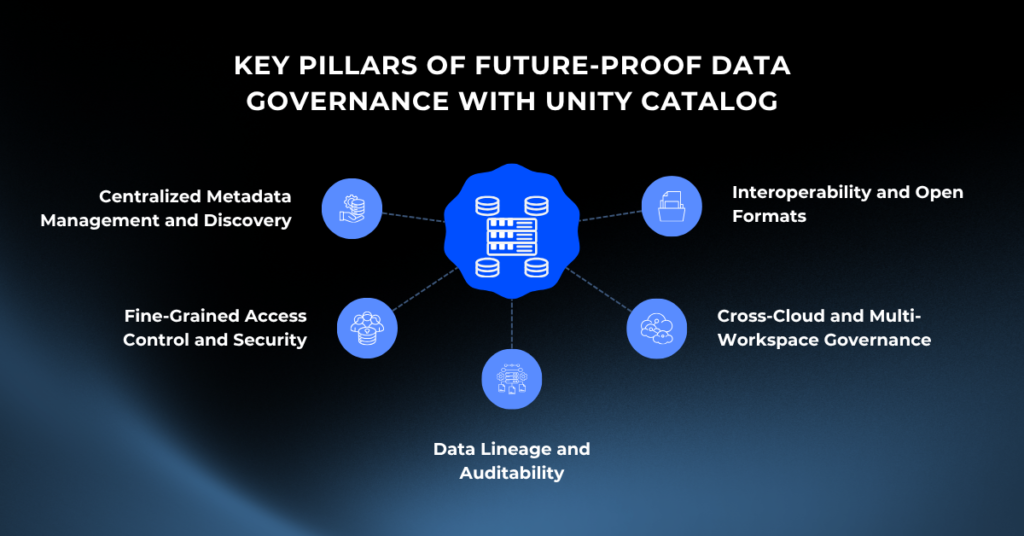
To truly understand the value of this platform, it helps to break down the foundational pillars that make it so effective for modern enterprises.
Centralized Metadata Management and Discovery
Databricks Unity Catalog gives your team a curated internal marketplace for data discovery. With the introduction of Unity Catalog Metrics, business metrics are treated as first-class data assets. This semantic layer ensures that everyone from marketing to finance works from the exact same trusted definitions, preventing misaligned KPIs and messy reporting.
Fine-Grained Access Control and Security
Security cannot be a blanket approach. Databricks Unity Catalog utilizes Attribute-Based Access Control (ABAC), allowing you to define flexible access policies using tags at the catalog, schema, or table level. If you need to restrict access to specific columns based on a user’s department or clearance level, ABAC handles this dynamically without requiring duplicate data pipelines.
Data Lineage and Auditability
Understanding where your data comes from is essential for both trust and compliance. The platform automatically captures end-to-end data lineage for tables, dashboards, and AI models. If a data quality issue arises, your engineers can instantly trace the error back to its source, dramatically reducing troubleshooting time and ensuring total transparency for compliance audits.
Cross-Cloud and Multi-Workspace Governance
Your data rarely lives in just one place. Databricks Unity Catalog embraces this reality through features like Delta Sharing and Lakehouse Federation. These protocols allow you to query remote data sources—such as Snowflake or PostgreSQL—and share live data sets securely with external partners, all without costly and slow data replication.
Interoperability and Open Formats
Format lock-in is a massive risk for growing enterprises. By fully supporting open formats like Delta Lake and Apache Iceberg, Databricks Unity Catalog ensures your organization retains full control over its data assets. Choose Databricks Unity Catalog if open ecosystem interoperability matters more to your data strategy than proprietary, vendor-locked solutions.
Strategic Advantages for Enterprises in 2026
Implementing a unified governance layer translates to highly tangible business outcomes. Here is how your enterprise benefits directly.
Enhanced Regulatory Compliance
Navigating regulations like CCPA, GDPR, and the newly established EU AI Act requires airtight data tracking. Because Databricks Unity Catalog centralizes access logs and automates PII classification, your compliance teams can generate audit reports in minutes rather than months. This proactive stance significantly reduces the risk of regulatory fines.
Improved Data Quality and Trust
Automated data quality monitoring within the catalog intelligently detects freshness and completeness issues across your schemas. By surfacing health indicators directly to consumers, Databricks Unity Catalog builds unwavering trust in business data [Databricks, 2025]. Your analysts spend less time questioning data validity and more time extracting actionable insights.
Accelerated Data Innovation and AI/ML Initiatives
AI models are only as good as the data feeding them. By providing data scientists with immediate, governed access to high-quality datasets, Databricks Unity Catalog accelerates the deployment of machine learning models. Teams no longer have to wait weeks for IT to provision data access, accelerating your time-to-market for innovative AI features.
Cost Optimization and Operational Efficiency
Managing multiple disparate catalogs requires massive administrative overhead. Consolidating your governance into a single metastore drastically reduces the labor costs associated with access management. Furthermore, by eliminating the need to move or copy data across clouds for sharing purposes, your enterprise saves significantly on cloud egress fees and storage costs.
Reduced Risk and Enhanced Security Posture
A decentralized governance strategy is a security breach waiting to happen. With central oversight, Tag Policies, and rigorous access controls, Databricks Unity Catalog minimizes your attack surface. You can confidently onboard new users and third-party vendors, knowing that your foundational data security remains uncompromised.
Is Databricks Unity Catalog Right for Your Enterprise?
Databricks Unity Catalog is the ideal solution for enterprises looking to enhance data collaboration, governance, and analytics. It’s particularly beneficial if your organization is facing challenges such as:
- Struggling with fragmented data across different departments.
- Lacking uniform policies for data access and security.
- Finding it difficult to implement AI and machine learning models effectively.
Unity Catalog offers a powerful solution by providing:
- A single platform to find all your data.
- Clear visibility into how data is used and transformed.
- Secure and efficient data management at scale.
Implementing Unity Catalog: Best Practices and Considerations
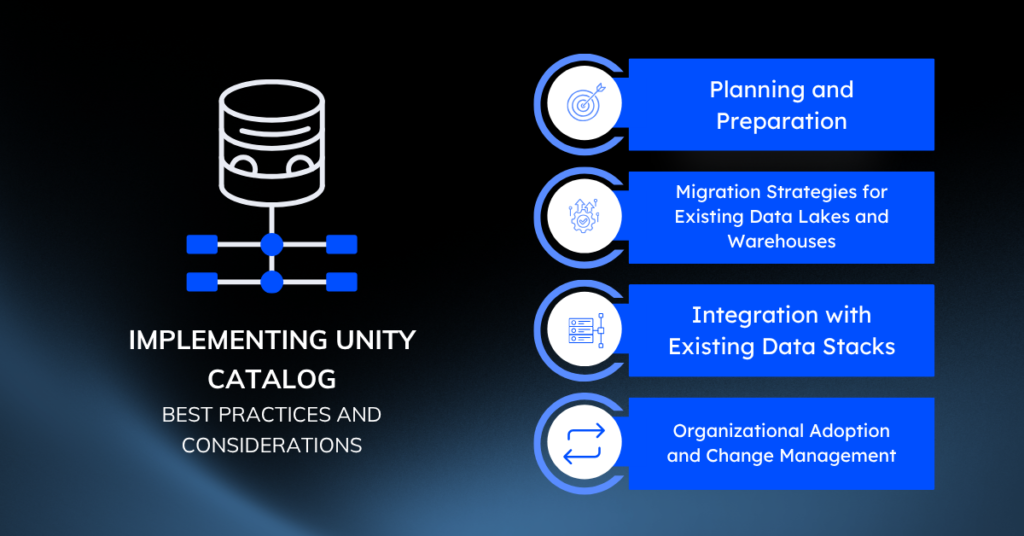
Transitioning to a new governance framework requires careful orchestration. Follow these steps to ensure a smooth and successful rollout.
Planning and Preparation
- Treat the rollout as a strategic initiative, not just an IT project.
- Assemble a cross-functional team including data owners, platform administrators, and security officers to ensure all perspectives are covered.
- Define your core object hierarchy and naming conventions from the start.
- Organize catalogs by business unit (e.g., finance_catalog) to make it easier for users to find what they need.
Migration Strategies for Existing Data Lakes and Warehouses
Here’s how to migrate from a legacy Hive Metastore:
- Don’t try to migrate everything at, just take a phased approach.
- Use the Databricks Unity Catalog Extension (UCX) to audit your current assets and automate the upgrade process.
- Begin by migrating a pilot team to test and refine your process.
Integration with Existing Data Stacks
To ensure seamless integration with your existing data stack, such as Tableau, Power BI, or dbt, follow these key steps:
- Adjust your business intelligence tools to work with Databricks Unity Catalog.
- Set up Single Sign-On (SSO) to streamline user access.
- Utilize fine-grained access controls to ensure security policies are applied consistently across all platforms.
Organizational Adoption and Change Management
To ensure your team embraces the new technology, focus on driving adoption and managing change effectively:
- Prioritize data literacy training and governance workshops to empower your team.
- Appoint clear Data Product Owners who are responsible for maintaining the quality and documentation of specific data domains.
- Show business users how Databricks Unity Catalog simplifies their daily tasks to encourage natural platform adoption.
Real-World Use Cases and Success Stories
To see the true potential of this technology, consider how different industries apply it to solve complex challenges.
Financial Services Risk Management and Compliance Reporting
A multinational bank utilizes Databricks Unity Catalog to govern petabytes of transaction data across Azure and AWS. By applying Attribute-Based Access Control, they enhance security, ensuring only authorized risk analysts can view unmasked customer financial records. This system simplifies compliance through automated lineage tracking, which allows them to instantly show regulators how specific liquidity metrics were calculated, thus increasing efficiency by eliminating manual compliance drudgery.
Healthcare Secure Data Sharing and Analytics
A network of hospitals leverages Delta Sharing within Databricks Unity Catalog to collaborate with external medical researchers, securely sharing anonymized patient outcomes without ever moving the data out of their secure cloud environment. This capability accelerates clinical trials for new treatments while ensuring strict adherence to HIPAA data privacy laws. Researchers can work with sensitive data securely without direct access to the hospital’s core systems, fostering secure and compliant collaboration.
Retail Personalized Customer Experiences and Supply Chain Optimization
A global retailer leverages the curated Discover experience in Databricks Unity Catalog to break down silos between its supply chain and marketing teams. By providing easy, trustworthy access to inventory data, marketing can build hyper-targeted regional ad campaigns. Concurrently, supply chain analysts utilize AI models governed by the catalog to accurately forecast seasonal product demand. This unified platform removes data silos, fostering better communication, optimized operations, and more effective cross-functional strategies between departments.
The Road Ahead: What to Expect from Unity Catalog Beyond 2026
Databricks continues to innovate aggressively. Understanding where the platform is headed will help you plan your long-term data strategy.
Emerging Features and Integrations
Expect to see even deeper integrations with generative AI tools. Databricks is heavily focused on expanding natural language querying, allowing non-technical business users to ask complex questions and receive context-aware answers governed by Unity Catalog Metrics. Furthermore, automated policy enforcement will become increasingly intelligent, predicting access needs based on user behavior patterns.
The Future of Data Mesh and Data Fabric Architectures
As enterprises shift toward decentralized Data Mesh architectures, Databricks Unity Catalog will serve as the essential connective tissue. It provides the federated governance layer required to let independent domains manage their own data products, while still enforcing global security and compliance standards across the entire enterprise fabric.
Why Choose Enlight Lab for Data Governance Transformation Using Unity Catalog
The transition to modern data governance takes time, planning, and commitment.
At Enlight Lab, we offer expert data engineering services to easily transform data architecture. As a leading provider of data management and governance solutions, our team of experienced professionals is dedicated to empowering organizations with seamless integration of Unity Catalog into their existing data infrastructure.
Seizing the Future of Data Governance Using Databricks Unity Catalog
Data governance is no longer a defensive necessity; it is a competitive advantage. The organizations that thrive over the next decade will be the ones that empower their teams with secure, frictionless access to high-quality data.
By unifying your data and AI assets under a single, intelligent governance framework, Databricks Unity Catalog breaks down silos, automates compliance, and accelerates innovation.
Rather than waiting for a regulatory challenge or security incident, now is the time to modernize your governance strategy. Connect with the Enlight Lab today to assess your existing metadata architecture and identify opportunities to build a secure, future-proof enterprise with Databricks Unity Catalog.