Steering your startup through early-stage growth requires more than just a great product idea. As a founder or technical leader, the pressure to scale infrastructure while keeping costs low is a daily reality for you.
The IT landscape grows more complex every year, blending legacy systems with cutting-edge artificial intelligence, multi-cloud environments, and sophisticated cybersecurity threats. This complexity often forces you to choose between rapid product iteration and stable, secure architecture.
By 2026, the strategic importance of the Chief Technology Officer (CTO) will reach an all-time high. Technical leaders are no longer just managing software teams; they are directly responsible for driving business revenue, ensuring regulatory compliance, and maintaining a competitive edge. Non-technical entrepreneurs also feel this weight, often struggling to bridge the gap between their business vision and the actual software execution required to make it happen.
Understanding and preparing for these hurdles is the only way to avoid stalled funding rounds or missed product launch deadlines. This guide breaks down the seven biggest CTO IT execution challenges you will probably face. More importantly, it gives you practical strategies to overcome each one without burning your budget or your best engineers.
The Top 7 IT Execution Challenges for 2026
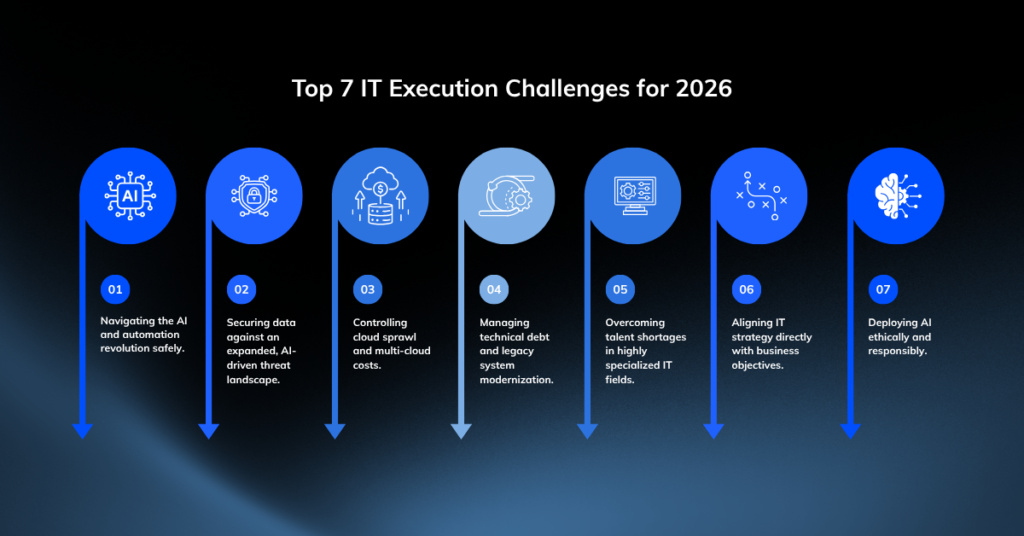
Below is a quick look at the most common CTO IT execution challenges organizations will face in the near future:
- Navigating the AI and automation revolution safely.
- Securing data against an expanded, AI-driven threat landscape.
- Controlling cloud sprawl and multi-cloud costs.
- Managing technical debt and legacy system modernization.
- Overcoming talent shortages in highly specialized IT fields.
- Aligning IT strategy directly with business objectives.
- Deploying AI ethically and responsibly.
The New Reality: What IT Execution Actually Means in 2026
Not long ago, IT execution meant delivering projects on time, keeping systems running, and staying within budget. That was the job.
Today, those are just table stakes.
The CTO role has expanded to leading AI adoption across the entire enterprise, including GenAI, RAG systems, and automation alongside cloud modernization with Kubernetes and microservices, and delivery pipelines built on CI/CD and observability.
Access to AI is no longer a differentiator. Every company has access to powerful AI tools. The real differentiator is the ability to operationalize AI to take it from a pilot that works in a controlled environment.
And that’s exactly where most CTOs are getting stuck.
Isolated pilots are proving value. But when organizations try to scale them across regulated environments, fragmented architectures, and legacy platforms not designed for AI-enabled change, problems started to emerge.
That gap between experimentation and execution is getting wider. And the leadership is taking notice.
Why IT Execution Is Harder Than Ever for CTOs in 2026
Execution today is not failing because CTOs lack vision. It is failing because:
- Technology ecosystems are more interconnected and complex
- AI, cloud, and data initiatives must be scaled, not piloted
- Cyber risk, compliance, and governance are non-negotiable
- Business leaders expect faster ROI from IT investments
The Top 7 CTO IT Execution Challenges You Can’t Afford to Ignore
Challenge 1: Navigating the AI and Automation Revolution
Integrating AI into core business processes
Bringing artificial intelligence into your core product is no longer optional if you want to stay competitive. However, bolting AI features onto an existing product without a clear strategy often leads to bloated infrastructure. Startups must identify exactly where automation will reduce manual workloads or improve customer experiences without unnecessarily increasing cloud computing costs.
Handling skill gaps for AI talent acquisition
Finding engineers who deeply understand machine learning models and generative AI frameworks is difficult and expensive. Because budget constraints are high for early-stage companies, competing with tech giants for top-tier AI talent is rarely feasible. This leaves technical leaders scrambling to build AI-driven products with teams that may lack the specialized expertise required to do it efficiently.
Overcoming team resistance to automation
Even when you secure the right tools, internal teams often push back against automation. Employees may fear that AI will replace their jobs, or they might simply find new automated workflows too difficult to learn. This friction slows down adoption rates and delays the return on your technology investments.
Solution: Strategic AI adoption framework and continuous learning
To fix these issues, technical leaders must implement a structured approach to AI.
- Deploy a strategic AI adoption framework: Start by automating internal, low-risk processes before rolling AI out to customer-facing products. Choose out-of-the-box AI APIs if speed to market matters more than highly customized models.
- Invest in continuous learning programs: Instead of overpaying for new AI specialists, upskill your current engineering team. Provide access to platforms like Coursera or dedicated internal workshops to build confidence and competence.
Challenge 2: Cybersecurity and Data Privacy in an Expanded Threat Landscape
Evolving cyber threats from AI-powered attacks
The cybersecurity landscape is fundamentally shifting. According to Gartner, 40% of enterprise applications will embed task-specific AI agents by 2026. While these autonomous agents boost productivity, they also expand the attack surface.
Hackers now use AI to execute prompt injection attacks and exploit supply chain vulnerabilities at machine speed, making traditional, rule-based security protocols largely ineffective.
Complying with future regulatory standards
Global data protection standards are tightening. Beyond GDPR and CCPA, new AI-specific regulations require companies to maintain strict oversight over how user data is processed. Non-technical founders often underestimate the engineering effort required to build compliant data pipelines, leading to rushed fixes right before critical audits or funding rounds.
Balancing security with agility and user experience
Startups must move fast to survive. Implementing heavy security protocols can slow down development cycles and create frustrating user experiences. CTOs face the constant challenge of securing infrastructure without bottlenecking the engineering team or annoying the end user with excessive authentication steps.
Solution: Proactive threat intelligence and zero-trust architectures
- Implement zero-trust architectures: Never assume internal network traffic is safe. Require strict identity verification for every user and AI agent attempting to access your systems.
- Use robust data governance: Clearly map out where user data lives, who has access to it, and how it is encrypted.
- Leverage proactive threat intelligence: Utilize automated security tools that monitor network behavior in real-time, detecting anomalies before they escalate into full breaches.
Challenge 3: Cloud Sprawl and Multi-Cloud Management
Managing costs across diverse cloud environments
Cloud services make it incredibly easy to spin up new servers, but that convenience often leads to cloud sprawl. Development teams abandon test environments, leave unused databases running, and accidentally rack up massive AWS or Azure bills.
For an early-stage startup, these unexpected costs can drain the runway fast.
Navigating interoperability and data migration challenges
To avoid vendor lock-in, many startups adopt a multi-cloud strategy. However, making different cloud platforms communicate smoothly is technically demanding. Moving large datasets between providers incurs high egress fees and introduces latency, complicating the overall architecture.
Ensuring consistent security in multi-cloud setups
Every cloud provider has its own security configurations. Managing access controls across AWS, Google Cloud, and Azure simultaneously creates blind spots. A misconfiguration in just one of these environments can expose sensitive startup data to the public internet.
Solution: FinOps strategies and unified cloud governance
- Adopt cloud cost management platforms: Tools like Datadog or native cloud cost explorers help visualize exactly where your money is going.
- Implement FinOps strategies: Create a culture of financial accountability within your engineering team. Developers should understand the cost implications of the code they write and the infrastructure they provision.
- Enforce unified cloud governance: Use Infrastructure as Code (IaC) tools like Terraform to ensure security policies are deployed consistently across all cloud environments.
Challenge 4: Technical Debt and Legacy System Modernization
Overcoming impacts from outdated systems
When startups rush to meet product launch deadlines, they take shortcuts. Over time, these shortcuts compound into technical debt.
Outdated technology stacks make it difficult to add new features, causing engineering teams to spend most of their time fixing bugs instead of building revenue-generating tools.
Balancing modernization against basic maintenance
Technical leaders constantly struggle to justify the cost of modernization to non-technical stakeholders. Rewriting a legacy application does not immediately add visible value to the end user. This makes it a tough sell when business teams are demanding new features to satisfy increased customer demand.
Following strategies for incremental modernization
Trying to rewrite an entire application from scratch, the “big bang” approach, is highly risky and often fails. Startups need ways to untangle their monolithic architectures slowly without disrupting the active user base.
Solution: Prioritized technical debt reduction and microservices
- Prioritize technical debt reduction: Track technical debt just like you track product features. Allocate 15-20% of every development sprint specifically to refactoring old code and updating dependencies.
- Adopt microservices architecture: Break down large, unwieldy applications into smaller, independent services. Choose a microservices approach if team agility and isolated deployments matter more than architectural simplicity.
- Embrace API-first development: Build standardized APIs to allow different parts of your system to communicate, making it easier to swap out outdated components later.
Challenge 5: Talent Shortages and Retention in Specialized IT Fields
Competing for skilled IT professionals
Even with recent market shifts, truly exceptional engineers, DevOps specialists, and security experts remain in high demand. Startups with limited budgets cannot always compete with the base salaries offered by enterprise tech companies, making hiring efficiency a major hurdle.
Upskilling and reskilling existing teams effectively
When you cannot hire externally, you must build talent internally. However, pulling engineers away from critical product work to attend training sessions temporarily reduces your output. Finding the right balance between delivering product features and developing employee skills is a constant tightrope walk.
Fostering a culture of continuous development
Retention is just as important as acquisition. If your top engineers feel their skills are stagnating, they will leave for companies working on more modern technology stacks. High turnover destroys cross-functional collaboration and delays product timelines.
Solution: Hybrid work models and internal training
- Offer flexible, hybrid work models: If you cannot compete on salary alone, compete on flexibility. Trusting your team with remote work options strongly improves employee retention.
- Invest in internal training academies: Set aside dedicated budget and time for certifications. Covering the cost of AWS or cybersecurity certifications shows your team you are invested in their long-term career growth.
- Focus on strong employer branding: Highlight the impact an engineer can have at your startup. Top talent often prefers early-stage companies where their code directly influences the business, rather than being a tiny cog in a massive corporate machine.
Challenge 6: Aligning IT Strategy with Business Objectives
Bridging the gap between technical and business teams
A major failure point in early-stage startups is the disconnect between the engineering department and the business side. Non-technical entrepreneurs might promise features to clients without understanding the engineering constraints. Conversely, engineers might spend weeks optimizing a database that nobody actually uses.
Measuring the ROI of IT investments
Tracking the return on investment for marketing is straightforward; tracking it for backend infrastructure is not. When a CTO requests budget for better servers or automated testing tools, they must prove how this spend translates to the bottom line, which is notoriously difficult to quantify.
Communicating technical value to non-technical leadership
Technical jargon isolates business stakeholders. If a CTO explains a server migration using terms like “kubernetes orchestration” and “containerization,” the board will tune out. Leaders must learn to translate technical metrics into business outcomes like “reduced customer churn” and “faster time to market.”
Solution: Cross-functional collaboration frameworks and OKRs
- Implement OKRs for IT: Tie engineering Objectives and Key Results directly to company-wide goals. If the company goal is to increase user acquisition, the IT goal should be ensuring the application can handle a 300% spike in traffic without crashing.
- Build cross-functional collaboration frameworks: Require product managers, lead engineers, and sales teams to hold regular alignment meetings. This ensures everyone understands both the technical limitations and the customer demands.
- Practice business relationship management: CTOs must act as translators. Frame every technical request around how it mitigates risk, saves money, or generates revenue.
Challenge 7: Ethical AI and Responsible Technology Deployment
Addressing bias in AI algorithms
Machine learning models learn from historical data. If that data contains human biases, the AI will replicate and scale those biases. For startups building hiring tools, fintech lending algorithms, or healthcare applications, algorithmic bias can lead to severe reputational damage and legal liability.
Prioritizing transparency and explainability in AI
Many advanced AI models operate as “black boxes.” Even the engineers who built them cannot always explain exactly why the AI made a specific decision. This lack of transparency makes it difficult to audit systems when things go wrong or when customers demand to know why they were denied a service.
Developing ethical guidelines for technology use
Ethics in technology are often treated as an afterthought.
Startups focused on survival rarely take the time to draft formal documentation on how user data should be ethically handled.
Solution: AI ethics committees and explainable AI tools
- Establish AI ethics committees: Even in a small startup, designate a cross-functional group to review how new AI features impact user privacy and fairness before they are pushed to production.
- Utilize explainable AI (XAI) tools: Prioritize AI models that provide clear logs of their decision-making processes. Choose interpretable models over highly complex black-box models if regulatory compliance and user trust are your top priorities.
- Draft responsible innovation principles: Create a simple, public-facing document outlining your company’s commitment to data privacy and ethical AI use. This builds trust with your early adopters and sets a clear standard for your engineering team.
Is Your IT Execution Model Future-Ready?
Use this quick checklist:
- Are your IT initiatives tied to measurable business KPIs?
- Do you have a clear roadmap from strategy to execution?
- Is technical debt actively managed?
- Are AI initiatives scalable and governed?
- Is your data infrastructure unified and reliable?
- Are stakeholders aligned across teams?
- Do you have visibility into cloud costs and performance?
If you answered “no” to 3 or more, your execution model needs immediate attention.
How CTOs Can Turn Execution into a Competitive Advantage
The best CTOs are not just technologists. They are business strategists, execution leaders, and change enablers.
They understand that technology alone does not create value; it is effective execution that drives real impact.
To gain a competitive edge, focus on these key areas:
- Maximize development velocity without sacrificing quality
- Choose cloud platforms and tools that scale seamlessly with your growth
- Mitigate technical debt proactively by creating a culture of strong code reviews
- Enable stronger collaboration between technical and non-technical teams
- Implement analytics tools that provide actionable insights into performance, user behavior, and resource efficiency.
Struggling with IT Execution Challenges? Consult Enlight Lab
The role of the CTO is profoundly different from what it was a decade ago.
Today, technical leaders must be proactive business strategists. By acknowledging and addressing these CTO IT execution challenges from managing technical debt to securely deploying AI, startups can protect their funding runway and consistently hit product launch deadlines.
The key takeaway is that technology execution cannot exist in a vacuum. Every line of code written and every server provisioned must serve a broader business purpose.
If you’re struggling with CTO IT execution challenges, don’t jump straight to tools or hiring. Start by identifying the bottlenecks in your execution model architecture, talent, processes, or governance.
At Enlight Lab, we work with engineering and product leaders to turn strategy into scalable execution systems. Connect with us and get the insights and operating models to transform ideas into high-impact outcomes.